Smart Manufacturing & Industry 4.0 in Charger Production: How Modern Charger Factories Are Becoming More Intelligent
Smart manufacturing in charger production means using connected equipment, production data, automation, digital quality control and intelligent testing to make charger manufacturing more efficient, traceable and consistent.
For modern USB-C PD, GaN and high-power chargers, Industry 4.0 is becoming more useful because product designs are getting smaller and more complex. A smart charger factory can monitor production conditions in real time, collect test data, identify process problems earlier and improve manufacturing efficiency without relying only on manual inspection.
Key Takeaways
• Smart manufacturing connects people, machines, data and quality control.
• Automation can improve production consistency, but it does not replace engineering expertise.
• Real-time production data helps factories identify problems earlier.
• Traceability is becoming increasingly important for USB-C and GaN charger production.
• Industry 4.0 is most valuable when technology solves real manufacturing problems.
Introduction: The Charger Factory Is Changing
Walk into an electronics factory today and you may still see many familiar things.
Operators assembling products.
Engineers checking samples.
Machines testing electrical performance.
Quality inspectors examining finished units.
But there is another layer that is becoming increasingly important: Data.
Production equipment can now record operating parameters. Testing machines can automatically store results. Manufacturing systems can track production batches. Quality teams can analyze defect trends instead of relying only on manual records.
This is where smart manufacturing comes into the picture.
For charger production, the change is particularly interesting.
A modern charger may be small enough to fit in the palm of your hand, but internally it can involve high-frequency power conversion, USB-C communication, multiple charging protocols, thermal management and several layers of protection. At the same time, customers expect:
• Smaller products.
• Higher power.
• Better efficiency.
• Stable quality.
• Faster delivery.
• More customization.
That combination puts more pressure on traditional manufacturing methods. Industry 4.0 does not mean putting a robot beside every production worker.
The real objective is much more practical: Use technology and manufacturing data to make the production process more controlled, visible and repeatable.
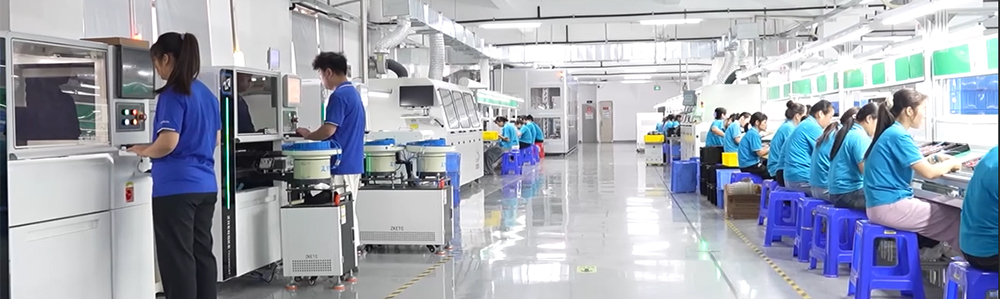
What Is Industry 4.0 in Charger Manufacturing?
Industry 4.0 is commonly associated with connected manufacturing, automation, data analysis and intelligent production systems.
In a charger factory, this can include:
• Automated testing.
• Digital production records.
• Equipment monitoring.
• Production traceability.
• Manufacturing execution systems.
• Automated inspection.
• Real-time quality data.
• Intelligent warehouse management.
A simple traditional production model might look like this:
Material → Assembly → Manual Testing → Quality Inspection → Finished Product
A more connected manufacturing environment looks different:
Material → Digital Tracking → Automated / Assisted Assembly → Automated Testing → Real-Time Data Collection → Quality Analysis → Traceable Finished Product
The second model gives the factory much more information about what is happening during production.
That information is valuable. Because when something goes wrong, the factory has a better chance of finding out why.
Why Smart Manufacturing Matters for Charger Production
It is easy to talk about Industry 4.0 as a technology trend. But manufacturers have a more practical question: What problem does it solve?
For charger production, there are several clear answers.
1. More Consistent Production
When a product is manufactured in large quantities, consistency becomes a major challenge.
A factory may produce:
• 5,000 units.
• 20,000 units.
• 100,000 units.
Customers expect all of them to perform according to the approved specification.
Automation and standardized production processes can reduce variation between units.
This is especially useful for high-volume charger products.
2. Faster Testing
Testing every charger manually can consume significant time.
Modern production testing equipment can automatically check parameters such as:
• Input voltage.
• Output voltage.
• Output current.
• Power.
• Charging protocol.
• Protection functions.
A production tester can also record the result automatically.
This is more efficient than relying entirely on handwritten records.
3. Better Traceability
Traceability is becoming more important as charger products become more sophisticated.
Imagine a customer reports a quality problem several weeks after delivery.
The factory needs to know:
• Which batch was involved?
• When was it produced?
• Which components were used?
• Which production line made it?
• What were the test results?
A digital traceability system can make this investigation much faster.
Without good records, engineers may need to investigate the problem almost from scratch.
From Manual Production to Connected Production
Traditional manufacturing is not necessarily bad. Manual operations are still important in electronics manufacturing because many assembly tasks require human judgment. The difference is that smart manufacturing does not necessarily attempt to remove people from the process.
Instead, it tries to give people better tools. For example:
An operator may still assemble a charger, but the production system can guide the operator through the correct process.
A testing machine can automatically verify the product. The result can then be stored in the system.
If the product fails, the system can flag it immediately.
This creates a relationship between: Operator + Equipment + Data + Quality System
That is much more useful than automation for the sake of automation.
Smart Production Equipment in a Charger Factory
A modern charger production line can include many different types of equipment. Not every factory will use the same level of automation.
The appropriate setup depends on:
• Product type.
• Production volume.
• Product complexity.
• Investment level.
• Customer requirements.
Some common technologies include the following.
Automated Electrical Testing
Electrical testing is one of the most suitable areas for automation. For example, a charger testing station can automatically check whether a unit meets predefined output requirements.
For a USB-C PD charger, the test may involve different output conditions. The system can evaluate:
• Voltage.
• Current.
• Power.
• PD profiles.
• Load response.
Instead of simply displaying a pass/fail result, a connected system can also save the measurement data.
That creates a useful historical record.
Automated Visual Inspection
Appearance is another area where automation can help. Camera-based inspection systems can identify certain visible defects, such as:
• Housing damage.
• Incorrect labels.
• Missing components.
• Assembly problems.
• Connector position issues.
However, automated visual inspection has limits. It should not be treated as a complete replacement for experienced quality personnel.
Some defects are difficult for a camera to judge. Human inspection remains useful, especially for unusual or complex problems.
The better approach is often a combination of: Machine Inspection + Human Quality Judgment
Production Data: The Most Valuable Part of Smart Manufacturing
Machines are useful, but data is often the real value behind Industry 4.0.
A modern production line can potentially collect information from different stages:
Material → Assembly → Electrical Testing → Aging / Reliability Testing → Final Inspection → Packaging
Each stage can generate data.
When these records are connected, the factory gains a clearer picture of the product's manufacturing history. For example, engineers may notice that failures increase on a particular production line.
Or a certain component batch may be associated with a higher failure rate.
Or a specific production shift may show unusual variation.
These patterns can be difficult to identify from paper records. With digital data, they become easier to see.
Real-Time Quality Monitoring
One of the biggest advantages of connected production is that quality problems can be identified earlier. Traditional quality management often focuses heavily on finished products.
Smart manufacturing adds another layer: monitoring the process while production is happening.
For example, suppose the normal failure rate of a production test is very low. Suddenly, the failure rate began to rise, and the interconnected system could send an alert to the quality team.
Engineers can then investigate:
• Equipment condition.
• Material batch.
• Production parameters.
• Assembly process.
• Operator workflow.
The factory may be able to correct the issue before thousands of additional units are produced. That is a major advantage.
Smart Manufacturing and GaN Charger Production
GaN chargers are a good example of why manufacturing control matters. Gallium nitride technology allows manufacturers to build smaller and more efficient chargers, but higher power density also creates engineering challenges.
For example: A compact 100W GaN charger has less physical space for heat dissipation than a much larger conventional charger.
Manufacturing consistency therefore becomes important. Small variations in components, assembly or thermal interfaces can affect product behavior.
While smart manufacturing cannot solve all engineering problems, it can help engineers and quality teams identify manufacturing differences more quickly.
This is especially valuable when producing:
• 65W GaN chargers.
• 100W GaN chargers.
• 140W PD chargers.
• 240W USB-C chargers.
Smart Manufacturing Does Not Replace Good Engineering
This point is worth emphasizing. A factory can have expensive automation equipment and still produce poor products.
Why?
Because manufacturing technology cannot compensate for a weak product design.
If the circuit design is wrong, automation will simply produce the wrong design faster.
If the thermal design is insufficient, a highly automated production line will not magically fix it.
If the testing criteria are incorrect, automated testing can still produce misleading results.
This is why Industry 4.0 should be connected with the earlier stages of product development.
A strong manufacturing system starts with:
Good Product Design → Proper Validation → Controlled Production → Data-Driven Improvement
This is also where NPI, DVT and PVT become important.
Connecting NPI, DVT, PVT and Smart Manufacturing
The four concepts should not be viewed separately. They are part of the same product lifecycle.
A simplified relationship looks like this:
NPI (Product Introduction)
↓
EVT / DVT (Design Validation)
↓
PVT (Production Validation)
↓
Smart Manufacturing (Controlled Mass Production)
↓
Production Data
↓
Continuous Improvement
NPI establishes how a new product enters manufacturing (Internal information from the charger factory: From Concept to Mass Production).
DVT checks whether the design works as intended (Here you can read about DVT and PVT verification from Gan charger manufacturers).
PVT checks whether the factory can manufacture it consistently.
Smart manufacturing then helps monitor and improve the production process at scale.
This is why Industry 4.0 is not simply a production-floor technology. It is part of a larger manufacturing system.
The Role of MES in Charger Manufacturing
One technology often associated with smart factories is MES — Manufacturing Execution System.
An MES can connect production activities with manufacturing information. Depending on the system, it may help manage:
• Work orders.
• Production status.
• Material tracking.
• Operator information.
• Test results.
• Quality records.
• Production history.
For a charger factory, this can create a digital link between an individual product and its manufacturing information.
The level of traceability depends on how the factory designs its system. Not every factory needs the same MES architecture.
The important point is that the system should solve real manufacturing needs rather than exist only as a marketing feature.
Digital Traceability: From Batch Numbers to Product History
Traceability can be simple or highly detailed.
At a basic level, a factory may track products by:
• Production date. Production line. Batch number.
A more advanced system may connect:
• Material batch. Production operator. Equipment. Test results. Inspection records. Final product.
The more detailed the traceability, the easier it becomes to investigate quality problems.
This matters particularly for B2B customers. A brand owner does not want to wait several days to understand what happened when a field issue appears. Fast root-cause analysis can make a significant difference.
Smart Manufacturing and Energy Efficiency
Industry 4.0 is not only about production speed. Data can also help factories understand energy consumption. Manufacturing equipment consumes electricity.
So do:
• Testing equipment.
• HVAC systems.
• Production lines.
• Lighting.
• Compressed air systems.
Connected monitoring can help factories identify unusual consumption and improve equipment utilization. For manufacturers producing high volumes of chargers, even small efficiency improvements can become meaningful over time.
What Smart Manufacturing Means for OEM Charger Buyers
For an OEM customer, the value of smart manufacturing is not simply seeing robots inside a factory.
The real question is: Does the manufacturing system give the customer more confidence?
A well-managed digital production environment can support:
• Better quality consistency.
• Faster issue investigation.
• Improved traceability.
• More predictable production.
• Better production data.
• Continuous process improvement.
This becomes particularly useful for long-term OEM projects. A customer may start with one charger model. Later, the product range may expand to:
• 30W, 45W, 65W, 100W, 140W, and 200W and above.
The manufacturing system needs to scale with the business.
That is where digitalization becomes more than a factory upgrade.
It becomes part of the supplier's long-term capability.
AI and Predictive Maintenance in Charger Manufacturing
Once production equipment is interconnected, manufacturers can not only collect data, but also use that data to identify patterns. This is where AI and predictive maintenance become useful.
Traditional equipment maintenance often follows a simple schedule: Run the machine for a certain period, then inspect or replace parts.
That approach works, but it is not always efficient.
A machine may need maintenance before the scheduled date. Or it may continue operating normally even though a scheduled maintenance task is unnecessary. With predictive maintenance, production data can be monitored for unusual changes.
For example:
1. Equipment temperature starts increasing.
2. Test results become less stable.
3. Production cycle time changes.
4. Failure frequency gradually increases.
These changes may indicate that the equipment needs maintenance. Our goal is not to let artificial intelligence make all maintenance decisions.
The practical goal is to identify potential problems earlier so engineers can investigate them before they become production interruptions.
Smart Warehouse and Material Management
Manufacturing does not begin when a component reaches the assembly line.
It begins much earlier, in the warehouse. A charger factory may need to manage large numbers of components: ICs, Capacitors, Transformers, Connectors, PCBs, Plastic housings, Cables, and Packaging materials.
If material management is poorly controlled, production can be affected even when the production line itself is highly automated.
Digital warehouse systems can help track:
• Material quantity, Incoming date, Supplier, Batch number, Storage location, Production allocation.
This creates a stronger connection between the warehouse and production line.
When a new production order is released, the system can help identify whether the required materials are available. This reduces the risk of discovering a material shortage only after production has already started.
Digital Quality Control
Quality control is another area where Industry 4.0 can make a practical difference.
Traditional quality inspection often depends heavily on manual records.
A digital quality system can connect inspection results directly with production information.
For example:
Production Batch → Electrical Test → Temperature Test → Visual Inspection → Final Quality Result
The information can then be stored digitally.
If problems arise later, the quality team can use more information to investigate. This can shorten the time required for root cause analysis.
Production Dashboards and Manufacturing KPIs
One visible feature of a smart factory is the production dashboard.
A dashboard can display information such as:
• Production quantity.
• Production target.
• Pass rate.
• Defect rate.
• Equipment status.
• Testing results.
• Production efficiency.
For factory managers, this allows them to quickly understand the situation on the production floor, but the dashboard can only be effective if the underlying data is accurate.
A beautiful screen does not automatically create a smart factory. The real value comes from using the information to make better decisions.
For example: If a production line's yield suddenly drops, the management team should be able to see the change quickly.
Then the engineering and quality teams can investigate the cause.
Automation vs. Human Expertise
There is a common misunderstanding about smart manufacturing: More automation means fewer people.
This is not the case; experienced engineers and operators remain crucial in the charger manufacturing industry.
Automation excels particularly at repetitive tasks, while humans are superior in many activities involving repetitive tasks:
• Problem solving.
• Engineering judgment.
• Unexpected failures.
• Process improvement.
• Product development.
Consider an electrical test failure.
The machine can identify charger malfunctions, but experienced engineers still need to determine: Why did it fail?
Was the problem caused by:
1. A component?
2. PCB assembly?
3. A test fixture?
4. A design issue?
5. A production parameter?
6. A material batch?
This is why smart manufacturing should be viewed as: Technology should assist humanity, not replace humanity.
The Challenge of Implementing Industry 4.0
Building a smart factory is not as simple as purchasing automated equipment.
There are several challenges.
1. Investment Cost
Automation equipment, testing systems, software and data infrastructure require investment.
For some production lines, the return may be obvious.
For others, full automation may not make economic sense.
Factories need to evaluate where automation creates real value.
2. System Integration
Different machines may come from different suppliers.
If they cannot communicate properly, the factory may end up with several disconnected systems.
That creates another problem: Data islands.
One machine has production data.
Another has testing data.
The warehouse has material information.
But the systems cannot easily communicate with each other.
A mature Industry 4.0 strategy should focus on integration rather than simply adding more machines.
3. Data Quality
Bad data leads to bad decisions.
If production records are incomplete or incorrect, digital systems become much less useful.
Therefore, factories need clear standards for:
• Data collection.
• Data storage.
• Data validation.
• Data access.
4. Employee Training
New technology changes how people work.
Operators may need to learn new systems.
Engineers may need to understand production data.
Quality teams may need new analytical skills.
Smart manufacturing therefore requires both: Technology investment + People development
What OEM Buyers Should Look for in a Smart Charger Factory
A factory does not need hundreds of robots to demonstrate manufacturing capability.
When evaluating a charger supplier, OEM buyers should look at what the technology actually accomplishes. (Here you can find more detailed information about the Charger Factory Audit Guide.)
Here are some useful questions.
Production
• Are key production processes standardized?
• Is equipment monitored?
• Is production data recorded?
Testing
• Are charger tests automated where appropriate?
• Are test results stored?
• Can failed units be traced?
Quality
• Can the factory identify production trends?
• Is defect data analyzed?
• Is there a documented corrective action process?
Traceability
• Can production batches be traced?
• Can material information be connected to production records?
• Can the factory investigate historical quality issues?
Engineering
• Does engineering work with production data?
• Can the factory use production feedback to improve product design?
These questions provide more useful information than simply asking: "Do you have Industry 4.0?"
Smart Manufacturing Should Support Continuous Improvement
One of the most valuable concepts in Industry 4.0 is the feedback loop.
Traditional manufacturing can look like this:
Design → Production → Shipment
A connected manufacturing system can create a much stronger loop:
Design → Production → Testing → Production Data → Analysis → Process Improvement → Better Production
The information generated during manufacturing can be used to improve future production.
For example, if a particular process repeatedly creates minor defects, the engineering team can investigate the root cause.
If a certain component shows unusual failure behavior, procurement and engineering teams can review the supplier or component specification. This is how manufacturing becomes a continuous learning process.
Smart Manufacturing and Charger Product Development
Industry 4.0 also changes the relationship between product development and manufacturing. In the past, engineering and production could operate almost independently.
Engineering developed the product.
Production manufactured it.
Quality inspected it.
Today, these functions can be connected through data.
Production feedback can help engineering understand:
• Which components are difficult to assemble.
• Which processes create variation.
• Which areas generate the most defects.
• Which designs are easier to manufacture.
This information can even influence the design of the next generation of chargers, and is especially important for companies that develop multiple charger models.
Why This Matters for High-Power Chargers
As charger power increases, manufacturing requirements become more demanding. 20W charger and a 140W charger do not create exactly the same engineering challenges.
Higher-power products require greater attention to:
• Thermal performance.
• Component reliability.
• Electrical stability.
• Power distribution.
• Safety.
• Testing.
For products such as 100W, 140W and 240W USB-C PD chargers, consistent manufacturing becomes particularly important.
Smart manufacturing can help factories monitor production variation and identify issues earlier.
It cannot replace engineering verification, but it can strengthen the relevant manufacturing system.
Thermal Reliability Engineering for Charger Manufacturing
The Future of Smart Charger Manufacturing
The next stage of charger manufacturing will likely involve deeper integration between:
• Product development.
• Engineering.
• Production.
• Quality.
• Supply chain.
• Data systems.
AI may help analyze production data.
Automated testing will become more capable.
Traceability will become more detailed.
Production systems will become increasingly connected.
But the fundamental goal will remain the same: Build reliable products efficiently and consistently.
Technology will continue to evolve, but the manufacturing goals will remain unchanged.
Smart Manufacturing Is a Capability, Not a Marketing Label
This is perhaps the most important point in the entire article.
A factory should not be considered "smart" simply because it has:
• Robots.
• Digital screens.
• Automated machines.
• A modern-looking production line.
Real smart manufacturing should produce measurable improvements.
• Better production consistency.
• Faster testing.
• Lower defect rates.
• Better traceability.
• Faster root-cause analysis.
• Improved production efficiency.
If technology does not improve the manufacturing process, it is difficult to call it meaningful digital transformation.
For B2B buyers, this distinction is crucial. When evaluating a charger factory, don't just focus on the equipment. The question should be: what aspects of the factory can be measured, controlled, traced, and improved? This is a much better indicator of manufacturing maturity.
Final Thoughts
The charger industry is moving into a more demanding manufacturing environment. Products are becoming smaller while power levels continue to increase.
USB-C has become central to modern charging; GaN technology is enabling higher power density.
At the same time, B2B customers expect:
• Consistent quality.
• Faster product development.
• Stable production.
• Clear traceability.
• Reliable delivery.
Smart manufacturing can help address these expectations. But it should not be viewed as a collection of expensive machines.
A truly effective Industry 4.0 system connects: People + Engineering + Equipment + Data + Quality
When these elements work together, a charger factory becomes more responsive and more capable of improving over time.
For OEM and ODM buyers, this is what ultimately matters. It's not about how high-tech the factory looks, but whether its manufacturing system can consistently translate charger designs into reliable products at commercial scale.
Frequently Asked Questions
Q1: What is smart manufacturing in charger production?
Smart manufacturing uses connected equipment, digital systems, automated testing, production data and traceability to improve charger manufacturing.
Q2: Does Industry 4.0 mean a charger factory must be fully automated?
No. Smart manufacturing does not require complete automation. The most effective approach combines automation with experienced engineers and operators.
Q3: Why is data important in charger manufacturing?
Production data helps factories monitor quality, identify trends, investigate failures and improve manufacturing processes.
Q4: How does smart manufacturing help GaN charger production?
It can improve process consistency, testing efficiency and traceability, which are increasingly important for compact high-power GaN chargers.
Q5: What is MES in manufacturing?
MES, or Manufacturing Execution System, connects production activities with manufacturing information such as work orders, production status, test results and quality records.
Q6: Can AI improve charger factory production?
AI can help analyze production and equipment data, identify unusual patterns and support predictive maintenance or quality analysis.
Q7: How should OEM buyers evaluate a smart charger factory?
Look at measurable capabilities such as production traceability, automated testing, data collection, quality monitoring and process improvement rather than simply counting automated machines.
Reviewed by: Zonsan R&D - Linda and Miller
Last reviewed: [August 25, 2026]