AC vs DC Power: What’s the Difference and Why Does It Matter in Modern Chargers?
⭐ Featured Snippet
AC (Alternating Current) changes direction periodically, while DC (Direct Current) flows in one direction continuously. Homes use AC power because it is efficient for long-distance transmission, while electronic devices like smartphones, laptops, and USB chargers use DC power for stable operation. Modern chargers convert AC into DC through internal power conversion circuits.
Introduction
Every time you plug a phone charger, USB-C PD charger, laptop adapter, or GaN fast charger into a wall outlet, something important happens behind the scenes:
👉 AC power becomes DC power.
Most people see electricity as simply “power.”
But from an engineering perspective, AC and DC behave completely differently.
In fact, understanding the difference between AC vs DC power is one of the foundations of:
• fast charging technology
• USB-C PD systems
• GaN chargers
• power adapters
• laptop chargers
• smartphone charging safety
And for modern charger manufacturers and OEM charger factories, mastering AC-to-DC conversion is at the core of product quality and efficiency.
What Is AC Power?
AC stands for:
👉 Alternating Current
This means the electrical current continuously changes direction.
Instead of flowing steadily in one path, the electrons rapidly oscillate back and forth.
How AC Works
In most countries:
• electricity alternates direction
• 50 or 60 times per second
This is measured in:
• 50Hz
• 60Hz
Why AC Became the Global Standard
AC power is ideal for:
✔ long-distance transmission
✔ lower infrastructure cost
✔ voltage conversion through transformers
That's why your wall outlet supplies AC power.
What Is DC Power?
DC stands for:
👉 Direct Current
Unlike AC:
DC electricity flows continuously in one direction.
Why Electronics Need DC
Modern electronics require:
• stable voltage
• precise current control
• clean electrical signals
Devices using DC include:
• smartphones
• tablets
• laptops
• routers
• gaming consoles
• LED systems
• USB chargers
👉 Batteries themselves are also DC power sources.
The Simplest Way to Understand AC vs DC
Think of electricity like water flow.
AC Power
AC is like water rapidly moving:
⬅➡⬅➡⬅➡
back and forth repeatedly.
DC Power
DC is like water flowing steadily:
➡➡➡➡➡
in one consistent direction.
That steady flow is exactly what delicate electronics need.
Why Chargers Convert AC Into DC
Your wall outlet provides AC power.
But your phone battery requires DC power.
So your charger performs a critical job:
👉 converting AC into stable DC electricity.
Without this conversion:
❌ your phone would not charge
❌ electronic circuits could fail
❌ batteries could be damaged
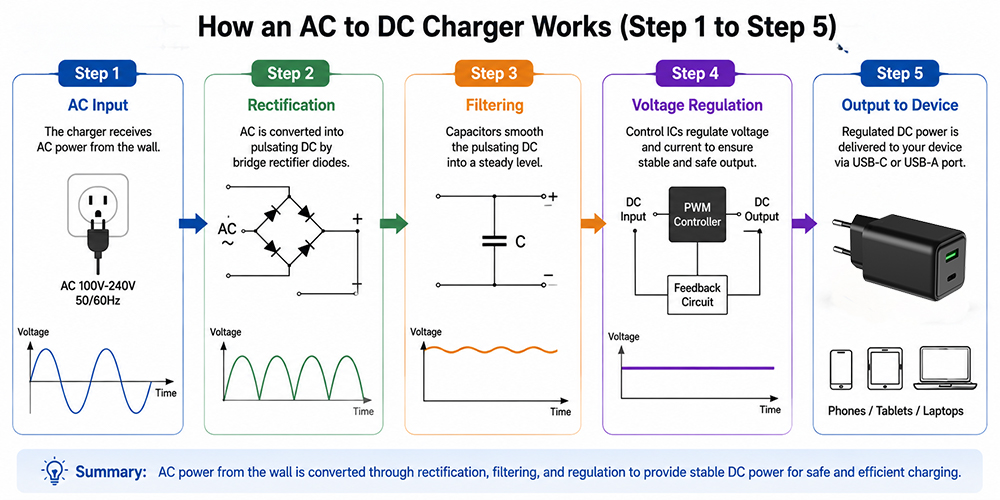
Inside every modern:
• USB charger
• PD charger
• laptop charger
• GaN charger
…there is a miniature power conversion system.
Step 1: AC Input
The charger receives AC power from the wall.
Examples:
• 100V–240V input
• 50/60Hz frequency
Step 2: Rectification
The charger converts AC into pulsating DC using:
👉 bridge rectifier diodes
Step 3: Filtering
Capacitors smooth the unstable waveform.
Result: ✔ cleaner DC power
Step 4: Voltage Regulation
Control ICs regulate:
• voltage
• current
• power delivery
Modern USB-C PD chargers and PPS chargers dynamically adjust voltage depending on the device.
Step 5: Output
Stable DC power is delivered to:
• smartphones / tablets / laptops
through USB-C or USB-A ports.
Why Fast Charging Depends on DC Precision
Fast charging is not just “more power.”
It requires extremely precise DC regulation.
Example: USB-C PD Charger
A modern PD charger factory must engineer systems capable of dynamically switching between:
• 5V / 9V / 12V / 15V / 20V
PPS Charging Is Even More Advanced
PPS (Programmable Power Supply) can finely adjust voltage in tiny increments.
This:
✔ improves efficiency
✔ reduces heat
✔ protects batteries
👉 That's why modern Samsung S26 charger factory designs increasingly rely on PPS optimization.
AC vs DC: Key Differences
| Feature | AC Power | DC Power |
| Direction | Alternates | One direction |
| Common Source | Wall outlets | Batteries |
| Long-distance transmission | Excellent | Less efficient |
| Used by electronics | No | Yes |
| Voltage conversion | Easy | More complex |
| Stability | Variable | Stable |
Why AC Is Better for Power Grids
Historically, AC won the “War of Currents” because it could:
• travel farther
• reduce transmission loss
• easily change voltage levels
This made AC ideal for:
• cities
• homes
• industrial infrastructure
Why DC Is Dominating Modern Electronics
Even though power grids use AC:
modern electronics increasingly rely on DC internally.
Why?
Because semiconductors require:
• stable voltage
• precise current flow
• low electrical noise
This is especially important for:
• AI devices
• smartphones
• high-speed processors
• USB-C PD chargers
• GaN laptop chargers
AC vs DC in Fast Chargers
A fast charger is essentially: 👉 an advanced AC-to-DC conversion machine.
Modern GaN charger manufacturers optimize:
• switching frequency
• conversion efficiency
• thermal management
• DC regulation precision
Why Efficiency Matters
A poor charger wastes energy as heat.
Example:
100W charger at 85% efficiency
→ wastes 15W as heat
A premium GaN charger at 94% efficiency:
→ wastes far less energy.
Why GaN Technology Improves AC-to-DC Conversion
GaN (Gallium Nitride) semiconductors allow chargers to:
✔ switch faster
✔ reduce power loss
✔ improve efficiency
✔ shrink charger size
This is why modern:
• 65W charger
• 100W USB-C charger
• 140W PD3.1 charger
…can now fit into surprisingly compact designs.
Zonsan GaN Charger Manufacture Insight
As a professional charger manufacturer, Zonsan Power↗ focuses heavily on AC-to-DC conversion efficiency across its product lines.
From 20W phone chargers to 140W laptop chargers, Zonsan engineers optimize:
• PCB layout
• transformer efficiency
• power IC tuning
• thermal management
to achieve safer and more stable DC output for fast charging applications.
Why Poor AC-to-DC Conversion Causes Problems
Low-quality chargers often suffer from:
• unstable voltage
• excessive ripple
• overheating
• poor efficiency
This can lead to:
❌ slow charging
❌ battery degradation
❌ charging disconnects
❌ safety risks
👉 This is why selecting a reliable phone charger manufacturer or USB charger factory matters for both brands and consumers.
The Future: USB-C, PD3.1 & High-Power DC Charging
The future of charging is moving toward:
• higher DC power delivery
• smarter voltage regulation
• more efficient AC conversion
Examples include:
• 240W USB-C PD3.1
• AI thermal management
• ultra-compact GaN chargers
• multi-port laptop chargers
The next generation of PD charger factories and charger type-C manufacturers will compete heavily on:
✔ efficiency
✔ heat reduction
✔ compact design
✔ intelligent power control
Final Verdict
The difference between AC and DC is fundamental to modern electronics.
👉 AC powers the grid.
👉 DC powers your devices.
And every modern charger exists to bridge that gap safely and efficiently.
Without advanced AC-to-DC conversion:
• fast charging would not exist
• USB-C PD would not function
• smartphones and laptops could not operate safely
FAQ (People Also Ask)
Q1: What is the main difference between AC and DC?
A: AC changes direction periodically, while DC flows continuously in one direction.
Q2: Why do phones use DC instead of AC?
A: Electronic circuits and batteries require stable DC power.
Q3: Does a charger convert AC to DC?
A: Yes. All phone chargers and laptop adapters convert AC into DC power.
Q4: Is USB power AC or DC?
A: USB power is DC.
Q5: Why is AC used in homes instead of DC?
A: AC is more efficient for long-distance power transmission.
Q6: Are batteries AC or DC?
A: Batteries supply DC power.
Q7: What is an AC to DC power adapter?
A: A device that converts wall AC electricity into DC for electronics.
Q8: Why do fast chargers need advanced DC control?
A: To safely regulate voltage and current during high-speed charging.