Portable Fast Charger OEM: Global Market Guide, Technology Trends, and How to Choose the Right Manufacturing Partner
It's about efficiency.
Thermal control.
Certification.
Brand differentiation.
And most importantly — choosing the right OEM fast charger manufacturer.
If you're a brand owner, distributor, Amazon seller, telecom operator, or electronics importer, this guide will help you understand:
✅ The global portable fast charger market landscape
✅ Key fast charging technologies (PD, PPS, GaN, QC)
✅ OEM vs ODM manufacturing models
✅ Compliance and certification requirements
✅ How to evaluate a reliable charger factory
✅ Future trends shaping 2026–2028
Let's break it down.
The Global Portable Fast Charger Market: Why OEM Demand Is Growing
The demand for portable fast chargers is accelerating across:
• Europe (PD & GaN adoption surge)
• South Korea (high PPS penetration)
• Middle East premium retail channels
• Americas e-commerce expansion
Key drivers include:
• USB-C becoming universal
• Higher device power requirements (laptops, tablets, gaming phones)
• Multi-device charging habits
• GaN efficiency improvements
• Sustainability regulations (ERP, energy efficiency mandates)
For brands, this creates opportunity — but only with the right OEM charger supplier.
What Is a Portable Fast Charger OEM?
A Portable Fast Charger OEM (Original Equipment Manufacturer) produces chargers that are branded and sold under another company’s name.
There are typically three cooperation models:
1. Pure OEM Manufacturing
You provide:
• Industrial design / PCB requirements / Brand identity / Packaging design
The charger factory handles:
• Production / Testing / Certification / Quality control
2. ODM (Original Design Manufacturing)
The manufacturer provides:
• Existing mold / Mature power platform / Certified solution
You customize:
• Logo / Housing color / Packaging / Minor spec adjustments
ODM shortens time-to-market.
3. Custom Power Solution Development
For enterprise or telecom projects requiring:
• Exclusive PCB architecture
• Multi-port dynamic power allocation
• Private protocol integration
• Smart thermal management
This requires a strong R&D charger manufacturer with in-house engineering capabilities.
Core Fast Charging Technologies Every OEM Buyer Must Understand
Choosing a charger manufacturer without understanding power protocols is risky.
Here are the key technologies shaping the portable charger industry:
USB Power Delivery (PD 3.0 / PD 3.1 EPR)
• Global standard fast charging protocol
• Up to 240W under PD 3.1 EPR
• Required for laptops, tablets, flagship smartphones
PD compatibility is essential for EU and North American markets.
PPS (Programmable Power Supply)
• Allows voltage adjustment in real-time
• Reduces heat during charging
• Critical for Samsung and Korean market devices
A professional PD PPS charger manufacturer should support 3.3–21V dynamic adjustment.
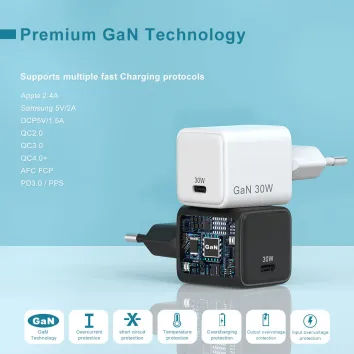
GaN (Gallium Nitride) Technology
GaN chargers provide:
• Higher efficiency
• Smaller size
• Lower heat generation
• Higher switching frequency
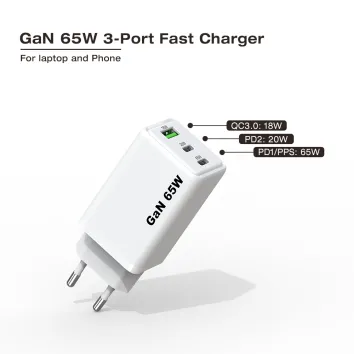
For 65W–140W portable chargers, GaN is now standard in premium segments.
Intelligent Power Allocation
Multi-port chargers must dynamically distribute power when:
• Two devices are plugged in
• A laptop and phone charge simultaneously
• Device charging requirements change mid-cycle
Without proper firmware control, charging becomes unstable.
Portable Fast Charger Power Ranges (5W–240W)
The portable fast charger OEM market spans:
| Power Range | Application |
| 5W–20W | Entry smartphones, earbuds |
| 25W–45W | Flagship phones, tablets |
| 65W | Ultrabooks |
| 100W | High-performance laptops |
| 140W–240W | Gaming laptops & future devices |
A reliable USB-C charger factory should support scalable platforms across multiple wattage tiers.
Certification Requirements for Global Markets
Compliance is not optional.
A qualified fast charger manufacturer must provide:
⭐ Europe — CE / RoHS / CB / ERP (Energy Efficiency Directive)
⭐ United Kingdom — UKCA
⭐ North America — FCC / ETL or UL
⭐ South America — INMETRO / IRAM / NOM / ICONTEC / INN
⭐ South Korea — KC (KCC)
⭐ Middle East — SASO (Saudi Arabia) / GCC conformity where required
Always request test reports — not just certificates.
How to Evaluate a Reliable Portable Fast Charger Factory
Selecting an OEM charger supplier requires more than price comparison.
Here’s a professional evaluation checklist:
1. R&D Capability
🟢 Does the factory have:
🟢 In-house PCB design team?
🟢 Thermal simulation capability?
🟢 Protocol integration engineers?
🟢 Firmware development support?
Without engineering depth, customization is limited.
2. Manufacturing Infrastructure
Look for:
👉 SMT production lines
👉 Aging test systems
👉 100% burn-in testing
👉 Automated optical inspection (AOI)
👉 In-circuit testing (ICT)
These determine long-term failure rates.
3. Quality Control System
Ask about:
🔍 Incoming material inspection (IQC)
🔍 In-process control (IPQC)
🔍 Final quality inspection (FQC)
🔍 Reliability testing cycles
ISO9001 certification should be standard.
4. Supply Chain Stability
A mature charger factory should have:
• Stable transformer suppliers
• Long-term IC partnerships
• GaN transistor sourcing capability
• Cable integration resources
Component instability leads to inconsistency.
5. MOQ and Lead Time Flexibility
For private label fast charger brands, flexibility matters.
Typical ranges:
MOQ: 1,000–3,000 units
Lead time: 25–35 days
2026–2028 Portable Charger Market Trends
Understanding future direction ensures long-term partnership value.
1. 140W+ PD 3.1 Growth
High-wattage laptop charging is expanding in Europe and North America.
2. GaN III Adoption
Next-generation GaN reduces switching losses further and improves power density.
3. Sustainability Pressure
EU energy regulations demand:
① Higher conversion efficiency
② Lower standby power consumption
③ Recyclable packaging
Factories must adapt to eco-compliance.
4. Integrated Cable Chargers
Consumers prefer:
① Built-in USB-C cable
② Foldable plug design
③ Travel-friendly compact chargers
Why OEM Partnerships Matter More Than Price
Low price without:
✅ Stable certification
✅ Consistent power output
✅ Thermal control
✅ Engineering support
Creates brand risk.
Long-term OEM partnership focuses on:
✅ Product roadmap alignment
✅ Technical upgrade capability
✅ Co-development opportunities
✅ Market expansion strategy
Featured Snippet Summary
A portable fast charger OEM is a manufacturer that designs and produces USB-C, PD, PPS, or GaN chargers for global brands under private labeling or custom development agreements. Selecting the right OEM partner requires evaluating R&D strength, certification compliance, power technology expertise, and quality control systems.
FAQ: Portable Fast Charger OEM
Q1: What is a portable fast charger OEM?
A manufacturer that produces fast chargers for brands under private label or customized agreements.
Q2: What is the difference between OEM and ODM charger manufacturing?
OEM follows client-provided design; ODM uses existing factory platforms with branding customization.
Q3: What certifications are required for Europe?
CE, RoHS, CB, and ERP compliance are mandatory.
Q4: Is GaN necessary for 65W chargers?
Not mandatory, but highly recommended for efficiency and compact size.
Q5: What is the MOQ for private label fast chargers?
Typically 1,000–3,000 units depending on customization level.
Q6: Can an OEM support PD 3.1 240W charging?
Advanced charger manufacturers with strong R&D can.
Q7: How long does charger certification take?
4–8 weeks depending on the target market and power rating.
Q8: What causes charger overheating issues?
Poor PCB design, low-quality components, and insufficient thermal management.
Q9: How do I verify a charger factory’s quality system?
Request ISO certificates, factory audit reports, and testing documentation.
Q10: What markets are growing fastest for fast chargers?
Europe, South Korea, Middle East premium segments, and North American e-commerce.
Q11: What is intelligent power allocation?
A system that dynamically distributes wattage across multiple ports safely.
Q12: Are integrated cable chargers trending?
Yes, especially in travel and retail segments.
Read More
Read More
Read More
Certification Requirements for Global Markets
Compliance is not optional.
A qualified fast charger manufacturer must provide:
⭐ Europe — CE / RoHS / CB / ERP (Energy Efficiency Directive)
⭐ United Kingdom — UKCA
⭐ North America — FCC / ETL or UL
⭐ South America — INMETRO / IRAM / NOM / ICONTEC / INN
⭐ South Korea — KC (KCC)
⭐ Middle East — SASO (Saudi Arabia) / GCC conformity where required
Always request test reports — not just certificates.
How to Evaluate a Reliable Portable Fast Charger Factory
Selecting an OEM charger supplier requires more than price comparison.
Here’s a professional evaluation checklist:
1. R&D Capability
🟢 Does the factory have:
🟢 In-house PCB design team?
🟢 Thermal simulation capability?
🟢 Protocol integration engineers?
🟢 Firmware development support?
Without engineering depth, customization is limited.
2. Manufacturing Infrastructure
Look for:
👉 SMT production lines
👉 Aging test systems
👉 100% burn-in testing
👉 Automated optical inspection (AOI)
👉 In-circuit testing (ICT)
These determine long-term failure rates.
3. Quality Control System
Ask about:
🔍 Incoming material inspection (IQC)
🔍 In-process control (IPQC)
🔍 Final quality inspection (FQC)
🔍 Reliability testing cycles
ISO9001 certification should be standard.
4. Supply Chain Stability
A mature charger factory should have:
• Stable transformer suppliers
• Long-term IC partnerships
• GaN transistor sourcing capability
• Cable integration resources
Component instability leads to inconsistency.
5. MOQ and Lead Time Flexibility
For private label fast charger brands, flexibility matters.
Typical ranges:
MOQ: 1,000–3,000 units
Lead time: 25–35 days
2026–2028 Portable Charger Market Trends
Understanding future direction ensures long-term partnership value.
1. 140W+ PD 3.1 Growth
High-wattage laptop charging is expanding in Europe and North America.
2. GaN III Adoption
Next-generation GaN reduces switching losses further and improves power density.
3. Sustainability Pressure
EU energy regulations demand:
① Higher conversion efficiency
② Lower standby power consumption
③ Recyclable packaging
Factories must adapt to eco-compliance.
4. Integrated Cable Chargers
Consumers prefer:
① Built-in USB-C cable
② Foldable plug design
③ Travel-friendly compact chargers
Why OEM Partnerships Matter More Than Price
Low price without:
✅ Stable certification
✅ Consistent power output
✅ Thermal control
✅ Engineering support
Creates brand risk.
Long-term OEM partnership focuses on:
✅ Product roadmap alignment
✅ Technical upgrade capability
✅ Co-development opportunities
✅ Market expansion strategy
Featured Snippet Summary
A portable fast charger OEM is a manufacturer that designs and produces USB-C, PD, PPS, or GaN chargers for global brands under private labeling or custom development agreements. Selecting the right OEM partner requires evaluating R&D strength, certification compliance, power technology expertise, and quality control systems.
FAQ: Portable Fast Charger OEM
Q1: What is a portable fast charger OEM?
A manufacturer that produces fast chargers for brands under private label or customized agreements.
Q2: What is the difference between OEM and ODM charger manufacturing?
OEM follows client-provided design; ODM uses existing factory platforms with branding customization.
Q3: What certifications are required for Europe?
CE, RoHS, CB, and ERP compliance are mandatory.
Q4: Is GaN necessary for 65W chargers?
Not mandatory, but highly recommended for efficiency and compact size.
Q5: What is the MOQ for private label fast chargers?
Typically 1,000–3,000 units depending on customization level.
Q6: Can an OEM support PD 3.1 240W charging?
Advanced charger manufacturers with strong R&D can.
Q7: How long does charger certification take?
4–8 weeks depending on the target market and power rating.
Q8: What causes charger overheating issues?
Poor PCB design, low-quality components, and insufficient thermal management.
Q9: How do I verify a charger factory’s quality system?
Request ISO certificates, factory audit reports, and testing documentation.
Q10: What markets are growing fastest for fast chargers?
Europe, South Korea, Middle East premium segments, and North American e-commerce.
Q11: What is intelligent power allocation?
A system that dynamically distributes wattage across multiple ports safely.
Q12: Are integrated cable chargers trending?
Yes, especially in travel and retail segments.
Read More
Read More
Read More