Component Lifecycle Management in Charger Manufacturing: How Factories Manage Obsolescence and Supply Risk
Provider of Information: Luo Zhang(Production Supervisor) & David Li(Quality Oversight)
Why Long-Term Component Availability Matters for USB-C Charger OEM Projects
A charger may be technically sound, commercially successful, and already in mass production when an unexpected problem appears: a key component is no longer available.
The supplier may discontinue a power IC, extend its lead time, change a production location, or stop supporting a particular component family. For the charger manufacturer, the immediate concern is not simply finding another part. It is determining whether the product can continue to be manufactured without changing its performance, reliability, or compliance status.
This is why component lifecycle management matters in charger manufacturing.
For USB-C PD chargers, GaN fast chargers, PPS products, and multi-port charging solutions, component availability needs to be considered beyond the initial product development stage. A design that works well today may still face supply challenges later in its commercial life.
From a manufacturer's perspective, the objective is straightforward: maintain the ability to build the approved product over time, while managing component changes in a technically responsible way.
What Is Component Lifecycle Management?
Component lifecycle management is the process of monitoring, evaluating, and managing electronic components throughout a product's commercial life, from initial selection and production use to obsolescence or replacement. In charger manufacturing, it helps engineering, purchasing, and production teams manage availability risks without introducing uncontrolled changes to the product.
It typically involves:
• Understanding the lifecycle status of critical components.
• Monitoring supplier availability and lead-time changes.
• Identifying parts with limited or uncertain long-term supply.
• Evaluating alternative components before they are urgently needed.
• Reviewing the technical impact of component changes.
• Maintaining accurate BOM and approval records.
• Planning for products that need to remain in production over several years.
Component lifecycle management is related to supplier quality management, but the two are not identical. Supplier quality focuses on whether components and suppliers consistently meet requirements. Lifecycle management focuses on whether the required components will remain available and supportable as market conditions change.
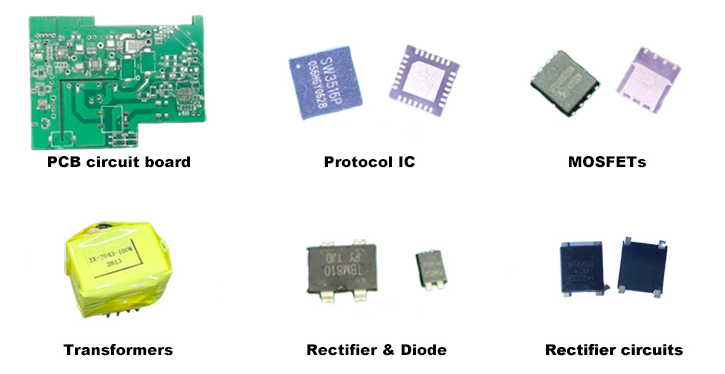
Why Charger Components Can Become a Long-Term Risk
Not all components present the same level of supply risk. A standard passive component may have several suitable sourcing options, while a specialized controller or power semiconductor may be more difficult to replace.
In a charger, the potential impact depends on the component's function, design dependencies, qualification status, and availability from alternative sources.
1. Power management ICs and GaN devices
Power controllers, switching devices, and GaN components can be closely tied to a specific circuit architecture. A replacement may require more than matching voltage and current ratings.
Engineers may need to evaluate switching behavior, gate-drive requirements, protection functions, thermal performance, EMI behavior, and interactions with the rest of the circuit.
2. Transformers and magnetic components
Transformers are often designed for a particular power topology, switching frequency, insulation system, and physical layout. A replacement that looks similar may have different electrical or thermal characteristics.
Depending on the design, changing a transformer may require further circuit evaluation and testing.
3. Capacitors and protection components
Capacitors, resistors, rectifiers, and protection devices may appear easier to replace, but their ratings and characteristics still matter. Voltage rating, temperature behavior, lifetime expectations, package dimensions, and circuit position can all affect suitability.
4. Connectors, plugs, and mechanical components
USB-C connectors, AC plugs, housings, and other mechanical parts can also become unavailable or undergo supplier changes. Even if their electrical function remains similar, dimensional or material differences may affect assembly, mechanical fit, safety, or product appearance.
The lesson is not that every component change is dangerous. It is that the consequences depend on where and how the component is used.
Step 1 — Identify the Components That Deserve Attention
A factory does not need to treat every BOM line as an equally serious lifecycle risk. A practical assessment starts by identifying components that are difficult to replace, have limited supply options, are subject to long lead times, or could have a significant effect on product performance if changed.
Relevant considerations include:
• Whether the component is central to the power-conversion architecture.
• Whether suitable alternative parts or suppliers exist.
• The manufacturer's published lifecycle status, where available.
• Typical and current lead times.
• Minimum order quantities and purchasing constraints.
• The expected commercial life and forecast volume of the charger.
• The amount of re-engineering or revalidation a replacement might require.
This assessment should be product-specific. A component that presents little risk in one charger design may be much more important in another.
For example, a custom transformer used in a compact high-power charger may have different replacement implications from a commonly available passive component used across several product families.
Step 2 — Monitor Component Status Before a Shortage Becomes Urgent
Lifecycle management works best when it begins before a component shortage threatens production.
Purchasing teams may monitor supplier notices, lead-time changes, allocation conditions, and availability trends. Engineering can help interpret the technical implications of a component's lifecycle status.
The factory should also distinguish between different situations:
Normal availability: The component can be sourced through the established purchasing process.
Supply pressure: Lead times, allocation, or availability have become less predictable.
Last-time-buy notification: The manufacturer has announced that orders must be placed before a specified deadline.
End-of-life status: The component is being discontinued or is no longer supported for new production, depending on the supplier's notice.
These situations call for different responses. A temporary shortage does not automatically justify redesigning a charger. Conversely, a formal end-of-life announcement may require a planned replacement strategy.
Supplier information should be verified with the component manufacturer or authorized supply channel wherever possible. A distributor's current stock listing alone is not a guarantee of long-term availability.
Step 3 — Evaluate the Options Before Changing the Product
When a component becomes difficult to source, the factory normally has several possible responses.
Option A: Secure supply of the existing component
If the part remains available and the commercial risk is manageable, purchasing may arrange suitable inventory or a longer-term supply plan.
This can be practical for a stable product with predictable demand. However, buying more inventory introduces cash-flow, storage, shelf-life, and demand-forecasting considerations. It may not be the best answer for every component.
Option B: Qualify another source
If the same component is available through another legitimate source, the manufacturer should verify authenticity, traceability, storage conditions where relevant, and supplier suitability.
An identical part number does not remove the need to consider sourcing risk. Counterfeit, mishandled, or poorly documented components can create problems even when their markings appear correct.
Option C: Approve an alternative component
An alternative part may help protect long-term production, but it must be evaluated against the actual design requirements.
The engineering team may need to review datasheets, electrical characteristics, thermal behavior, mechanical fit, circuit interactions, and the required verification plan.
Option D: Redesign part of the circuit or product
If no suitable replacement exists, a design change may be necessary. This can involve the PCB, power architecture, transformer, protection circuit, or mechanical layout.
A redesign generally requires more engineering effort than a controlled component substitution, so it is better handled as a planned product-development activity whenever possible.
Step 4 — Understand the Cost of Replacing a Component
The price of an alternative component is only one part of the decision.
A replacement may affect:
• Engineering analysis and development time.
• PCB layout or tooling requirements.
• Electrical and thermal performance.
• EMI behavior and product compatibility.
• Safety evaluation and certification status.
• Test procedures and production documentation.
• Inventory of the existing component.
• Customer approval requirements.
The total cost of a change can therefore exceed the price difference between two parts.
This is particularly important for OEM and ODM projects. A buyer may have approved a specific charger sample and packaging specification. If a later component change affects product characteristics or certification, the factory may need to coordinate with the customer before releasing the revised product.
The appropriate level of evaluation depends on the nature of the change and the product's applicable requirements. Not every component substitution requires a complete redesign, but no replacement should be assumed acceptable solely because its headline specifications look similar.
Step 5 — Keep Lifecycle Information Connected to the Product BOM
A useful lifecycle process needs reliable records.
The BOM should identify the approved component and the relevant manufacturer or supplier information. Depending on the system, supporting records may include datasheets, specifications, approval status, lifecycle notices, alternative-part evaluations, and engineering change history.
This information helps teams answer practical questions:
• Which products use the affected component?
• Is the component used in multiple charger models?
• Is there an approved alternative?
• What testing or review was completed?
• Does the change require customer notification or approval?
• Which production lots used the original or revised component?
These questions become harder to answer when purchasing, engineering, and production maintain disconnected records.
For a deeper discussion of supplier approval and material control, see Supplier Quality Management in Charger Manufacturing.
Step 6 — Plan for Product Families, Not Just Individual Models
Some charger manufacturers develop several products around related power architectures or common components. When this is technically appropriate, platform reuse can simplify component planning and make engineering resources more efficient.
However, shared components should not be assumed to be interchangeable across every model. Power rating, thermal conditions, circuit topology, mechanical design, and certification requirements may differ.
A lifecycle review should therefore identify where components are genuinely shared and where a replacement would affect only one product.
This is especially useful for manufacturers supplying several power ratings or customized versions to different markets. A well-maintained component map can help identify the potential scope of a shortage or design change before it disrupts production.
What OEM and ODM Buyers Should Ask a Charger Manufacturer
For buyers planning a long-running charger program, component lifecycle management deserves attention during supplier evaluation.
Useful questions include:
• How does the factory monitor the lifecycle status of critical components?
• What happens if a power IC, GaN device, or transformer becomes unavailable?
• Does the factory maintain documented and technically evaluated alternatives where appropriate?
• How are component substitutions reviewed and approved?
• How does the supplier determine whether a change affects testing, certification, or customer approval?
• Can the factory identify which product models and production lots use a particular component?
• How are existing inventory and product continuity managed during a transition?
A good supplier should be able to explain its process clearly. Buyers should avoid assuming that every factory has a formal component-obsolescence database or a fully qualified alternative for every BOM item; these capabilities need to be confirmed for the specific project.
How ZONSAN Fits Into This Process
ZONSAN manufactures USB-C chargers, GaN fast chargers, PD/PPS products, and multi-port charging solutions for OEM and ODM customers.
In a customized charger project, component selection is connected to the intended power rating, circuit architecture, physical design, charging requirements, and target market. Those decisions also influence how the product can be maintained if supply conditions change later.
For buyers planning a long-term program, it is useful to discuss expected production duration, forecast volume, critical specifications, component-change approval requirements, and any market-specific certification constraints during project planning.
This does not eliminate supply risk, but it helps establish a clearer basis for managing future changes rather than treating every shortage as an emergency.
Final Thoughts
Component lifecycle management is an important part of keeping a charger product viable after its initial launch.
A successful design needs more than the right components at the time of development. It also needs a practical plan for handling supply changes, component obsolescence, alternative sourcing, and the engineering work required to maintain product conformity.
For charger manufacturers, the objective is not to prevent every component from becoming unavailable. That is rarely possible. The objective is to recognize risk early, evaluate options carefully, preserve the product's approved requirements, and avoid uncontrolled substitutions.
For OEM and ODM buyers, asking about lifecycle planning can reveal how prepared a supplier is to support a product beyond its first production order.
FAQ: Component Lifecycle Management in Charger Manufacturing
Q1. What is component lifecycle management in charger manufacturing?
It is the process of tracking and managing electronic components from initial selection through ongoing production, supply changes, and eventual obsolescence or replacement. It helps manufacturers maintain product continuity while controlling the technical risks of component changes.
Q2. Why do charger components become obsolete?
Component manufacturers may discontinue product families, consolidate production, change technology, or stop supporting older devices. Market demand and supply-chain conditions can also affect availability. The reasons vary by component and supplier.
Q3. Which charger components are most difficult to replace?
The answer depends on the design. Specialized power ICs, GaN devices, transformers, and components with tight electrical or mechanical dependencies may require substantial evaluation. Some passive components can be easier to replace, but their suitability still depends on the application.
Q4. Can a charger factory replace an unavailable component with one that has the same ratings?
Not automatically. Matching headline ratings does not guarantee equivalent switching behavior, thermal performance, protection functions, EMI behavior, mechanical fit, or compliance. Engineering review and appropriate verification are necessary.
Q5. What is the difference between component obsolescence and a temporary shortage?
A temporary shortage affects current availability but may not indicate that the component is being discontinued. Obsolescence means the manufacturer is ending or has ended support or production, according to the applicable lifecycle notice. The correct response depends on the supplier's verified status and the product's needs.
Q6. Should OEM buyers ask about component lifecycle before mass production?
Yes, especially for products expected to remain in production for an extended period. Discussing critical components, expected supply duration, approved changes, and customer notification requirements can reduce the risk of unexpected disruption.
Q7. Does every component change require full product recertification?
No. The necessary evaluation depends on the component, the nature of the change, the product design, applicable regulations, and certification-body requirements. The manufacturer should assess the impact rather than assume that either no additional work or complete recertification is always necessary.
Q8. How does component lifecycle management support long-term charger production?
It helps manufacturers identify supply risks earlier, plan inventory or alternative sourcing, evaluate technical changes, and maintain accurate product records. These activities can reduce avoidable production interruptions and help preserve product consistency.