USB-C PD3.1 and EPR Charging Explained: Why 240W Charging Changes Everything
USB-C was mostly associated with:
• smartphones
• tablets
• small accessories
• lightweight ultrabooks
But today, things look very different.
Modern USB-C charging now supports:
• 140W MacBook charging
• gaming laptop charging
• workstation charging
• multi-display docking systems
• high-performance GaN desktop chargers
And the technology behind this transformation is:
👉 USB PD3.1 with EPR charging.
In many ways, PD3.1 is no longer just an upgrade.
It represents a complete shift in how modern power delivery systems are designed.
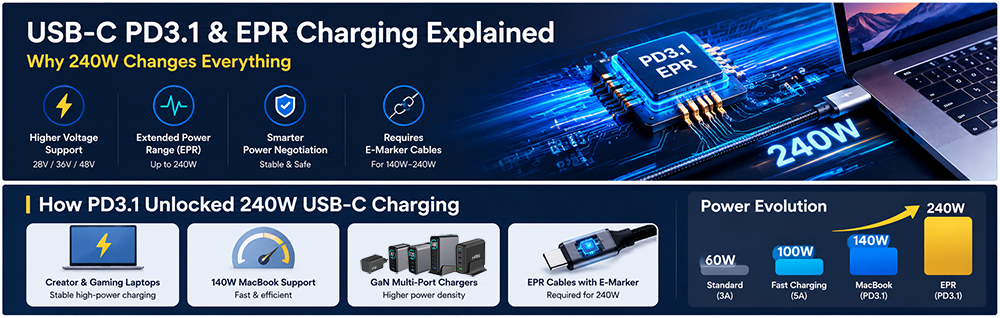
USB PD3.1 is the latest major version of the USB Power Delivery standard.
It was introduced to dramatically increase USB-C charging power beyond previous limits.
Earlier USB PD versions were primarily limited to: 100W maximum.
That was already impressive for its time.
But the rapid growth of:
• creator laptops
• gaming laptops
• portable workstations
• high-refresh external displays
• AI computing devices
created demand for much higher charging power.
This is where PD3.1 enters the picture.
What Is EPR Charging?
EPR stands for: Extended Power Range.
It is one of the biggest additions introduced with USB PD3.1.
EPR expands USB-C charging beyond traditional voltage levels.
Before PD3.1 (SPR)
Earlier USB PD systems mainly used: 5V / 9V / 15V / 20V
This was called: SPR (Standard Power Range).
Maximum power: 100W.
After PD3.1 (EPR)
PD3.1 introduced: 28V / 36V / 48V
This new mode became: EPR (Extended Power Range).
Now USB-C can theoretically deliver: up to 240W.
Why 240W Charging Is a Huge Industry Shift
240W charging is not simply “more power.”
It fundamentally changes what USB-C can replace.
For years, powerful laptops depended on:
• large barrel chargers
• proprietary adapters
• heavy power bricks
But PD3.1 now allows USB-C to support:
• gaming laptops
• creator workstations
• portable monitors
• docking systems
• future AI hardware
through a universal connector.
This is why many engineers see PD3.1 as a turning point for the entire charging industry.
Real-World Example: MacBook 140W Charging
One of the most famous early examples of PD3.1 adoption came from Apple.
Modern MacBook Pro models introduced: 140W USB-C charging.
This immediately pushed awareness of:
• USB-C EPR cables
• 140W GaN chargers
• PD3.1 compatibility
into the mainstream market.
Many consumers suddenly realized: not all USB-C cables and chargers are equal.
Why PD3.1 Requires Better USB-C Cables
Higher power creates higher engineering demands.
At 240W charging levels, USB-C systems must handle:
• higher voltage
• higher thermal stress
• greater current stability
• increased insulation requirements
• more demanding safety protection
This is why PD3.1 systems require: EPR-rated USB-C cables.
What Makes an EPR Cable Different?
Compared to standard USB-C cables, EPR cables typically include:
• advanced E-Marker chips
• stronger insulation materials
• thicker conductors
• improved shielding
• better connector durability
Without these upgrades, stable 240W charging becomes extremely difficult.
Why Cheap USB-C Cables Become Dangerous at High Power
At lower power levels, poor cable quality may only cause:
• slower charging
• mild heat
• unstable charging speed
But at: 140W / 180W / 240W
…the risks increase dramatically.
Low-quality cables may experience:
• overheating
• voltage instability
• connector degradation
• insulation stress
• long-term reliability issues
This is why professional charger manufacturers increasingly emphasize cable engineering alongside charger design.
How PD3.1 Changes GaN Charger Design
PD3.1 is also reshaping the GaN charger industry.
Modern GaN chargers now require optimization for:
• higher voltage switching
• thermal efficiency
• dynamic power balancing
• EPR communication
• intelligent protocol management
This is especially important for:
• multi-port desktop chargers
• laptop charging stations
• travel GaN chargers
• workstation charging hubs
The charger industry is no longer focused only on wattage.
Now the focus is: stable high-power ecosystem design.
Why Gaming Laptops Accelerated PD3.1 Growth
Gaming laptops are one of the biggest reasons PD3.1 adoption accelerated so quickly.
Modern gaming systems consume enormous power during:
• GPU rendering
• high-refresh gaming
• AI workloads
• 3D design
• streaming
Traditional 100W USB-C charging often became insufficient.
PD3.1 solves this problem by enabling much higher USB-C power delivery.
This makes USB-C increasingly viable as a true laptop power platform.
Another Major Change: USB-C Is Becoming Universal
One overlooked effect of PD3.1 is standardization.
Manufacturers increasingly want:
• one charger
• one cable
• one ecosystem
for: phones / tablets / laptops / gaming systems / accessories / mobile devices
This is accelerating the shift away from proprietary charging systems.
Over the next few years, USB-C may become the dominant universal power standard for consumer electronics.
Why Thermal Engineering Matters More With PD3.1
One of the biggest challenges in high-power charging is heat.
At: 140W, 180W, 240W
even small inefficiencies generate significant thermal buildup.
This affects:
• cable lifespan
• connector reliability
• charging stability
• internal PCB temperature
• long-term durability
As a result, modern PD3.1 charger factories increasingly invest in:
• thermal simulation
• heat dissipation design
• intelligent power allocation
• advanced PCB layouts
rather than simply increasing wattage numbers.
Why Some “240W Chargers” Still Underperform
Many consumers assume:“If the charger says 240W, everything will work perfectly.”
But real charging performance depends on the entire charging chain:
• charger quality
• cable quality
• EPR support
• E-Marker communication
• laptop compatibility
• PD negotiation stability
A weak cable can still reduce charging performance dramatically.
This is why PD3.1 ecosystems require better overall engineering coordination.
ZONSAN's Perspective on the Future of PD3.1 Charging
As a professional GaN charger manufacturer and OEM fast charging supplier, Zonsan Power
closely follows the rapid transition toward PD3.1 and EPR charging ecosystems.
The charging industry is entering a new phase where:
• charger architecture
• cable engineering
• protocol optimization
• thermal management
• safety certification
must all work together as a complete system.
For applications such as:
• 140W MacBook charging
• gaming laptop charging
• desktop GaN charging stations
• multi-port PD chargers
• AI workstation charging
PD3.1 compatibility is becoming increasingly important for future product development.
What Devices Will Benefit Most From PD3.1?
Creator Laptops
Video editing and rendering systems require higher sustained charging power.
Gaming Laptops
Modern gaming systems increasingly support USB-C charging.
Portable Workstations
Engineering and AI laptops benefit from universal high-power charging.
Multi-Device Desktop Charging
PD3.1 enables fewer chargers with higher overall power output.
Will 240W USB-C Replace Traditional Laptop Chargers?
In many cases: yes.
The industry is already shifting toward:
• universal USB-C charging
• compact GaN chargers
• single-cable ecosystems
However, extremely high-performance gaming systems may still require proprietary adapters for maximum power.
But for most users, PD3.1 represents the future of laptop charging.
Final Thoughts
USB PD3.1 is far more than a simple charging upgrade.
It transforms USB-C from a phone charging connector into a universal high-power energy platform.
With support for:
• 140W charging
• 180W charging
• 240W charging
• EPR ecosystems
• advanced GaN chargers
USB-C is rapidly replacing traditional charging systems across the entire electronics industry.
And as charging power continues increasing, the importance of:
• cable quality
• EPR compatibility
• thermal engineering
• intelligent power negotiation
will only continue growing.
The future of charging is no longer just faster.
It is becoming smarter, more universal, and far more integrated than ever before.
FAQ (People Also Ask)
Q1: What is USB PD3.1?
USB PD3.1 is the latest USB Power Delivery standard supporting charging up to 240W.
Q2: What does EPR mean in USB-C charging?
EPR stands for Extended Power Range, enabling higher-voltage USB-C charging.
Q3: Can USB-C really support 240W charging?
Yes. PD3.1 EPR charging supports up to 240W under compatible hardware conditions.
Q4: Do I need a special cable for PD3.1 charging?
Yes. PD3.1 charging requires EPR-rated USB-C cables with E-Marker support.
Q5: Why is my 240W charger charging slowly?
The cable, laptop compatibility, or PD negotiation may limit charging performance.
Q6: Is PD3.1 better than PD3.0?
PD3.1 supports significantly higher charging power and improved future compatibility.
Q7: Can PD3.1 charge gaming laptops?
Yes. PD3.1 is increasingly used for gaming laptop USB-C charging.
Q8: Will USB-C replace traditional laptop chargers?
For many laptops, USB-C PD3.1 is already replacing proprietary charging systems.
Read more about charging.
• “What Is an E-Marker Chip and Why Does Your USB-C Cable Need One?”↗
• “Why some USB-C Cables Cannot Charge Laptops Properly ”↗
• “USB Power Delivery Revision 3.1 Specification”↗
• “USB Type-C Cable and Connector Specification”↗
Read More
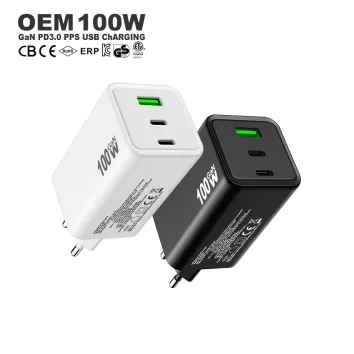
Designed for OEM charger manufacturing and brand customization, this 100W USB-C wall charger combines high output power, intelligent power distribution, and compact GaN design, making it ideal for modern users who require efficient charging across smartphones, tablets, and laptops.
Read More
Read More