What is a power bank? How does it work?
Smartphones, tablets, wireless earbuds, and portable devices have become an essential part of daily life. However, battery life remains one of the biggest challenges for modern users. When there is no wall outlet nearby, a power bank provides a convenient solution by storing electrical energy and transferring it to electronic devices whenever needed.
But what exactly is a power bank? How does a power bank work? What do terms like mAh, USB-C, PD charging, and fast charging mean?
With many different models available in the market, choosing the right power bank can be confusing. Some power banks are designed for smartphones, while others can charge tablets, handheld gaming devices, and even laptops.
In this guide, we will explain:
• What a power bank is
• How a power bank works internally
• How battery capacity is measured
• The difference between standard and fast charging power banks
• How to choose the right charging solution for your devices
Quick Answer: What Is a Power Bank?
A power bank is a portable battery device that stores electrical energy and uses built-in electronic circuits to charge smartphones, tablets, laptops, and other rechargeable devices.
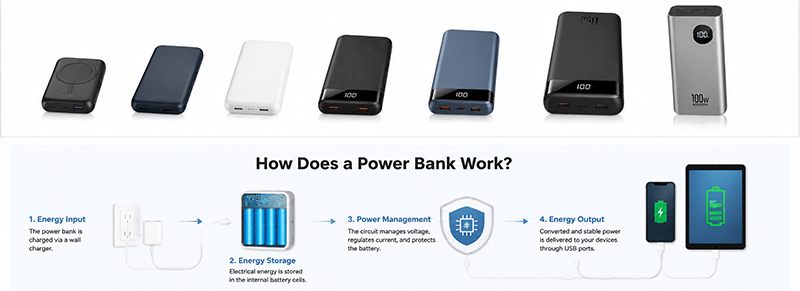
A power bank works by:
1. Receiving electricity from a charger and storing energy inside internal battery cells.
2. Managing and protecting the stored energy through a control circuit.
3. Converting stored battery power into a stable output voltage.
4. Delivering electricity to connected devices through USB or USB-C ports.
In simple terms:
A power bank is a portable energy storage device that allows you to recharge electronic devices without connecting directly to a wall outlet.
What Is a Power Bank?
A power bank is also known as a portable charger, external battery, or portable battery pack.
It contains rechargeable battery cells and electronic components that allow users to store electricity and use it later.
Unlike a traditional wall charger that directly converts AC power from a wall outlet into DC power for a device, a power bank works as an energy storage system.
The basic process is:
Wall outlet → Charger → Power bank battery → Electronic device
For example:
• A USB-C charger charges the power bank.
• The power bank stores electrical energy inside battery cells.
• When a smartphone is connected, the power bank releases stored energy to recharge the phone.
This makes power banks especially useful for:
• Travel
• Outdoor activities
• Business trips
• Emergency charging
• Daily mobile use
Why Are Power Banks Becoming More Popular?
Modern electronic devices are becoming more powerful, but battery capacity cannot increase indefinitely because manufacturers need to keep devices thin and lightweight.
Many users rely on:
• Smartphones for communication
• Tablets for work and entertainment
• Wireless earbuds for audio
• Smart watches for health tracking
• Portable gaming devices
As a result, portable charging solutions have become increasingly important.
A modern power bank allows users to carry additional battery capacity without carrying multiple charging adapters.
For example:
A single portable charger can provide additional power for:
• Smartphone charging during travel
• Tablet charging during work
• Emergency laptop charging
How Does a Power Bank Work?
Understanding how a power bank works requires looking at its internal charging process.
A power bank mainly operates through four stages:
1. Energy Input: Charging the Power Bank
When a power bank is connected to a wall charger, electricity enters through the charging port.
Common input ports include:
• USB-C / Micro USB (older models)
Modern power banks increasingly use USB-C input because it supports:
• Faster charging speed
• Higher power delivery
• Improved compatibility
For example, a USB-C PD charger can charge a compatible power bank much faster than a traditional low-power charger.
2. Energy Storage: Battery Cells Store Electricity
Inside a power bank are rechargeable battery cells, usually lithium-ion or lithium-polymer batteries.
These battery cells store electrical energy in chemical form.
Common battery configurations include:
• Single-cell battery design
• Multiple battery cell configurations
• High-capacity battery systems
The total stored energy is usually measured in:
• mAh (milliamp hours)
• Wh (watt hours)
For example:
• 5,000mAh power bank
• 10,000mAh power bank
• 20,000mAh power bank
A higher capacity generally means more stored energy, but it also usually increases the size and weight of the power bank.
3. Power Management: Controlling Energy Flow
A power bank cannot directly send battery power to a smartphone because battery voltage is not always suitable for electronic devices.
The internal circuit manages:
• Voltage conversion
• Current regulation
• Charging speed
• Temperature control
• Safety protection
Important internal components include:
• Battery Management System (BMS)
• Charging IC
• Power conversion circuit
• Protection circuit
These components ensure stable and safe charging.
4. Energy Output: Charging Your Device
When a device is connected, the power bank converts stored battery energy into usable output power.
The output process involves:
Battery energy → Voltage conversion → USB output → Device battery
Modern power banks may support different charging technologies, including:
• USB Power Delivery (PD)
• Quick Charge (QC)
• Programmable Power Supply (PPS)
These technologies allow compatible devices to charge faster and more efficiently.
A power bank is also known as a portable charger, external battery, or portable battery pack.
It contains rechargeable battery cells and electronic components that allow users to store electricity and use it later.
Unlike a traditional wall charger that directly converts AC power from a wall outlet into DC power for a device, a power bank works as an energy storage system.
The basic process is:
Wall outlet → Charger → Power bank battery → Electronic device
For example:
• A USB-C charger charges the power bank.
• The power bank stores electrical energy inside battery cells.
• When a smartphone is connected, the power bank releases stored energy to recharge the phone.
This makes power banks especially useful for:
• Travel
• Outdoor activities
• Business trips
• Emergency charging
• Daily mobile use
Why Are Power Banks Becoming More Popular?
Modern electronic devices are becoming more powerful, but battery capacity cannot increase indefinitely because manufacturers need to keep devices thin and lightweight.
Many users rely on:
• Smartphones for communication
• Tablets for work and entertainment
• Wireless earbuds for audio
• Smart watches for health tracking
• Portable gaming devices
As a result, portable charging solutions have become increasingly important.
A modern power bank allows users to carry additional battery capacity without carrying multiple charging adapters.
For example:
A single portable charger can provide additional power for:
• Smartphone charging during travel
• Tablet charging during work
• Emergency laptop charging
How Does a Power Bank Work?
Understanding how a power bank works requires looking at its internal charging process.
A power bank mainly operates through four stages:
1. Energy Input: Charging the Power Bank
When a power bank is connected to a wall charger, electricity enters through the charging port.
Common input ports include:
• USB-C / Micro USB (older models)
Modern power banks increasingly use USB-C input because it supports:
• Faster charging speed
• Higher power delivery
• Improved compatibility
For example, a USB-C PD charger can charge a compatible power bank much faster than a traditional low-power charger.
2. Energy Storage: Battery Cells Store Electricity
Inside a power bank are rechargeable battery cells, usually lithium-ion or lithium-polymer batteries.
These battery cells store electrical energy in chemical form.
Common battery configurations include:
• Single-cell battery design
• Multiple battery cell configurations
• High-capacity battery systems
The total stored energy is usually measured in:
• mAh (milliamp hours)
• Wh (watt hours)
For example:
• 5,000mAh power bank
• 10,000mAh power bank
• 20,000mAh power bank
A higher capacity generally means more stored energy, but it also usually increases the size and weight of the power bank.
3. Power Management: Controlling Energy Flow
A power bank cannot directly send battery power to a smartphone because battery voltage is not always suitable for electronic devices.
The internal circuit manages:
• Voltage conversion
• Current regulation
• Charging speed
• Temperature control
• Safety protection
Important internal components include:
• Battery Management System (BMS)
• Charging IC
• Power conversion circuit
• Protection circuit
These components ensure stable and safe charging.
4. Energy Output: Charging Your Device
When a device is connected, the power bank converts stored battery energy into usable output power.
The output process involves:
Battery energy → Voltage conversion → USB output → Device battery
Modern power banks may support different charging technologies, including:
• USB Power Delivery (PD)
• Quick Charge (QC)
• Programmable Power Supply (PPS)
These technologies allow compatible devices to charge faster and more efficiently.
Main Components Inside a Power Bank
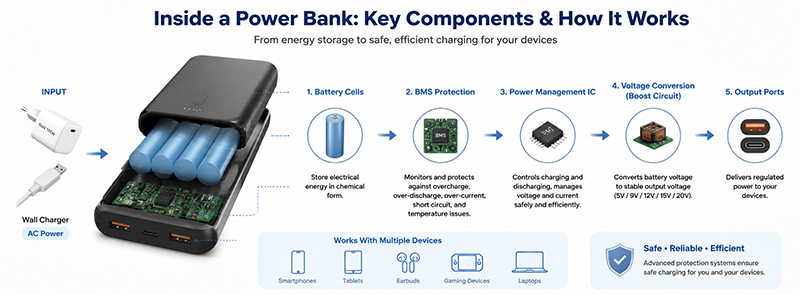
Although a power bank looks like a simple portable battery, it contains several important electronic components.
1. Battery Cells
Battery cells are the core energy storage component.
Most modern power banks use:
Lithium-ion Battery Cells
Advantages:
• High energy density
• Long lifespan
• Mature technology
• Cost-effective
Lithium Polymer Battery Cells
Advantages:
• Flexible design options
• Lightweight structure
• Better shape customization
2. Battery Management System (BMS)
The BMS is responsible for monitoring and protecting the battery.
It manages:
• Overcharging protection
• Over-discharging protection
• Over-current protection
• Short-circuit protection
• Temperature monitoring
A high-quality BMS is essential for safety and battery lifespan.
3. Charging IC
The charging IC controls how electricity enters and leaves the battery.
It helps manage:
• Charging efficiency
• Input power
• Output power
• Charging protocols
Advanced charging ICs allow power banks to support fast charging technologies.
4. Voltage Conversion Circuit
Battery cells typically operate at a lower voltage than many electronic devices require.
The power conversion circuit increases or regulates voltage to provide suitable output.
For example:
A power bank may convert stored battery energy into:
• 5V output
• 9V output
• 12V output
• Higher USB-C PD voltage levels
This allows compatibility with different devices.
How Does a Power Bank Charge a Phone?
When a smartphone is connected to a power bank, several communication processes happen automatically.
The power bank and device exchange information to determine:
• Supported charging speed
• Required voltage
• Required current
• Charging mode
For standard charging:
The power bank provides basic 5V output.
For fast charging:
The device and power bank negotiate higher power levels through charging protocols.
Examples:
USB-C PD Charging
Supports higher power output for:
• Smartphones, Tablets, Laptops
PPS Charging
Provides more flexible voltage adjustment for compatible devices.
QC Fast Charging
A popular fast charging technology used by many Android devices.
Why Charging Technology Matters
Not all power banks provide the same charging performance.
A high-capacity power bank does not always mean faster charging.
Charging performance depends on:
• Battery capacity
• Output power
• Charging protocol
• Cable quality
• Device compatibility
For example:
A 20,000mAh power bank with only a 10W output may charge devices much slower than a 10,000mAh power bank supporting 65W PD fast charging.
This is why modern portable charging solutions increasingly focus on:
• USB-C ports
• PD charging
• Fast charging capability
• Higher power efficiency
Understanding Power Bank Capacity: What Does mAh Mean?
One of the most important specifications when choosing a power bank is battery capacity, usually measured in mAh (milliamp hours).
Many users assume that a higher mAh number always means better performance. However, capacity is only one factor. Actual charging performance also depends on:
Battery conversion efficiency
• Output power
• Charging protocol
• Device battery size
• Cable quality
What Does mAh Mean on a Power Bank?
mAh stands for milliamp hour, which represents the amount of electrical charge stored in a battery.
For example:
A 5,000mAh power bank stores less energy than a 10,000mAh power bank.
A 20,000mAh power bank can generally provide more charging cycles than a 10,000mAh model.
Common power bank capacities include:
| Capacity | Suitable For |
| 5,000mAh | Emergency smartphone charging, lightweight travel |
| 10,000mAh | Daily smartphone charging |
| 20,000mAh | Multiple phone charges, tablets, longer trips |
| 30,000mAh+ | High-capacity charging, professional use |
However, the usable output energy is always lower than the advertised battery capacity because energy conversion creates some power loss.
mAh vs Wh: What Is the Difference?
Although power banks are commonly labeled with mAh, energy is technically measured in Wh (watt hours).
The relationship is:
Wh = (mAh × Voltage) ÷ 1000
Because battery voltage and output voltage are different, the actual usable capacity depends on the internal conversion efficiency.
For example:
A 10,000mAh power bank does not mean it can deliver exactly 10,000mAh to a smartphone.
During charging, some energy is lost due to:
• Voltage conversion
• Heat generation
• Circuit operation
• Cable resistance
High-quality power banks usually achieve better energy conversion efficiency.
How Many Times Can a Power Bank Charge a Phone?
The number of times a power bank can recharge a phone depends on:
• Power bank capacity
• Smartphone battery capacity
• Charging efficiency
• Charging speed
A simple estimate:
Number of charges ≈ Power bank capacity ÷ Phone battery capacity × efficiency factor
For example:
A 10,000mAh power bank may provide approximately:
• Around 1.5-2 full charges for many smartphones
A 20,000mAh power bank may provide:
• Around 3-4 smartphone charges depending on efficiency and device battery size
Actual results vary because modern fast charging systems adjust power output dynamically.
Different Types of Power Banks
Power banks have evolved significantly. Modern models are no longer limited to basic battery storage.
Different types are designed for different user needs.
1. Standard Power Bank
A standard power bank is the most common type.
Typical features:
• USB-A output
• Basic 5V charging
• 5,000mAh-20,000mAh capacity
Advantages:
• Affordable
• Easy to use
• Compatible with many devices
Suitable for:
• Emergency charging
• Daily smartphone use
• Basic travel needs
However, standard models usually provide slower charging compared with modern USB-C fast charging solutions.
2. Fast Charging Power Bank
A fast charging power bank supports higher output power and advanced charging protocols.
Common technologies include:
• USB Power Delivery (PD)
• Quick Charge (QC)
• PPS
Features:
• Faster charging speed
• Higher output power
• Better device compatibility
Examples:
• 18W fast charging power bank
• 30W PD power bank
• 65W USB-C power bank
Fast charging power banks are increasingly popular because users want shorter charging times.
3. USB-C PD Power Bank
USB-C PD power banks represent one of the biggest developments in portable charging technology.
PD stands for Power Delivery, a charging standard developed through the USB-C ecosystem.
Compared with traditional USB charging, PD supports:
• Higher power output
• Intelligent power negotiation
• Faster charging speeds
A USB-C PD power bank can support:
• Smartphones, Tablets, Portable gaming devices, Some laptops
Higher-power models may support:
• 45W output
• 65W output
• 100W output
For example:
A 65W PD power bank can potentially charge compatible laptops while traveling.
4. Wireless Power Bank
Wireless power banks allow devices to charge without a physical cable.
They usually use:
• Qi wireless charging technology
• Magnetic alignment systems
Advantages:
• Convenient charging
• Reduced cable dependence
• Easy smartphone charging
Limitations:
• Lower efficiency compared with wired charging
• Slower charging speed
• Heat management challenges
Wireless power banks are mainly designed for convenience rather than maximum charging performance.
5. Solar Power Bank
Solar power banks include built-in solar panels that can generate electricity from sunlight.
They are designed for:
• Outdoor activities
• Camping
• Emergency situations
However, solar charging is usually slow because the built-in solar panels are relatively small.
For everyday charging, traditional USB-C charging remains much faster and more practical.
What Charger Should You Use With a Power Bank?
Choosing the right charger for a power bank is important because the input charging speed determines how quickly the battery can be refilled.
For basic power banks:
A standard USB charger may be sufficient.
For modern fast charging power banks:
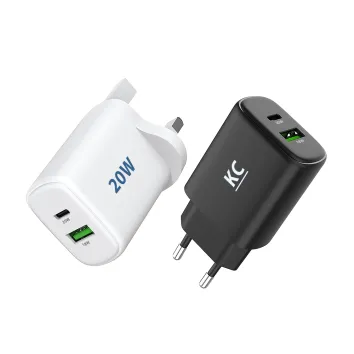
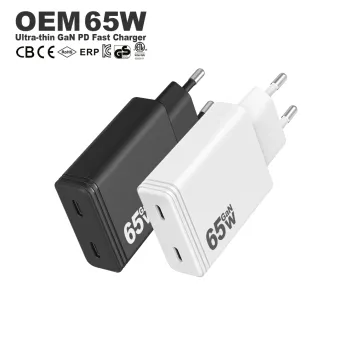
A USB-C PD charger is usually recommended.
Examples:
mAh vs Wh: What Is the Difference?
Although power banks are commonly labeled with mAh, energy is technically measured in Wh (watt hours).
The relationship is:
Wh = (mAh × Voltage) ÷ 1000
Because battery voltage and output voltage are different, the actual usable capacity depends on the internal conversion efficiency.
For example:
A 10,000mAh power bank does not mean it can deliver exactly 10,000mAh to a smartphone.
During charging, some energy is lost due to:
• Voltage conversion
• Heat generation
• Circuit operation
• Cable resistance
High-quality power banks usually achieve better energy conversion efficiency.
How Many Times Can a Power Bank Charge a Phone?
The number of times a power bank can recharge a phone depends on:
• Power bank capacity
• Smartphone battery capacity
• Charging efficiency
• Charging speed
A simple estimate:
Number of charges ≈ Power bank capacity ÷ Phone battery capacity × efficiency factor
For example:
A 10,000mAh power bank may provide approximately:
• Around 1.5-2 full charges for many smartphones
A 20,000mAh power bank may provide:
• Around 3-4 smartphone charges depending on efficiency and device battery size
Actual results vary because modern fast charging systems adjust power output dynamically.
Different Types of Power Banks
Power banks have evolved significantly. Modern models are no longer limited to basic battery storage.
Different types are designed for different user needs.
1. Standard Power Bank
A standard power bank is the most common type.
Typical features:
• USB-A output
• Basic 5V charging
• 5,000mAh-20,000mAh capacity
Advantages:
• Affordable
• Easy to use
• Compatible with many devices
Suitable for:
• Emergency charging
• Daily smartphone use
• Basic travel needs
However, standard models usually provide slower charging compared with modern USB-C fast charging solutions.
2. Fast Charging Power Bank
A fast charging power bank supports higher output power and advanced charging protocols.
Common technologies include:
• USB Power Delivery (PD)
• Quick Charge (QC)
• PPS
Features:
• Faster charging speed
• Higher output power
• Better device compatibility
Examples:
• 18W fast charging power bank
• 30W PD power bank
• 65W USB-C power bank
Fast charging power banks are increasingly popular because users want shorter charging times.
3. USB-C PD Power Bank
USB-C PD power banks represent one of the biggest developments in portable charging technology.
PD stands for Power Delivery, a charging standard developed through the USB-C ecosystem.
Compared with traditional USB charging, PD supports:
• Higher power output
• Intelligent power negotiation
• Faster charging speeds
A USB-C PD power bank can support:
• Smartphones, Tablets, Portable gaming devices, Some laptops
Higher-power models may support:
• 45W output
• 65W output
• 100W output
For example:
A 65W PD power bank can potentially charge compatible laptops while traveling.
4. Wireless Power Bank
Wireless power banks allow devices to charge without a physical cable.
They usually use:
• Qi wireless charging technology
• Magnetic alignment systems
Advantages:
• Convenient charging
• Reduced cable dependence
• Easy smartphone charging
Limitations:
• Lower efficiency compared with wired charging
• Slower charging speed
• Heat management challenges
Wireless power banks are mainly designed for convenience rather than maximum charging performance.
5. Solar Power Bank
Solar power banks include built-in solar panels that can generate electricity from sunlight.
They are designed for:
• Outdoor activities
• Camping
• Emergency situations
However, solar charging is usually slow because the built-in solar panels are relatively small.
For everyday charging, traditional USB-C charging remains much faster and more practical.
What Charger Should You Use With a Power Bank?
Choosing the right charger for a power bank is important because the input charging speed determines how quickly the battery can be refilled.
For basic power banks:
A standard USB charger may be sufficient.
For modern fast charging power banks:
A USB-C PD charger is usually recommended.
Examples:
| Power Bank Input | Recommended Charger |
| 5W-10W Input | Standard USB charger |
| 18W-30W Input | USB-C PD charger |
| 45W-65W Input | Fast PD charger |
| 100W Input | High-power USB-C PD charger |
A higher-quality charger can improve:
• Charging efficiency
• Charging speed
• Safety performance
This is why charger technology plays an important role in the complete portable power ecosystem.
Charging Technology Behind Modern Portable Power Devices
Although a power bank stores energy, the charging system around it determines overall user experience.
Modern charging solutions increasingly rely on:
USB-C Technology
USB-C has become the preferred connector because it supports:
• Higher power transfer
• Reversible connection
• Universal compatibility
Power Delivery (PD)
USB PD enables intelligent communication between chargers and devices.
It allows systems to select the appropriate:
• Voltage
• Current
• Power level
This improves charging efficiency and safety.
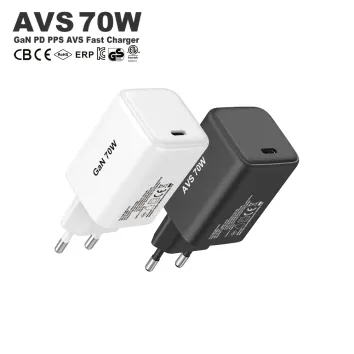
GaN Charging Technology
GaN (Gallium Nitride) technology has changed the design of modern chargers.
Compared with traditional silicon chargers, GaN chargers provide:
• Higher efficiency
• Smaller size
• Better thermal performance
• Higher power density
For users charging power banks, smartphones, tablets, and laptops, a compact GaN charger can provide a more efficient charging experience.
Professional Charger Factory for Fast Charging Solutions
Although power banks are portable energy storage products, the charging performance behind them depends heavily on charger technology.
Zonsan is a professional charger factory and USB charger manufacturer specializing in:
• USB wall chargers
• GaN chargers
• PD fast chargers
• USB-C charging solutions
• Desktop chargers
• Laptop chargers
With OEM and ODM experience, Zonsan provides customized charging solutions for global brands, distributors, and business customers.
The company focuses on:
• Advanced charging technology
• Product reliability
• Safety certification compliance
• Customized product development
From compact smartphone chargers to high-power charging solutions, professional charger design helps create safer and more efficient charging experiences.
How to Choose the Right Power Bank?
When selecting a power bank, consider the following factors:
1. Choose the Right Capacity
For daily smartphone use:
5,000mAh-10,000mAh
For travel:
10,000mAh-20,000mAh
For multiple devices:
20,000mAh or higher
2. Check Charging Speed
Do not focus only on capacity.
Look for:
• USB-C output
• PD support
• Fast charging compatibility
A smaller high-power power bank may provide a better experience than a larger low-speed model.
3. Consider Device Compatibility
Check whether the power bank supports your devices.
Important factors:
• Output wattage
• Charging protocol
• Cable compatibility
4. Pay Attention to Safety Features
A reliable power bank should include:
• Overcharge protection
• Overcurrent protection
• Short circuit protection
• Temperature protection
Safety is especially important for lithium battery products.
Frequently Asked Questions About Power Banks
Q1: What is a power bank?
A power bank is a portable battery device that stores electrical energy and provides power to electronic devices such as smartphones, tablets, and laptops.
Q2: How does a power bank work?
A power bank stores electricity inside rechargeable battery cells and converts the stored energy into regulated output power through internal charging circuits.
Q3: How long does a power bank last?
Most quality power banks can last around 500-1,000 charging cycles depending on battery quality, usage conditions, and charging habits.
Q4: Is a power bank safe?
Yes, a quality power bank with proper battery protection systems is safe to use. Important safety features include overcharge protection, temperature control, and short-circuit protection.
Q5: What capacity power bank should I buy?
For daily smartphone charging, 10,000mAh is usually sufficient. For travel or multiple devices, 20,000mAh or higher may be more suitable.
Q6: Can a power bank charge a laptop?
Yes. Some high-power USB-C PD power banks can charge compatible laptops. Models supporting 45W, 65W, or higher output are commonly used for portable laptop charging.
Q7: What is a PD power bank?
A PD power bank supports USB Power Delivery technology, allowing faster and more efficient charging through USB-C connections.
Q8: Why does my power bank charge slowly?
Slow charging may be caused by:
• Low charger input power
• Poor-quality cable
• Limited power bank output
• Device compatibility issues
Q9: Is a higher mAh power bank always better?
Not necessarily. Capacity is important, but charging speed, safety, efficiency, and portability are also important factors.
Q10: What charger is best for charging a power bank?
For modern high-capacity power banks, a USB-C PD charger is usually the best choice because it provides faster and more efficient charging.
Conclusion: Understanding Power Banks and Charging Technology
A power bank is more than a simple portable battery. It is a complete charging system that combines battery technology, power management, voltage conversion, and charging protocols.
Understanding:
• How a power bank works
• What mAh means
• How charging speed affects performance
• The role of USB-C and PD technology
helps users choose better portable charging solutions.
At the same time, charger technology plays an important role in improving the overall charging experience. Advanced solutions such as GaN chargers, USB-C PD chargers, and fast chargers continue to make charging smaller, faster, and more efficient.
As a professional charger factory, Zonsan focuses on developing reliable charging products and customized USB charging solutions for global customers.
Read More
Read More
Read More
• Charging efficiency
• Charging speed
• Safety performance
This is why charger technology plays an important role in the complete portable power ecosystem.
Charging Technology Behind Modern Portable Power Devices
Although a power bank stores energy, the charging system around it determines overall user experience.
Modern charging solutions increasingly rely on:
USB-C Technology
USB-C has become the preferred connector because it supports:
• Higher power transfer
• Reversible connection
• Universal compatibility
Power Delivery (PD)
USB PD enables intelligent communication between chargers and devices.
It allows systems to select the appropriate:
• Voltage
• Current
• Power level
This improves charging efficiency and safety.
GaN Charging Technology
GaN (Gallium Nitride) technology has changed the design of modern chargers.
Compared with traditional silicon chargers, GaN chargers provide:
• Higher efficiency
• Smaller size
• Better thermal performance
• Higher power density
For users charging power banks, smartphones, tablets, and laptops, a compact GaN charger can provide a more efficient charging experience.
Professional Charger Factory for Fast Charging Solutions
Although power banks are portable energy storage products, the charging performance behind them depends heavily on charger technology.
Zonsan is a professional charger factory and USB charger manufacturer specializing in:
• USB wall chargers
• GaN chargers
• PD fast chargers
• USB-C charging solutions
• Desktop chargers
• Laptop chargers
With OEM and ODM experience, Zonsan provides customized charging solutions for global brands, distributors, and business customers.
The company focuses on:
• Advanced charging technology
• Product reliability
• Safety certification compliance
• Customized product development
From compact smartphone chargers to high-power charging solutions, professional charger design helps create safer and more efficient charging experiences.
How to Choose the Right Power Bank?
When selecting a power bank, consider the following factors:
1. Choose the Right Capacity
For daily smartphone use:
5,000mAh-10,000mAh
For travel:
10,000mAh-20,000mAh
For multiple devices:
20,000mAh or higher
2. Check Charging Speed
Do not focus only on capacity.
Look for:
• USB-C output
• PD support
• Fast charging compatibility
A smaller high-power power bank may provide a better experience than a larger low-speed model.
3. Consider Device Compatibility
Check whether the power bank supports your devices.
Important factors:
• Output wattage
• Charging protocol
• Cable compatibility
4. Pay Attention to Safety Features
A reliable power bank should include:
• Overcharge protection
• Overcurrent protection
• Short circuit protection
• Temperature protection
Safety is especially important for lithium battery products.
Frequently Asked Questions About Power Banks
Q1: What is a power bank?
A power bank is a portable battery device that stores electrical energy and provides power to electronic devices such as smartphones, tablets, and laptops.
Q2: How does a power bank work?
A power bank stores electricity inside rechargeable battery cells and converts the stored energy into regulated output power through internal charging circuits.
Q3: How long does a power bank last?
Most quality power banks can last around 500-1,000 charging cycles depending on battery quality, usage conditions, and charging habits.
Q4: Is a power bank safe?
Yes, a quality power bank with proper battery protection systems is safe to use. Important safety features include overcharge protection, temperature control, and short-circuit protection.
Q5: What capacity power bank should I buy?
For daily smartphone charging, 10,000mAh is usually sufficient. For travel or multiple devices, 20,000mAh or higher may be more suitable.
Q6: Can a power bank charge a laptop?
Yes. Some high-power USB-C PD power banks can charge compatible laptops. Models supporting 45W, 65W, or higher output are commonly used for portable laptop charging.
Q7: What is a PD power bank?
A PD power bank supports USB Power Delivery technology, allowing faster and more efficient charging through USB-C connections.
Q8: Why does my power bank charge slowly?
Slow charging may be caused by:
• Low charger input power
• Poor-quality cable
• Limited power bank output
• Device compatibility issues
Q9: Is a higher mAh power bank always better?
Not necessarily. Capacity is important, but charging speed, safety, efficiency, and portability are also important factors.
Q10: What charger is best for charging a power bank?
For modern high-capacity power banks, a USB-C PD charger is usually the best choice because it provides faster and more efficient charging.
Conclusion: Understanding Power Banks and Charging Technology
A power bank is more than a simple portable battery. It is a complete charging system that combines battery technology, power management, voltage conversion, and charging protocols.
Understanding:
• How a power bank works
• What mAh means
• How charging speed affects performance
• The role of USB-C and PD technology
helps users choose better portable charging solutions.
At the same time, charger technology plays an important role in improving the overall charging experience. Advanced solutions such as GaN chargers, USB-C PD chargers, and fast chargers continue to make charging smaller, faster, and more efficient.
As a professional charger factory, Zonsan focuses on developing reliable charging products and customized USB charging solutions for global customers.
Read More
Read More
Read More