Why Does My Charger Make a Buzzing Sound?
Personnel: Operations: Ken and Charger Engineer: Luke
1. 🔍 Identifying the Sound: Hum, Whine, vs Buzz
Chargers may emit one of two common sounds:
·Hum / Whine (coil whine): A steady low-frequency vibration from magnetic components—typically harmless .
·Buzz / Crackle: Intermittent, erratic sounds indicating loose windings, failing capacitors, or faulty insulation—could be dangerous.
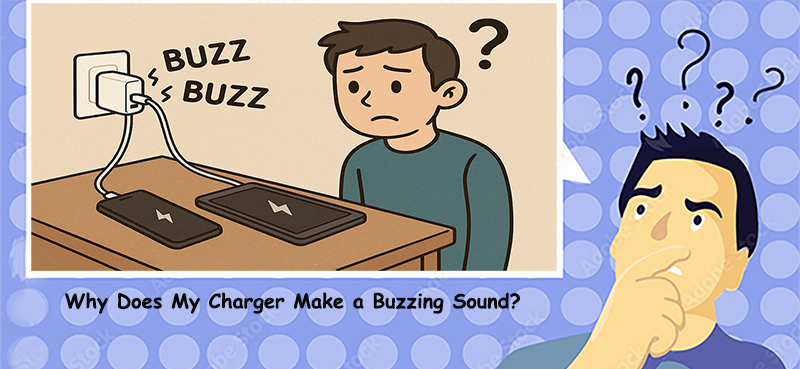
From a Charger Engineer's Perspective: Not All Charger Noise Means the Same Thing
When a customer says, "My charger is buzzing," the first step for an charger engineer is not immediately to determine whether the charger is safe or unsafe.
The first step is to identify what kind of sound is actually occurring. A charger can produce different acoustic characteristics depending on: switching frequency, load level, input voltage, magnetic component design, transformer construction, inductor construction, mechanical fixation, control mode, component aging, electrical abnormality.
For this reason, engineers distinguish between a relatively stable hum or whine and an irregular buzzing, crackling, or popping sound.
This distinction is important because the sound itself is not always enough to determine the root cause.
What Is Coil Whine?
Coil whine is a term commonly used to describe audible noise associated with vibrating magnetic components.
Chargers contain components such as: transformers, inductors, chokes. These components operate with changing magnetic fields.
Under certain operating conditions, mechanical forces can cause very small movements or vibrations within the component structure. If the resulting vibration reaches a frequency that is audible to humans, the user may hear a high-pitched or humming sound.
This is one reason why a charger can produce sound even though it contains no traditional moving mechanical parts such as a motor or fan.
Why Can the Same Charger Sound Different Under Different Conditions?
A charger may be quiet in one situation and produce an audible sound in another.
For example, the sound may change when:
1. no device is connected
2. a smartphone is connected
3. a laptop is connected
4. the device is nearly fully charged
5. the charger is operating at a higher load
6. input voltage changes
This is because the internal power-conversion circuit does not necessarily operate in exactly the same way under every load condition. From an engineering perspective, load condition is therefore an important part of acoustic evaluation.
2. 🎧 Why Chargers Hum or Buzz
From Switching Power Supplies (PD, GaN, USB):
Chargers use high-frequency switching (20 kHz+), and aging or cheap parts can leak into audible ranges.
Main Causes:
·Magnet vibrations in transformers (coil whine)
·Capacitor issues—faulty ones may produce warning buzzes.
·Loose internal components (PCB, coils)
·External interference or aging reducing glue adhesion in transformers
If the wiring between the charger and the outlet is not making good contact, it may also cause your phone to hum or buzz when you plug it in.
How Switching Power Conversion Can Produce Audible Noise
Modern USB chargers are generally based on switching power conversion rather than simple linear power supplies.
A simplified charging process can be understood as: AC input → power conversion → high-frequency switching → transformer / magnetic components → rectification and filtering → regulated DC output
During this process, electrical energy is switched at high frequency. The exact switching architecture depends on the charger design.
Engineers need to simultaneously control multiple variables, such as switching frequency, switching waveforms, magnetic flux, component losses, EMI (electromagnetic interference) performance, thermal performance, and output regulation characteristics.
An audible sound can occur when electrical excitation interacts with mechanical characteristics of magnetic or other components. Therefore, reducing charger noise is not simply a matter of "making the charger quieter." It is an engineering optimization problem.
Can Capacitors Cause Charger Noise?
Capacitors themselves are not the only possible source of audible noise, but abnormal capacitor behavior can be associated with abnormal charger operation. For example, a failing component can affect: output stability / switching behavior / ripple / temperature / protection behavior.
This is why an engineer should not diagnose a charger simply by listening to the sound.
A charger that suddenly changes from a faint, stable hum to an irregular buzzing or crackling sound should be treated differently from a charger that has always produced a very quiet operating sound.
Why Manufacturing Quality Matters (Two 65W chargers: one for $20, the other for $10. What accounts for the difference?)
For individual buyers and B2B charger buyers, this is where product engineering and manufacturing quality become particularly important.
A charger is more than just the embodiment of a circuit schematic; its final acoustic performance can be influenced by factors such as component consistency, transformer manufacturing, winding quality, bonding or mechanical fixation methods, PCB assembly, soldering quality, housing assembly, and production process control.
Two products using a similar circuit architecture can therefore have different acoustic performance if their component quality and manufacturing processes differ. This is one reason professional charger manufacturers need both R&D capability and production quality control.
Why GaN Chargers May Also Produce Audible Noise
GaN chargers are designed to achieve high efficiency and high power density in a compact form factor. However, GaN does not automatically mean silent.
The interior of a gallium nitride (GaN) charger still contains the components described above. (magnetic components, switching circuits, capacitors, control ICs, PCB assemblies, and etc.)
Factory charger engineers, however, need to strike a balance among various parameters, as overall acoustic performance depends on the complete power supply architecture and design. A compact 65W or 100W GaN charger can require particularly careful optimization because more power is being processed within a relatively small enclosure.
3. Is it Dangerous if My Phone Charger Buzzes When Plugged In?
A buzzing sound from your phone charger when it's plugged in can be disconcerting and is not something to ignore. Although it may not always lead to dangerous situations, there is a risk of electric shock, short circuit, or even a fire hazard. It's essential to stop using the charger immediately and either replace it with a new one or have your home wiring and/or outlets inspected by a professional. Safety should always be a priority when dealing with electrical devices.
✅ Is the Noise Safe?
Safe Signs:
·Persistent low hum
·Sound present only during charging (normal under load) .
Danger Signs:
·Sharp buzzing, crackling, or popping
·Charger heating hot to the touch
·Sparks, smoke, or cable damage
If you experience dangerous signs, unplug immediately and replace the charger.
A More Practical Engineering Assessment
For charger engineers, a charger should not be judged as dangerous based solely on the sound it makes. they typically evaluate noise issues by considering other operational characteristics as well.
For example:
Scenario A — Very faint and stable sound
A very faint, consistent sound that occurs under particular operating conditions may be related to normal switching or magnetic component vibration.
This does not automatically indicate a safety failure.
Scenario B — Sudden change in sound
If a previously quiet charger suddenly develops a loud buzzing sound, further inspection is appropriate.
Scenario C — Noise + excessive temperature
Noise accompanied by abnormal heating is a more serious warning sign.
Scenario D — Noise + crackling/sparking/smell
The charger should be disconnected immediately and should not continue to be used.
The important principle is: Acoustic noise should be evaluated together with electrical, thermal and physical symptoms.
What Aspects Do Charger Engineers Focus on When Troubleshooting?
When investigating a noisy charger sample, engineers may compare:
• Input voltage, Load condition, Output voltage, Output current,
• Temperature, Ripple, Switching behavior, Acoustic noise, Component condition.
This helps determine whether the sound is associated with normal operating behavior or an abnormal electrical/mechanical condition.
Internal Factory Testing Unknown to Consumers — Charger Noise Testing at the Factory
For a professional charger manufacturer, acoustic performance can be evaluated during product development and quality verification.
A typical evaluation may include different operating conditions rather than testing the charger only once.
For example:
| Test Condition | Purpose |
| No load | Evaluate standby behavior |
| Low load | Observe low-power operation |
| Medium load | Evaluate normal charging |
| High load | Evaluate high-power operation |
| Different input voltages | Check operating consistency |
| Different charging devices | Observe load-dependent behavior |
Specific test conditions will be defined based on the charger's design and product requirements.
Example: Internal Acoustic Noise Verification
For a charger sample under development, a manufacturer may use an acoustic measurement setup to record the operating noise under controlled conditions.
The test report can record the following information: product model, input voltage, load conditions, measurement distance, environmental conditions, measured acoustic levels, and test equipment.
This type of evidence is more useful than simply stating that a charger is "quiet." It allows engineers and B2B customers to understand under what conditions the result was obtained.
Important: Internal engineering test results apply to the tested sample and specified test conditions. They should not automatically be interpreted as universal performance guarantees for every production unit.
Noise Testing Is Only One Part of Charger Quality Control
In addition to noise testing, charger manufacturers conduct other important engineering tests, including:
Ripple Testing — Ripple testing helps engineers evaluate output stability.
Thermal Testing — Temperature testing helps determine how the charger behaves under sustained load.
Aging Testing — Long-duration operation can help identify potential reliability issues.
Depending on the product, aging evaluation may involve sustained operation under controlled load and environmental conditions.
4. 🛠 How to Handle a Buzzing Charger
Key Points
1.Test alternate outlets and sockets — it could be faulty wiring.
2.Try another charger — if it still hums, the outlet might be at fault.
3.Watch heat levels — mild warmth is ok, but excessive heat is red-flag.
4.Upgrade to quality — choose OEM or certified GaN chargers with proper components.
5.Replace faulty units — especially buzzing chargers with suspected capacitor issues.
A Simple Troubleshooting Process. If you are troubleshooting a noisy charger, try to isolate the source systematically.
Step 1 — Change the outlet
This helps determine whether the noise may be related to the electrical supply or outlet.
Step 2 — Change the cable
A damaged or poorly connected cable can create abnormal charging behavior.
Step 3 — Change the device
Try the charger with another compatible device.
Step 4 — Compare load conditions
Check whether the noise appears only under: low load, high load, fast charging, standby.
Step 5 — Check temperature
A slight temperature rise can be normal during power conversion, but abnormal heating deserves attention.
What B2B Buyers Should Ask a Charger Manufacturer
If you are purchasing chargers for a brand, retailer or OEM project (GaN chargers, 65W chargers, 100W chargers, desktop chargers, multi-port chargers, high-density compact chargers), noise performance can be included in the product specification and validation process.
Ask the supplier:
Has the charger been evaluated for audible noise?
Under what load conditions?
At what input voltage?
What measurement equipment is used?
Is there an internal test report?
Are ripple and thermal tests also performed?
How are magnetic components controlled during production?
How is consistency between production batches controlled?
For B2B products, consistency is often just as important as the performance of a single sample.
5. ℹ️ FAQs You’ve Been Asking
Question and Answer
Q1: Is coil whine normal?
A1: Yes—steady hum from magnetic parts is generally safe.
Q2: Will buzzing damage my device?
A2: Possibly—replace noisy chargers to avoid risk.
Q3: My GaN charger buzzes—should I worry?
A3: Slight hum is common in GaN but sharp buzz warrants replacement.
Q4: Can a buzzing charger start a fire?
A4: Yes—loose parts or failed capacitors can overheat or spark.
Q5: Why does my charger buzz only when my phone is connected?
A5: The charger's operating condition changes when a load is connected.
Different charging loads can change the behavior of the power conversion circuit and magnetic components.
A faint sound that appears only under a particular load does not automatically indicate a failure. However, abnormal noise combined with overheating, smell, crackling or unstable charging should not be ignored.
Q6: Why does my charger buzz when the phone is almost fully charged?
A6: The charger and phone may change their power demand as the battery approaches a higher state of charge.
This can change the charger's operating mode. As a result, the acoustic behavior may also change.
Q7: Are 65W and 100W GaN chargers more likely to buzz?
A7: Not necessarily. Higher-power compact chargers have more demanding power-conversion designs, but acoustic performance depends on the complete circuit, magnetic components, mechanical construction and manufacturing quality.
Q8: Can charger noise be tested during manufacturing?
A8: Yes. A manufacturer can establish acoustic verification procedures during product development and quality control.
Q9: Does a quiet charger always mean it is a high-quality charger?
A9: No. Low acoustic noise is only one aspect of charger performance.
6. 📌 Final Takeaway
A quiet hum from your PD or GaN charger? Usually nothing to worry about—there's vibration from transformers or coils. But sharp buzzing, heat, or sparking? That’s a serious red flag: Cut off power immediately, unplug the power cord and replace it.
Choosing high-quality chargers with strong internal design helps you avoid these issues and ensures device safety long-term.
From the perspective of charger manufacturers
Charger noise is ultimately an engineering issue involving electrical design, magnetic components, mechanical construction and manufacturing quality.
An excellent charger design strikes a balance among the following factors: Power + Efficiency + Thermal Performance + EMI + Reliability + Acoustic Performance
For B2B customers, the goal should not simply be to find a charger that is "silent." The more useful question is: How does the charger perform under defined and repeatable operating conditions?
Professional charger manufacturers need to be able to articulate the engineering details behind their products and, where appropriate, provide supporting test data. For OEM and private-label charger projects, this becomes even more important because product quality needs to remain consistent from prototype to mass production.
What Makes a Good Charger Manufacturer?
For brands and distributors looking for an OEM or ODM charger supplier, technical capability matters.
Look for a manufacturer with experience in: USB-C PD, GaN power architecture, power electronics, thermal design, magnetic components, charger testing, reliability verification, certification, production quality control etc.
The ability to manufacture a charger is different from the ability to engineer, test and consistently manufacture one. That distinction can have a direct impact on product reliability and customer experience.
Suggested Reading
• Is Your Phone Charger Making a High-Pitched Noise?
• Can You Charge Your Phone With a Laptop Charger?
• What Is a GaN Charger?
• 3A vs. 5A vs. 6A Charging Cables
• How Does USB-C Power Delivery Work?
Reviewed by: Zonsan R&D team, Luke and Miller
Technical Review: Charger Problem & Power Solutions
Last reviewed: [August 27, 2026]
Example: Internal Acoustic Noise Verification
For a charger sample under development, a manufacturer may use an acoustic measurement setup to record the operating noise under controlled conditions.
The test report can record the following information: product model, input voltage, load conditions, measurement distance, environmental conditions, measured acoustic levels, and test equipment.
This type of evidence is more useful than simply stating that a charger is "quiet." It allows engineers and B2B customers to understand under what conditions the result was obtained.
Important: Internal engineering test results apply to the tested sample and specified test conditions. They should not automatically be interpreted as universal performance guarantees for every production unit.
Noise Testing Is Only One Part of Charger Quality Control
In addition to noise testing, charger manufacturers conduct other important engineering tests, including:
Ripple Testing — Ripple testing helps engineers evaluate output stability.
Thermal Testing — Temperature testing helps determine how the charger behaves under sustained load.
Aging Testing — Long-duration operation can help identify potential reliability issues.
Depending on the product, aging evaluation may involve sustained operation under controlled load and environmental conditions.
4. 🛠 How to Handle a Buzzing Charger
Key Points
1.Test alternate outlets and sockets — it could be faulty wiring.
2.Try another charger — if it still hums, the outlet might be at fault.
3.Watch heat levels — mild warmth is ok, but excessive heat is red-flag.
4.Upgrade to quality — choose OEM or certified GaN chargers with proper components.
5.Replace faulty units — especially buzzing chargers with suspected capacitor issues.
A Simple Troubleshooting Process. If you are troubleshooting a noisy charger, try to isolate the source systematically.
Step 1 — Change the outlet
This helps determine whether the noise may be related to the electrical supply or outlet.
Step 2 — Change the cable
A damaged or poorly connected cable can create abnormal charging behavior.
Step 3 — Change the device
Try the charger with another compatible device.
Step 4 — Compare load conditions
Check whether the noise appears only under: low load, high load, fast charging, standby.
Step 5 — Check temperature
A slight temperature rise can be normal during power conversion, but abnormal heating deserves attention.
What B2B Buyers Should Ask a Charger Manufacturer
If you are purchasing chargers for a brand, retailer or OEM project (GaN chargers, 65W chargers, 100W chargers, desktop chargers, multi-port chargers, high-density compact chargers), noise performance can be included in the product specification and validation process.
Ask the supplier:
Has the charger been evaluated for audible noise?
Under what load conditions?
At what input voltage?
What measurement equipment is used?
Is there an internal test report?
Are ripple and thermal tests also performed?
How are magnetic components controlled during production?
How is consistency between production batches controlled?
For B2B products, consistency is often just as important as the performance of a single sample.
5. ℹ️ FAQs You’ve Been Asking
Question and Answer
Q1: Is coil whine normal?
A1: Yes—steady hum from magnetic parts is generally safe.
Q2: Will buzzing damage my device?
A2: Possibly—replace noisy chargers to avoid risk.
Q3: My GaN charger buzzes—should I worry?
A3: Slight hum is common in GaN but sharp buzz warrants replacement.
Q4: Can a buzzing charger start a fire?
A4: Yes—loose parts or failed capacitors can overheat or spark.
Q5: Why does my charger buzz only when my phone is connected?
A5: The charger's operating condition changes when a load is connected.
Different charging loads can change the behavior of the power conversion circuit and magnetic components.
A faint sound that appears only under a particular load does not automatically indicate a failure. However, abnormal noise combined with overheating, smell, crackling or unstable charging should not be ignored.
Q6: Why does my charger buzz when the phone is almost fully charged?
A6: The charger and phone may change their power demand as the battery approaches a higher state of charge.
This can change the charger's operating mode. As a result, the acoustic behavior may also change.
Q7: Are 65W and 100W GaN chargers more likely to buzz?
A7: Not necessarily. Higher-power compact chargers have more demanding power-conversion designs, but acoustic performance depends on the complete circuit, magnetic components, mechanical construction and manufacturing quality.
Q8: Can charger noise be tested during manufacturing?
A8: Yes. A manufacturer can establish acoustic verification procedures during product development and quality control.
Q9: Does a quiet charger always mean it is a high-quality charger?
A9: No. Low acoustic noise is only one aspect of charger performance.
6. 📌 Final Takeaway
A quiet hum from your PD or GaN charger? Usually nothing to worry about—there's vibration from transformers or coils. But sharp buzzing, heat, or sparking? That’s a serious red flag: Cut off power immediately, unplug the power cord and replace it.
Choosing high-quality chargers with strong internal design helps you avoid these issues and ensures device safety long-term.
From the perspective of charger manufacturers
Charger noise is ultimately an engineering issue involving electrical design, magnetic components, mechanical construction and manufacturing quality.
An excellent charger design strikes a balance among the following factors: Power + Efficiency + Thermal Performance + EMI + Reliability + Acoustic Performance
For B2B customers, the goal should not simply be to find a charger that is "silent." The more useful question is: How does the charger perform under defined and repeatable operating conditions?
Professional charger manufacturers need to be able to articulate the engineering details behind their products and, where appropriate, provide supporting test data. For OEM and private-label charger projects, this becomes even more important because product quality needs to remain consistent from prototype to mass production.
What Makes a Good Charger Manufacturer?
For brands and distributors looking for an OEM or ODM charger supplier, technical capability matters.
Look for a manufacturer with experience in: USB-C PD, GaN power architecture, power electronics, thermal design, magnetic components, charger testing, reliability verification, certification, production quality control etc.
The ability to manufacture a charger is different from the ability to engineer, test and consistently manufacture one. That distinction can have a direct impact on product reliability and customer experience.
Suggested Reading
• Is Your Phone Charger Making a High-Pitched Noise?
• Can You Charge Your Phone With a Laptop Charger?
• What Is a GaN Charger?
• 3A vs. 5A vs. 6A Charging Cables
• How Does USB-C Power Delivery Work?
Reviewed by: Zonsan R&D team, Luke and Miller
Technical Review: Charger Problem & Power Solutions
Last reviewed: [August 27, 2026]