How to Choose a Reliable GaN Charger Manufacturer in 2026 (OEM & B2B Guide)
The global charging industry is changing rapidly.
In 2026, buyers are no longer simply sourcing:
“USB chargers”
or:
“phone adapters”
Instead, modern charging products now involve:
• GaN semiconductors
• PD3.1 protocols
• PPS fast charging
• thermal engineering
• intelligent power management
• multi-device compatibility
• global certification compliance
As a result:
choosing the right:
GaN charger manufacturer
has become far more important than simply comparing prices.
A weak supplier may create problems like:
• overheating
• unstable charging
• certification delays
• inconsistent quality
• high failure rates
• poor protocol compatibility
Meanwhile, a professional charger factory can become a long-term strategic partner for your brand.
This guide explains:
how professional buyers evaluate reliable OEM charger manufacturers in 2026.
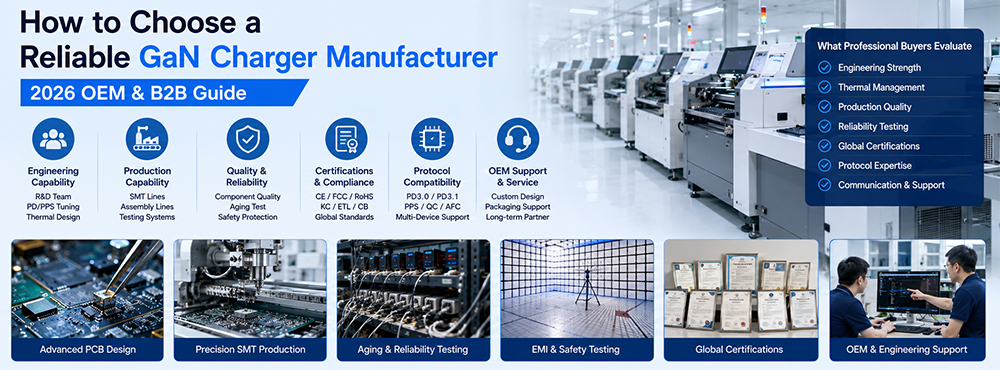
Why the Charger Industry Is Becoming More Engineering-Driven
Several years ago, many chargers looked similar externally.
Today, however, modern fast charging products involve highly complex engineering systems.
Especially for:
• 65W GaN chargers
• 100W PD chargers
• 140W PD3.1 chargers
• desktop charging stations
• multi-port PPS chargers
the internal architecture matters enormously.
This includes:
• PCB layout
• transformer design
• thermal management
• protocol tuning
• EMI control
• power allocation algorithms
This is why buyers increasingly prioritize: engineering capability
instead of simply focusing on low manufacturing cost.
Step 1: Evaluate the Factory's Engineering Capability
One of the biggest differences between factories is:
whether they truly understand charging engineering.
Some factories mainly assemble existing reference designs.
Professional charger manufacturers usually have:
• independent R&D teams
• PCB engineering capability
• thermal simulation experience
• PD/PPS protocol tuning expertise
• reliability testing systems
This becomes especially important for:
• high-power GaN chargers
• multi-port charging systems
• custom OEM projects
Signs of a Strong Engineering Factory
A reliable charger manufacturer can usually explain:
• thermal architecture
• power efficiency optimization
• component selection
• EMI reduction methods
• charging protocol compatibility
• heat dissipation strategy
instead of only discussing:
• price
• MOQ
• delivery time
Step 2: Check Real Production Capability
Some companies market themselves as “manufacturers” while outsourcing production elsewhere.
A real charger factory should have visible production capability, including:
• SMT production lines
• assembly lines
• aging test systems
• automatic testing equipment
• QC processes
• engineering labs
Professional buyers should request:
• factory videos
• production photos
• testing procedures
• assembly workflow information
before placing large orders.
Why SMT Capability Matters
SMT (Surface Mount Technology) directly affects:
• PCB quality
• soldering precision
• electrical reliability
• charging stability
Poor SMT quality often leads to:
• overheating
• unstable charging
• premature product failure
Especially in compact GaN chargers, PCB density is extremely high.
This means manufacturing precision becomes critical.
Step 3: Understand Thermal Engineering Ability
One of the biggest challenges in modern charging products is:
heat management.
As chargers become:
• smaller
• more powerful
• multi-port capable
thermal density increases significantly.
A reliable GaN charger factory should understand:
• airflow design
• thermal pads
• potting
• heat dissipation materials
• PCB copper balancing
• temperature protection systems
This is especially important for:
• 100W+
• 140W
• PD3.1 / PD3.2(AVS)
• desktop chargers
Why Cheap Chargers Often Fail Long Term
Many low-cost chargers focus only on:
• appearance
• advertised wattage
• low BOM cost
But long-term reliability depends heavily on:
• internal engineering
• thermal optimization
• component quality
• safety margins
This is why some chargers become extremely hot after several months of use.
Step 4: Verify Certification Experience
Professional charger manufacturers should understand global certification requirements.
This includes:
• CE / FCC / RoHS / KC / ETL / CB / ERP / UKCA
Different markets require different compliance standards.
For example:
Several years ago, many chargers looked similar externally.
Today, however, modern fast charging products involve highly complex engineering systems.
Especially for:
• 65W GaN chargers
• 100W PD chargers
• 140W PD3.1 chargers
• desktop charging stations
• multi-port PPS chargers
the internal architecture matters enormously.
This includes:
• PCB layout
• transformer design
• thermal management
• protocol tuning
• EMI control
• power allocation algorithms
This is why buyers increasingly prioritize: engineering capability
instead of simply focusing on low manufacturing cost.
Step 1: Evaluate the Factory's Engineering Capability
One of the biggest differences between factories is:
whether they truly understand charging engineering.
Some factories mainly assemble existing reference designs.
Professional charger manufacturers usually have:
• independent R&D teams
• PCB engineering capability
• thermal simulation experience
• PD/PPS protocol tuning expertise
• reliability testing systems
This becomes especially important for:
• high-power GaN chargers
• multi-port charging systems
• custom OEM projects
Signs of a Strong Engineering Factory
A reliable charger manufacturer can usually explain:
• thermal architecture
• power efficiency optimization
• component selection
• EMI reduction methods
• charging protocol compatibility
• heat dissipation strategy
instead of only discussing:
• price
• MOQ
• delivery time
Step 2: Check Real Production Capability
Some companies market themselves as “manufacturers” while outsourcing production elsewhere.
A real charger factory should have visible production capability, including:
• SMT production lines
• assembly lines
• aging test systems
• automatic testing equipment
• QC processes
• engineering labs
Professional buyers should request:
• factory videos
• production photos
• testing procedures
• assembly workflow information
before placing large orders.
Why SMT Capability Matters
SMT (Surface Mount Technology) directly affects:
• PCB quality
• soldering precision
• electrical reliability
• charging stability
Poor SMT quality often leads to:
• overheating
• unstable charging
• premature product failure
Especially in compact GaN chargers, PCB density is extremely high.
This means manufacturing precision becomes critical.
Step 3: Understand Thermal Engineering Ability
One of the biggest challenges in modern charging products is:
heat management.
As chargers become:
• smaller
• more powerful
• multi-port capable
thermal density increases significantly.
A reliable GaN charger factory should understand:
• airflow design
• thermal pads
• potting
• heat dissipation materials
• PCB copper balancing
• temperature protection systems
This is especially important for:
• 100W+
• 140W
• PD3.1 / PD3.2(AVS)
• desktop chargers
Why Cheap Chargers Often Fail Long Term
Many low-cost chargers focus only on:
• appearance
• advertised wattage
• low BOM cost
But long-term reliability depends heavily on:
• internal engineering
• thermal optimization
• component quality
• safety margins
This is why some chargers become extremely hot after several months of use.
Step 4: Verify Certification Experience
Professional charger manufacturers should understand global certification requirements.
This includes:
• CE / FCC / RoHS / KC / ETL / CB / ERP / UKCA
Different markets require different compliance standards.
For example:
| Market Common | Certification |
| Europe | CE(EMC, LVD), ERP, RoHS |
| South Korea | KC, KCC |
| United States | FCC, ETL, UL |
| Middle East | CB, CE |
| UK | UKCA |
Factories without certification experience may cause:
• customs delays
• failed testing
• redesign costs
• shipment problems
Step 5: Evaluate Protocol Compatibility
Modern charging products must support multiple protocols simultaneously.
A good USB-C charger supplier should understand:
• PD3.0
• PD3.1
• PD3.2
• PPS
• QC
• Samsung Super Fast Charging
• Apple fast charging
• USB-C EPR
Poor protocol optimization may result in:
• unstable charging
• incompatibility
• reduced charging speed
• customer complaints
Step 6: Ask About Reliability Testing
Reliable charger manufacturers invest heavily in testing systems.
Professional factories usually perform:
• aging tests
• burn-in tests
• overcurrent testing
• short-circuit testing
• temperature testing
• drop testing
• EMI testing
before mass shipment.
This dramatically reduces failure rates.
Step 7: Evaluate Communication & OEM Support
A professional OEM charger factory should also provide:
• engineering communication
• custom packaging support
• industrial design coordination
• certification assistance
• technical troubleshooting
• production updates
The best factories behave more like: long-term engineering partners
than simple suppliers.
Why More Brands Are Choosing Specialized GaN Factories
The charging market has become highly specialized.
Brands increasingly seek factories that focus specifically on:
• GaN charging
• USB-C PD systems
• high-power adapters
• compact thermal architecture
instead of general electronics assembly.
This is because modern fast charging products require deep technical expertise.
ZONSAN's Perspective on OEM GaN Charger Manufacturing
As a professional OEM GaN charger manufacturer and USB-C PD charger supplier, Zonsan Power has seen buyer priorities shift dramatically in recent years.
Today, B2B customers increasingly focus on:
• engineering stability
• protocol compatibility
• thermal reliability
• certification readiness
• long-term product consistency
especially for:
• 65W GaN chargers
• 100W laptop chargers
• PD3.1 PD3.2 charging systems
• desktop charging stations
Modern OEM projects increasingly require close coordination between:
• R&D teams
• thermal engineers
• certification teams
• production departments
• protocol tuning specialists
rather than traditional low-cost assembly manufacturing.
Questions Professional Buyers Should Ask a Charger Factory
Before choosing a supplier, buyers should ask:
• Do you have independent R&D?
• How do you manage thermal performance?
• What testing systems do you use?
• Which certifications can you support?
• Can you provide PD/PPS tuning customization?
• What is your aging test process?
• How do you manage production consistency?
• Can you support private label/OEM projects?
The answers often reveal the real engineering capability of the factory.
The Future of OEM Charging Manufacturing
The future of charging products will increasingly involve:
• AI power allocation
• PD3.1 ecosystems
• USB-C universal charging
• higher power density
• smarter thermal systems
• compact multi-device charging
As charging complexity increases: factory engineering capability
will become one of the biggest competitive advantages in the industry.
Final Thoughts
Choosing a reliable GaN charger manufacturer in 2026 is no longer simply about finding the lowest quote.
The real difference between suppliers now lies in:
• engineering capability
• thermal design
• reliability systems
• certification experience
• production consistency
• protocol expertise
As USB-C charging ecosystems continue evolving, professional OEM charger factories will play a much larger role in helping brands develop reliable, high-performance charging products for global markets.
Related knowledge expansion
• “Why GaN Chargers Run Cooler Than Traditional Silicon Chargers”↗
• “Best 65W GaN Chargers for MacBook & Samsung in 2026”↗
• “USB Power Delivery Official Standards”↗
• “IEC International Safety Standards”↗
FAQ (People Also Ask)
Q1: What should I look for in a GaN charger manufacturer?
You should evaluate engineering capability, thermal design experience, certifications, testing systems, and production consistency.
Q2: Why is thermal engineering important for chargers?
High-power compact chargers generate significant heat, so thermal management directly affects reliability and safety.
Q3: What certifications should a charger factory support?
Common certifications include CE, FCC, RoHS, KC, ETL, CB, ERP, and UKCA depending on the target market.
Q4: What is the difference between an OEM and ODM charger factory?
OEM factories manufacture based on customer specifications, while ODM factories provide existing designs that brands can customize.
Q5: Why do some chargers fail after several months?
Poor component quality, weak thermal design, and inadequate testing often cause premature failure.
Q6: What testing should professional charger factories perform?
Factories should conduct aging tests, thermal tests, EMI testing, overcurrent protection testing, and reliability testing.
Q7: Why is protocol compatibility important?
Proper PD/PPS optimization ensures stable charging across Apple, Samsung, laptops, tablets, and other USB-C devices.
Q8: Are all GaN charger factories the same?
No. Engineering capability, production quality, and thermal expertise vary significantly between factories.
• customs delays
• failed testing
• redesign costs
• shipment problems
Step 5: Evaluate Protocol Compatibility
Modern charging products must support multiple protocols simultaneously.
A good USB-C charger supplier should understand:
• PD3.0
• PD3.1
• PD3.2
• PPS
• QC
• Samsung Super Fast Charging
• Apple fast charging
• USB-C EPR
Poor protocol optimization may result in:
• unstable charging
• incompatibility
• reduced charging speed
• customer complaints
Step 6: Ask About Reliability Testing
Reliable charger manufacturers invest heavily in testing systems.
Professional factories usually perform:
• aging tests
• burn-in tests
• overcurrent testing
• short-circuit testing
• temperature testing
• drop testing
• EMI testing
before mass shipment.
This dramatically reduces failure rates.
Step 7: Evaluate Communication & OEM Support
A professional OEM charger factory should also provide:
• engineering communication
• custom packaging support
• industrial design coordination
• certification assistance
• technical troubleshooting
• production updates
The best factories behave more like: long-term engineering partners
than simple suppliers.
Why More Brands Are Choosing Specialized GaN Factories
The charging market has become highly specialized.
Brands increasingly seek factories that focus specifically on:
• GaN charging
• USB-C PD systems
• high-power adapters
• compact thermal architecture
instead of general electronics assembly.
This is because modern fast charging products require deep technical expertise.
ZONSAN's Perspective on OEM GaN Charger Manufacturing
As a professional OEM GaN charger manufacturer and USB-C PD charger supplier, Zonsan Power has seen buyer priorities shift dramatically in recent years.
Today, B2B customers increasingly focus on:
• engineering stability
• protocol compatibility
• thermal reliability
• certification readiness
• long-term product consistency
especially for:
• 65W GaN chargers
• 100W laptop chargers
• PD3.1 PD3.2 charging systems
• desktop charging stations
Modern OEM projects increasingly require close coordination between:
• R&D teams
• thermal engineers
• certification teams
• production departments
• protocol tuning specialists
rather than traditional low-cost assembly manufacturing.
Questions Professional Buyers Should Ask a Charger Factory
Before choosing a supplier, buyers should ask:
• Do you have independent R&D?
• How do you manage thermal performance?
• What testing systems do you use?
• Which certifications can you support?
• Can you provide PD/PPS tuning customization?
• What is your aging test process?
• How do you manage production consistency?
• Can you support private label/OEM projects?
The answers often reveal the real engineering capability of the factory.
The Future of OEM Charging Manufacturing
The future of charging products will increasingly involve:
• AI power allocation
• PD3.1 ecosystems
• USB-C universal charging
• higher power density
• smarter thermal systems
• compact multi-device charging
As charging complexity increases: factory engineering capability
will become one of the biggest competitive advantages in the industry.
Final Thoughts
Choosing a reliable GaN charger manufacturer in 2026 is no longer simply about finding the lowest quote.
The real difference between suppliers now lies in:
• engineering capability
• thermal design
• reliability systems
• certification experience
• production consistency
• protocol expertise
As USB-C charging ecosystems continue evolving, professional OEM charger factories will play a much larger role in helping brands develop reliable, high-performance charging products for global markets.
Related knowledge expansion
• “Why GaN Chargers Run Cooler Than Traditional Silicon Chargers”↗
• “Best 65W GaN Chargers for MacBook & Samsung in 2026”↗
• “USB Power Delivery Official Standards”↗
• “IEC International Safety Standards”↗
FAQ (People Also Ask)
Q1: What should I look for in a GaN charger manufacturer?
You should evaluate engineering capability, thermal design experience, certifications, testing systems, and production consistency.
Q2: Why is thermal engineering important for chargers?
High-power compact chargers generate significant heat, so thermal management directly affects reliability and safety.
Q3: What certifications should a charger factory support?
Common certifications include CE, FCC, RoHS, KC, ETL, CB, ERP, and UKCA depending on the target market.
Q4: What is the difference between an OEM and ODM charger factory?
OEM factories manufacture based on customer specifications, while ODM factories provide existing designs that brands can customize.
Q5: Why do some chargers fail after several months?
Poor component quality, weak thermal design, and inadequate testing often cause premature failure.
Q6: What testing should professional charger factories perform?
Factories should conduct aging tests, thermal tests, EMI testing, overcurrent protection testing, and reliability testing.
Q7: Why is protocol compatibility important?
Proper PD/PPS optimization ensures stable charging across Apple, Samsung, laptops, tablets, and other USB-C devices.
Q8: Are all GaN charger factories the same?
No. Engineering capability, production quality, and thermal expertise vary significantly between factories.