Why GaN Chargers Run Cooler Than Traditional Silicon Chargers (Engineering Explained)
A few years ago, high-power chargers were usually:a
• large, heavy, hot, difficult to carry
A traditional 100W laptop charger often required:
• large transformers
• thick cooling structures
• bulky housings
But today, modern GaN chargers can deliver:
• 65W / 100W / 140W
• even 240W PD3.1 charging
inside remarkably compact designs.
Even more impressive:
many GaN chargers operate noticeably cooler than older silicon chargers.
So what exactly makes this possible?
The answer lies deep inside the engineering architecture of modern fast chargers.
And in 2026, thermal efficiency has become one of the biggest competitive advantages in the USB-C charging industry.
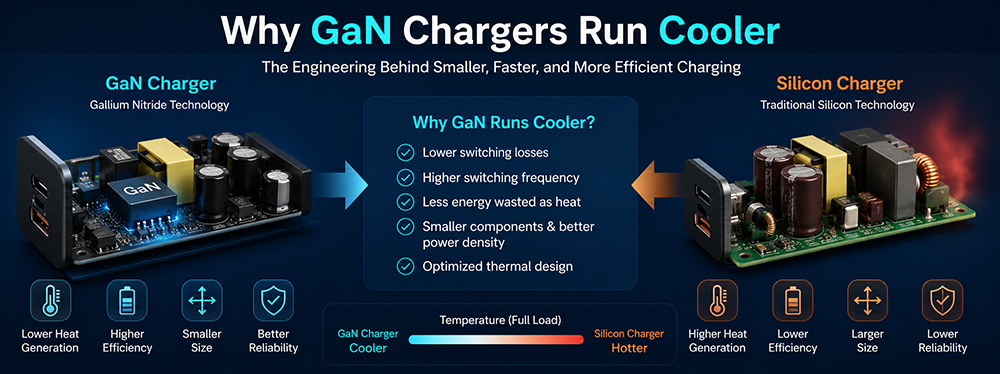
What Is the Main Difference Between GaN and Silicon?
Traditional chargers use: silicon-based semiconductors.
For decades, silicon has been the standard material used in power electronics.
However, as charging power increased, silicon began facing several limitations:
• higher switching losses
• larger heat generation
• lower frequency efficiency
• bigger transformer requirements
This is where: GaN (Gallium Nitride)
started changing the industry.
GaN is a next-generation semiconductor material capable of operating at:
• much higher switching frequencies
• lower energy loss
• higher efficiency
• lower heat generation
compared to traditional silicon components.
Why Heat Matters in Fast Charging
Heat is one of the biggest enemies of electronic devices.
Inside a fast charger, heat affects:
• charging stability
• lifespan
• efficiency
• safety
• component aging
As charging power increases from:
20W to:
• 100W+
• 140W+
• 240W
thermal management becomes dramatically more difficult.
This is especially true for:
• USB-C laptop chargers
• multi-port GaN chargers
• PD3.1 desktop chargers
• PPS fast chargers
The Real Engineering Reason GaN Runs Cooler
The biggest reason GaN chargers run cooler is: lower power loss during switching.
Inside every charger, power conversion happens extremely rapidly.
Semiconductor switches constantly turn:
• ON
• OFF
thousands — or even millions — of times per second.
During these switching cycles: traditional silicon components lose more energy as heat.
GaN components are significantly more efficient during this process.
This means: less wasted energy becomes heat.
Higher Switching Frequency = Smaller Components
One of GaN’s biggest advantages is its ability to operate at: much higher switching frequencies.
This allows engineers to reduce the size of:
• transformers
• inductors
• filtering components
inside the charger.
As a result: modern GaN chargers can become:
• smaller
• lighter
• more compact
without sacrificing charging performance.
Why Smaller Doesn't Always Mean Hotter
Many users assume: smaller chargers must get hotter.
But in advanced GaN designs, the opposite is often true.
Because GaN reduces internal energy loss:
the charger can maintain:
• higher efficiency
• lower thermal buildup
• more stable temperature behavior
even in compact housings.
Of course:
thermal engineering still matters enormously.
A poorly designed GaN charger can still overheat.
This is why engineering quality is critical.
Why Thermal Design Is Becoming More Important in 2026
Modern chargers now combine:
• high wattage
• multiple ports
• intelligent power allocation
• compact travel designs
inside very limited internal space.
This creates major thermal engineering challenges.
Especially for:
• 100W USB-C chargers
• 140W PD3.1 chargers
• desktop charging stations
• multi-device charging hubs
heat management is now a core design priority.
Inside Modern GaN Thermal Architecture
Professional GaN charger manufacturers now optimize thermal performance through:
• PCB layout optimization
• heat dissipation structures
• thermal pads
• potting materials
• airflow simulation
• intelligent temperature protection ICs
The goal is not simply:“making the charger cooler.”
Instead, it is about:maintaining stable efficiency under long-term high-power operation.
Why Cheap GaN Chargers Often Run Hotter
Not all GaN chargers are engineered equally.
Two chargers may both advertise:“100W GaN Fast Charger”
while performing completely differently thermally.
Low-quality chargers often reduce cost through:
• weaker PCB design
• lower-grade components
• poor thermal materials
• inadequate heat dissipation
• unstable PD tuning
As a result:
they may experience:
• overheating
• thermal throttling
• unstable charging
• reduced lifespan
especially during high-load charging.
Why Multi-Port GaN Chargers Generate More Heat
Single-port chargers are relatively straightforward.
But multi-port GaN chargers are far more complex.
A modern desktop charger may simultaneously power:
• laptops / phones / tablets / gaming devices
through multiple USB-C and USB-A ports.
This requires:
• dynamic power allocation
• real-time thermal balancing
• protocol coordination
• internal temperature monitoring
The engineering difficulty increases significantly.
Why PD3.1 Makes Thermal Engineering Harder
PD3.1 introduced: Extended Power Range (EPR)
which supports charging up to: 240W.
Higher voltage and current levels dramatically increase thermal demands.
Professional PD3.1 charger manufacturers must carefully optimize:
• transformer design
• MOSFET efficiency
• PCB copper thickness
• thermal conductivity
• EPR cable compatibility
to maintain safe operation.
How Smart Temperature Protection Works
Modern GaN chargers include multiple protection systems.
These may include:
• over-temperature protection
• over-current protection
• voltage monitoring
• dynamic power reduction
• thermal shutdown systems
Some advanced chargers can intelligently reduce output power temporarily if internal temperatures become excessive.
This helps protect both:
• the charger
• connected devices
ZONSAN's Perspective on GaN Thermal Engineering
As a professional GaN charger manufacturer and OEM PD charger supplier, Zonsan Power has observed that thermal engineering is becoming one of the most critical differentiators in modern USB-C charging products.
Especially for:
• 100W GaN chargers
• 140W PD3.1 chargers
• desktop charging stations
• multi-port PPS chargers
stable thermal architecture directly affects:
• reliability
• charging consistency
• product lifespan
• user safety
Modern charger engineering increasingly requires coordination between:
• PCB layout
• component selection
• thermal materials
• protocol tuning
• intelligent power management
rather than simply increasing wattage numbers.
Why GaN Technology Is Perfect for Modern Devices
Modern devices increasingly demand:
• higher charging speed
• smaller chargers
• lower heat
• multi-device charging
• travel portability
GaN technology aligns perfectly with these trends.
This is why GaN adoption is accelerating across:
• smartphones
• laptops
• tablets
• gaming handhelds
• AI laptops
• creator workstations
GaN vs Silicon Charger Comparison
| Feature | Traditional Silicon Charger | GaN Charger |
| Heat Generation | Higher | Lower |
| Efficiency | Moderate | Higher |
| Size | Larger | Smaller |
| Switching Frequency | Lower | Higher |
| Charging Stability | Good | Better |
| Thermal Management | More Difficult | More Efficient |
| High-Power Capability | Limited | Excellent |
The Future of GaN Charging
The future of charging is moving toward:
• higher efficiency
• smarter thermal control
• compact high-power systems
• AI power optimization
• universal USB-C ecosystems
GaN technology will likely become the foundation of:
• next-generation laptop charging
• AI workstation charging
• PD3.1 ecosystems
• ultra-compact travel chargers
over the next several years.
Final Thoughts
GaN chargers run cooler not because they magically eliminate heat, but because they dramatically improve:
• power conversion efficiency
• switching performance
• thermal optimization
compared to traditional silicon-based chargers.
As charging power continues increasing across modern USB-C ecosystems, thermal engineering will become even more important.
And in the coming years, the difference between:
• low-end GaN products
and:
• professionally engineered GaN chargers
will become increasingly obvious to both consumers and B2B buyers.
Recommended Reading
• “What Is GaN Charger Technology?”↗
• “Inside a Charger: PCB, IC, Transformer Explained”↗
• “USB Power Delivery Specification Overview”↗
FAQ (People Also Ask)
Q1: Why do GaN chargers produce less heat?
GaN semiconductors reduce energy loss during switching, which improves efficiency and lowers heat generation.
Q2: Are GaN chargers safer than silicon chargers?
Professionally engineered GaN chargers can provide excellent thermal performance and safety protection systems.
Q3: Why are GaN chargers smaller?
GaN components support higher switching frequencies, allowing smaller transformers and internal components.
Q4: Do GaN chargers still get hot?
Yes. All chargers generate heat, especially under high-power charging. However, GaN chargers usually manage heat more efficiently.
Q5: Why do cheap GaN chargers overheat?
Low-quality thermal design, weak PCB layouts, and poor components can reduce efficiency and increase heat buildup.
Q6: Is GaN better for laptop charging?
Yes. GaN chargers are ideal for high-power USB-C laptop charging because of their efficiency and compact size.
Q7: What is the difference between GaN and silicon chargers?
GaN chargers generally provide higher efficiency, lower heat generation, and smaller designs compared to traditional silicon chargers.
Q8: Will GaN replace silicon chargers completely?
GaN adoption is growing rapidly, especially in fast charging and high-power USB-C applications, but silicon still exists in many lower-cost products.
The future of charging is moving toward:
• higher efficiency
• smarter thermal control
• compact high-power systems
• AI power optimization
• universal USB-C ecosystems
GaN technology will likely become the foundation of:
• next-generation laptop charging
• AI workstation charging
• PD3.1 ecosystems
• ultra-compact travel chargers
over the next several years.
Final Thoughts
GaN chargers run cooler not because they magically eliminate heat, but because they dramatically improve:
• power conversion efficiency
• switching performance
• thermal optimization
compared to traditional silicon-based chargers.
As charging power continues increasing across modern USB-C ecosystems, thermal engineering will become even more important.
And in the coming years, the difference between:
• low-end GaN products
and:
• professionally engineered GaN chargers
will become increasingly obvious to both consumers and B2B buyers.
Recommended Reading
• “What Is GaN Charger Technology?”↗
• “Inside a Charger: PCB, IC, Transformer Explained”↗
• “USB Power Delivery Specification Overview”↗
FAQ (People Also Ask)
Q1: Why do GaN chargers produce less heat?
GaN semiconductors reduce energy loss during switching, which improves efficiency and lowers heat generation.
Q2: Are GaN chargers safer than silicon chargers?
Professionally engineered GaN chargers can provide excellent thermal performance and safety protection systems.
Q3: Why are GaN chargers smaller?
GaN components support higher switching frequencies, allowing smaller transformers and internal components.
Q4: Do GaN chargers still get hot?
Yes. All chargers generate heat, especially under high-power charging. However, GaN chargers usually manage heat more efficiently.
Q5: Why do cheap GaN chargers overheat?
Low-quality thermal design, weak PCB layouts, and poor components can reduce efficiency and increase heat buildup.
Q6: Is GaN better for laptop charging?
Yes. GaN chargers are ideal for high-power USB-C laptop charging because of their efficiency and compact size.
Q7: What is the difference between GaN and silicon chargers?
GaN chargers generally provide higher efficiency, lower heat generation, and smaller designs compared to traditional silicon chargers.
Q8: Will GaN replace silicon chargers completely?
GaN adoption is growing rapidly, especially in fast charging and high-power USB-C applications, but silicon still exists in many lower-cost products.