iPhone 18 Pro AVS Charging Compatibility Problems, Charger Selection and FAQs
Provider of Information: Michael Chen and Luke (Engineer)
Why an AVS Label Does Not Always Mean Faster Charging
If you are choosing a charger for the iPhone 18 Pro or iPhone 18 Pro Max, checking the wattage printed on the adapter is no longer enough. Apple says wired fast charging for these models can reach around 50% in approximately 15 minutes when using a suitable 60W-capable adapter with Adjustable Voltage Supply (AVS) and a USB-C cable.
However, there is a practical detail buyers should understand: a charger can advertise AVS support without successfully negotiating AVS with the iPhone. Independent testing has found chargers that report the relevant AVS profile but still charge the iPhone through a fixed USB Power Delivery (USB-PD) voltage.
For buyers, importers, and charger manufacturers, this changes how compatibility should be evaluated. Output wattage, protocol support, advertised specifications, and real-device performance all matter, but they do not tell exactly the same story.
This guide focuses on the compatibility questions that matter when choosing an iPhone 18 Pro series charger: which AVS profile is relevant, why some chargers fall back to standard USB-PD, how to troubleshoot charging problems, and what to check before buying or developing a compatible charger.
1. What Does the iPhone 18 Pro Need for AVS Fast Charging?
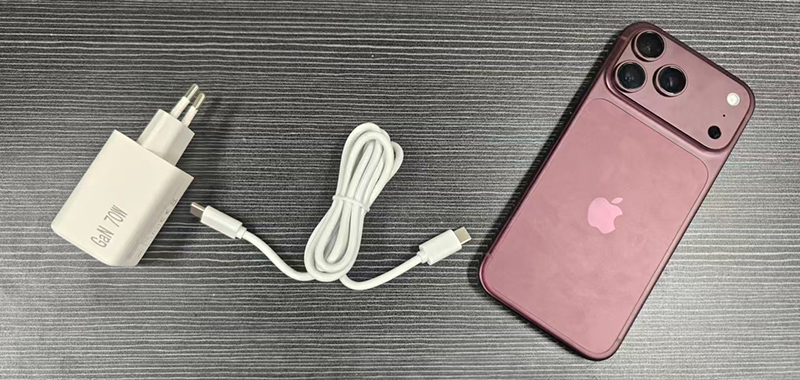
According to Apple's official fast-charging guidance, iPhone 18 Pro and iPhone 18 Pro Max users can charge to around 50% in approximately 15 minutes under the stated test conditions. Apple specifies its 40W Dynamic Power Adapter with 60W maximum output, or a comparable third-party adapter rated for 60W or more that supports AVS and USB Power Delivery 3.2.
That recommendation contains three important details:
• Power capability: The adapter must meet the specified power requirement.
• Protocol capability: It must support the relevant AVS implementation, not simply advertise a high wattage.
• A suitable cable: The connection must support the required charging arrangement.
A 100W or 140W label does not automatically mean that the iPhone will charge faster than it would with a 60W adapter. The phone requests power according to its charging capabilities and current operating conditions. The charger must support the requested power-delivery mode, and the phone must successfully negotiate it.
The advertised maximum output of a charger is also its overall capacity, not the amount every connected device will draw.
Apple's advertised charging time is a test result, not a guarantee for every charging session. Battery level, temperature, device activity, cable condition, and other operating conditions can affect the result.
2. SPR AVS vs. EPR AVS: Why the Difference Matters
AVS stands for Adjustable Voltage Supply. It is a USB Power Delivery feature that allows a compatible power source to adjust its output voltage within a supported range in response to a device's request.
The important point for iPhone 18 Pro series buyers is that not all AVS implementations are interchangeable.
USB-PD has different power ranges and related protocol capabilities. For the compatibility issue discussed here, the distinction between Standard Power Range AVS (SPR AVS) and Extended Power Range AVS (EPR AVS) is particularly important.
| Feature | SPR AVS | EPR AVS |
| General context | Standard Power Range | Extended Power Range |
| Common profile discussed in current iPhone 18 Pro Max tests | 9–20V | 15–28V |
| Maximum power of the profile | Depends on the supported current and implementation | Depends on the supported current and implementation |
| What buyers should know | The relevant profile in the cited iPhone 18 Pro Max tests | EPR AVS support alone did not provide the same result in those tests |
These voltage ranges describe the profiles discussed in the cited tests, not every possible charger configuration. Actual output also depends on current limits and the charger's power design.
In its iPhone 18 Pro Max charging review, ChargerLAB reported that the phone successfully used SPR AVS with certain adapters, reaching a measured peak above 50W. Other adapters, including some high-wattage models, used a conventional USB-PD profile instead.
Charge-Test's independent compatibility analysis likewise distinguishes SPR AVS from EPR AVS and explains why the distinction matters in its tests.
The takeaway is straightforward: do not assume that a charger will provide the iPhone's AVS charging performance simply because its product page mentions AVS or PD 3.1. Check the specific supported profile and, where possible, verified compatibility with the exact phone model.
For a broader explanation of charging protocols, see USB-C PD protocol tuning in charger development.
3. Why Can an AVS Charger Still Charge at Around 43–45W?
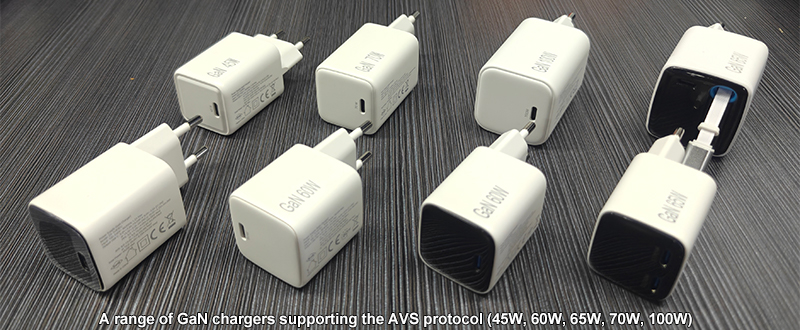
This is one of the most confusing issues for buyers. A charger may support 100W output and list AVS among its features, yet a power meter may show that the iPhone draws approximately 43–45W rather than reaching the roughly 50–52W peak reported in some successful SPR AVS tests.
There are several possible reasons.
The charger supports the wrong AVS profile
A charger may support EPR AVS but not the SPR AVS profile relevant to the tested iPhone charging mode. In that case, the presence of the word “AVS” on the product page does not establish compatibility.
The profile is advertised, but the phone does not use it
A USB-C charger can advertise a protocol capability during negotiation, but that does not prove that the connected phone will select and use it.
Charge-Test reported cases in which a charger exposed a 9–20V SPR AVS profile to test equipment, but the iPhone still used a fixed USB-PD voltage. The measured result was lower than the peak obtained with a successfully negotiated SPR AVS connection.
The reason for this behavior should not be assumed without further evidence. The interaction may depend on the charger implementation, the order or combination of advertised profiles, device behavior, or other compatibility details. A single test result is not enough to establish one universal cause.
The charger has a high total rating but different port limits
Multi-port chargers often share their available power between connected devices. A 100W charger may provide its maximum rating only under specific port and load conditions.
If a laptop or another device is connected, the available output on the iPhone's port may change. For a fair compatibility test, verify the charger's port allocation and test it under the intended connection conditions.
Charging conditions limit the power draw
Even when the protocol works, peak power is not maintained throughout the entire charging cycle. Battery level, temperature, background activity, and thermal management can cause the phone to reduce power.
A reading taken after the phone has warmed up or passed its initial fast-charging period should not be treated as a definitive protocol compatibility result.
Read More
4. How to Check Whether Your Charger Actually Uses AVS
If you want to establish whether a charger is compatible with the iPhone 18 Pro Max's higher-speed charging mode, use a repeatable testing process rather than relying on the wattage label.
Step 1: Check the detailed specifications.
Look for the exact USB-PD and AVS capabilities, including the voltage range and supported current. If the listing only says “AVS compatible,” ask the manufacturer for the detailed output profile or a protocol test report.
Step 2: Check the exact charger model and port.
Different models in the same product family may use different internal designs or firmware. For multi-port chargers, check the port being used and whether other ports are occupied.
Step 3: Use a suitable USB-C cable.
Use a known-good cable rated for the intended charging conditions. A cable that is damaged, poorly constructed, or unsuitable for the required current can complicate testing. Do not assume that a cable marked 240W will make an incompatible charger support AVS; the charger and phone still need to negotiate a compatible mode.
Step 4: Use a compatible USB-PD analyzer.
A suitable protocol analyzer can help identify the profiles advertised by the charger and the voltage and current being negotiated. However, a test instrument merely detecting an AVS profile does not prove that the phone is using it.
Step 5: Test the phone's actual charging behavior.
Start with a low battery level, allow the device to cool to a normal operating temperature, and test under repeatable conditions. Record the negotiated protocol, voltage, current, and charging power over time.
Step 6: Repeat the test.
Repeatability matters. One brief peak reading is not enough to characterize an entire charging session, and a single successful negotiation may not establish reliable behavior across all operating conditions.
For commercial product evaluation, a documented compatibility test with the exact phone and charger model is more useful than a generic claim that the adapter supports AVS.
Read More
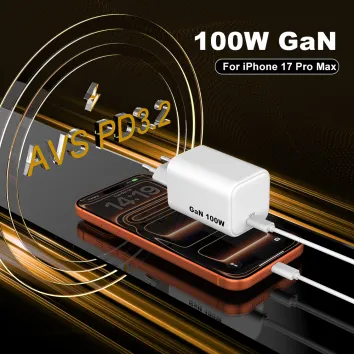
5. Does a 100W or 140W Charger Make the iPhone Charge Faster?
Not necessarily. A higher-wattage charger provides more available power for devices that can use it. It does not force the iPhone to draw the full output rating.
In Charge-Test's tests of the iPhone 18 Pro Max, a charger with working SPR AVS reached approximately 52W peak charging power, while several tested chargers using fixed USB-PD profiles reached approximately 43–45W. The results apply to the specific devices tested; they are not universal figures for every charger in those wattage classes.
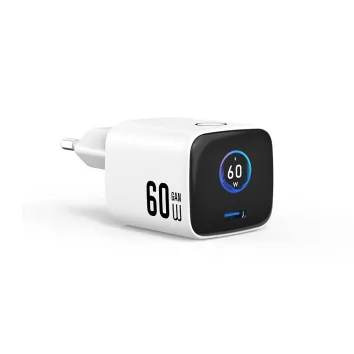
This means that a compatible 60W charger may achieve a higher iPhone peak than a 100W charger that does not successfully negotiate the relevant AVS mode.
A 100W or 140W model can still make sense if you also charge a laptop, tablet, or other USB-C device. In that case, evaluate the overall port configuration, power-sharing behavior, size, thermal performance, and price rather than choosing by wattage alone.
If your only goal is to charge an iPhone, first establish whether the additional AVS performance is important enough to justify buying a new adapter.
Read More
Read More
6. What Should Buyers Check Before Choosing an iPhone 18 Charger?
For consumers, the priority is reliable charging and clear compatibility information. For wholesalers, brands, and retailers, the same issue becomes a product-selection and customer-support concern.
Before placing an order, check the following:
| What to check | Why it matters |
| Exact AVS profile | Helps distinguish the relevant SPR AVS capability from a generic AVS claim |
| USB-PD support | Establishes the charger's broader power-delivery capability |
| Rated output and port limits | Shows how much power is available under specified conditions |
| Real-device test results | Helps confirm whether the phone actually negotiates the expected charging mode |
| Cable requirements | Avoids treating the cable as an afterthought |
| Thermal and safety validation | Supports consistent operation under intended conditions |
| Model and version identification | Prevents results from one version being applied to a different product |
| Warranty and quality control | Matters for after-sales support and repeat purchasing |
For B2B buyers, it is also worth asking the manufacturer for the output profile table, test conditions, sample evaluation procedure, and model-specific documentation before approving mass production.
A charger that works with one phone or one analyzer is not automatically proven compatible with every USB-C device. Compatibility claims should be based on a clearly defined test scope.
7. What Charger Manufacturers Need to Consider When Developing AVS Products
For charger manufacturers, AVS compatibility is not simply a matter of adding a feature to a specification sheet. It needs to be considered as part of the power architecture, protocol implementation, verification process, and final product validation.
During development, engineering teams should review the requested output profiles, controller configuration, firmware behavior where applicable, component selection, thermal design, and port-power allocation. The finished charger should then be tested against the intended devices and operating conditions.
• Does the charger advertise the expected protocol profile?
• Can the charger deliver the requested voltage and current within its design limits?
• Does the target device successfully negotiate the intended charging mode?
• Does the result remain stable across repeated tests?
• Does the charger meet applicable safety, thermal, and electromagnetic compatibility requirements?
These checks answer different questions. Passing one does not automatically prove the others.
For OEM and ODM projects, buyers should define compatibility requirements before finalizing the design. If a product is intended to support iPhone 18 Pro series AVS charging, include the target phone model, required charging mode, test equipment, test conditions, and acceptance criteria in the validation plan.
At ZONSAN, charger engineering and manufacturing work covers USB-C fast-charging products across a range of output levels. For a potential OEM or ODM project, buyers can discuss the target power rating, supported protocols, port configuration, regional plug requirements, and required validation scope with the engineering team. Final compatibility claims should be based on the specifications and test results of the particular model.
8. Troubleshooting(Engineer's recommendation): What If Your iPhone Does Not Reach the Expected Charging Power?
If your iPhone charges normally but does not reach the peak you expected, check these items before replacing the charger.
Confirm the charger's profile. Make sure it supports the relevant SPR AVS mode rather than only a different AVS implementation.
Check the exact model. Similar product names do not guarantee identical internal specifications. Confirm the model number and version.
Test with one device connected. On a multi-port charger, disconnect other devices and retest to rule out power-sharing limitations.
Check the cable and connectors. Try a known-good USB-C cable and inspect both connectors for damage or debris.
Control the test conditions. Test with a relatively low battery level and allow the phone to return to a normal temperature. Charging power normally changes as the battery fills.
Use protocol measurements if available. A USB-PD analyzer can help identify the negotiated mode. Do not rely only on the charger's screen or a short-lived wattage reading.
Compare against a known-compatible adapter. If possible, use an adapter whose behavior has been confirmed with the same phone model. This helps separate a charger-specific issue from normal variation in charging conditions.
If the phone charges reliably but peaks around 43–45W, that does not necessarily indicate a fault. It may be using a fixed USB-PD mode rather than SPR AVS. If charging repeatedly disconnects, becomes unstable, or the charger shows abnormal behavior, stop using the suspect setup and check the charger and cable before further testing.
Conclusion
Choosing an iPhone 18 Pro or iPhone 18 Pro Max charger requires more than comparing wattage ratings. Apple's fast-charging guidance specifies a 60W-capable adapter with AVS and USB-PD 3.2 for the stated wired fast-charging result, while independent testing shows that the exact AVS profile and successful negotiation can affect real-world peak power.
The practical lesson is to verify the profile, identify the exact charger model, and look for repeatable tests with the target phone. A 100W or 140W label alone does not guarantee a higher charging speed, and detecting AVS on a test instrument is not the same as confirming that the phone actually uses it.
For consumers, model-specific compatibility evidence is the most useful buying guide. For brands and importers, clear protocol specifications and a defined real-device validation process can reduce uncertainty before a charger enters mass production.
Frequently Asked Questions
Q1: Does the iPhone 18 Pro Max require an AVS charger?
Apple specifies an AVS-capable 60W-or-higher adapter supporting USB-PD 3.2 for its stated wired fast-charging result of around 50% in 15 minutes. The phone can also charge with other compatible USB-PD adapters, although charging performance may differ.
Q2: Is every USB-PD 3.2 charger compatible with iPhone 18 Pro AVS charging?
No. The version number alone does not prove that the charger supports the required AVS profile or that the phone will successfully negotiate it. Check the detailed specifications and model-specific test results.
Q3: Is SPR AVS the same as EPR AVS?
No. They refer to different power ranges and supported voltage profiles. In the cited iPhone 18 Pro Max tests, SPR AVS was the relevant mode for reaching the reported peak above 50W; EPR AVS alone did not provide the same result.
Q4: Why does my 100W charger only show around 45W?
The phone may be using a fixed USB-PD profile instead of SPR AVS. Other possible factors include port power sharing, battery level, temperature, cable condition, and the point in the charging cycle when the measurement is taken.
Q5: Will a 140W charger charge an iPhone faster than a 60W charger?
Not automatically. The phone draws power according to its negotiated charging mode and current operating conditions. A compatible 60W charger may reach the same iPhone peak as a higher-rated adapter, while the higher-rated model may offer more capacity for other devices.
Q6: Does a 240W USB-C cable guarantee AVS compatibility?
No. A cable's power rating does not make the charger support a protocol profile it lacks. Use a suitable, good-quality cable, but verify the charger and device negotiation separately.
Q7: Can I use my existing USB-PD charger?
Usually, a compatible USB-PD charger can still charge the phone. The charging speed depends on the charger's available profiles and the phone's negotiated mode. You may not need to replace an existing charger if its current performance meets your needs.
Q8: How can I confirm that my charger is using AVS?
A compatible USB-PD analyzer can help show the advertised profiles and negotiated voltage and current. To establish that the phone actually uses AVS, test the charger with the target phone under repeatable conditions; profile detection alone is insufficient.
Q9: Is PPS support the same as AVS support?
No. PPS and AVS are distinct USB-PD capabilities. A charger that supports PPS should not be assumed to support the specific AVS profile required for a particular charging mode.
Q10: What should a brand request from an OEM charger manufacturer?
Request the detailed output profile table, the exact supported protocol versions and AVS profiles, port-power allocation information, relevant safety documentation, and test results with the intended phone model. Define the required compatibility and acceptance criteria before approving mass production.