Is Your Phone Charger Making a High-Pitched Noise? Is It Dangerous?
Have you ever noticed a high-pitched noise coming from your phone charger? Whether it's a fast charger, PD charger, or USB-C charger, this strange sound can be concerning. Many users immediately wonder: why does my charger make noise? Wondering if this is a sign of a malfunction or safety hazard. Let's dive into why your charger might be making noise, whether it's dangerous, and what steps you should take to protect your devices and your safety.

Why Does My Charger Make a High-Pitched Noise?
The high-pitched noise you're hearing is typically caused by the coil inside the charger vibrating as it converts electrical energy. This phenomenon is known as electromagnetic interference (EMI) and is more common in switch-mode power supplies found in modern chargers, including GaN chargers and fast chargers.
Chargers work by converting alternating current (AC) into the direct current (DC) needed to power devices. This conversion process involves components like capacitors and coils, which can produce noise, especially when dealing with higher power outputs (such as 45W or 100W chargers).
What Is Coil Whine in a Charger?
A high-pitched sound from a phone charger is often related to a phenomenon known as coil whine. Although a charger has no mechanical moving parts like a motor or fan, some internal electronic components can still create tiny physical vibrations.
Inside a modern switching charger, several components work together:
• Transformer, Inductor, Capacitors, Switching MOSFETs, Power control circuits
During AC-to-DC conversion, the charger rapidly switches electrical energy at high frequency. These changes create electromagnetic forces inside magnetic components.
When these forces cause a component to physically vibrate, the vibration can produce an audible sound. This is why users may sometimes hear:
• high-pitched squealing
• buzzing
• clicking
• faint humming
• from a charger.
The sound itself does not automatically mean the charger is unsafe.
The important question is: Is the noise caused by normal electromagnetic vibration, or is it a sign of a design or component problem?
Which Components Inside a Charger Can Create Noise?
From a charger engineer's perspective, noise analysis starts by identifying which internal components may be vibrating.
1. Transformer
The transformer is one of the most common sources of audible noise. Its main function is: voltage conversion, electrical isolation, energy transfer.
During operation, magnetic forces can create small mechanical movements inside the transformer structure.
If the vibration frequency falls within the human audible range, users may hear a high-pitched sound.
2. Inductor and Choke Components
Inductors are commonly used for: energy storage, filtering, EMI control
Similar to transformers, inductors contain magnetic materials that may experience mechanical vibration under changing electrical conditions.
Poor mechanical fixing or insufficient vibration control can increase audible noise.
3. Capacitors and Switching Circuits
Modern fast chargers operate through high-frequency switching.
During different charging conditions: low battery, high power charging, near full battery, standby mode; the charger changes its operating state.
These changes can sometimes create different acoustic characteristics.
Can GaN Chargers Make High-Pitched Noise?
GaN chargers are becoming increasingly popular because they can achieve:
• higher power density
• smaller size
• improved efficiency
• compact designs
However, GaN technology does not completely eliminate electrical noise. A GaN charger still contains:
• magnetic components
• switching circuits
• power control systems
Therefore, coil vibration and switching-related noise can still occur.
In fact, compact high-power chargers create additional engineering challenges because more power is processed in a smaller physical space. For charger engineers, the goal is not simply to increase power output.
The goal is to balance: efficiency, thermal performance, electromagnetic compatibility, acoustic performance, reliability.
A well-designed GaN charger should deliver high power while maintaining stable operation and acceptable noise levels.
Is It Dangerous?
In most cases, the high-pitched noise from your charger is not dangerous. It's simply a side effect of the electronic components working to convert power. However, there are some conditions under which the noise could indicate a potential issue:
1. Overheating: If the charger becomes excessively hot while making a noise, it could be a sign of overheating, which could damage your device or cause a safety risk.
2. Low-Quality or Faulty Charger: Poorly manufactured chargers or those that lack proper safety features could potentially pose a risk of electrical failure, overheating, or even fire.
3. Incompatible Charger: Using an incorrect charger for your device, such as using a 30W USB-C charger for a device that requires higher power, can cause the charger to work inefficiently, which may result in unwanted noise.
Is My Charger Noise Normal or Dangerous?
The high-pitched noise you're hearing is typically caused by the coil inside the charger vibrating as it converts electrical energy. This phenomenon is known as electromagnetic interference (EMI) and is more common in switch-mode power supplies found in modern chargers, including GaN chargers and fast chargers.
Chargers work by converting alternating current (AC) into the direct current (DC) needed to power devices. This conversion process involves components like capacitors and coils, which can produce noise, especially when dealing with higher power outputs (such as 45W or 100W chargers).
What Is Coil Whine in a Charger?
A high-pitched sound from a phone charger is often related to a phenomenon known as coil whine. Although a charger has no mechanical moving parts like a motor or fan, some internal electronic components can still create tiny physical vibrations.
Inside a modern switching charger, several components work together:
• Transformer, Inductor, Capacitors, Switching MOSFETs, Power control circuits
During AC-to-DC conversion, the charger rapidly switches electrical energy at high frequency. These changes create electromagnetic forces inside magnetic components.
When these forces cause a component to physically vibrate, the vibration can produce an audible sound. This is why users may sometimes hear:
• high-pitched squealing
• buzzing
• clicking
• faint humming
• from a charger.
The sound itself does not automatically mean the charger is unsafe.
The important question is: Is the noise caused by normal electromagnetic vibration, or is it a sign of a design or component problem?
Which Components Inside a Charger Can Create Noise?
From a charger engineer's perspective, noise analysis starts by identifying which internal components may be vibrating.
1. Transformer
The transformer is one of the most common sources of audible noise. Its main function is: voltage conversion, electrical isolation, energy transfer.
During operation, magnetic forces can create small mechanical movements inside the transformer structure.
If the vibration frequency falls within the human audible range, users may hear a high-pitched sound.
2. Inductor and Choke Components
Inductors are commonly used for: energy storage, filtering, EMI control
Similar to transformers, inductors contain magnetic materials that may experience mechanical vibration under changing electrical conditions.
Poor mechanical fixing or insufficient vibration control can increase audible noise.
3. Capacitors and Switching Circuits
Modern fast chargers operate through high-frequency switching.
During different charging conditions: low battery, high power charging, near full battery, standby mode; the charger changes its operating state.
These changes can sometimes create different acoustic characteristics.
Can GaN Chargers Make High-Pitched Noise?
GaN chargers are becoming increasingly popular because they can achieve:
• higher power density
• smaller size
• improved efficiency
• compact designs
However, GaN technology does not completely eliminate electrical noise. A GaN charger still contains:
• magnetic components
• switching circuits
• power control systems
Therefore, coil vibration and switching-related noise can still occur.
In fact, compact high-power chargers create additional engineering challenges because more power is processed in a smaller physical space. For charger engineers, the goal is not simply to increase power output.
The goal is to balance: efficiency, thermal performance, electromagnetic compatibility, acoustic performance, reliability.
A well-designed GaN charger should deliver high power while maintaining stable operation and acceptable noise levels.
Is It Dangerous?
In most cases, the high-pitched noise from your charger is not dangerous. It's simply a side effect of the electronic components working to convert power. However, there are some conditions under which the noise could indicate a potential issue:
1. Overheating: If the charger becomes excessively hot while making a noise, it could be a sign of overheating, which could damage your device or cause a safety risk.
2. Low-Quality or Faulty Charger: Poorly manufactured chargers or those that lack proper safety features could potentially pose a risk of electrical failure, overheating, or even fire.
3. Incompatible Charger: Using an incorrect charger for your device, such as using a 30W USB-C charger for a device that requires higher power, can cause the charger to work inefficiently, which may result in unwanted noise.
Is My Charger Noise Normal or Dangerous?
| Situation | Possible Explanation | Recommended Action |
| Very faint high-pitched sound | Normal electronic vibration | Usually acceptable |
| Noise only during high-power charging | Load-related switching behavior | Monitor temperature |
| Noise disappears after unplugging device | Power-state related | Usually not a safety issue |
| Loud buzzing with overheating | Possible fault | Stop using |
| Crackling or burning smell | Possible electrical problem | Replace immediately |
| Noise becomes louder over time | Possible component aging | Consider replacement |

What Should You Do?
If your charger is making noise but not overheating, it's usually not a cause for alarm. However, it's important to follow these tips to ensure your safety:
· Check for Overheating: If your charger feels hot to the touch or your device is heating up, stop charging immediately and check the charger's specifications.
· Use Certified Chargers: Always use certified chargers from reputable brands. Avoid cheap, uncertified third-party chargers, as they may not have the necessary safety features. Certified chargers, such as GaN chargers and fast chargers, are designed with safety in mind and have passed safety testing.
· Switch to a Different Outlet: If the charger still makes noise after cooling down, try using a different outlet or power source to see if that resolves the issue.
· Replace Faulty Chargers: If the noise persists or the charger becomes hot even under normal conditions, it's time to replace it. Always opt for quality mobile chargers or PD chargers that meet safety standards.
Can I Prevent the High-Pitched Noise?
While some level of noise is unavoidable due to the nature of power conversion, you can minimize it by ensuring the following:
1. Choose Higher-Quality Chargers: Invest in brand-name chargers such as the Apple fast charger, Samsung Super Fast Charger, or GaN chargers that are known for their durability and reliability.
2. Avoid Overloading the Charger: Don't try to charge multiple high-power devices simultaneously with a single charger that doesn't support it.
3. Use a Cooling Pad or Stand: If you're using a charger that generates more heat, like a MacBook charger, consider using a cooling pad or stand to allow better airflow.
How Charger Manufacturers Reduce Noise During Design
From a charger manufacturer's perspective, reducing audible noise starts during product design, not after production. Engineers typically consider several factors.
1. Magnetic Component Selection
Transformer and inductor design directly affects vibration behavior.
Engineers evaluate: core material, winding structure, magnetic gap design, mechanical stability.
Different designs can produce different acoustic results.
2. Mechanical Fixing
Internal components must be properly secured.
Charger Manufacturers may use:
1. adhesive materials
2. insulation structures
3. mechanical support methods
to reduce unwanted vibration.
3. PCB Layout Optimization
A charger is not only about selecting components.
PCB design also affects: switching behavior, electromagnetic interference, thermal performance.
A better layout can improve overall stability.
4. Firmware and Power Control Optimization
Modern chargers use intelligent power management. The charger continuously adjusts: voltage, current, switching behavior, and according to device requirements.
Optimizing these transitions can help reduce unnecessary operating noise.
5. Production Testing
A professional charger factory should include quality-control procedures such as:
• electrical performance testing
• safety testing
• thermal testing
• abnormal noise inspection
Noise is not only a customer experience issue. It can also provide engineers with information about charger behavior.
How Charger Engineers Test and Control Audible Noise
A professional charger manufacturer does not evaluate charger noise only by human hearing. During product development and quality control, engineers analyze noise together with electrical performance, thermal behavior and reliability.
Professional charger factory assessments typically include:
1. Acoustic Testing - Engineers can measure: sound level, frequency range, operating condition.
Example: standby mode, low-power charging, maximum power output.
2. Load Condition Testing - Noise can change depending on power demand.
A charger may behave differently when:
• no device is connected
• charging a smartphone
• charging a laptop
• operating near maximum output
Therefore, testing should include different load conditions.
3. Temperature Testing - Noise evaluation should also consider thermal behavior.
A charger that produces sound together with: abnormal heat, unstable output, charging interruption; may require further investigation.
4. Long-Term Reliability Testing - Some noises may become more noticeable after extended operation.
Reliability testing helps identify whether:
• components remain stable
• vibration increases over time
• performance changes after aging
If your charger is making noise but not overheating, it's usually not a cause for alarm. However, it's important to follow these tips to ensure your safety:
· Check for Overheating: If your charger feels hot to the touch or your device is heating up, stop charging immediately and check the charger's specifications.
· Use Certified Chargers: Always use certified chargers from reputable brands. Avoid cheap, uncertified third-party chargers, as they may not have the necessary safety features. Certified chargers, such as GaN chargers and fast chargers, are designed with safety in mind and have passed safety testing.
· Switch to a Different Outlet: If the charger still makes noise after cooling down, try using a different outlet or power source to see if that resolves the issue.
· Replace Faulty Chargers: If the noise persists or the charger becomes hot even under normal conditions, it's time to replace it. Always opt for quality mobile chargers or PD chargers that meet safety standards.
Can I Prevent the High-Pitched Noise?
While some level of noise is unavoidable due to the nature of power conversion, you can minimize it by ensuring the following:
1. Choose Higher-Quality Chargers: Invest in brand-name chargers such as the Apple fast charger, Samsung Super Fast Charger, or GaN chargers that are known for their durability and reliability.
2. Avoid Overloading the Charger: Don't try to charge multiple high-power devices simultaneously with a single charger that doesn't support it.
3. Use a Cooling Pad or Stand: If you're using a charger that generates more heat, like a MacBook charger, consider using a cooling pad or stand to allow better airflow.
How Charger Manufacturers Reduce Noise During Design
From a charger manufacturer's perspective, reducing audible noise starts during product design, not after production. Engineers typically consider several factors.
1. Magnetic Component Selection
Transformer and inductor design directly affects vibration behavior.
Engineers evaluate: core material, winding structure, magnetic gap design, mechanical stability.
Different designs can produce different acoustic results.
2. Mechanical Fixing
Internal components must be properly secured.
Charger Manufacturers may use:
1. adhesive materials
2. insulation structures
3. mechanical support methods
to reduce unwanted vibration.
3. PCB Layout Optimization
A charger is not only about selecting components.
PCB design also affects: switching behavior, electromagnetic interference, thermal performance.
A better layout can improve overall stability.
4. Firmware and Power Control Optimization
Modern chargers use intelligent power management. The charger continuously adjusts: voltage, current, switching behavior, and according to device requirements.
Optimizing these transitions can help reduce unnecessary operating noise.
5. Production Testing
A professional charger factory should include quality-control procedures such as:
• electrical performance testing
• safety testing
• thermal testing
• abnormal noise inspection
Noise is not only a customer experience issue. It can also provide engineers with information about charger behavior.
How Charger Engineers Test and Control Audible Noise
A professional charger manufacturer does not evaluate charger noise only by human hearing. During product development and quality control, engineers analyze noise together with electrical performance, thermal behavior and reliability.
Professional charger factory assessments typically include:
1. Acoustic Testing - Engineers can measure: sound level, frequency range, operating condition.
Example: standby mode, low-power charging, maximum power output.
2. Load Condition Testing - Noise can change depending on power demand.
A charger may behave differently when:
• no device is connected
• charging a smartphone
• charging a laptop
• operating near maximum output
Therefore, testing should include different load conditions.
3. Temperature Testing - Noise evaluation should also consider thermal behavior.
A charger that produces sound together with: abnormal heat, unstable output, charging interruption; may require further investigation.
4. Long-Term Reliability Testing - Some noises may become more noticeable after extended operation.
Reliability testing helps identify whether:
• components remain stable
• vibration increases over time
• performance changes after aging
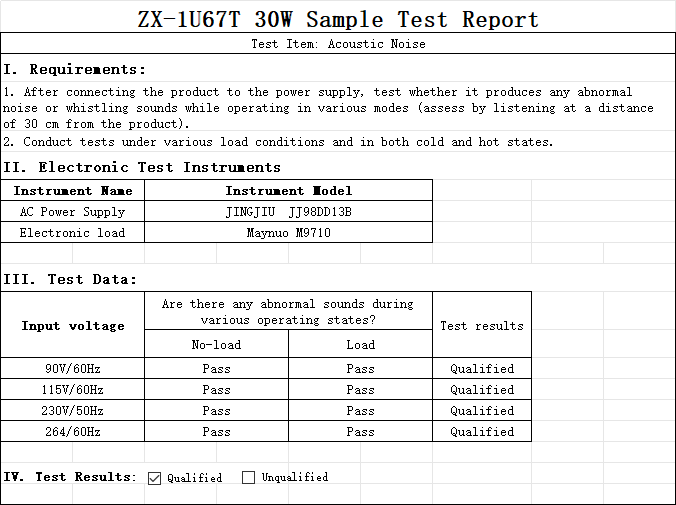
Internal Acoustic Noise Verification Example: 30W GaN Charger
As a charger manufacturer, evaluating audible noise is an important part of product development and quality control. A charger may produce different acoustic characteristics depending on: Input voltage, load condition, operating state, component design.
To evaluate audible noise performance, we conducted an internal acoustic verification test on a charger sample.
The purpose of this test was to measure the audible sound level generated by the charger under controlled operating conditions.
| Test Item | Details |
| Product | 30W charger sample(Model: ZX-1U67T) |
| Test Purpose | Audible noise verification |
| Measurement Distance | 30 cm |
| Test Equipment | AC power source + electronic load |
| Test Conditions | No-load and loaded conditions |
Input Voltage Conditions
The sample was tested under multiple AC input conditions:
| Input Voltage | Frequency | No-load | Load |
| 90V | 60Hz | Pass | Pass |
| 115V | 60Hz | Pass | Pass |
| 230V | 50Hz | Pass | Pass |
| 264V | 60Hz | Pass | Pass |
Test Result: The tested charger sample passed the internal audible noise evaluation under all tested input voltage and load conditions. (No abnormal audible noise was detected during the tested conditions.)
This internal verification confirms the acoustic performance of the tested sample under the specified conditions. Actual performance may vary depending on charger design, components and operating environment.
Ripple Testing: Another Important Charger Quality Indicator
Besides audible noise testing, charger engineers also evaluate electrical stability through ripple testing.
Ripple refers to small unwanted fluctuations in the DC output voltage. (You can view information and standards regarding charger ripple here.)
A well-designed charger should maintain stable output performance during different operating conditions. Ripple testing helps engineers evaluate:
• power conversion stability
• circuit design performance
• component behavior
• output quality
A charger with good electrical design should maintain stable output while delivering the required charging power.
Ripple Testing: Another Important Charger Quality Indicator
Besides audible noise testing, charger engineers also evaluate electrical stability through ripple testing.
Ripple refers to small unwanted fluctuations in the DC output voltage. (You can view information and standards regarding charger ripple here.)
A well-designed charger should maintain stable output performance during different operating conditions. Ripple testing helps engineers evaluate:
• power conversion stability
• circuit design performance
• component behavior
• output quality
A charger with good electrical design should maintain stable output while delivering the required charging power.
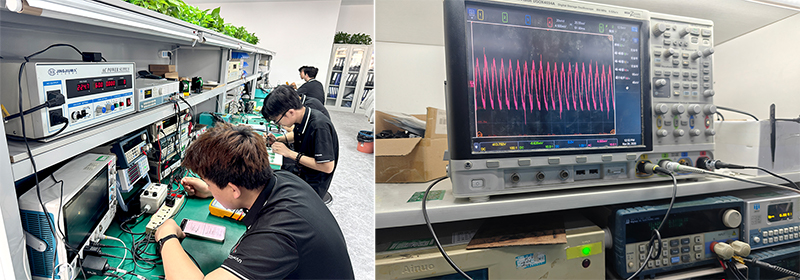
Reliability Testing: Aging Test for Charger Stability
Before chargers enter mass production, manufacturers typically perform reliability evaluations.
One important test is aging testing.(A Look Inside a Professional Charger Factory: Aging Tests)
During aging tests, chargers operate continuously under controlled conditions to evaluate:
• thermal stability, output consistency, component reliability, long-term performance.
A charger that performs well in short-term testing should also maintain stable operation during extended use.
Why Noise Testing Is Important for High-Power GaN Chargers
GaN chargers allow manufacturers to achieve higher power density in smaller packages. However, higher power density also creates engineering challenges.
Engineers need to balance:
• switching frequency, efficiency, thermal performance, electromagnetic compatibility, acoustic behavior.
A compact charger design requires careful optimization because more power is processed within a smaller physical space.
Therefore, GaN charger development is not only about achieving higher wattage.
It is about achieving: High power + Stable performance + Good user experience
From a Charger Manufacturer's Perspective: Why Noise Control Matters
For consumers, the noise generated by a charger is merely an annoyance; for manufacturers, however, it represents a deeper engineering challenge.
During development, engineers need to consider:
Electrical Design: switching frequency, power conversion efficiency, component selection.
Mechanical Design: transformer structure, component fixing, vibration control.
Manufacturing Process: assembly consistency, soldering quality, component placement.
Quality Control: electrical testing, thermal testing, reliability testing.
A charger is a combination of electrical engineering, thermal management and manufacturing precision.
For Zonsan, a mobile phone charger that meets the required standards must undergo more than thirty additional tests—and pass them all—before entering full-scale production. This significantly increases OEM buyers' trust in Zonsan charger manufacturer's product quality assessment and control.
Why Charger Noise Matters for OEM and Wholesale Buyers
For OEM charger projects, audible noise is not only a consumer complaint.
It can affect: product reviews, customer satisfaction, return rates, brand reputation.
When developing chargers for retail markets, buyers should consider: target power level, charger size, charging protocol, thermal requirements, acoustic performance, certification requirements.
A successful charger design is not only about achieving high wattage. It is about creating a complete user experience.

Some final thoughts and suggestions
In most cases, a high-pitched noise from your charger is a normal occurrence due to the inner components at work. However, it's important to stay alert for signs of overheating, faults, or inefficiency. Always use certified chargers and avoid low-quality third-party options. If you notice that the noise is accompanied by heat or other issues, it's best to replace the charger for your safety.
Remember, choosing the right USB-C charger, PD charger, or fast charger is essential to ensure both safety and optimal charging performance. Keep an eye on the quality of your chargers, and don't hesitate to replace them when needed for a safe and reliable charging experience. Avoid greater losses (of property).
FAQ
Q1: Why does my charger make noise only when charging?
Because the charger changes from standby mode to active power conversion mode. Different power levels can create different switching conditions and electromagnetic behavior.
Q2: Are GaN chargers quieter than traditional chargers?
Not always. GaN technology improves efficiency and size, but noise performance depends on the complete charger design.
Q3: Does a noisy charger mean it is dangerous?
Not necessarily. A faint high-frequency sound can be caused by normal component vibration.
However, noise combined with overheating, smell, sparks or unstable charging should not be ignored.
Q4: Why does my charger become noisy near 100% battery?
Near full charge, the phone reduces charging power.
The charger changes operating conditions, which can sometimes change switching behavior and create audible noise.
Reviewed by: Zonsan R&D Team — Miller and Michael
Technical Review: Internal PCB structure, noise, ripple, aging test, etc.
Last reviewed: [August 20, 2026]