How Chargers Go Through Aging Tests Before Shipping: Why Burn-In Testing Is Essential for Long-Term Reliability
Quick Answer(Featured Snippet)
A charger aging test, also known as a burn-in test, is a controlled validation process in which finished chargers operate continuously under specified electrical loads for an extended period before shipment. The purpose is to identify early-life failures, verify stable electrical performance and improve overall product reliability before products reach customers.
Key Takeaways
• Aging tests are designed to detect potential early-life failures before shipment.
• Burn-in testing is one part of reliability verification—not a replacement for engineering design.
• Professional manufacturers monitor output voltage, current, temperature and operating stability throughout the test.
• Aging duration varies depending on product design, customer requirements and quality standards.
• Well-planned aging tests help reduce field failures and improve long-term customer satisfaction.
Introduction
Imagine receiving a brand-new charger that works perfectly the first few times you use it.
Then, after only a few days, it suddenly stops charging.
In many cases, this type of failure is not caused by years of wear.
Instead, it results from a hidden weakness that already existed when the product left the factory.
Engineers refer to this phenomenon as early-life failure.
Although these failures represent only a small percentage of total production, they have a disproportionate impact on customer experience, warranty costs and brand reputation.
This is one reason professional charger manufacturers perform aging tests, also known as burn-in tests, before products are shipped.
Rather than evaluating a charger for only a few minutes, aging tests allow it to operate continuously under controlled conditions for an extended period.
If hidden manufacturing defects or unstable components exist, they are much more likely to appear during this stage than after the charger reaches the customer.
For OEM and ODM manufacturers, aging testing is therefore more than a quality inspection.
It is an important step in validating that production consistency matches the engineering standards established during product development.

What Is an Aging Test?
An aging test is a production-stage reliability evaluation performed after assembly and functional inspection.
Finished chargers are connected to electronic loads and allowed to operate continuously under predetermined test conditions.
During the test, engineers observe whether the charger maintains stable operation while monitoring key electrical characteristics.
Unlike a simple functional inspection—which may last only a few seconds—aging tests evaluate product behavior over time.
This distinction is important.
Some manufacturing defects only become visible after components warm up, materials expand or repeated switching cycles occur.
By operating the charger continuously, engineers increase the likelihood of identifying these hidden problems before shipment.
Why Is It Also Called Burn-In Testing?
The term burn-in often causes confusion.
Some people assume it refers to overheating the product.
In reality, burn-in simply describes operating electronic products under controlled conditions for an extended period to reveal early failures.
The objective is not to damage the charger.
Instead, it is to verify that the product continues operating normally after sustained use.
In electronics manufacturing, burn-in testing has been widely used for decades across products such as power supplies, industrial controllers, communication equipment and medical devices.
Modern USB-C chargers apply the same basic principle.
Why Early-Life Failures Matter
Engineers often describe the reliability of electronic products using what is known as the "bathtub curve."
Although the exact failure pattern varies by product, electronic devices generally experience three stages:
• Early-life failures
• Stable operating period
• Wear-out failures
The first stage receives particular attention during manufacturing.
Products that contain hidden defects are more likely to fail shortly after entering service.
Examples include:
• Weak solder joints
• Marginal electronic components
• Manufacturing contamination
• Assembly defects
• Improper connector installation
Aging tests help identify many of these issues before shipment, reducing the likelihood that customers encounter them during normal use.
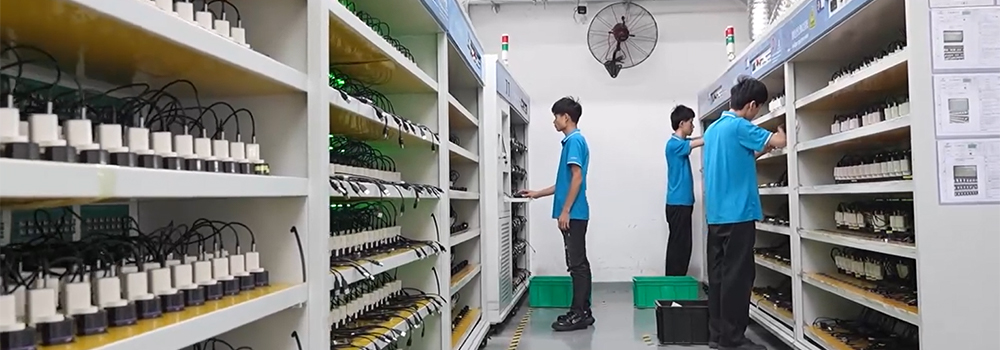
What Happens During an Aging Test?
Although procedures differ among manufacturers, a professional aging process generally includes several common elements.
Continuous Electrical Load
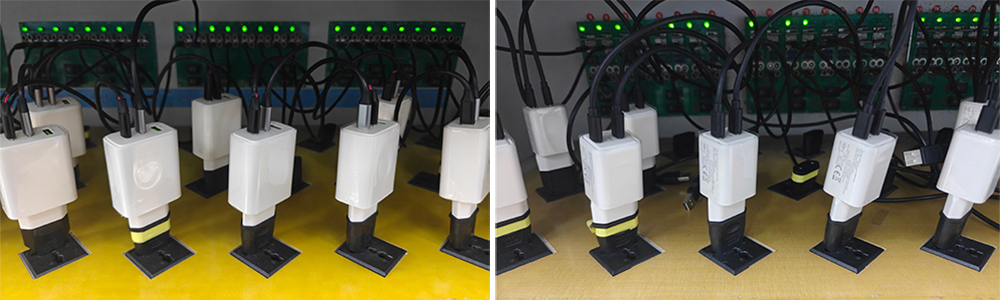
The charger operates while supplying power to an electronic load that simulates real charging conditions.
Depending on the product, engineers may test at full rated power, partial load or multiple operating levels.
Temperature Stabilization
As the charger continues operating, internal temperatures gradually stabilize.
This allows engineers to observe behavior after thermal equilibrium is reached rather than only during startup.
Electrical Performance Monitoring
Throughout the test, important parameters may be observed, including:
• Output voltage stability
• Output current consistency
• Power delivery performance
• Protection circuit behavior
• Temperature trends
Products showing abnormal behavior are removed for further investigation.
Final Functional Verification
After the aging period is complete, chargers typically undergo another functional inspection before packaging.
This confirms that the product continues meeting electrical performance requirements following extended operation.
How Long Should an Aging Test Last?
This is one of the questions OEM buyers ask most frequently.
The answer is more nuanced than simply choosing a fixed number of hours.
Aging duration depends on factors such as:
• Product power level
• Customer quality requirements
• Manufacturing standards
• Production capacity
• Product application
• Reliability objectives
Some production lines perform relatively short burn-in evaluations as part of standard manufacturing.
Others—particularly for industrial or specialized applications—may require considerably longer validation periods.
More importantly, test quality matters more than test duration alone.
A well-controlled aging process with appropriate electrical loading, accurate monitoring and clear acceptance criteria often provides more value than simply extending operating time without meaningful observation.
Aging Testing Is Not the Same as Reliability Testing
A common misunderstanding is that passing an aging test proves a charger is highly reliable.
Professional engineers view the situation differently.
Aging tests primarily target early-life failures.
Long-term reliability depends on many additional factors, including:
• Circuit design
• Thermal management
• Component quality
• PCB layout
• Environmental validation
• Electrical safety testing
• Manufacturing consistency
This is why aging tests should be considered one element within a comprehensive reliability engineering program rather than the entire program itself.
What Types of Defects Can Aging Tests Reveal?
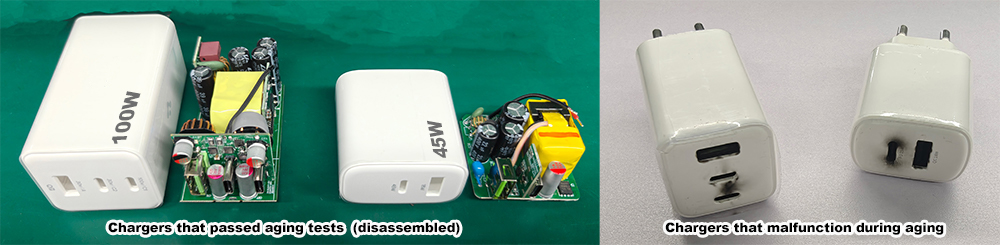
One of the biggest advantages of an aging test is that it exposes problems that may not appear during a short functional inspection.
A charger can power on normally, negotiate the correct USB PD profile and pass an initial output test within seconds. However, once it has been operating continuously for a period of time, hidden weaknesses may begin to surface.
Professional manufacturers commonly use aging tests to help identify issues such as:
Intermittent Solder Joint Problems
A solder joint that appears acceptable during assembly may become unstable after repeated heating.
As internal temperatures rise, thermal expansion can cause weak solder joints to develop intermittent electrical contact.
These failures are often difficult to detect during a brief production test but become much more apparent during continuous operation.
Component Instability
Electronic components from any supplier have manufacturing tolerances.
Occasionally, a component may operate correctly when cold but become unstable after reaching its normal operating temperature.
Aging tests help identify these early failures before shipment.
Thermal-Related Abnormalities
Continuous operation allows the charger to reach thermal equilibrium.
At this point, engineers can verify that temperatures remain stable and that no unexpected hotspots appear inside the product.
Abnormal thermal behavior may indicate issues involving:
• Transformer performance
• PCB layout
• Component placement
• Thermal interface materials
• Enclosure design
Protection Circuit Performance
Professional USB-C chargers include multiple protection mechanisms, including:
• Over-current protection (OCP)
• Over-voltage protection (OVP)
• Over-temperature protection (OTP)
• Short-circuit protection (SCP)
Although these circuits are verified during engineering validation, aging tests provide an additional opportunity to confirm that the charger continues operating normally under extended load.
Equipment Used in Professional Aging Tests
Modern charger factories rely on automated equipment rather than manual observation alone.
A typical aging test system includes several integrated elements.
Electronic Load Systems
Electronic loads simulate the power demand of real devices.
Unlike simple resistive loads, programmable electronic loads allow engineers to precisely control output current and power levels throughout the test.
Power Monitoring Equipment
Voltage, current and power are continuously monitored to verify stable operation.
Some systems automatically record performance data throughout the entire aging cycle, making it easier to identify abnormal trends.
Temperature Monitoring
Many production lines also monitor environmental temperature and, in some cases, critical product temperatures.
Maintaining consistent test conditions improves repeatability and helps ensure meaningful results.
Centralized Aging Racks
Professional factories often use dedicated aging racks capable of testing dozens—or even hundreds—of chargers simultaneously.
Centralized systems improve efficiency while allowing technicians to monitor large production batches under standardized conditions.

Common Misconceptions About Aging Tests
Although aging tests are widely used in electronics manufacturing, several misconceptions continue to appear.
Misconception 1: Longer Aging Always Means Better Quality
Not necessarily.
A poorly controlled 24-hour test may provide less value than a carefully monitored shorter test with appropriate loading conditions and clearly defined acceptance criteria.
The effectiveness of an aging test depends on both its duration and its execution.
Misconception 2: Every Charger Needs the Same Aging Procedure
Different products have different requirements.
A compact 20W charger and a 140W multi-port GaN charger operate under very different electrical and thermal conditions.
Professional manufacturers typically adjust testing strategies based on product complexity, power level and customer requirements rather than applying a one-size-fits-all process.
Misconception 3: Aging Tests Replace Engineering Validation
They do not.
Aging tests verify production consistency and help identify early-life failures.
Engineering validation—including thermal analysis, EMC testing, reliability evaluation and safety verification—must already be completed before products enter production.
Misconception 4: A Product That Passes Aging Will Never Fail
No manufacturing process can guarantee zero failures.
The purpose of aging is to reduce the likelihood of early defects reaching customers, not eliminate every possible future failure.
Long-term reliability always depends on sound engineering, high-quality materials and consistent manufacturing processes working together.
How Professional Manufacturers Build an Effective Aging Process
Rather than viewing aging as an isolated production step, experienced charger manufacturers integrate it into a broader quality management system.
A well-designed aging program generally includes:
Clearly Defined Test Standards
Before production begins, engineering teams establish standardized testing procedures covering operating conditions, loading methods, pass/fail criteria and record keeping.
Stable Test Environment
Maintaining consistent environmental conditions improves the repeatability of results and reduces unnecessary variation between production batches.
Data Collection and Traceability
Modern factories increasingly record production data electronically.
Tracking aging results helps engineers identify long-term manufacturing trends, evaluate process capability and support continuous improvement.
Feedback Into Engineering
Perhaps the most valuable aspect of aging testing is feedback.
If recurring abnormalities appear during production, engineering teams analyze the root cause and improve future product designs or manufacturing processes.
In this way, aging tests contribute not only to quality control but also to ongoing product development.
Final Thoughts
Aging tests play an important role in professional charger manufacturing because they help identify hidden weaknesses before products reach customers.
However, their value extends beyond detecting individual defects.
A well-planned aging program reflects the maturity of a manufacturer's engineering process, quality management system and commitment to long-term product reliability.
For OEM and ODM customers, understanding how a supplier approaches aging validation provides valuable insight into overall manufacturing capability.
The best charger factories do not simply operate products for a fixed number of hours.
They design aging procedures based on engineering objectives, product characteristics and continuous process improvement.
Ultimately, aging tests are not about proving that a charger works today.
They help build confidence that it will continue working reliably long after it leaves the factory.
Frequently Asked Questions (FAQ)
Q1: What is an aging test for a charger?
An aging test is a controlled production process in which chargers operate continuously under electrical load to help identify early-life failures before shipment.
Q2: Is an aging test the same as a burn-in test?
Yes. In electronics manufacturing, the terms aging test and burn-in test are often used interchangeably.
Q3: Why do charger manufacturers perform aging tests?
To detect hidden manufacturing defects, verify stable electrical performance and reduce the risk of early product failures.
Q4: Does a longer aging test always mean better quality?
Not necessarily. A well-designed and properly monitored aging process is generally more valuable than simply extending the testing time.
Q5: What equipment is used during aging tests?
Electronic loads, programmable power supplies, monitoring systems, temperature measurement equipment and automated aging racks are commonly used.
Q6: Can an aging test guarantee that a charger will never fail?
No. Aging tests reduce the likelihood of early failures but cannot eliminate every possible long-term failure.
Q7: Is aging testing required for every charger?
Testing procedures vary depending on product design, customer requirements and the manufacturer's quality management system.
Q8: Why is aging testing important for OEM buyers?
It helps improve production consistency, reduce warranty claims and strengthen confidence in long-term product quality.
More Articles About Gan Charger Manufacturers
• Why Charger Reliability Matters More Than Fast Charging Speed: How Professional Manufacturers Engineer Long-Term Performance.↗
• Thermal Design in USB-C Chargers: How Professional Engineers Control Heat for Better Performance and Reliability.↗
• How Flyback Converters Work in USB-C Chargers: The Power Conversion Technology Behind Fast Charging.↗