PD3.0 vs PD3.1 vs PD3.2 (AVS): The Future of USB-C Charging
Just a few years ago, chargers mainly focused on:
• higher wattage
• faster charging speed
• smaller adapter size
But in 2026, the charging industry is entering a completely different era.
Now, the focus is shifting toward:
• intelligent power delivery
• thermal optimization
• dynamic voltage control
• AI-based power management
• ultra-efficient charging ecosystems
This evolution can clearly be seen through the progression of:
• PD3.0
• PD3.1
• PD3.2 (AVS)
And while many consumers already recognize: PD3.1
very few fully understand:
AVS (Adjustable Voltage Supply)
which is becoming one of the most important future technologies in USB-C charging.
What Is USB Power Delivery (USB PD)?
USB Power Delivery (USB PD) is an intelligent fast charging protocol developed by:
USB-IF (USB Implementers Forum)
It allows devices and chargers to negotiate:
• voltage
• current
• power output
through USB-C connections.
Unlike traditional chargers that provide fixed output only, USB PD dynamically communicates with devices to optimize:
• charging speed
• efficiency
• safety
• thermal behavior
What Is PD3.0?
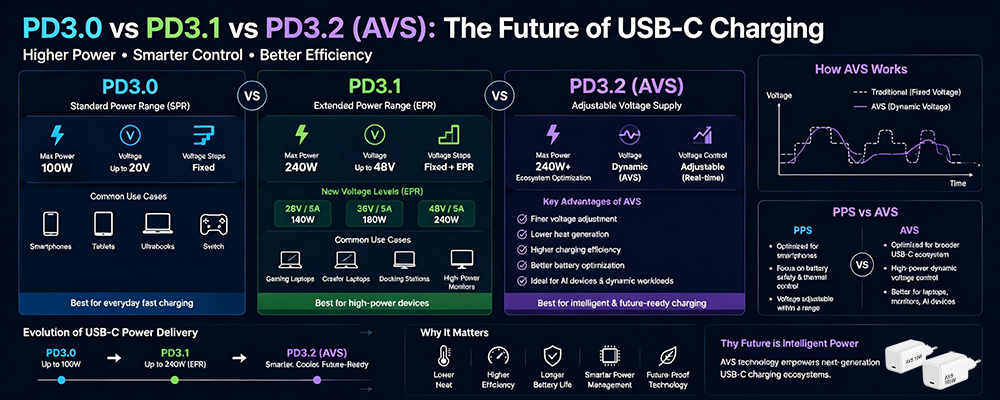
PD3.0 became the mainstream USB-C fast charging standard for several years.
It supports charging power up to: 100W
using fixed voltage profiles such as:
• 5V, 9V, 15V, 20V
PD3.0 helped popularize fast charging across:
• smartphones / tablets / ultrabooks / Nintendo Switch / MacBook Air / USB-C accessories
For many users, PD3.0 is still more than sufficient today.
What Is PD3.1?
PD3.1 introduced one of the biggest upgrades in USB-C history:
Extended Power Range (EPR)
This expanded USB-C charging capability from:
• 100W
to:
• 240W
PD3.1 added new voltage levels:
| Voltage | Current | Power |
| 28V | 5A | 140W |
| 36V | 5A | 180W |
| 48V | 5A | 240W |
This allowed USB-C to power:
• gaming laptops
• creator workstations
• AI laptops
• high-performance displays
• advanced docking stations
through a single cable.
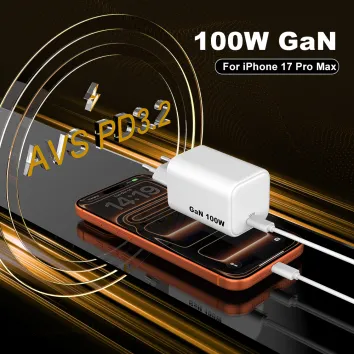
What Is PD3.2 (AVS)?
PD3.2 introduces a more advanced concept called:
AVS (Adjustable Voltage Supply)
Unlike older PD systems that mainly relied on fixed voltage “steps,” AVS allows much more flexible and continuous voltage adjustment.
This creates:
• smoother power delivery
• lower thermal stress
• higher charging efficiency
• more intelligent power optimization
especially under varying workloads.
Read More
Why AVS Is a Major Industry Shift
Traditional charging systems usually jump between fixed voltages like:
• 5V, 9V, 15V, 20V
But real devices rarely operate perfectly at those exact voltage points.
As a result, excess power often becomes: heat.
AVS solves this by enabling: finer-grained voltage adjustment.
Instead of large voltage jumps, the charger can dynamically provide voltage much closer to what the device actually needs.
This dramatically improves:
• efficiency
• thermal behavior
• battery optimization
PD3.0 vs PD3.1 vs PD3.2 Comparison
• gaming laptops
• creator workstations
• AI laptops
• high-performance displays
• advanced docking stations
through a single cable.
What Is PD3.2 (AVS)?
PD3.2 introduces a more advanced concept called:
AVS (Adjustable Voltage Supply)
Unlike older PD systems that mainly relied on fixed voltage “steps,” AVS allows much more flexible and continuous voltage adjustment.
This creates:
• smoother power delivery
• lower thermal stress
• higher charging efficiency
• more intelligent power optimization
especially under varying workloads.
Read More
Why AVS Is a Major Industry Shift
Traditional charging systems usually jump between fixed voltages like:
• 5V, 9V, 15V, 20V
But real devices rarely operate perfectly at those exact voltage points.
As a result, excess power often becomes: heat.
AVS solves this by enabling: finer-grained voltage adjustment.
Instead of large voltage jumps, the charger can dynamically provide voltage much closer to what the device actually needs.
This dramatically improves:
• efficiency
• thermal behavior
• battery optimization
PD3.0 vs PD3.1 vs PD3.2 Comparison
| Feature | PD3.0 | PD3.1 | PD3.2 (AVS) |
| Max Power | 100W | 240W | 240W+ Ecosystem Optimization |
| Voltage Control | Fixed steps | Fixed + EPR | Dynamic Adjustable Voltage |
| Main Focus | Fast charging | High-power charging | Intelligent power optimization |
| Thermal Efficiency | Good | Better | Best |
| AI Device Support | Limited | Better | Excellent |
| Future Readiness | Moderate | High | Very High |
Why AVS Is Better for Thermal Management
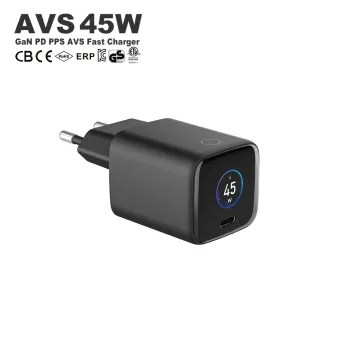
One of the biggest advantages of AVS is: lower heat generation.
When voltage precisely matches device demand:
• power conversion becomes more efficient
• energy waste decreases
• thermal buildup is reduced
This is especially important for:
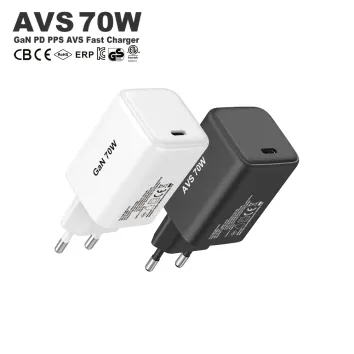
• compact GaN chargers
• AI laptops
• multi-port desktop chargers
• gaming devices
• high-density USB-C charging systems
Read More
AVS vs PPS: What's the Difference?
Many people confuse:
• PPS (Programmable Power Supply)
and:
• AVS (Adjustable Voltage Supply)
because both involve dynamic voltage control.
However, they are not identical technologies.
PPS Mainly Focuses On:
• smartphone charging
• battery optimization
• Samsung Super Fast Charging
• mobile thermal control
AVS Focuses More On:
• broader USB-C ecosystem management
• high-power dynamic regulation
• laptop charging optimization
• intelligent system-level efficiency
• future AI computing devices
You can think of:
PPS = smartphone-focused optimization
while:
AVS = next-generation universal USB-C optimization
Why AI Laptops Will Accelerate AVS Adoption
The rise of AI laptops is changing power requirements dramatically.
Modern AI systems experience highly dynamic workloads involving:
• GPU acceleration
• AI processing bursts
• variable CPU demand
• external device synchronization
This creates rapidly changing power consumption behavior.
AVS is ideal for these scenarios because it allows:
• real-time voltage adjustment
• smoother power balancing
• lower thermal spikes
• more efficient transient response
Read More
Why AVS Works Perfectly with GaN Chargers
GaN technology enables:
• higher switching frequency
• lower energy loss
• smaller charger size
• faster dynamic response
This makes GaN chargers especially suitable for: AVS-based charging systems.
Without GaN, future AVS desktop chargers would likely become much larger and hotter.
Why Cable Quality Matters More in PD3.2
As USB-C charging becomes more advanced, cable quality becomes increasingly important.
High-power AVS systems require:
• EPR-certified cables
• Stable signal integrity
• Low thermal resistance
• Intelligent cable communication
Poor-quality cables may reduce:
• charging stability
• efficiency
• thermal performance
especially under 140W–240W charging conditions.
Why OEM Charger Factories Are Preparing for AVS
Professional charger manufacturers are already preparing for: AVS ecosystem expansion.
This includes upgrading:
• PCB architectures
• protocol IC systems
• thermal engineering
• voltage regulation systems
• dynamic power management
especially for:
• PD3.1 desktop chargers
• AI laptop chargers
• next-generation USB-C charging stations
ZONSAN's Perspective on PD3.2 & AVS
As a professional GaN charger manufacturer and OEM USB-C charger supplier, Zonsan Power has observed increasing industry attention toward:
• AVS charging
• intelligent power allocation
• next-generation USB-C ecosystems
• thermal efficiency optimization
Especially in:
• AI laptop charging
• creator workstation charging
• high-power desktop GaN chargers
future charging systems are expected to rely more heavily on:
• dynamic voltage regulation
• intelligent thermal management
• advanced protocol coordination
rather than simply increasing wattage numbers alone.
Why PD3.2 Represents the Future of USB-C Charging
The charging industry is moving beyond: “faster charging only.”
The future now focuses on:
• smarter charging
• lower heat
• higher efficiency
• universal compatibility
• intelligent power ecosystems
PD3.2 and AVS are foundational technologies for this transition.
Over the next several years, AVS will likely become increasingly important in:
• laptops
• monitors
• AI systems
• creator workstations
• multi-device USB-C environments
Final Thoughts
PD3.0 introduced mainstream USB-C fast charging.
PD3.1 expanded USB-C into high-power 240W ecosystems.
But PD3.2 with AVS represents something even more important: intelligent dynamic power delivery.
As USB-C charging evolves beyond simple wattage competition, technologies like AVS will help create:
• cooler chargers
• smarter power systems
• more efficient charging
• longer battery lifespan
• next-generation AI device ecosystems
And in the coming years, the difference between:
• basic fast chargers
and:
• intelligently engineered AVS charging systems
will become increasingly obvious.
Recommended External
• “Why GaN Chargers Run Cooler Than Traditional Silicon Chargers”↗
• “Inside Charger Thermal Design: Pads, Potting & Heat Dissipation”↗
• “USB Power Delivery Official Specifications”↗
• “USB-IF Official USB Type-C Information”↗
FAQ (People Also Ask)
Q1: What is PD3.2 AVS?
A: PD3.2 AVS (Adjustable Voltage Supply) is an advanced USB-C power delivery technology that enables more flexible and intelligent voltage regulation.
Q2: What is the difference between PD3.1 and PD3.2?
A: PD3.1 mainly introduced Extended Power Range (EPR) up to 240W, while PD3.2 AVS focuses more on intelligent dynamic voltage optimization.
Q3: Is AVS better than PPS?
A: AVS and PPS target different applications. PPS mainly optimizes smartphone charging, while AVS supports broader high-power USB-C ecosystems.
Q4: Why does AVS reduce heat?
A: AVS dynamically adjusts voltage more precisely to device demand, reducing energy waste and thermal buildup.
Q5: Do I need AVS for my phone?
A: Most smartphones currently work well with PD3.0 or PPS. AVS will become more important for future laptops and high-performance devices.
Q6: Will AVS replace PPS?
A: Not necessarily. PPS and AVS may coexist depending on device category and charging requirements.
Q7: Why are GaN chargers important for AVS?
A: GaN technology enables faster switching, better thermal efficiency, and more responsive dynamic power control.
Q8: Is PD3.2 already widely available?
A: PD3.2 AVS is still emerging, but industry adoption is expected to grow rapidly over the next several years.
One of the biggest advantages of AVS is: lower heat generation.
When voltage precisely matches device demand:
• power conversion becomes more efficient
• energy waste decreases
• thermal buildup is reduced
This is especially important for:
• compact GaN chargers
• AI laptops
• multi-port desktop chargers
• gaming devices
• high-density USB-C charging systems
Read More
AVS vs PPS: What's the Difference?
Many people confuse:
• PPS (Programmable Power Supply)
and:
• AVS (Adjustable Voltage Supply)
because both involve dynamic voltage control.
However, they are not identical technologies.
PPS Mainly Focuses On:
• smartphone charging
• battery optimization
• Samsung Super Fast Charging
• mobile thermal control
AVS Focuses More On:
• broader USB-C ecosystem management
• high-power dynamic regulation
• laptop charging optimization
• intelligent system-level efficiency
• future AI computing devices
You can think of:
PPS = smartphone-focused optimization
while:
AVS = next-generation universal USB-C optimization
Why AI Laptops Will Accelerate AVS Adoption
The rise of AI laptops is changing power requirements dramatically.
Modern AI systems experience highly dynamic workloads involving:
• GPU acceleration
• AI processing bursts
• variable CPU demand
• external device synchronization
This creates rapidly changing power consumption behavior.
AVS is ideal for these scenarios because it allows:
• real-time voltage adjustment
• smoother power balancing
• lower thermal spikes
• more efficient transient response
Read More
Why AVS Works Perfectly with GaN Chargers
GaN technology enables:
• higher switching frequency
• lower energy loss
• smaller charger size
• faster dynamic response
This makes GaN chargers especially suitable for: AVS-based charging systems.
Without GaN, future AVS desktop chargers would likely become much larger and hotter.
Why Cable Quality Matters More in PD3.2
As USB-C charging becomes more advanced, cable quality becomes increasingly important.
High-power AVS systems require:
• EPR-certified cables
• Stable signal integrity
• Low thermal resistance
• Intelligent cable communication
Poor-quality cables may reduce:
• charging stability
• efficiency
• thermal performance
especially under 140W–240W charging conditions.
Why OEM Charger Factories Are Preparing for AVS
Professional charger manufacturers are already preparing for: AVS ecosystem expansion.
This includes upgrading:
• PCB architectures
• protocol IC systems
• thermal engineering
• voltage regulation systems
• dynamic power management
especially for:
• PD3.1 desktop chargers
• AI laptop chargers
• next-generation USB-C charging stations
ZONSAN's Perspective on PD3.2 & AVS
As a professional GaN charger manufacturer and OEM USB-C charger supplier, Zonsan Power has observed increasing industry attention toward:
• AVS charging
• intelligent power allocation
• next-generation USB-C ecosystems
• thermal efficiency optimization
Especially in:
• AI laptop charging
• creator workstation charging
• high-power desktop GaN chargers
future charging systems are expected to rely more heavily on:
• dynamic voltage regulation
• intelligent thermal management
• advanced protocol coordination
rather than simply increasing wattage numbers alone.
Why PD3.2 Represents the Future of USB-C Charging
The charging industry is moving beyond: “faster charging only.”
The future now focuses on:
• smarter charging
• lower heat
• higher efficiency
• universal compatibility
• intelligent power ecosystems
PD3.2 and AVS are foundational technologies for this transition.
Over the next several years, AVS will likely become increasingly important in:
• laptops
• monitors
• AI systems
• creator workstations
• multi-device USB-C environments
Final Thoughts
PD3.0 introduced mainstream USB-C fast charging.
PD3.1 expanded USB-C into high-power 240W ecosystems.
But PD3.2 with AVS represents something even more important: intelligent dynamic power delivery.
As USB-C charging evolves beyond simple wattage competition, technologies like AVS will help create:
• cooler chargers
• smarter power systems
• more efficient charging
• longer battery lifespan
• next-generation AI device ecosystems
And in the coming years, the difference between:
• basic fast chargers
and:
• intelligently engineered AVS charging systems
will become increasingly obvious.
Recommended External
• “Why GaN Chargers Run Cooler Than Traditional Silicon Chargers”↗
• “Inside Charger Thermal Design: Pads, Potting & Heat Dissipation”↗
• “USB Power Delivery Official Specifications”↗
• “USB-IF Official USB Type-C Information”↗
FAQ (People Also Ask)
Q1: What is PD3.2 AVS?
A: PD3.2 AVS (Adjustable Voltage Supply) is an advanced USB-C power delivery technology that enables more flexible and intelligent voltage regulation.
Q2: What is the difference between PD3.1 and PD3.2?
A: PD3.1 mainly introduced Extended Power Range (EPR) up to 240W, while PD3.2 AVS focuses more on intelligent dynamic voltage optimization.
Q3: Is AVS better than PPS?
A: AVS and PPS target different applications. PPS mainly optimizes smartphone charging, while AVS supports broader high-power USB-C ecosystems.
Q4: Why does AVS reduce heat?
A: AVS dynamically adjusts voltage more precisely to device demand, reducing energy waste and thermal buildup.
Q5: Do I need AVS for my phone?
A: Most smartphones currently work well with PD3.0 or PPS. AVS will become more important for future laptops and high-performance devices.
Q6: Will AVS replace PPS?
A: Not necessarily. PPS and AVS may coexist depending on device category and charging requirements.
Q7: Why are GaN chargers important for AVS?
A: GaN technology enables faster switching, better thermal efficiency, and more responsive dynamic power control.
Q8: Is PD3.2 already widely available?
A: PD3.2 AVS is still emerging, but industry adoption is expected to grow rapidly over the next several years.