Inside Charger Thermal Design: Pads, Potting & Heat Dissipation (Engineering Guide)
Modern fast chargers are becoming:
• smaller
• more powerful
• more compact
• more intelligent
But there is one engineering challenge that keeps becoming harder: heat management.
A few years ago, a typical phone charger delivered:
• 5W
• 10W
Today, modern USB-C chargers can output:
• 65W
• 100W
• 140W
• even 240W PD3.1 power
inside palm-sized designs.
This creates enormous thermal pressure inside the charger housing.
And without proper thermal engineering, high temperatures can lead to:
• charging instability
• overheating
• reduced lifespan
• efficiency loss
• safety risks
This is why modern charger factories now invest heavily in: thermal architecture engineering.
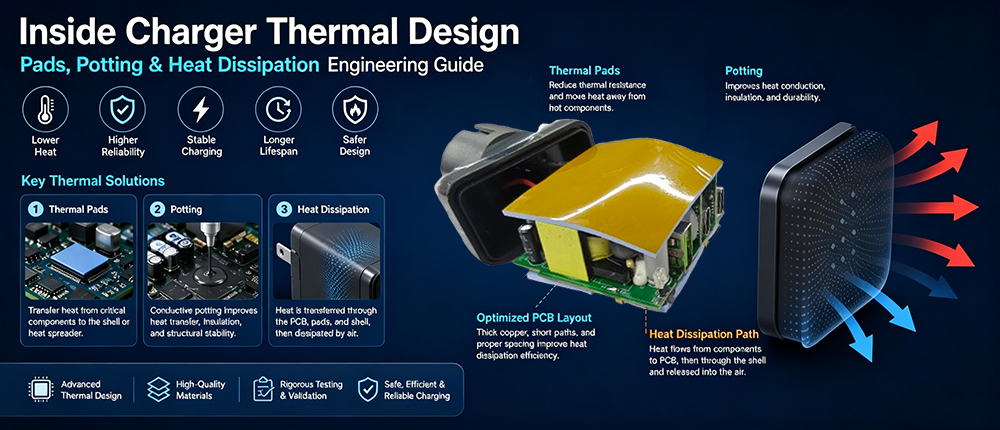
Why Chargers Generate Heat
Every charger converts: AC power → DC power.
During this conversion process, some energy is inevitably lost as heat.
Inside a charger, heat mainly comes from:
• semiconductor switching
• transformers
• MOSFETs
• rectification systems
• PCB resistance
• high-current pathways
As charging wattage increases, thermal density rises dramatically.
Especially in:
• GaN chargers
• PD3.1 chargers
• multi-port desktop chargers
• PPS fast chargers
thermal engineering becomes critical.
Why Heat Is Dangerous for Chargers
Excessive heat affects:
| Area | Impact |
| Efficiency | Lower charging efficiency |
| Lifespan | Faster component aging |
| Stability | Voltage fluctuation |
| Safety | Risk of overheating |
| Charging | Speed Thermal throttling |
Heat is one of the biggest long-term reliability challenges in compact fast chargers.
The Evolution of Charger Thermal Design
Traditional low-power chargers often relied on:
• simple ventilation
• large housing volume
• lower power density
But modern GaN chargers require far more advanced thermal strategies.
Today’s charger engineers must optimize:
• internal airflow
• PCB heat distribution
• thermal conductivity
• component spacing
• heat transfer pathways
inside extremely compact structures.
What Are Thermal Pads in Chargers?
Thermal pads are soft thermally conductive materials placed between:
• heat-generating components
and:
• the charger housing or heatsink
Their purpose is to transfer heat away from critical components efficiently.
Why Thermal Pads Matter
Inside compact chargers, some components can become extremely hot during operation.
Thermal pads help reduce localized hotspots by improving:
• thermal conductivity
• heat spreading
• temperature balancing
They are commonly used around:
• MOSFETs
• transformers
• GaN power ICs
• inductors
especially in:
• 65W+
• 100W+
• multi-port chargers
What Is Potting in Charger Manufacturing?
Potting is a manufacturing process where electronic components are surrounded by:
thermally conductive resin or silicone materials.
This process helps:
• improve heat transfer
• reduce vibration
• increase insulation
• improve structural stability
• protect sensitive components
Potting is commonly used in:
• high-power adapters
• industrial power supplies
• premium GaN chargers
Why Potting Is Important in GaN Chargers
Modern GaN chargers operate at:
• higher switching frequencies
• higher thermal density
compared to older silicon chargers.
Potting helps distribute internal heat more evenly while improving:
• reliability
• durability
• long-term stability
Especially in compact USB-C chargers, potting can significantly improve thermal performance.
PCB Layout Is One of the Biggest Thermal Factors
Many people think charger heat mainly depends on:
• external housing
or:
• fan systems
But in reality: PCB design is one of the most important thermal engineering factors.
Professional charger manufacturers optimize:
• copper thickness
• current pathways
• component spacing
• grounding layers
• thermal vias
to improve heat dissipation across the PCB.
Read More
Why Poor PCB Design Causes Overheating
Low-quality PCB layouts often create:
• thermal concentration
• unstable current distribution
• excessive resistance
• localized hotspots
This can lead to:
• overheating
• thermal throttling
• reduced charger lifespan
especially under continuous high-load charging.
How Heat Dissipation Works Inside a Charger
Modern charger thermal systems usually rely on: passive cooling.
Unlike laptops, most chargers do not use fans.
Instead, they dissipate heat through:
• PCB copper layers
• thermal pads
• housing conduction
• air convection
• potting materials
The charger shell itself often becomes part of the heat transfer system.
Why Charger Housing Materials Matter
Housing materials directly affect thermal behavior.
Common charger housing materials include:
The Evolution of Charger Thermal Design
Traditional low-power chargers often relied on:
• simple ventilation
• large housing volume
• lower power density
But modern GaN chargers require far more advanced thermal strategies.
Today’s charger engineers must optimize:
• internal airflow
• PCB heat distribution
• thermal conductivity
• component spacing
• heat transfer pathways
inside extremely compact structures.
What Are Thermal Pads in Chargers?
Thermal pads are soft thermally conductive materials placed between:
• heat-generating components
and:
• the charger housing or heatsink
Their purpose is to transfer heat away from critical components efficiently.
Why Thermal Pads Matter
Inside compact chargers, some components can become extremely hot during operation.
Thermal pads help reduce localized hotspots by improving:
• thermal conductivity
• heat spreading
• temperature balancing
They are commonly used around:
• MOSFETs
• transformers
• GaN power ICs
• inductors
especially in:
• 65W+
• 100W+
• multi-port chargers
What Is Potting in Charger Manufacturing?
Potting is a manufacturing process where electronic components are surrounded by:
thermally conductive resin or silicone materials.
This process helps:
• improve heat transfer
• reduce vibration
• increase insulation
• improve structural stability
• protect sensitive components
Potting is commonly used in:
• high-power adapters
• industrial power supplies
• premium GaN chargers
Why Potting Is Important in GaN Chargers
Modern GaN chargers operate at:
• higher switching frequencies
• higher thermal density
compared to older silicon chargers.
Potting helps distribute internal heat more evenly while improving:
• reliability
• durability
• long-term stability
Especially in compact USB-C chargers, potting can significantly improve thermal performance.
PCB Layout Is One of the Biggest Thermal Factors
Many people think charger heat mainly depends on:
• external housing
or:
• fan systems
But in reality: PCB design is one of the most important thermal engineering factors.
Professional charger manufacturers optimize:
• copper thickness
• current pathways
• component spacing
• grounding layers
• thermal vias
to improve heat dissipation across the PCB.
Read More
Why Poor PCB Design Causes Overheating
Low-quality PCB layouts often create:
• thermal concentration
• unstable current distribution
• excessive resistance
• localized hotspots
This can lead to:
• overheating
• thermal throttling
• reduced charger lifespan
especially under continuous high-load charging.
How Heat Dissipation Works Inside a Charger
Modern charger thermal systems usually rely on: passive cooling.
Unlike laptops, most chargers do not use fans.
Instead, they dissipate heat through:
• PCB copper layers
• thermal pads
• housing conduction
• air convection
• potting materials
The charger shell itself often becomes part of the heat transfer system.
Why Charger Housing Materials Matter
Housing materials directly affect thermal behavior.
Common charger housing materials include:
| Material | Thermal Performance |
| Standard | Plastic Basic |
| Fireproof PC Material | Better safety |
| Aluminum Alloy | Excellent heat transfer |
| Composite Materials | Balanced performance |
Premium desktop GaN chargers increasingly use:
• aluminum alloy structures
• internal thermal shielding
• multi-layer insulation systems
for better cooling efficiency.
Why Multi-Port Chargers Are Harder to Cool
Single-port chargers already generate substantial heat.
Multi-port chargers are even more challenging because they must manage:
• simultaneous power output
• dynamic power allocation
• protocol switching
• internal thermal balancing
A modern 140W desktop GaN charger may power:
• laptops / tablets / smartphones / gaming devices
all at the same time.
This creates extremely complex thermal conditions.
How Smart Temperature Protection Works
Professional chargers include multiple protection systems.
These may include:
• over-temperature protection
• power reduction logic
• thermal shutdown systems
• current monitoring
• voltage regulation
Some intelligent chargers dynamically reduce power output if internal temperatures exceed safe limits.
Why Cheap Chargers Often Run Hotter
Many low-cost chargers focus heavily on:
• appearance
• advertised wattage
• aggressive pricing
while reducing investment in:
• thermal materials
• PCB engineering
• testing systems
• heat dissipation structures
As a result, these chargers may:
• overheat easily
• degrade faster
• charge unstably
• fail prematurely
especially during laptop charging.
• aluminum alloy structures
• internal thermal shielding
• multi-layer insulation systems
for better cooling efficiency.
Why Multi-Port Chargers Are Harder to Cool
Single-port chargers already generate substantial heat.
Multi-port chargers are even more challenging because they must manage:
• simultaneous power output
• dynamic power allocation
• protocol switching
• internal thermal balancing
A modern 140W desktop GaN charger may power:
• laptops / tablets / smartphones / gaming devices
all at the same time.
This creates extremely complex thermal conditions.
How Smart Temperature Protection Works
Professional chargers include multiple protection systems.
These may include:
• over-temperature protection
• power reduction logic
• thermal shutdown systems
• current monitoring
• voltage regulation
Some intelligent chargers dynamically reduce power output if internal temperatures exceed safe limits.
Why Cheap Chargers Often Run Hotter
Many low-cost chargers focus heavily on:
• appearance
• advertised wattage
• aggressive pricing
while reducing investment in:
• thermal materials
• PCB engineering
• testing systems
• heat dissipation structures
As a result, these chargers may:
• overheat easily
• degrade faster
• charge unstably
• fail prematurely
especially during laptop charging.

ZONSAN's Perspective on Thermal Engineering
As a professional GaN charger manufacturer and OEM USB-C charger supplier, Zonsan Power has seen thermal engineering become one of the most important aspects of modern charger development.
Especially for:
• 100W GaN chargers
• 140W PD3.1 chargers
• multi-port desktop chargers
• compact travel adapters
stable thermal architecture directly affects:
• charging consistency
• efficiency
• reliability
• long-term product safety
Modern charger development increasingly requires coordination between:
• PCB engineers
• thermal engineers
• protocol tuning teams
• component suppliers
• production engineers
to optimize overall charging performance.
Why Thermal Engineering Will Matter Even More in the Future
The future of charging is moving toward:
• higher wattage
• smaller form factors
• AI power allocation
• universal USB-C ecosystems
• multi-device charging
As power density increases, thermal management will become one of the biggest competitive advantages in the charging industry.
Factories with strong thermal engineering capability will likely dominate the next generation of:
• PD3.1 chargers
• GaN desktop chargers
• AI laptop chargers
• high-power travel adapters
Final Thoughts
Modern chargers are no longer simple power adapters.
They are highly engineered power conversion systems operating inside extremely compact environments.
And behind every reliable fast charger is a carefully designed thermal architecture involving:
• PCB optimization
• thermal pads
• potting
• intelligent protection systems
• heat dissipation engineering
As charging power continues increasing in the USB-C era, thermal engineering will become even more critical for both consumers and OEM charger manufacturers.
More Information on GaN Charger
• “Why GaN Chargers Run Cooler Than Traditional Silicon Chargers”↗
• “How to Choose a Reliable GaN Charger Manufacturer”↗
• “USB Power Delivery Official Specifications”↗
• “IEEE Thermal Management Engineering Resources”↗
FAQ (People Also Ask)
Q1: Why do fast chargers get hot?
Fast chargers generate heat during AC-to-DC power conversion, especially under high-power charging conditions.
Q2: What are thermal pads in chargers?
Thermal pads transfer heat away from critical components such as MOSFETs and transformers.
Q3: What is potting in charger manufacturing?
Potting uses thermally conductive materials to improve heat transfer, insulation, and structural protection inside chargers.
Q4: Why are GaN chargers smaller?
GaN semiconductors operate more efficiently at higher switching frequencies, allowing smaller internal components.
Q5: Can overheating damage a charger?
Yes. Excessive heat can reduce efficiency, shorten lifespan, and potentially affect safety and charging stability.
Q6: Why do cheap chargers overheat more easily?
Lower-quality chargers often use weaker PCB layouts, poor thermal materials, and inadequate heat dissipation design.
Q7: Do chargers use fans for cooling?
Most compact chargers rely on passive cooling through PCB design, thermal materials, and housing heat dissipation.
Q8: Why is thermal engineering important for PD3.1 chargers?
Higher wattage charging creates greater thermal density, requiring advanced heat management systems for safe operation.