Why Some USB-C Chargers Charge Faster Than Others (Even with the Same Wattage)
“65W means 65W.”
But in reality, two chargers with the exact same wattage can produce:
• very different charging speeds
• different temperatures
• different battery behavior
• different long-term charging stability
This is especially noticeable with:
• iPhones
• Samsung Galaxy devices
• MacBooks
• gaming handhelds
• laptops
Some chargers feel incredibly fast and stable.
Others become hot, throttle quickly, or charge inconsistently.
So what actually causes the difference?
The answer involves far more than wattage alone.
Modern charging speed depends on:
• charging protocols
• voltage regulation
• thermal engineering
• cable quality
• power allocation
• device compatibility
• internal charger architecture
Let's break it down properly.
Wattage Alone Does Not Determine Charging Speed
One of the biggest misconceptions in fast charging is:
“Higher wattage always charges faster.”
That is only partially true.
Real charging performance depends on whether the charger can deliver: the correct voltage and current profile
that the device actually requests.
If the protocol negotiation fails or is limited, charging speed drops immediately.
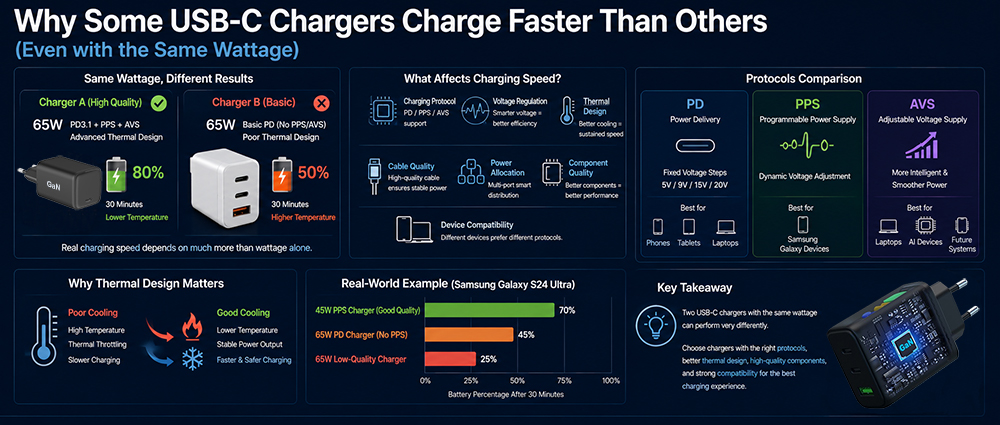
Example: Two 65W Chargers Can Behave Completely Differently
Imagine:
Charger A
• supports PD3.1
• PPS
• AVS
• intelligent thermal regulation
while:
Charger B
• only supports basic PD fixed voltage
• has weak thermal design
• uses low-quality components
Even though both advertise: 65W
their real-world charging behavior may differ dramatically.
Why Charging Protocols Matter
Modern USB-C charging relies heavily on communication between:
• the charger
and:
• the device
This communication determines:
• voltage
• current
• thermal limits
• charging curve behavior
The better the protocol support, the better the charging optimization.
PD vs PPS vs AVS
Modern chargers may support several protocols simultaneously.
PD (Power Delivery)
PD is the mainstream USB-C charging standard.
It supports:
• phones / tablets / laptops / gaming devices
PD typically uses fixed voltage steps like:
• 5V / 9V / 15V / 20V
PPS (Programmable Power Supply)
PPS enables: dynamic voltage adjustment
primarily for smartphones.
Samsung Super Fast Charging heavily relies on PPS.
PPS helps:
• reduce heat
• improve charging efficiency
• protect battery lifespan
AVS (Adjustable Voltage Supply)
AVS is part of newer USB PD ecosystem evolution.
It provides:
• more intelligent voltage regulation
• smoother power transitions
• better high-power optimization
especially for:
• laptops
• future USB-C ecosystems
Why Samsung Phones Often Charge Faster on PPS Chargers
Samsung flagship phones usually prefer: PPS-compatible chargers.
Without PPS support, charging speed may drop significantly even if wattage appears high.
For example:
A basic:
• 65W PD charger
may charge slower than:
• a high-quality 45W PPS charger
on Samsung devices.
This surprises many users.
Why iPhones Behave Differently
Apple devices use a different charging optimization philosophy.
iPhones focus heavily on:
• thermal management
• battery longevity
• adaptive charging behavior
As a result, iPhones may intentionally reduce charging speed under:
• high temperatures
• heavy usage
• battery aging conditions
Even with a powerful charger connected.
Why Thermal Design Changes Charging Speed
Heat is one of the biggest hidden factors affecting charging speed.
When internal charger temperatures rise too high: thermal throttling occurs.
The charger or device automatically reduces power output to protect:
• battery health
• charging ICs
• internal components
This is why some cheap chargers start fast but slow down dramatically after several minutes.
Why GaN Chargers Often Maintain Speed Better
GaN chargers typically provide:
• higher efficiency
• lower heat generation
• faster switching
• better power density
This helps maintain: stable charging performance
for longer periods.
Especially during:
• laptop charging
• multi-device charging
• prolonged high-load operation
Why Cable Quality Matters More Than People Think
Many charging problems actually come from: poor-quality USB-C cables.
A weak cable may limit:
• voltage stability
• current transmission
• EPR support
• data communication
This directly affects charging speed.
EPR Cables Are Important for PD3.1
High-power charging above: 100W
usually requires: EPR-certified cables.
Without proper cable support:
• charging speed drops
• power negotiation may fail
• thermal issues may increase
especially on:
• MacBook Pro 140W charging
• gaming laptops
• desktop GaN chargers
Why Multi-Port Chargers Sometimes Slow Down
Many users notice charging speed changes when multiple devices are connected.
This happens because: power allocation changes dynamically.
For example:
A charger may provide:
• 100W on a single port
but:
• 65W + 30W
when two devices are connected simultaneously.
Smarter chargers handle this transition more efficiently.
Why Internal Components Matter
Two chargers may look nearly identical externally.
But internally, the differences can be enormous.
High-quality chargers often use:
• premium capacitors
• advanced MOSFETs
• optimized transformers
• intelligent protocol ICs
• better PCB layouts
These factors improve:
• stability
• efficiency
• thermal behavior
• charging consistency
Why Cheap Chargers Often Advertise Misleading Numbers
Some low-cost chargers advertise: “65W”
but can only sustain that power briefly.
Under continuous load, they may:
• overheat
• throttle
• reduce voltage stability
• lower charging speed
Professional charger manufacturers test: sustained power delivery
instead of only peak numbers.
Why Device Compatibility Is Becoming More Complex
Modern devices all have different charging behaviors.
For example:
| Device | Preferred Protocol |
| iPhone | PD (iPhone 18 may support AVS) |
| Samsung Galaxy | PPS |
| MacBook Pro | PD3.1 |
| Gaming Laptop | PD3.1 EPR |
| Laptop | AVS-ready systems |
This means: one charger does not always optimize every device equally.
Why Future Chargers Will Become “Smarter”
The future of charging is no longer only about: higher wattage.
It is increasingly about:
• intelligent regulation
• thermal optimization
• dynamic voltage control
• AI-based power allocation
This is why:
• PPS
• AVS
• PD3.2
• smart power management
are becoming major industry trends.
ZONSAN's Perspective on Real-World Charging Performance
As a professional GaN charger manufacturer and OEM USB-C charger supplier, Zonsan Power has observed that real charging experience increasingly depends on:
• protocol optimization
• PCB engineering
• thermal management
• dynamic power allocation
• device compatibility testing
rather than wattage numbers alone.
Especially for:
• 65W+
• 100W
• 140W PD3.1 chargers
engineering optimization now plays a major role in:
• sustained charging speed
• temperature stability
• long-term reliability
Modern charger development increasingly requires coordination between:
• protocol engineers
• thermal engineers
• PCB designers
• compatibility testing teams
to ensure stable performance across multiple device ecosystems.
Final Thoughts
Two USB-C chargers with identical wattage ratings can perform very differently in real-world use.
Because modern charging speed depends on far more than: wattage alone.
Real charging performance is influenced by:
• PD/PPS/AVS support
• thermal engineering
• cable quality
• PCB architecture
• protocol optimization
• sustained power stability
As USB-C ecosystems continue evolving, the best chargers will increasingly be defined not by: peak numbers
but by: intelligent engineering.
Recommended
• “PD3.0 vs PD3.1 vs PD3.2 (AVS): The Future of USB-C Charging”↗
• “Inside Charger Thermal Design: Pads, Potting & Heat Dissipation”↗
• “USB Power Delivery Official Specifications”↗
• “USB-IF Certified USB-C Cable Information”↗
FAQ (People Also Ask)
Q1: Why do some 65W chargers charge faster than others?
A: Because charging speed depends on protocol support, thermal design, cable quality, and power regulation — not wattage alone.
Q2: Does PPS make charging faster?
A: Yes. PPS allows more precise voltage adjustment, improving charging efficiency and reducing heat, especially on Samsung devices.
Q3: Why does my charger slow down after a few minutes?
A: Thermal throttling may occur when charger or battery temperatures become too high.
Q4: Are GaN chargers faster than regular chargers?
A: GaN chargers are often more efficient and maintain stable charging speeds longer due to better thermal performance.
Q5: Why does cable quality affect charging speed?
A: Poor-quality cables may limit current transmission, voltage stability, and protocol communication.
Q6: What is AVS charging?
A: AVS (Adjustable Voltage Supply) is a next-generation USB-C charging technology focused on dynamic intelligent voltage regulation.
Q7; Why does my phone charge slowly even with a fast charger?
A: Your device may not support the charger’s protocol, or thermal protection may reduce charging speed.
Q8: Is higher wattage always better?
A: Not always. Proper protocol compatibility and thermal engineering are often more important than peak wattage numbers alone.
Why Future Chargers Will Become “Smarter”
The future of charging is no longer only about: higher wattage.
It is increasingly about:
• intelligent regulation
• thermal optimization
• dynamic voltage control
• AI-based power allocation
This is why:
• PPS
• AVS
• PD3.2
• smart power management
are becoming major industry trends.
ZONSAN's Perspective on Real-World Charging Performance
As a professional GaN charger manufacturer and OEM USB-C charger supplier, Zonsan Power has observed that real charging experience increasingly depends on:
• protocol optimization
• PCB engineering
• thermal management
• dynamic power allocation
• device compatibility testing
rather than wattage numbers alone.
Especially for:
• 65W+
• 100W
• 140W PD3.1 chargers
engineering optimization now plays a major role in:
• sustained charging speed
• temperature stability
• long-term reliability
Modern charger development increasingly requires coordination between:
• protocol engineers
• thermal engineers
• PCB designers
• compatibility testing teams
to ensure stable performance across multiple device ecosystems.
Final Thoughts
Two USB-C chargers with identical wattage ratings can perform very differently in real-world use.
Because modern charging speed depends on far more than: wattage alone.
Real charging performance is influenced by:
• PD/PPS/AVS support
• thermal engineering
• cable quality
• PCB architecture
• protocol optimization
• sustained power stability
As USB-C ecosystems continue evolving, the best chargers will increasingly be defined not by: peak numbers
but by: intelligent engineering.
Recommended
• “PD3.0 vs PD3.1 vs PD3.2 (AVS): The Future of USB-C Charging”↗
• “Inside Charger Thermal Design: Pads, Potting & Heat Dissipation”↗
• “USB Power Delivery Official Specifications”↗
• “USB-IF Certified USB-C Cable Information”↗
FAQ (People Also Ask)
Q1: Why do some 65W chargers charge faster than others?
A: Because charging speed depends on protocol support, thermal design, cable quality, and power regulation — not wattage alone.
Q2: Does PPS make charging faster?
A: Yes. PPS allows more precise voltage adjustment, improving charging efficiency and reducing heat, especially on Samsung devices.
Q3: Why does my charger slow down after a few minutes?
A: Thermal throttling may occur when charger or battery temperatures become too high.
Q4: Are GaN chargers faster than regular chargers?
A: GaN chargers are often more efficient and maintain stable charging speeds longer due to better thermal performance.
Q5: Why does cable quality affect charging speed?
A: Poor-quality cables may limit current transmission, voltage stability, and protocol communication.
Q6: What is AVS charging?
A: AVS (Adjustable Voltage Supply) is a next-generation USB-C charging technology focused on dynamic intelligent voltage regulation.
Q7; Why does my phone charge slowly even with a fast charger?
A: Your device may not support the charger’s protocol, or thermal protection may reduce charging speed.
Q8: Is higher wattage always better?
A: Not always. Proper protocol compatibility and thermal engineering are often more important than peak wattage numbers alone.