Can Use a 100W Charger for My Smartphone? - 2025 Updated Guide Overview
Reviewers: Emma and Luke
Review Date: September 3, 2026
Yes, you can use a 100 W charger for your smartphone - but there's more to it than just plugging it in. The real power lies in compatibility, certification, and smart charging protocols.
In this guide, we'll answer:
·Can a 100 W charger damage your phone?
·Will it work with 25 W, 35 W, or 65 W phones like iPhone 16 or Galaxy phones?. ls it overkill, or future-proof?
·Tips for safely using 100 W chargers from factory-grade suppliers
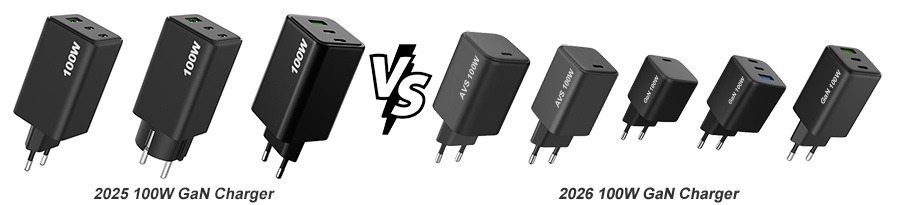
When people see “100W charger,” they sometimes assume that connecting a smartphone will force 100W into the phone. That is not how a properly designed USB-C charging system works.
From a charger engineer's perspective, the more useful way to think about a 100W charger is: 100W is the charger's maximum rated output capability—not necessarily the power consumed by every connected device.
The actual charging power depends on the interaction between: Charger + Charging Protocol + Cable + Smartphone + Battery Condition.
For example, a 100W USB-C PD charger may be capable of delivering high-power output, while a smartphone may request and accept only the power level supported by its own charging system. This is why a 100W charger can be used for many lower-power smartphones without automatically forcing them to charge at 100W.
Why This Matters for B2B Charger Buyers
For consumers, the question is usually: “Can I safely use this charger?”
For a brand owner, retailer, or distributor, there are additional questions:
• What output profiles does the charger support?
• Does it support USB-C PD? Does it support PPS?
• Which smartphone platforms have been tested?
• What cable is required for the advertised power?
• How does the charger behave at full load?
• How does it perform thermally?
• What protections are included?
• What certifications are available for the target market?
• Can the same design remain consistent during mass production?
For B2B purchasing, 100W should therefore be treated as a product specification, not the entire product evaluation.
1. The Short Answer: "Yes, as Long as It's the Right Kind"
Modern smartphones manage charging intelligently, only drawing as much power as they can safely handle. A 100 W PD charger won't force 100 W into your phone - it dynamically delivers the correct voltage and current.
Related Searches:
·Can I use 100 Wcharger for 65 Wphone? →Yes, you'll get 65 W or the device's max supported.
·Is 100 Wcharger safe for Samsung?→Yes, if the device supports PD, PPS or equivalent protocols.
What Actually Happens When You Connect a Phone to a 100W PD Charger
A simplified charging sequence looks like this:
1. The charger is connected
↓
2. The phone and charger identify supported charging capabilities
↓
3. A compatible charging mode is established
↓
4. The phone requests an appropriate power level
↓
5. The charger supplies power within its supported operating range
↓
6. The phone manages the charging process according to its own requirements
This is why the charger's maximum rating and the phone's actual charging power are two different things.
100W Does Not Mean 100W at All Times
Even when a smartphone supports relatively high-power charging, actual power consumption can change throughout the charging cycle.
Charging power can vary according to: battery state of charge, battery temperature, phone temperature, system load, charging protocol, charger capability, cable capability, and device power-management strategy etc.
Therefore, a phone's peak charging power should not be confused with its power consumption throughout the entire charging session.
For example, a phone may briefly approach its maximum supported charging power under suitable conditions and then reduce power as charging progresses.
This is normal behavior.
Important: Maximum Charging Power Is Device- and Protocol-Dependent
2. Do These Phones Accept 100 W Charging?
| Phone Model | Max Supported Charging Rate | Remarks |
| iPhone 16 (USB-C) | ~27W | 100 W is overkill but safe |
| iPhone 17 (USB-C) | ~40W | 100 W is overkill but safe |
| Samsung Galaxy S25 | ~45W (PPS) | 100 W works if PPS or PD-compliant |
| Samsung Galaxy S26 | ~60W (PPS) | 100 W works if PPS or PD-compliant |
| Mid-range Androids | 25W–65W or 45W - 100W | Charger will just limit power output |
| Laptops (USB-C charging) | Up to 140–240W | 100 W may work but slower than higher PD |
Don't Confuse "100W Charger" With "100W Phone"
A 100W charger can be useful even if the smartphone itself does not support 100W charging.
For example, one charger may be used for smartphone, tablet, laptop, handheld gaming device, headphones, and other USB-C accessories.
This makes higher-power USB-C chargers attractive as multi-device charging solutions.
Therefore, its advantage does not necessarily lie in the ability to charge a phone at 100W. The real advantage is that a single charger can support a wider variety of devices.
3. What Makes a 100 W Charger Safe?
Key factors that ensure safety and compatibility:
·USB Power Delivery (PD) or PPS support
·Quality control from credible factory manufacturers / OEM suppliers
·Built-in protections: overvoltage, overcurrent, temperature, short circuit
·Trusted certifications: CE (Europe),KC (Korea), RoHS,etc.
·USB Power Delivery (PD) or PPS support
·Quality control from credible factory manufacturers / OEM suppliers
·Built-in protections: overvoltage, overcurrent, temperature, short circuit
·Trusted certifications: CE (Europe),KC (Korea), RoHS,etc.
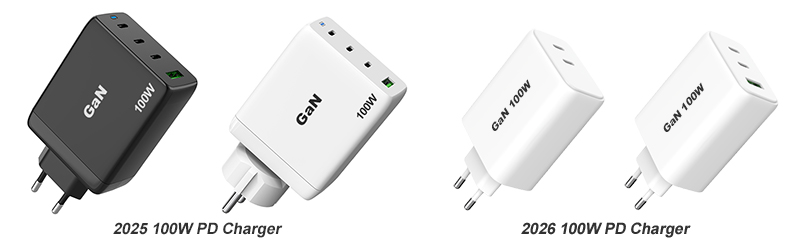
Safety Is More Than Having a Protection IC
From a charger engineer's perspective, protection functions are only one part of the overall safety design.
A professional 100W charger may need to consider:
Input protection; Protection against abnormal input conditions.
Output over-voltage protection; Helps prevent the output from exceeding the intended operating range.
Over-current protection; Helps control abnormal output current conditions.
Short-circuit protection; Allows the charger to respond appropriately to a short-circuit condition.
Over-temperature protection; Helps protect the charger when internal temperatures become excessive.
Thermal design; Components, PCB layout and enclosure design all influence heat dissipation.
Thermal Design Becomes More Important at 100W
Higher output power means the charger must process more electrical energy. Even with a highly efficient power-conversion design, some energy becomes heat.
For a compact 100W charger, engineers therefore need to consider: semiconductor losses, transformer losses, switching losses, PCB copper losses, connector losses, enclosure thermal characteristics and ambient temperature.
A small enclosure is attractive to consumers, but it also gives engineers less physical space for heat management.
How a Factory Verifies a 100W Charger
A professional charger manufacturer can evaluate a 100W charger under controlled load conditions.
Only by passing the following verifications can the safety and consistency of mass-produced chargers be ensured.
Higher output power means the charger must process more electrical energy. Even with a highly efficient power-conversion design, some energy becomes heat.
For a compact 100W charger, engineers therefore need to consider: semiconductor losses, transformer losses, switching losses, PCB copper losses, connector losses, enclosure thermal characteristics and ambient temperature.
A small enclosure is attractive to consumers, but it also gives engineers less physical space for heat management.
How a Factory Verifies a 100W Charger
A professional charger manufacturer can evaluate a 100W charger under controlled load conditions.
Only by passing the following verifications can the safety and consistency of mass-produced chargers be ensured.
| Test | Purpose |
| No-load test | Check standby behavior |
| Low-load test | Evaluate low-power operation |
| Rated-load test | Verify specified output |
| Full-load test | Evaluate maximum operating condition |
| Thermal test | Monitor temperature rise |
| Ripple test | Evaluate output stability |
| Protection test | Verify safety responses |
| Aging test | Evaluate long-duration operation |
| Device compatibility test | Check real-device charging behavior |
The exact test conditions depend on the product design and target market.

4.When 100 W Is Really Useful
·Charging laptops with 100W-200 W input requirement
·Multi-device charging stations (e.g., 100 W output split between 65W + 35 W)
·Lighter, compact dimension alternatives to bulky laptop bricks
Using a 100 W GaN charger from a reputable factory gives flexibility and future-proofing.
* What are GaN 1, GaN 2, and GaN 3? ↗
Single-Port vs. Multi-Port 100W Chargers
This is an important distinction that buyers sometimes overlook.
A charger labeled 100W may mean: 100W maximum output from one USB-C port or 100W total output shared across multiple ports
These are not the same product experience.
For example: 100W total could potentially be allocated as: USB-C1: 65W + USB-C2: 35W, or USB-C1: 65W + (USB-C2 + USB-A: 25W); depending on the product design.
The specific power distribution scheme is clearly indicated in the product specification.
100W as a B2B Multi-Device Platform
For charger brands, 100W is particularly interesting because it sits in a useful range between conventional phone chargers and higher-power laptop adapters.
A well-designed 100W USB-C PD charger can potentially target: smartphone users, tablet users, laptop users, business travelers, home-office users, gaming users, and multi-device households
For OEM/ODM customers, this means that a single underlying power platform can be used to derive different products by adjusting a few elements.
The final specification should always be validated by the engineering team rather than assuming that every 100W platform is interchangeable.
5. When to Avoid 100 W Chargers
·Older gadgets without USB-C PD support: they will fall back to slower charging (not harmful,
but pointless)
·Cheap non-certified chargers that could risk safety or battery health
The Real Problem Is Usually Not "100W"
A high-wattage charger is not automatically unsafe simply because it has a high power rating.
The more important question is: Is the charger properly designed, tested and compatible with the intended device?
For this reason, a professionally engineered 100W charger can be a better choice than a poorly designed lower-power charger.
Rather than selecting products based solely on price and wattage.
Warning Signs of a Poor-Quality Charger
A charger deserves closer attention if it shows: abnormal overheating! burning smell! crackling sounds! unstable charging! repeated charging interruptions! damaged housing! loose connectors! unexplained power drops! (Why Does My Charger Make a Buzzing Sound?)
Do not continue using a product that is behaving abnormally simply because the charger has a high power rating.
100W Charger Cable Requirements (3A/5A/6A Charging Cables)
The charger is only one part of the system. For high-power USB-C charging, the cable can also influence performance.
A charger project should therefore define: Charger specification + Cable specification, rather than evaluating the charger independently.
At the same time, the claim that "any USB-C cable supports 100W charging" is incorrect.
This is an important distinction that buyers sometimes overlook.
A charger labeled 100W may mean: 100W maximum output from one USB-C port or 100W total output shared across multiple ports
These are not the same product experience.
For example: 100W total could potentially be allocated as: USB-C1: 65W + USB-C2: 35W, or USB-C1: 65W + (USB-C2 + USB-A: 25W); depending on the product design.
The specific power distribution scheme is clearly indicated in the product specification.
100W as a B2B Multi-Device Platform
For charger brands, 100W is particularly interesting because it sits in a useful range between conventional phone chargers and higher-power laptop adapters.
A well-designed 100W USB-C PD charger can potentially target: smartphone users, tablet users, laptop users, business travelers, home-office users, gaming users, and multi-device households
For OEM/ODM customers, this means that a single underlying power platform can be used to derive different products by adjusting a few elements.
The final specification should always be validated by the engineering team rather than assuming that every 100W platform is interchangeable.
5. When to Avoid 100 W Chargers
·Older gadgets without USB-C PD support: they will fall back to slower charging (not harmful,
but pointless)
·Cheap non-certified chargers that could risk safety or battery health
The Real Problem Is Usually Not "100W"
A high-wattage charger is not automatically unsafe simply because it has a high power rating.
The more important question is: Is the charger properly designed, tested and compatible with the intended device?
For this reason, a professionally engineered 100W charger can be a better choice than a poorly designed lower-power charger.
Rather than selecting products based solely on price and wattage.
Warning Signs of a Poor-Quality Charger
A charger deserves closer attention if it shows: abnormal overheating! burning smell! crackling sounds! unstable charging! repeated charging interruptions! damaged housing! loose connectors! unexplained power drops! (Why Does My Charger Make a Buzzing Sound?)
Do not continue using a product that is behaving abnormally simply because the charger has a high power rating.
100W Charger Cable Requirements (3A/5A/6A Charging Cables)
The charger is only one part of the system. For high-power USB-C charging, the cable can also influence performance.
A charger project should therefore define: Charger specification + Cable specification, rather than evaluating the charger independently.
At the same time, the claim that "any USB-C cable supports 100W charging" is incorrect.
What a Professional 100W Charger Manufacturer Should Be Able to Explain
If you are purchasing a 100W charger (whether OEM or private-label), please ask the merchant or supplier for the following information:
What is the maximum single-port output?
What PD profiles are supported?
Is PPS supported?
What happens under multi-port loading?
Whether it is genuine 100W charging? (specifically regarding very low-priced 100W chargers)
Does it hold compliance certifications for regions such as Europe and the Americas?
6.FAQ Section
Q1: Can I use a 100 W charger for my 65 W phone?
Yes. Your phone will only draw what it needs, safely limiting to 65 W.
Q2: Can I use a 100 W charger for iPhone 16?
Yes. iPhone 16's max fast charging is ~27 W; a 100 W charger will deliver that-no harm done.
Q3: Will a 100 W charger damage my phone?
No, if it's certified and PD-compliant. The phone controls draw; good chargers have built-in protections.
Q4: Is a 100 W charger good for my laptop as well?
Yes, if your laptop supports USB-C PD. It's a great multi-device option.
Q5: Is a 100 W charger safe for Samsung phones?
Yes, if the charger supports PPS or PD protocols--Samsung phones accept modern protocols safely.
Q6: Will a 100W charger make my phone charge faster?
Not necessarily. Charging speed is limited by the phone's supported charging system, charger compatibility, cable capability and charging conditions.
A 100W charger provides more available capacity, but the phone determines how much power it can use under a compatible charging condition.
Q7: Is a 100W GaN charger better than a conventional 100W charger?
Not automatically. GaN can enable compact and efficient designs, but the final product depends on the entire engineering system.
Q8: Can I charge my phone and laptop at the same time with a 100W charger?
Potentially yes, if the charger is designed as a multi-port charger.
However, the total 100W rating may be shared between the connected ports.
Always check the manufacturer's specific power-allocation table.
Q9: Do I need a special cable for a 100W charger?
You should use a cable that supports the intended charging power and protocol requirements.
For higher-power USB-C charging, cable current capability and E-marker implementation may become relevant.
Q10: Should a B2B buyer ask for 100W charger test reports?
Yes. For OEM or private-label projects, it is crucial to request internal product specifications, test reports, certification documents, and the like.
Final Takeaway: Is a 100W Charger Safe for a Smartphone?
Yes, a properly designed and compatible 100W USB-C charger can be used with many smartphones.
But the important point is: The phone does not automatically receive the charger's maximum 100W output simply because the charger is rated at 100W.
Actual charging depends on the interaction between: Phone + Charger + Protocol + Cable + Charging Conditions
For consumers, the priority should be using a reputable, compatible charger.
For B2B buyers, the evaluation should go further.
A good 100W charger is therefore not defined only by the “100W” printed on its housing.
It is defined by how reliably and consistently the complete charging system delivers that power under its specified operating conditions.
A Practical Rule for Consumers
If your phone supports 25W, 30W, 45W or another lower charging level, using a reputable 100W USB-C PD charger can still make sense.
You are buying available charging capacity, not forcing your phone to consume the full 100W. The same charger can then potentially be used for other compatible devices in the future.
That is where a 100W charger can provide real value.
A Practical Rule for B2B Buyers
When evaluating a 100W charger supplier, don't ask only: “Can you make a 100W charger?”
Ask: “How do you validate the 100W design, and how do you maintain its performance during mass production?”
That second question tells you much more about the manufacturer's engineering and manufacturing capability.
7. Related Internal Articles
1. GaN Charger vs Normal Charger: What's Best for 2026? ↗
2. PPS vs PD Charger:Which One is Better in 2026? ↗
Factory Gan Charger Wholesaler
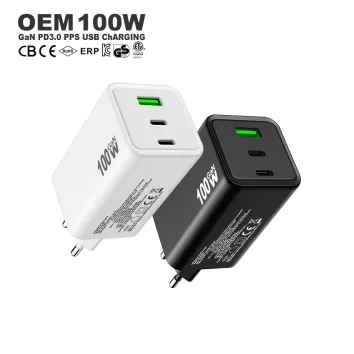
Designed for OEM charger manufacturing and brand customization, this 100W USB-C wall charger combines high output power, intelligent power distribution, and compact GaN design, making it ideal for modern users who require efficient charging across smartphones, tablets, and laptops.
Read More
Read More
-universal-charging-for-laptop-samsung-iphone-fast-charger-zx-3u43t.jpg)
Read More
If you are purchasing a 100W charger (whether OEM or private-label), please ask the merchant or supplier for the following information:
What is the maximum single-port output?
What PD profiles are supported?
Is PPS supported?
What happens under multi-port loading?
Whether it is genuine 100W charging? (specifically regarding very low-priced 100W chargers)
Does it hold compliance certifications for regions such as Europe and the Americas?
6.FAQ Section
Q1: Can I use a 100 W charger for my 65 W phone?
Yes. Your phone will only draw what it needs, safely limiting to 65 W.
Q2: Can I use a 100 W charger for iPhone 16?
Yes. iPhone 16's max fast charging is ~27 W; a 100 W charger will deliver that-no harm done.
Q3: Will a 100 W charger damage my phone?
No, if it's certified and PD-compliant. The phone controls draw; good chargers have built-in protections.
Q4: Is a 100 W charger good for my laptop as well?
Yes, if your laptop supports USB-C PD. It's a great multi-device option.
Q5: Is a 100 W charger safe for Samsung phones?
Yes, if the charger supports PPS or PD protocols--Samsung phones accept modern protocols safely.
Q6: Will a 100W charger make my phone charge faster?
Not necessarily. Charging speed is limited by the phone's supported charging system, charger compatibility, cable capability and charging conditions.
A 100W charger provides more available capacity, but the phone determines how much power it can use under a compatible charging condition.
Q7: Is a 100W GaN charger better than a conventional 100W charger?
Not automatically. GaN can enable compact and efficient designs, but the final product depends on the entire engineering system.
Q8: Can I charge my phone and laptop at the same time with a 100W charger?
Potentially yes, if the charger is designed as a multi-port charger.
However, the total 100W rating may be shared between the connected ports.
Always check the manufacturer's specific power-allocation table.
Q9: Do I need a special cable for a 100W charger?
You should use a cable that supports the intended charging power and protocol requirements.
For higher-power USB-C charging, cable current capability and E-marker implementation may become relevant.
Q10: Should a B2B buyer ask for 100W charger test reports?
Yes. For OEM or private-label projects, it is crucial to request internal product specifications, test reports, certification documents, and the like.
Final Takeaway: Is a 100W Charger Safe for a Smartphone?
Yes, a properly designed and compatible 100W USB-C charger can be used with many smartphones.
But the important point is: The phone does not automatically receive the charger's maximum 100W output simply because the charger is rated at 100W.
Actual charging depends on the interaction between: Phone + Charger + Protocol + Cable + Charging Conditions
For consumers, the priority should be using a reputable, compatible charger.
For B2B buyers, the evaluation should go further.
A good 100W charger is therefore not defined only by the “100W” printed on its housing.
It is defined by how reliably and consistently the complete charging system delivers that power under its specified operating conditions.
A Practical Rule for Consumers
If your phone supports 25W, 30W, 45W or another lower charging level, using a reputable 100W USB-C PD charger can still make sense.
You are buying available charging capacity, not forcing your phone to consume the full 100W. The same charger can then potentially be used for other compatible devices in the future.
That is where a 100W charger can provide real value.
A Practical Rule for B2B Buyers
When evaluating a 100W charger supplier, don't ask only: “Can you make a 100W charger?”
Ask: “How do you validate the 100W design, and how do you maintain its performance during mass production?”
That second question tells you much more about the manufacturer's engineering and manufacturing capability.
7. Related Internal Articles
1. GaN Charger vs Normal Charger: What's Best for 2026? ↗
2. PPS vs PD Charger:Which One is Better in 2026? ↗
Factory Gan Charger Wholesaler
Designed for OEM charger manufacturing and brand customization, this 100W USB-C wall charger combines high output power, intelligent power distribution, and compact GaN design, making it ideal for modern users who require efficient charging across smartphones, tablets, and laptops.
Read More
Read More
Read More