How a Fast Charger Works: Step-by-Step Animation Guide (2026 Ultimate Guide)
⭐ Featured Snippet
Fast charging works by increasing voltage and current through advanced protocols like USB-C Power Delivery (PD) and PPS. Inside a charger, AC power is converted to DC, regulated by IC chips, and dynamically adjusted based on device needs. This allows faster, safer charging for smartphones, tablets, and laptops.
Introduction
Why does a 20W charger feel slow, while a 65W or 100W USB-C PD charger powers your device in minutes?
👉 The answer lies in how fast charging actually works inside the charger.
Modern phone chargers, wall chargers, and USB chargers are no longer simple adapters—they are intelligent power systems designed by advanced charger manufacturers and OEM factories.
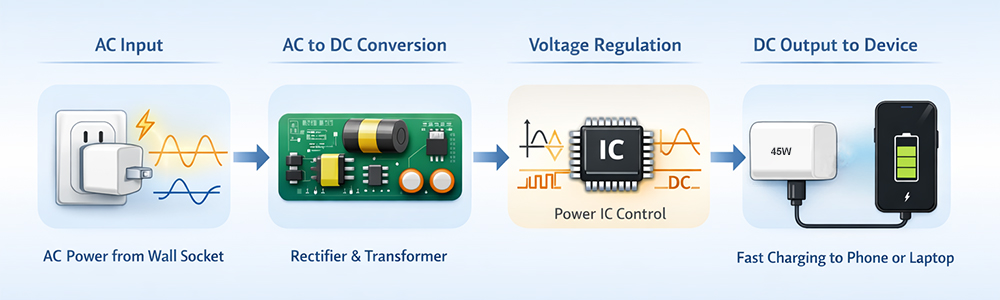
⚡ Step-by-Step: How a Fast Charger Works
Below is a simplified visual guide 👇
Fast Charger Working Principle
Step 1: AC Power Input (Wall Socket)
Power enters from AC outlet (110V–240V)
Used by all wall chargers and laptop chargers
👉 This is the starting point for every phone charger manufacturer design
Step 2: AC → DC Conversion (Rectifier + Transformer)
Inside the charger:
• rectifier converts AC → DC
• transformer adjusts voltage level
👉 This stage is critical for:
• 20W / 25W / 30W chargers
• 65W / 100W / 140W PD chargers
Step 3: Power Regulation (IC Control + Protocols)
This is where fast charging happens.
The power IC (chip):
• detects device requirements
• negotiates voltage & current
• activates protocols like: USB-C PD / PPS / QC
👉 Without this step, fast charging is impossible.
Step 4: Dynamic Output to Device
The charger delivers:
• optimized voltage
• stable current
• real-time adjustment
👉 Result:
⚡ faster charging
🔋 safer battery health
🌡 lower heat
⚙️ Fast Charging Protocols Explained
USB-C Power Delivery (PD)
• up to 240W (PD3.1)
• used for laptops, tablets
PPS (Programmable Power Supply)
• dynamic voltage adjustment
• used in Samsung fast charging
👉 Learn more about internal charger structure here: Inside a Chargher Key Components Explained↗
Why Fast Chargers Are Faster (Core Principle)
Traditional chargers:
• fixed voltage
• limited current
Fast chargers:
• increase power (W = V × A)
• dynamically adjust output
👉 Example:
• 5V × 2A = 10W
• 20V × 5A = 100W
🔥 Role of GaN Technology
Modern GaN chargers use advanced semiconductors to:
• reduce size
• increase efficiency
• lower heat
Zonsan Engineering Insight
As a professional charger manufacturer, Zonsan focuses on optimizing internal fast charging architecture.
From IC selection to transformer design, Zonsan ensures:
• high efficiency
• stable PD/PPS output
• low thermal loss
Why Fast Charging Safety Depends on Design
A high-quality PD charger factory ensures:
✔ accurate voltage control
✔ thermal protection
✔ stable PCB layout
👉 Poor-quality chargers may cause:
❌ overheating
❌ slow charging
❌ device damage
👉 For safety insights, see: GaN Fast Charger Explained↗
OEM Charger Factory Perspective
For brands sourcing chargers:
Choosing the right phone charger manufacturer or laptop charger manufacturer is critical.
Look for:
• PD3.1 & PPS support
• GaN technology capability
• certifications (CE, RoHS, FCC, KCC)
• stable mass production
Zonsan Factory Capability
Zonsan provides OEM & ODM services for:
• 20W–140W fast chargers
• USB-C PD chargers
• PPS chargers
• GaN chargers
With 17+ years of experience, Zonsan supports global brands with:
• customized design
• certified products
• scalable production
Common Fast Charger Power Ranges
📱 Smartphones & Mobile Devices & USB Devices
• 20W charger
• 25W charger
• 30W charger
• 35W charger
💻 Mobile Phone & Laptops & Tablets & MacBook
• 45W charger
• 65W charger
• 100W charger
• 120W charger
• 140W charger
👉 Power level determines charging speed—but only if internal design is strong.
Conclusion
Fast charging is not just about higher wattage.
It’s about:
✔ intelligent IC control
✔ efficient power conversion
✔ safe thermal management
👉 Understanding how it works helps both consumers and B2B buyers make better decisions.
FAQ (People Also Ask)
Q1: How does a fast charger work step by step?
It converts AC to DC, regulates voltage via IC, and dynamically adjusts output using fast charging protocols.
Q2: What makes a charger “fast”?
Higher power output combined with smart voltage/current control.
Q3: Is fast charging safe for batteries?
Yes, if the charger includes proper protection and protocol control.
Q4: What is PD vs PPS charging?
PD delivers fixed profiles, while PPS adjusts voltage dynamically.
Q5: Why do some 100W chargers feel slower?
Device limits and cable capability affect real output.
Q6: Do all USB-C chargers support fast charging?
No. Only chargers with PD or PPS protocols support fast charging.
Q7: What is the role of IC in fast charging?
It manages voltage, current, and communication with the device.
Q8: Are GaN chargers better?
Yes, they are more efficient, compact, and generate less heat.