Charger Engineering Change Control: How Mobile Phone Charger Manufacturers Validate Design Changes Without Disrupting Mass Production
Provider of Information: Luke and Selike (Engineer)
Why Engineering Changes Need More Than a Quick Approval
A mobile phone charger design is rarely frozen forever after the first successful prototype. During development and mass production, engineers may need to change a component, adjust a PCB layout, revise a USB-C power profile, modify the housing, or qualify a different supplier.
Some changes are small. Others can affect electrical performance, thermal behavior, safety, certification, or production consistency.
The difficulty is not simply making the change. It is making sure the revised product still performs as intended — and that every department is working from the same approved version.
This is where mobile charger engineering change control becomes important.
In a professional charger manufacturing environment, an engineering change should have a clear reason, a defined scope, an impact assessment, appropriate validation, and a controlled release into production. Without that process, a technically acceptable modification can still create problems on the factory floor.
For mobile phone charger brands, importers, and OEM buyers, understanding engineering change management is also a practical way to evaluate a manufacturer's development discipline. It helps answer an important question: when a product needs to change, can the factory control that change without creating uncertainty in the finished product?
1. What Is Engineering Change Control in Phone Charger Manufacturing?
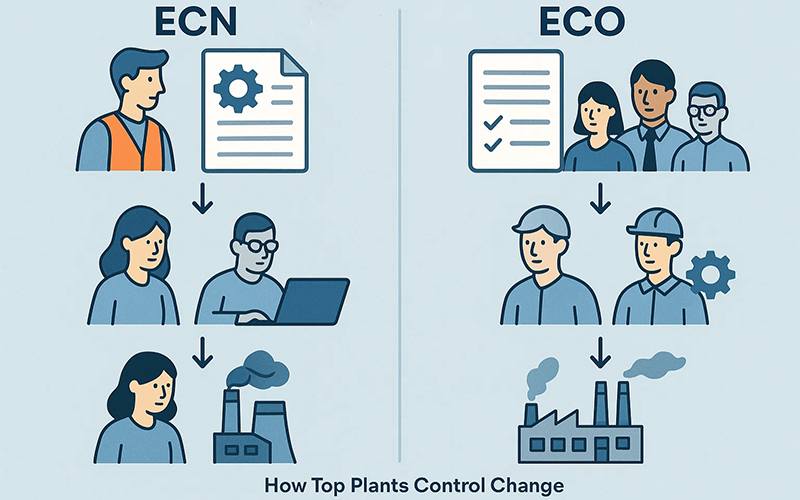
Engineering change control is the process used to review, approve, verify, document, and release changes to an existing product or manufacturing process.
In electronics manufacturing, several related terms are commonly used:
• ECR (Engineering Change Request): A request to investigate or propose a change.
• ECO (Engineering Change Order): An approved instruction to implement a defined engineering change.
• ECN (Engineering Change Notice): A formal notice communicating an approved change to the relevant departments or stakeholders.
Terminology varies between companies. Some phone charger manufacturers use ECO and ECN differently, or combine parts of the process into one document. What matters is that the responsibilities and approval stages are clearly defined.
For a USB-C charger, an engineering change may involve much more than replacing one electronic component. It can affect the electrical design, mechanical structure, firmware or protocol configuration, production process, supplier documentation, and certification status.
For example, changing a power-stage component may require phone charger engineers to review its electrical characteristics, operating temperature, switching behavior, and compatibility with the existing circuit. Even if the replacement component has a similar headline rating, it should not automatically be treated as an identical substitute.
Engineering change control provides a structured way to make that decision.Engineering change control provides a structured way to make that decision.
2. What Usually Triggers an Engineering Change?
Not every change begins with a product failure. In fact, many changes are preventive or commercially driven.
In smart phone charger development and production, common triggers include the following.
Component availability and supplier changes (Most common)
When semiconductors, capacitors, transformer materials, connectors, or other certified components become difficult to procure—or when such materials are in short supply—manufacturers will validate and introduce alternatives to ensure production continuity. However, any alternative component must be evaluated against the specific requirements of the circuit. Similar model numbers or identical nominal ratings do not necessarily guarantee that the electrical characteristics are exactly the same.
Design improvement
Engineering teams may identify an opportunity to improve the PCB layout, reduce unnecessary complexity, refine a protection circuit, or improve the mechanical arrangement.
The proposed improvement still needs to be checked against the complete product design. A change that benefits one area may introduce a new constraint elsewhere.
Customer customization
An OEM customer may request a different USB-C port configuration, output allocation, housing dimension, plug type, label, or charging protocol requirement.
Some requests are straightforward. Others affect the existing electrical or mechanical architecture and therefore require a more detailed engineering review.
Certification or market requirements
A product intended for a new market may require changes to its plug configuration, labeling, materials, documentation, or compliance testing.
A manufacturer should determine whether the proposed revision affects the existing certification evidence and whether additional assessment is needed.
Manufacturing process changes
A new production fixture, assembly method, soldering parameter, supplier, or material may require process validation.
Even when the circuit design remains unchanged, a manufacturing change can affect the consistency of the finished charger.
The important point is that engineering change management should cover both product-design changes and relevant process changes. Otherwise, the factory may control the drawing revision while overlooking a change happening on the production line.
3. The Engineering Change Control Process: From Request to Production Release
A controlled process does not need to be complicated, but it should have clear stages. The following is a practical framework for USB-C Gan charger manufacturing.
Step 1 — Record the Change Request
Every proposed change should begin with a documented request.
The request should explain:
• Which model or product revision is affected
• What needs to change
• Why the change is being proposed
• Which component, drawing, specification, or process is involved
• Whether existing inventory or work in progress may be affected
• Whether the request comes from engineering, procurement, production, quality, or the customer
A request such as "replace the power IC because the original part is unavailable" is a starting point, not an approved engineering instruction. The team still needs to identify the exact part, the reason for replacement, and the potential impact on the product.
Step 2 — Conduct an Engineering Impact Assessment
Before approval, the relevant engineers should evaluate what the proposed change could affect.
For a charger, the assessment may cover:
| Area | Questions to evaluate |
| Electrical design | Will voltage, current, losses, or circuit behavior change? |
| Thermal design | Could the change affect component temperature or heat distribution? |
| USB-C protocol | Could PD, PPS, AVS, or device negotiation behavior be affected? |
| Protection functions | Are current, voltage, and temperature protection behaviors still appropriate? |
| PCB design | Are footprints, spacing, routing, and assembly requirements affected? |
| Mechanical structure | Does the change affect component clearance, housing fit, or insulation arrangements? |
| Compliance | Does the change affect applicable certification or test evidence? |
| Manufacturing | Will assembly instructions, fixtures, inspection, or test procedures need revision? |
The assessment should be proportional to the change.
A logo adjustment does not require the same technical review as a change to the primary power stage. On the other hand, a component substitution should not be approved solely because its nominal voltage and current ratings appear suitable.
Step 3 — Determine the Required Validation
Once the impact is understood, engineers should decide what evidence is needed before the change can be released.
A minor documentation correction may require a document review. A change to a critical electronic component may require electrical testing, thermal evaluation, protection verification, or a more extensive design validation.
For a USB-C Gan charger, relevant verification may include:
• Output voltage and current behavior
• Full-load operation under defined conditions
• PD, PPS or AVS negotiation, where applicable
• Protection response
• Temperature behavior
• EMI-related assessment where the change may affect emissions
• Mechanical fit and assembly checks
• Applicable safety or certification review
The exact test scope depends on the change. Repeating every test for every revision is not always necessary, but the manufacturer should be able to explain why the selected validation is sufficient.
Step 4 — Approve the Change Before Implementation
Engineering changes should not proceed directly to mass production simply because they have been discussed or a single sample has been tested. The relevant departments must review the supporting rationale in accordance with the company’s change control process and formally approve the revision.
• Electrical engineering, Mechanical engineering
• Quality engineering, Manufacturing engineering
• Procurement or supplier quality
• Project management
• The customer, where contractually required
For OEM charger projects, customer approval may be especially important when the change affects agreed specifications, appearance, materials, performance, or certification commitments.
The approval record should identify the exact revision being released and any conditions attached to the change.
Step 5 — Update Controlled Documents
This is a stage that can easily be underestimated. Once a change is approved, the relevant documents need to be updated so that production, inspection, procurement, and engineering teams are using the same information.
• BOM and approved component list
• Schematic and PCB layout
• Mechanical drawings
• Firmware or protocol configuration records
• Work instructions
• Inspection criteria
• Test specifications
• Packaging or product labels
• Certification-related documentation
Updating only the engineering drawing is not enough if the purchasing department is still ordering the previous component or the production line is following an outdated work instruction.
Step 6 — Control the Production Cut-In
The next question is when the revised design becomes effective.
A production cut-in plan should define how the factory moves from the old revision to the new one. This is particularly important when both versions may exist in inventory or in production at the same time.
The plan should clarify:
• The effective production order or date
• Which component lots are approved for the revised version
• How existing inventory will be handled
• Whether work in progress can be completed using the old revision
• How old and new versions will be identified
• Whether finished products need separate traceability
A controlled transition helps prevent mixed revisions, undocumented substitutions, and confusion during later troubleshooting.
Step 7 — Verify the First Production Run
A successful engineering sample does not automatically prove that the revised product will be manufactured consistently.
The first production run after a meaningful change should receive the level of verification appropriate to the risk. This may include checking the revised BOM, assembly conditions, critical test results, and product identification.
In the event of an issue, the factory should be able to trace it back to the specific version, component batch, and production lot involved. Furthermore, change control records must be archived and closed, with relevant verification evidence and release status attached.
4. Why Component Substitution Needs Formal Change Control
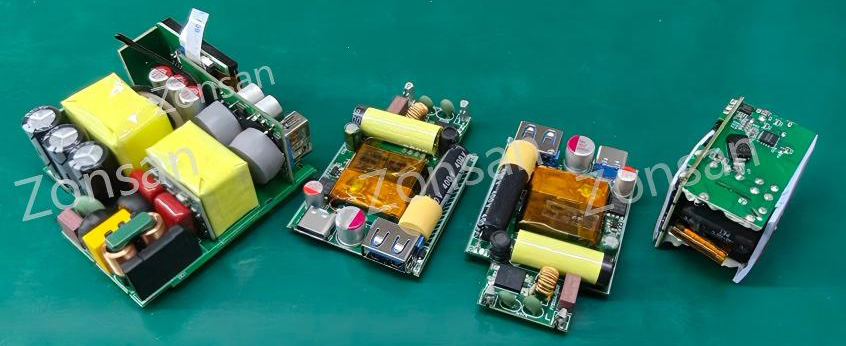
Component substitution is one of the most common reasons for engineering changes in charger manufacturing. It is also an area where assumptions can become expensive.
Consider a charger using a particular power semiconductor. A supplier proposes another device with a similar voltage rating, current rating, and package.
At first glance, the replacement may look acceptable. But the two parts may differ in switching characteristics, gate charge, thermal behavior, protection requirements, or other parameters relevant to the circuit.
Those differences can influence the wider power stage.
The same principle applies to capacitors, transformers, rectifiers, USB-C connectors, and other components. A replacement should be evaluated according to its role in the actual design, not simply its headline specification.
Consequently, Zonsan, a manufacturer of mobile phone chargers, has established and maintains an "Approved Components List" and has defined a formal process for component substitution. The purchasing department will not introduce other components into an already finalized design without the necessary engineering evaluation.
This is particularly important for products that remain in production over an extended period. A controlled substitution process helps maintain product consistency when supply-chain conditions change.
Related reading: How Charger Engineers Evaluate Alternative Components.
5. How Engineering Changes Can Affect USB-C PD and PPS Performance
Modern Phone fast chargers are not just power-conversion circuits. Their behavior also depends on protocol communication between the charger and the connected device. Any changes to the PD controller, power stage configuration, firmware, current-sensing circuitry, or output design can potentially affect charging performance.
For example, a modification intended to improve component availability might change the response of the power stage or the way the charger behaves during a particular operating condition.
That does not mean every component change will affect USB-C negotiation. It means the impact should be considered rather than assumed away.
When a change touches protocol-related functions, engineers need to recheck:
• Supported USB-PD power profiles
• PPS operation, where supported
• Voltage and current limits
• Device compatibility
• Multi-port power allocation
• Protection behavior during negotiation and operation
The test plan should reflect the product's intended specifications. A charger that still powers on and charges a phone has not necessarily passed all the checks required for a revised design.
For a deeper look at protocol development, see How USB-C PD Protocol Tuning Works in Charger Development.
6. Revision Control: How to Prevent Old and New Designs from Getting Mixed Up
A technically correct change can still cause production problems if the factory cannot identify which version is being built.
This is why revision control is a core part of engineering change management. Each released revision should have an identifiable version or revision code. The factory should be able to connect that revision to its approved BOM, drawings, work instructions, and test requirements.
For example, if a 65W charger moves from one approved power IC to another, the production record should make it possible to identify which batches contain the original component and which contain the revised one.
The same principle applies to a PCB revision, housing update, or modified output configuration.
A useful revision-control system should answer three questions:
1.What changed? The exact component, design, document, or process revision.
2.When did it change? The approval and production cut-in point.
3.Which products are affected? The relevant samples, production batches, inventory, and shipments.
This information becomes particularly valuable when a customer reports an issue months after delivery. Without traceability for versions and batches, a charger factory may waste effort investigating the wrong product version when troubleshooting issues.


7. Phone Charger Engineering Change Control and DVT/PVT: How They Work Together
Design Validation Testing (DVT) and Production Validation Testing (PVT) are used to evaluate whether a product design and its production process are ready for the next stage.
Engineering change control serves a different but closely related purpose: it manages what happens when the design or process needs to change.
A change may require additional DVT-level verification, PVT checks, or a limited first-production assessment. The required level depends on the nature and risk of the revision.
For example:
• A change to a non-functional label may need document and appearance verification.
• A revised connector may need mechanical-fit and electrical checks.
• A power-stage component replacement may require more extensive electrical, thermal, and protection verification.
• A manufacturing process change may require a production trial to confirm consistency.
The important distinction is that DVT and PVT are not substitutes for change approval. Nor does every engineering change automatically require a complete new product validation cycle.
A well-managed process links the change request to the relevant verification evidence and release decision.
Related reading: DVT and PVT Validation for Chargers: How New Products Move From Design to Mass Production.
8. Questions OEM Buyers Should Ask When Working with Wholesale Mobile Charger Manufacturers
For a brand or importer, engineering change control may not be the first topic discussed during supplier selection. Buyers often begin with wattage, price, MOQ, lead time, and certification.
Those are all important. But it is also worth understanding how the manufacturer handles changes after a product has been approved.
A few practical questions can reveal a lot:
How are component substitutions approved?
→ Ask whether procurement can change a component independently or whether engineering review is required.
How are product revisions identified?
→ The manufacturer should be able to explain how different PCB, BOM, or mechanical revisions are distinguished.
What happens when a change affects performance or certification?
→ Ask how the factory determines whether additional testing, documentation, or customer approval is needed.
Can the factory trace a finished product to its production revision?
→ This is useful when investigating field issues, repeat orders, or differences between shipments.
How will the customer be informed about an important change?
→ For OEM projects, changes affecting agreed specifications should be communicated through a defined approval process.
Zonsan(charger supplier) don't complicate every change; the key is whether the factory can accurately distinguish between "low-risk adjustments" and "changes that may affect product performance or compliance."
9. Common Engineering Change Control Mistakes
Even manufacturers with experienced engineering teams can encounter problems when change procedures are not followed consistently.
Treating a similar component as an identical replacement — Two parts with similar headline ratings may behave differently in the actual circuit. Technical equivalence needs to be assessed in context.
Updating the BOM but not the production documents — This can leave operators, inspectors, or procurement teams working with outdated information.
Testing a sample without defining the change scope — A successful sample is useful evidence, but the test should address the actual risks introduced by the modification.
Allowing production to use an unapproved revision — This creates uncertainty about which design was built and whether the product matches the approved specification.
Ignoring existing inventory — A change may be technically approved but still require a clear plan for old components, work in progress, and finished goods.
Failing to notify the customer — If an OEM change affects a customer's agreed product requirements, undocumented implementation can create commercial and compliance disputes.
These issues are not solved by adding more paperwork. They are solved by making sure that each change has a clear owner, a defined approval route, appropriate evidence, and a controlled production release.
10. Why Change Control Matters for Long-Term Phone Charger Manufacturing
The development of mobile phone chargers is rarely a "one-off" project. A product may remain in a manufacturer’s portfolio for many years, spanning multiple production runs and potentially undergoing periodic adjustments to its components or manufacturing processes.
During this period, supply chains may shift, the availability of certain components may cease, and customer demand may continue to evolve. Furthermore, manufacturers might need to refine designs or adapt products to suit different markets.
The objective is not to prevent change. It is to make change predictable.
A structured engineering change process helps the factory preserve the relationship between the approved design, the production version, and the finished product. It also gives OEM customers a clearer understanding of what is being supplied across repeat orders.
For phone charger manufacturers, this is part of maintaining a stable product platform. A platform can be reused and developed over time, but its revisions still need to be controlled.
For buyers, the practical benefit is straightforward: fewer surprises when a product is reordered, customized, or maintained over its commercial life.
How ZONSAN Approaches Charger Development and Manufacturing
ZONSAN develops and manufactures USB C, PD and Gan charging products for OEM and ODM customers, covering power levels from 5W to 240W. Its product development work involves electrical design, PCB engineering, structural development, protocol requirements, sample validation, and production preparation.
For a customized charger project, engineering changes may arise as specifications are refined, components are reviewed, or the product moves from prototype to mass production.
The important consideration is to evaluate each proposed change against the actual product requirements. A change to a logo or packaging specification is different from a change to a power-stage component, PCB layout, or charging protocol.
For brands, importers, and wholesalers planning a new charger project, it is worth discussing revision control and change approval at the beginning — not only after the first production order has been placed.
A clear change-control arrangement helps both sides understand what has been approved, what needs further validation, and which product revision will be delivered.
Final Thoughts
Engineering changes are a normal part of phone charger development and long-term manufacturing. The risk comes from making changes without understanding their impact or controlling how they enter production.
A reliable engineering change control process connects the request, technical assessment, approval, validation, documentation, and production release. It also keeps the manufacturer and customer aligned when a product specification or approved design needs to evolve.
For an OEM charger buyer, this is worth discussing before mass production begins. The ability to build a charger matters. The ability to manage its revisions consistently matters just as much when the product becomes a long-term business.
FAQ - Charger Engineering Change Control
Q1: What is engineering change control in phone charger manufacturing?
Engineering change control is the process of reviewing, approving, validating, documenting, and releasing changes to a charger design or manufacturing process. It helps ensure that revised products continue to meet their approved technical and production requirements.
Q2: What is the difference between ECR, ECO, and ECN?
ECR commonly means Engineering Change Request, ECO means Engineering Change Order, and ECN means Engineering Change Notice. The exact usage varies by company, but these terms generally cover the proposal, authorization, and communication of an engineering change.
Q3: Why do usb charger manufacturers need an ECN process?
A controlled ECN process helps communicate approved changes to engineering, procurement, production, quality, and other relevant teams. It reduces the risk of unapproved substitutions, outdated documents, and mixed product revisions.
Q4: Does replacing a pd or gan charger component require engineering approval?
A replacement that affects the approved design should go through the manufacturer's defined review process. Engineers need to evaluate whether the alternative component is suitable for the actual circuit and whether additional verification is required.
Q5: Can a component change affect USB-C PD or PPS performance?
It can, depending on the component and its role in the design. Changes to the controller, power stage, sensing circuit, or related configuration may affect protocol behavior, output characteristics, or device compatibility. The impact should be verified when relevant.
Q6: Does every engineering change require a full DVT and PVT process?
No. The required verification depends on the nature and risk of the change. A minor cosmetic revision may need limited checks, while a change to a critical electrical component may require more extensive validation.
Q7: How can OEM buyers know whether a mobile phone charger manufacturer controls design revisions?
Buyers can ask how the factory identifies revisions, approves component substitutions, updates BOMs and drawings, handles production cut-in, and traces finished products to their production batches.
Q8: Why is revision control important for repeat charger orders?
Revision control helps ensure that repeat orders use the agreed product configuration. It also allows the manufacturer to identify which design and component versions were used in each production batch.
Q9: Who should approve an engineering change?
The approval team depends on the change. It may include electrical engineering, mechanical engineering, quality, manufacturing, procurement, project management, and the customer when the change affects agreed OEM requirements.
Q10: What should an OEM charger change-control agreement include?
It should clarify which changes require customer approval, how revisions are identified, what validation evidence is needed, how changes are communicated, and how existing inventory and production batches are handled.