How Over-Voltage and Over-Current Protection Work in Modern USB-C Chargers
Most people never think about charger protection systems.
They simply plug in a phone, tablet, laptop, or power bank and expect charging to work safely.
And most of the time, it does.
What many users don't realize is that modern chargers are constantly monitoring electrical conditions in real time.
Every second, protection circuits are checking:
• Output voltage
• Output current
• Power delivery status
• Device communication
• Internal operating conditions
If something abnormal occurs, the charger must react immediately.
Otherwise, excessive voltage or excessive current could damage:
• Smartphones
• Tablets
• Laptops
• Batteries
• Charging circuits
• The charger itself
This is why Over-Voltage Protection (OVP) and Over-Current Protection (OCP) have become essential parts of every high-quality USB-C charger, PD charger, PPS charger, and GaN charger.
In this article, we'll explore how these protection systems work, how manufacturers test them, and why they are among the most important engineering features inside modern chargers.

What Is Over-Voltage Protection (OVP)?
Over-Voltage Protection is designed to prevent output voltage from exceeding safe limits.
In simple terms:
If voltage becomes too high, the charger intervenes before damage occurs.
For example:
A USB-C charger negotiating 9V output should never accidentally deliver 20V to a device expecting only 9V.
If such an event occurred without protection, it could potentially damage:
• Battery charging circuits
• USB-C controllers
• Sensitive electronic components
OVP continuously monitors voltage levels and reacts whenever output exceeds predefined safety thresholds.
The response may include:
• Limiting output
• Reducing power
• Disconnecting output
• Entering protection mode
The goal is always the same:
Prevent dangerous voltage exposure.
What Is Over-Current Protection (OCP)?
Over-Current Protection focuses on current rather than voltage.
Current increases when connected devices attempt to draw more power than intended.
Examples include:
• Faulty devices
• Damaged charging cables
• Internal device failures
• Unexpected load conditions
Without protection, excessive current can create:
• Excessive heat
• Connector damage
• PCB stress
• Component overload
OCP continuously monitors current flow.
When current exceeds safe limits, the charger immediately takes corrective action.
This helps prevent overheating and protects both the charger and connected devices.
Why Voltage and Current Problems Are Different
Although OVP and OCP often work together, they solve different problems.
Think of voltage as pressure.
Think of current as flow.
A charger may experience:
Normal Voltage + Excessive Current
or
Excessive Voltage + Normal Current
or
Both Conditions Simultaneously
Each scenario requires different protective responses.
This is why modern charger safety architecture includes multiple independent protection layers rather than relying on a single safeguard.
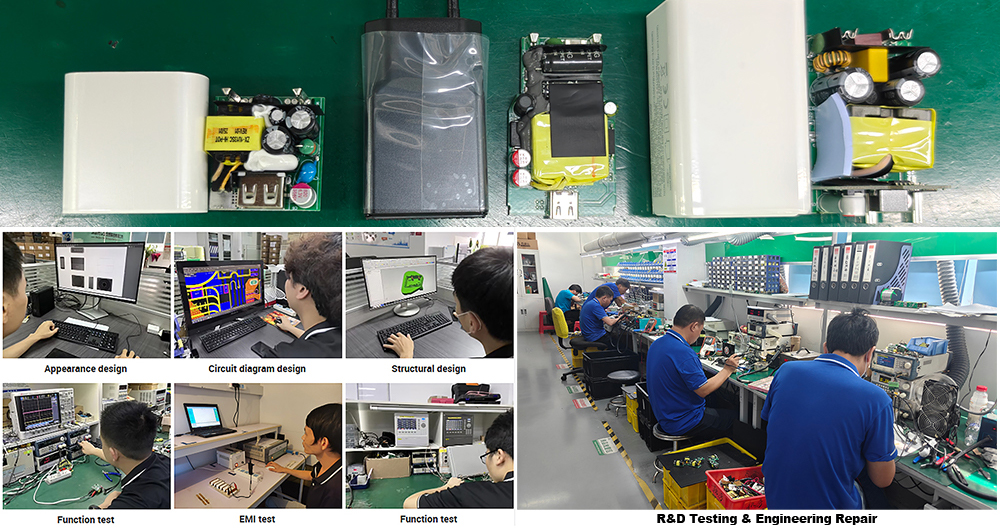
How Modern USB-C Chargers Monitor Power
Unlike older chargers that delivered fixed outputs, USB-C PD chargers continuously communicate with connected devices.
The charger constantly evaluates:
• Requested voltage
• Requested current
• Negotiated power level
• Real-time load behavior
For example:
A PD charger may dynamically switch between:
• 5V, 9V, 12V, 15V, 20V
• PPS adjustable voltages
This flexibility creates tremendous charging efficiency.
Unlike older chargers that delivered fixed outputs, USB-C PD chargers continuously communicate with connected devices.
The charger constantly evaluates:
• Requested voltage
• Requested current
• Negotiated power level
• Real-time load behavior
For example:
A PD charger may dynamically switch between:
• 5V, 9V, 12V, 15V, 20V
• PPS adjustable voltages
This flexibility creates tremendous charging efficiency.
However, it also requires sophisticated protection systems.
Modern chargers therefore rely on:
• PD controllers
• Power management ICs
• Current sensing circuits
• Firmware algorithms
to maintain safe operation.
What Happens When OVP Activates?
When output voltage exceeds safe limits:
1. Detection circuitry identifies the abnormal condition.
2. Control systems verify the event.
3. Protection logic activates.
4. Output power is reduced or disconnected.
5. Safe operating mode is entered.
The entire process may occur within milliseconds.
The user often notices nothing more than charging temporarily stopping.
Behind the scenes, however, the charger may have prevented serious damage.
What Happens When OCP Activates?
The process is similar.
When excessive current demand occurs:
1. Current sensors detect overload.
2. Control ICs evaluate severity.
3. Protection circuits intervene.
4. Output current is limited or shut down.
5. System recovers after conditions normalize.
Some chargers automatically recover.
Others require reconnection before charging resumes.
The behavior depends on the protection architecture.

How Manufacturers Test OVP and OCP
Professional charger manufacturers never assume protection systems work.
They verify performance through controlled testing.
Engineers intentionally create abnormal operating conditions.
Testing may include:
OVP Testing
• Output voltage verification
• Fault simulation
• Control loop testing
• Power stage validation
OCP Testing
• Current overload simulation
• Maximum load testing
• Dynamic load testing
• Recovery verification
The objective is to ensure protection activates before component damage occurs.
Why Protection Testing Improves Reliability
Many engineers view OVP and OCP as safety features.
They are also reliability features.
Repeated overload testing helps identify:
• Weak components
• PCB limitations
• Thermal weaknesses
• Design vulnerabilities
As a result, protection testing often drives product improvements beyond safety requirements.
Many reliability enhancements originate from protection validation programs.
How OVP and OCP Work Together
A quality charger rarely depends on a single protection mechanism.
Instead, multiple protection systems operate simultaneously.
Typical protection architecture includes:
• OVP (Over Voltage Protection)
• OCP (Over Current Protection)
• SCP (Short Circuit Protection)
• OTP (Over Temperature Protection)
• UVP (Under Voltage Protection)
Each protection layer addresses different risks.
Together, they create a comprehensive safety system.
This layered approach is one reason why modern USB-C chargers are significantly safer than early generations of charging products.
Why Cheap Chargers Often Have Weaker Protection
Protection systems add cost.
They require:
• Better ICs
• Additional circuitry
• More engineering
• More testing
• More validation
Low-cost chargers sometimes reduce expenses by simplifying protection architecture.
Unfortunately, users rarely discover these differences until abnormal conditions occur.
This is why professional charger manufacturers prioritize safety validation rather than relying solely on basic functionality testing.

How ZONSAN Verifies OVP and OCP Performance
At ZONSAN, protection verification is integrated throughout charger development and production validation.
Engineers evaluate OVP and OCP performance across products including:
• 20W USB-C Chargers
• 25W Fast Chargers
• 35W GaN Chargers
• 45W PPS Chargers
• 65W Laptop Chargers
• 100W PD Chargers
• 140W PD3.1 Chargers
Testing focuses on:
• Protection activation thresholds
• Response speed
• Thermal stability
• Recovery behavior
• Long-term reliability
The objective is not only certification compliance but also delivering reliable charging performance throughout the product lifecycle.
Final Thoughts
Most users never see OVP or OCP working.
In fact, the best protection systems are the ones you never notice.
Every day, these circuits quietly monitor voltage and current conditions, ensuring devices receive safe and stable power.
As USB-C charging continues evolving toward higher power levels and more advanced charging protocols, protection engineering becomes increasingly important.
Behind every reliable charger is a network of safety systems working continuously to protect both the charger and the devices connected to it.
FAQ
Q1: What is Over-Voltage Protection (OVP)?
A: OVP prevents output voltage from exceeding safe limits that could damage connected devices.
Q2: What is Over-Current Protection (OCP)?
A: OCP prevents excessive current flow that could cause overheating or component stress.
Q3: Why do chargers need both OVP and OCP?
A: Voltage and current faults are different electrical conditions. Separate protection systems are needed to address each risk effectively.
Q4: Can OVP protect my phone battery?
A: Yes. OVP helps prevent excessive voltage from reaching the device's charging circuitry.
Q5: Does OCP prevent overheating?
A: In many cases, yes. Limiting excessive current reduces heat generation and component stress.
Q6: How fast do protection systems respond?
A: Modern protection systems often react within milliseconds.
Q7: Are OVP and OCP required for certification?
A: Most modern safety standards require appropriate protection mechanisms as part of product safety design.
Q8: Do GaN chargers use OVP and OCP?
A: Absolutely. GaN chargers rely on the same fundamental protection principles as traditional chargers.
Recommended reading
• Over-current protection works alongside short circuit protection to create a complete charger safety architecture. Learn more in How Short Circuit Protection Is Tested in Modern USB-C Chargers.↗
• Excessive current often leads directly to thermal stress, making thermal validation an important part of protection engineering. Explore Inside Temperature Rise Testing for Fast Chargers.↗
• Protection verification is one of the many engineering evaluations described in How We Test USB-C Chargers Before Shipment.↗
• Modern charger safety architectures are commonly evaluated against IEC 62368-1 requirements.↗