How Charger Safety Certifications Prove Product Quality: What Happens Before a Charger Earns CE, ETL, FCC, CB and KC Approval?
Quick Answer (Featured Snippet)
A charger certification such as CE, ETL, FCC, CB or KC does far more than add a logo to the product. Before a charger can earn these certifications, manufacturers must complete extensive engineering work, including PCB design, thermal optimization, electrical safety validation, EMC testing, reliability testing and quality verification. Certification confirms that a charger meets specific market requirements—but true product quality depends on both rigorous engineering and consistent manufacturing.
Key Takeaways
• CE, ETL, FCC, CB and KC certifications verify compliance with specific safety and regulatory standards.
• Certification starts long before products arrive at an accredited laboratory.
• Engineering design, thermal management, protection circuits and reliability testing all contribute to successful certification.
• Different countries require different certifications because their regulations are different.
• A certified charger is only as reliable as the engineering and manufacturing process behind it.
Table of Contents
• Why Safety Certifications Matter More Than Most Buyers Think
• Certification Doesn't Start at the Laboratory
• What Happens Before a Charger Is Submitted for Certification
• How Certification Laboratories Evaluate Chargers
• Why Different Countries Require Different Certifications
• Why Certification Alone Doesn't Guarantee Product Quality
• How ZONSAN Prepares Chargers for Global Certification
• Frequently Asked Questions
Why Safety Certifications Matter More Than Most Buyers Think
Walk into any electronics store and you'll notice familiar symbols printed on chargers and power adapters.
Some products display CE.
Others carry ETL, FCC, KC, CB, UKCA, or several certifications together.
For many buyers, these logos are simply labels that indicate a product can be sold in a particular country.
From an engineering perspective, however, they represent something much more important.
They represent months of design reviews, repeated testing, engineering improvements, documentation and verification before a charger is ever approved for mass production.
A certification mark is not something that is added at the end of manufacturing.
Instead, it is the result of hundreds of engineering decisions made throughout the entire product development process.
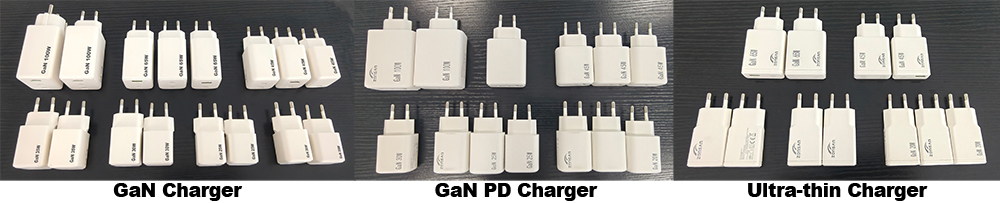
For professional USB-C charger manufacturers, GaN charger factories, and OEM power adapter suppliers, certification is not a single event—it is an integrated part of product development.
A Common Misunderstanding About Charger Certifications
One of the biggest misconceptions in the charging industry is that certification automatically means premium quality.
Unfortunately, that's not always true.
Imagine two 65W GaN chargers.
Both carry a CE mark.
Both comply with European regulations.
But internally, they may be completely different products.
One may use premium capacitors, carefully designed thermal structures, reinforced transformer insulation and multiple protection circuits.
The other may simply meet the minimum requirements necessary to obtain certification.
Both products are legally compliant.
Only one is engineered for long-term reliability.
This is why experienced buyers rarely ask only:
"Does your charger have CE certification?"
Instead, they ask:
• How was it tested?
• How is quality controlled?
• How many engineering validation stages were completed?
• How do you verify consistency in mass production?
Certification answers one question.
Engineering answers many more.
Certification Doesn't Start at the Laboratory
One of the biggest surprises for new product managers is discovering that certification laboratories rarely help design a charger.
Their responsibility is to evaluate a finished design—not create one.
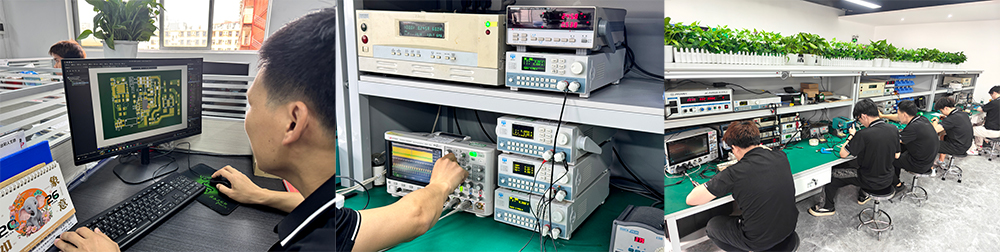
Long before a prototype is shipped to a testing laboratory, engineers have already completed numerous technical tasks.
These include:
• Power architecture selection
• Transformer optimization
• PCB layout
• Component selection
• Thermal simulation
• USB Power Delivery protocol integration
• Protection circuit design
• Mechanical structure optimization
If these foundations are weak, certification testing becomes much more difficult.
In many cases, products fail not because the laboratory is strict, but because engineering preparation was incomplete.
Engineering Comes Before Certification
Professional charger development usually follows several engineering stages before certification begins.
Although terminology varies between manufacturers, the process often includes:
Concept Design
Engineers determine the target power level, charging protocols and intended market.
For example:
• 20W USB-C Charger
• 35W GaN Charger
• 45W PPS Charger
• 65W Laptop Charger
• 100W Multi-Port Charger
• 140W PD3.1 Charger
Each product has different engineering priorities.
Schematic Design
Next comes the electrical design.
Engineers select:
• Controller ICs
• GaN or silicon devices
• Transformers
• Capacitors
• MOSFETs
• USB-C PD controllers
• Protection ICs
Every component influences efficiency, thermal performance and long-term reliability.
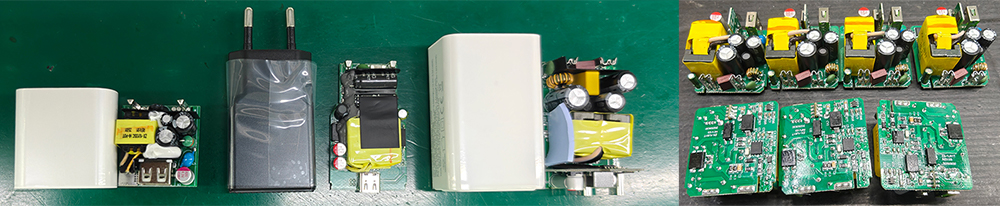
PCB Layout
This stage is often underestimated.
PCB layout affects:
• Electromagnetic interference (EMI)
• Heat distribution
• Signal integrity
• Safety distances
• Manufacturing consistency
Even minor routing changes can improve thermal performance or reduce EMC problems.
Prototype Development
Once the first engineering sample is built, testing begins immediately.
Very few first prototypes pass every internal evaluation.
Instead, engineers repeatedly improve the design based on measured data.
This iterative process is what separates mature charger manufacturers from factories that simply assemble reference designs.
Before Certification, Every Professional Factory Performs Internal Validation
Sending an unstable product directly to a certification laboratory would waste both time and money.
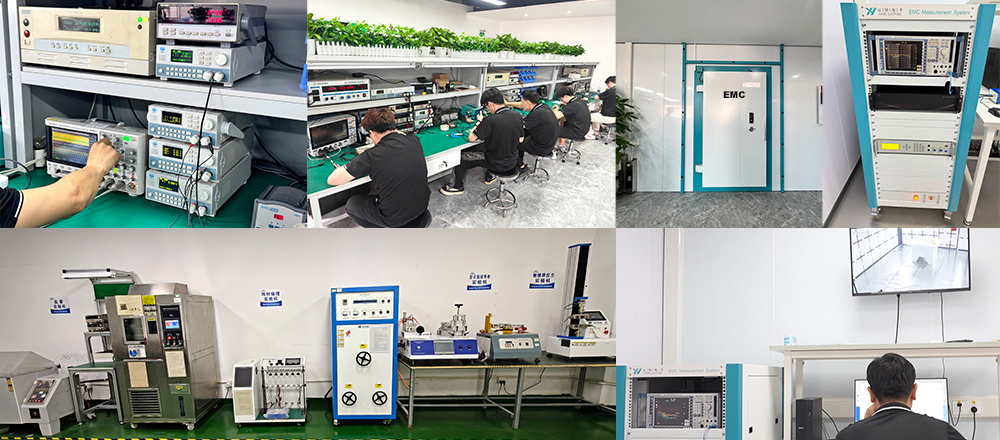
Instead, experienced manufacturers complete extensive internal validation first.
Typical engineering verification includes:
• Output voltage accuracy
• Output current stability
• USB Power Delivery negotiation
• PPS voltage adjustment
• Efficiency measurement
• Full-load operation
• No-load power consumption
• Temperature rise evaluation
• Short circuit protection
• Over-current protection
• Over-voltage protection
• Drop testing
• Connector durability
• Aging tests
Only after these evaluations demonstrate stable performance does a product move toward formal certification.
This approach significantly increases the likelihood of passing third-party testing on the first submission.
Engineer's Insight
One of the biggest differences between experienced charger manufacturers and low-cost assembly factories is when engineering problems are discovered.
A mature engineering team aims to identify and solve issues during prototype development—not during certification.
By the time a charger reaches an accredited laboratory, the product should already be stable, thermally optimized and internally validated.
Certification should confirm good engineering, not compensate for poor engineering.
How Certification Laboratories Evaluate Chargers
Many people imagine that certification is simply a matter of sending a charger to a laboratory and waiting for a pass or fail result.
The reality is far more comprehensive.
Certification laboratories don't ask a single question:
"Does this charger work?"
Instead, they ask dozens of engineering questions.
For example:
• Is the insulation sufficient?
• Does the charger remain safe under full load?
• Will the housing become too hot?
• Can the charger survive abnormal operating conditions?
• Does it create excessive electromagnetic interference?
• Are creepage and clearance distances compliant?
• Will the product continue operating safely after repeated stress?
Each question represents a different engineering discipline.
A charger can perform perfectly during daily charging and still fail certification because one critical safety requirement has not been met.
This is why certification should never be viewed as paperwork.
It is a systematic engineering evaluation.
Step 1 — Electrical Safety Testing
Electrical safety is always one of the first priorities.
The laboratory verifies that dangerous voltages remain isolated from accessible parts.
Typical evaluations include:
• Insulation resistance
•Dielectric withstand (Hi-Pot) testing
• Ground continuity (where applicable)
• Leakage current measurement
• Creepage and clearance verification
These tests help ensure that users cannot accidentally come into contact with hazardous voltage during normal operation or foreseeable misuse.
For USB-C wall chargers, proper transformer insulation and PCB spacing are particularly important.
Even a high-efficiency GaN charger cannot pass certification if its electrical isolation does not meet safety requirements.
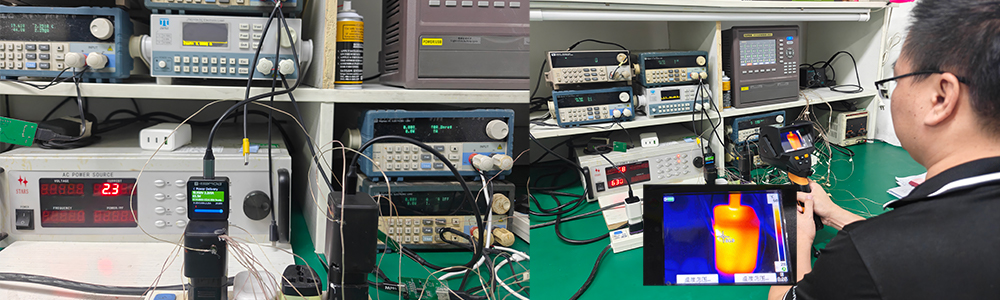
Step 2 — Temperature Rise Evaluation
Heat is one of the biggest enemies of long-term reliability.
Certification laboratories therefore evaluate how much temperature increases while the charger operates under specified conditions.
During testing, engineers monitor:
• Housing temperature
• Transformer temperature
• Power semiconductor temperature
• PCB hotspots
• Internal thermal distribution
The objective isn't to eliminate heat.
Every charger generates heat during power conversion.
Instead, the goal is to confirm that temperatures remain within safe operating limits throughout continuous operation.
A charger that operates safely at 20°C may behave very differently after several hours at full power.
This is why temperature rise testing is performed over extended periods.
Step 3 — Electromagnetic Compatibility (EMC)
Every switching power supply generates electromagnetic noise.
Without proper design, this noise may interfere with nearby electronics.
Certification laboratories therefore evaluate:
• Conducted emissions
• Radiated emissions
• Electromagnetic immunity
• Signal stability
Good EMC performance begins during PCB layout—not inside the testing laboratory.
Engineers often spend weeks optimizing:
• Switching frequencies
• Ground planes
• Transformer design
• Shielding
• Filter circuits
Small improvements in layout can significantly reduce electromagnetic interference.
Step 4 — Protection System Verification
Modern fast chargers include multiple protection mechanisms working together.
Certification testing verifies that these systems operate correctly under abnormal conditions.
Typical protection tests include:
• Short Circuit Protection (SCP)
• Over-Current Protection (OCP)
• Over-Voltage Protection (OVP)
• Over-Temperature Protection (OTP)
Rather than assuming these features work, engineers intentionally simulate fault conditions.
The charger must detect the abnormal event and enter a safe operating state before damage occurs.
This layered protection architecture has become increasingly important as charging power continues to increase.
Step 5 — Abnormal Operation Testing
Real-world users don't always use chargers perfectly.
Cables become damaged.
Ports accumulate dust.
Devices behave unexpectedly.
Certification standards therefore include abnormal operating conditions designed to simulate situations that could occur during years of daily use.
Examples include:
• Sustained overload
• Fault simulations
• Abnormal voltage conditions
• Output short circuits
• Extended full-load operation
The goal is not simply to see whether the charger survives.
The goal is to verify that it fails safely when necessary.
Why Different Markets Require Different Certifications
Many buyers ask: "If my charger already has CE certification, why do I also need ETL or KC?"
The answer is simple.
Different countries have different regulatory systems.
Although many safety principles are shared globally, each market maintains its own compliance requirements.
| Certification | Primary Market | Main Focus |
| CE | European Union | Product safety, EMC and regulatory compliance |
| FCC | United States | Electromagnetic interference (EMI) |
| ETL | North America | Electrical safety testing |
| KC | South Korea | National safety and EMC requirements |
| CB | International | Mutual recognition between certification bodies |
| UKCA | United Kingdom | UK regulatory compliance |
For OEM customers selling internationally, obtaining multiple certifications is often necessary.
This allows the same charger platform to enter different markets while complying with local regulations.
Certification Is Not the Same as Quality
This is perhaps the most important point in the entire article.
Certification proves that a product complies with specific standards.
It does not automatically prove that every charger is manufactured with the same level of consistency.
Two products may both carry identical certification marks.
Yet they can differ significantly in:
• Component quality
• PCB workmanship
• Thermal design
• Assembly precision
• Manufacturing control
• Reliability over years of use
This is why experienced B2B buyers evaluate far more than certificates.
They also assess:
• Factory management systems
• Engineering capability
• Process control
• Reliability testing
• Production consistency
Certification is one piece of the puzzle—not the entire picture.
Common Mistakes Buyers Make
Many first-time importers focus almost exclusively on certification logos.
In practice, this can lead to poor purchasing decisions.
Common misconceptions include:
❌ "If a charger has CE certification, it must be high quality."
Reality: CE confirms compliance with European requirements, but it does not indicate whether premium or economy-grade components were used.
❌ "ETL certification guarantees zero product failures."
Reality: ETL evaluates safety and compliance. Long-term reliability still depends on engineering, manufacturing quality and process control.
❌ "Every charger with the same certification performs the same."
Reality: Certification establishes minimum compliance requirements, while engineering determines long-term performance.
Engineer's Insight
One lesson experienced charger engineers learn early is that certification is the result of good engineering—not a substitute for it.
If a product repeatedly fails EMC, thermal or safety evaluations, the solution is rarely found in additional paperwork.
Instead, engineers return to the design.
They improve the PCB layout.
They redesign the transformer.
They optimize thermal paths.
They refine protection circuits.
Only after these engineering improvements are complete does certification become straightforward.
In other words, successful certification begins on the engineer's workbench—not inside the laboratory.
How ZONSAN Prepares Chargers Before Global Certification
Certification is one of the final milestones in product development—but the preparation begins much earlier.
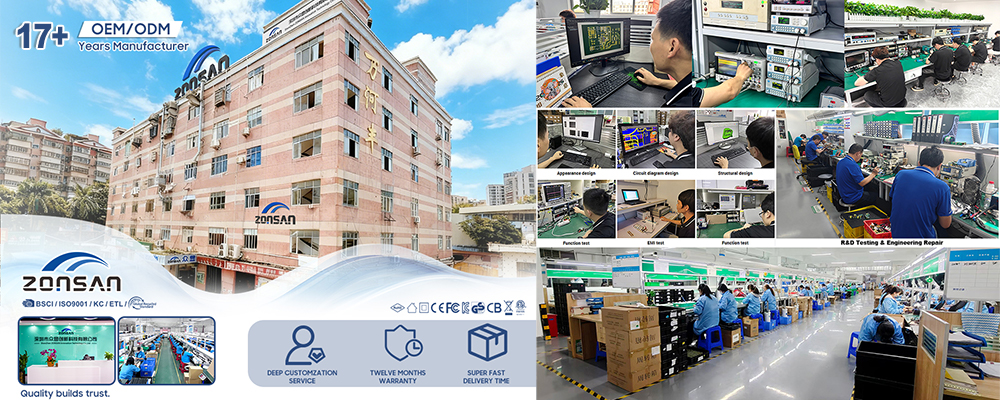
At ZONSAN, engineering and compliance teams work together from the earliest design stage to ensure every charger is developed with certification requirements in mind rather than treating compliance as an afterthought.
Before any USB-C charger, GaN charger, or PD power adapter is submitted to an accredited laboratory, it has already undergone multiple rounds of internal verification. These evaluations help identify potential issues early, reducing redesign cycles and improving the likelihood of passing certification on the first submission.
The internal process typically includes:
• PCB design review
• Component verification
• USB Power Delivery protocol validation
• Thermal performance analysis
• Efficiency optimization
• Full-load endurance testing
• Protection system verification
• Reliability evaluation
• Manufacturing process assessment
Only after these stages demonstrate stable performance does the product proceed to formal certification testing.
This engineering-first approach allows ZONSAN to support OEM and ODM customers across Europe, South Korea, the Middle East, North America and other global markets with products designed for long-term reliability—not simply minimum compliance.
Engineering Doesn't End After Certification
Receiving a certification report does not mean engineering work is complete.
In professional charger manufacturing, certification marks the beginning of continuous quality control.
Every production batch should continue to be monitored for consistency.
Typical factory quality assurance includes:
• Incoming material inspection
• SMT process inspection
• AOI inspection
• Functional testing
• Aging tests
• Output verification
• Random reliability sampling
• Final quality inspection before shipment
This ensures that products manufactured months after certification continue to perform consistently.
For OEM customers, this consistency is just as important as the certification itself.
Why This Matters for OEM Buyers
If you're sourcing chargers for your own brand, certification should be one of several evaluation criteria—not the only one.
When selecting a charger manufacturer, consider questions such as:
• Does the factory have an experienced R&D team?
• Are products developed from original engineering or copied reference designs?
• How are reliability tests performed?
• What protection systems are validated internally?
• Does the factory have experience with multiple international certifications?
• Can the supplier support future product upgrades and regulatory changes?
These questions often reveal far more about long-term product quality than a certificate alone.
Engineer's Insight
One of the most valuable lessons in charger development is this:
Certification verifies that a design meets a standard. Engineering determines how well that product performs over the next five years.
The best charger manufacturers never design products simply to pass certification.
They design products to remain safe, efficient and reliable throughout their entire service life.
When certification becomes the result of disciplined engineering—not the objective itself—better products naturally follow.
Final Thoughts
A certification logo may occupy only a few millimeters on a charger housing.
Yet behind that small symbol lies months of engineering work, design optimization, testing and validation.
CE, ETL, FCC, CB and KC certifications each serve an important purpose by helping ensure products meet regulatory requirements in different markets.
However, certifications tell only part of the story.
True product quality is built through thoughtful engineering, rigorous testing, consistent manufacturing and continuous improvement.
For buyers, understanding this distinction leads to better sourcing decisions.
For manufacturers, it reinforces an important principle:
Certification is not the beginning of quality—it is the evidence that quality has already been engineered into the product.
Frequently Asked Questions
Q1: Does CE certification guarantee a charger is high quality?
A: No. CE certification confirms compliance with applicable European safety and EMC regulations. Product quality still depends on engineering design, component selection and manufacturing consistency.
Q2: What is the difference between CE and ETL certification?
A: CE is primarily required for products sold within the European Economic Area, while ETL demonstrates compliance with North American electrical safety standards.
Q3: Why do some chargers carry multiple certifications?
A: Manufacturers selling globally often obtain multiple certifications so the same product can legally enter different regional markets.
Q4: Is FCC certification related to charging speed?
A: No. FCC certification focuses on electromagnetic interference (EMI), ensuring electronic devices do not cause unacceptable radio-frequency interference.
Q5: What does CB certification mean?
A: The CB Scheme provides international recognition of safety testing, helping manufacturers simplify certification in multiple countries.
Q6: Why is KC certification important?
A: KC certification is required for many electronic products entering the South Korean market and demonstrates compliance with Korean safety and EMC requirements.
Q7: How long does charger certification usually take?
A: Depending on product complexity and laboratory schedules, certification may take several weeks to several months, especially if design modifications are required after testing.
Q8: What should OEM buyers verify besides certifications?
A: OEM buyers should also evaluate the supplier's engineering capability, factory quality management system, production consistency, reliability testing procedures and after-sales technical support.
Articles you might be interested in
• Modern safety certifications also verify that essential protection systems function correctly. Learn more in How Over-Voltage and Over-Current Protection Work in Modern USB-C Chargers.↗
• Short circuit testing is one of the abnormal condition evaluations commonly performed before certification. Read How Short Circuit Protection Is Tested in Modern USB-C Chargers.↗
• Certification is only one part of product validation. Discover the complete factory inspection process in How We Test USB-C Chargers Before Shipment.↗
This allows the same charger platform to enter different markets while complying with local regulations.
Certification Is Not the Same as Quality
This is perhaps the most important point in the entire article.
Certification proves that a product complies with specific standards.
It does not automatically prove that every charger is manufactured with the same level of consistency.
Two products may both carry identical certification marks.
Yet they can differ significantly in:
• Component quality
• PCB workmanship
• Thermal design
• Assembly precision
• Manufacturing control
• Reliability over years of use
This is why experienced B2B buyers evaluate far more than certificates.
They also assess:
• Factory management systems
• Engineering capability
• Process control
• Reliability testing
• Production consistency
Certification is one piece of the puzzle—not the entire picture.
Common Mistakes Buyers Make
Many first-time importers focus almost exclusively on certification logos.
In practice, this can lead to poor purchasing decisions.
Common misconceptions include:
❌ "If a charger has CE certification, it must be high quality."
Reality: CE confirms compliance with European requirements, but it does not indicate whether premium or economy-grade components were used.
❌ "ETL certification guarantees zero product failures."
Reality: ETL evaluates safety and compliance. Long-term reliability still depends on engineering, manufacturing quality and process control.
❌ "Every charger with the same certification performs the same."
Reality: Certification establishes minimum compliance requirements, while engineering determines long-term performance.
Engineer's Insight
One lesson experienced charger engineers learn early is that certification is the result of good engineering—not a substitute for it.
If a product repeatedly fails EMC, thermal or safety evaluations, the solution is rarely found in additional paperwork.
Instead, engineers return to the design.
They improve the PCB layout.
They redesign the transformer.
They optimize thermal paths.
They refine protection circuits.
Only after these engineering improvements are complete does certification become straightforward.
In other words, successful certification begins on the engineer's workbench—not inside the laboratory.
How ZONSAN Prepares Chargers Before Global Certification
Certification is one of the final milestones in product development—but the preparation begins much earlier.
At ZONSAN, engineering and compliance teams work together from the earliest design stage to ensure every charger is developed with certification requirements in mind rather than treating compliance as an afterthought.
Before any USB-C charger, GaN charger, or PD power adapter is submitted to an accredited laboratory, it has already undergone multiple rounds of internal verification. These evaluations help identify potential issues early, reducing redesign cycles and improving the likelihood of passing certification on the first submission.
The internal process typically includes:
• PCB design review
• Component verification
• USB Power Delivery protocol validation
• Thermal performance analysis
• Efficiency optimization
• Full-load endurance testing
• Protection system verification
• Reliability evaluation
• Manufacturing process assessment
Only after these stages demonstrate stable performance does the product proceed to formal certification testing.
This engineering-first approach allows ZONSAN to support OEM and ODM customers across Europe, South Korea, the Middle East, North America and other global markets with products designed for long-term reliability—not simply minimum compliance.
Engineering Doesn't End After Certification
Receiving a certification report does not mean engineering work is complete.
In professional charger manufacturing, certification marks the beginning of continuous quality control.
Every production batch should continue to be monitored for consistency.
Typical factory quality assurance includes:
• Incoming material inspection
• SMT process inspection
• AOI inspection
• Functional testing
• Aging tests
• Output verification
• Random reliability sampling
• Final quality inspection before shipment
This ensures that products manufactured months after certification continue to perform consistently.
For OEM customers, this consistency is just as important as the certification itself.
Why This Matters for OEM Buyers
If you're sourcing chargers for your own brand, certification should be one of several evaluation criteria—not the only one.
When selecting a charger manufacturer, consider questions such as:
• Does the factory have an experienced R&D team?
• Are products developed from original engineering or copied reference designs?
• How are reliability tests performed?
• What protection systems are validated internally?
• Does the factory have experience with multiple international certifications?
• Can the supplier support future product upgrades and regulatory changes?
These questions often reveal far more about long-term product quality than a certificate alone.
Engineer's Insight
One of the most valuable lessons in charger development is this:
Certification verifies that a design meets a standard. Engineering determines how well that product performs over the next five years.
The best charger manufacturers never design products simply to pass certification.
They design products to remain safe, efficient and reliable throughout their entire service life.
When certification becomes the result of disciplined engineering—not the objective itself—better products naturally follow.
Final Thoughts
A certification logo may occupy only a few millimeters on a charger housing.
Yet behind that small symbol lies months of engineering work, design optimization, testing and validation.
CE, ETL, FCC, CB and KC certifications each serve an important purpose by helping ensure products meet regulatory requirements in different markets.
However, certifications tell only part of the story.
True product quality is built through thoughtful engineering, rigorous testing, consistent manufacturing and continuous improvement.
For buyers, understanding this distinction leads to better sourcing decisions.
For manufacturers, it reinforces an important principle:
Certification is not the beginning of quality—it is the evidence that quality has already been engineered into the product.
Frequently Asked Questions
Q1: Does CE certification guarantee a charger is high quality?
A: No. CE certification confirms compliance with applicable European safety and EMC regulations. Product quality still depends on engineering design, component selection and manufacturing consistency.
Q2: What is the difference between CE and ETL certification?
A: CE is primarily required for products sold within the European Economic Area, while ETL demonstrates compliance with North American electrical safety standards.
Q3: Why do some chargers carry multiple certifications?
A: Manufacturers selling globally often obtain multiple certifications so the same product can legally enter different regional markets.
Q4: Is FCC certification related to charging speed?
A: No. FCC certification focuses on electromagnetic interference (EMI), ensuring electronic devices do not cause unacceptable radio-frequency interference.
Q5: What does CB certification mean?
A: The CB Scheme provides international recognition of safety testing, helping manufacturers simplify certification in multiple countries.
Q6: Why is KC certification important?
A: KC certification is required for many electronic products entering the South Korean market and demonstrates compliance with Korean safety and EMC requirements.
Q7: How long does charger certification usually take?
A: Depending on product complexity and laboratory schedules, certification may take several weeks to several months, especially if design modifications are required after testing.
Q8: What should OEM buyers verify besides certifications?
A: OEM buyers should also evaluate the supplier's engineering capability, factory quality management system, production consistency, reliability testing procedures and after-sales technical support.
Articles you might be interested in
• Modern safety certifications also verify that essential protection systems function correctly. Learn more in How Over-Voltage and Over-Current Protection Work in Modern USB-C Chargers.↗
• Short circuit testing is one of the abnormal condition evaluations commonly performed before certification. Read How Short Circuit Protection Is Tested in Modern USB-C Chargers.↗
• Certification is only one part of product validation. Discover the complete factory inspection process in How We Test USB-C Chargers Before Shipment.↗