USB-C Cable Explained: Why Some Cables Support 240W and Others Don’t
• chargers
• wattage
• GaN technology
• charging protocols
But one of the most overlooked parts of fast charging is actually: the cable itself.
In modern USB-C ecosystems, the cable is no longer just a “wire.”
It has become:
• an intelligent communication component
• a power delivery pathway
• a thermal management factor
• a charging safety system
And as USB-C charging expands toward:
• 140W
• 180W
• 240W PD3.1 charging
cable engineering is becoming more important than ever.
This is why some USB-C cables can safely support: 240W charging
while others cannot even maintain stable: 60W charging.
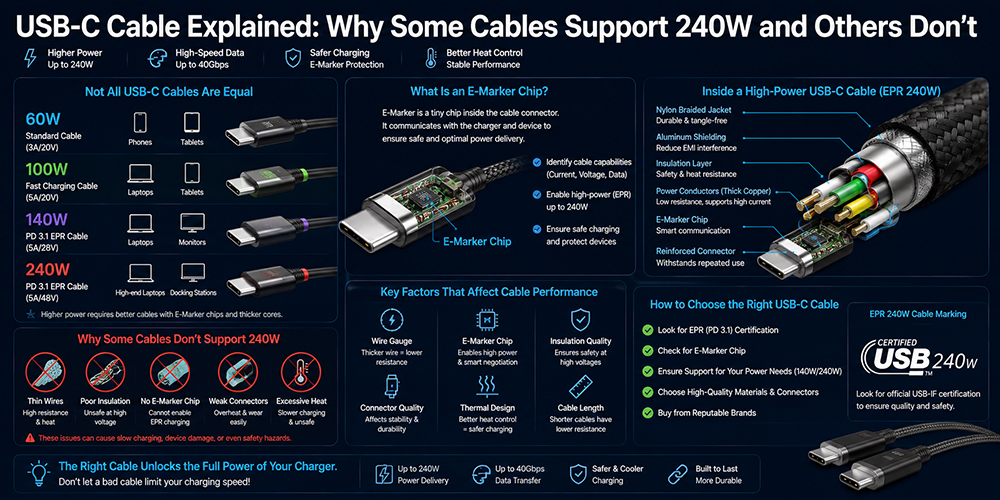
Why USB-C Cables Are More Complicated Than Before
Older charging cables were relatively simple.
They mainly transferred:
• power
• basic data
Modern USB-C cables now support:
• high-speed data
• video output
• intelligent charging negotiation
• PD3.1 EPR charging
• dynamic voltage systems
• Thunderbolt communication
This dramatically increases engineering complexity.
What Determines USB-C Cable Charging Capability?
Several factors determine whether a USB-C cable can support:
• 60W / 100W / 140W / 240W charging.
These include:
• wire gauge
• internal resistance
• insulation materials
• connector quality
• thermal performance
• E-Marker chip capability
What Is an E-Marker Chip?
Modern high-power USB-C cables often include: E-Marker chips.
An E-Marker is a tiny controller chip embedded inside the cable connector.
It communicates with:
• the charger
• the device
to confirm:
• maximum supported current
• voltage capability
• data capability
• EPR compatibility
Without this chip: many devices will refuse higher-power charging.
Why 240W Charging Requires EPR Cables
PD3.1 introduced: EPR (Extended Power Range)
which expanded USB-C charging up to: 240W.
This allows voltage levels such as:
• 28V / 36V / 48V
at: 5A current
However, these higher voltages create:
• more thermal stress
• stricter insulation requirements
• greater safety demands
As a result: standard USB-C cables are insufficient.
Only certified: EPR cables
can safely support:
• 140W
• 180W
• 240W charging

Why Cheap USB-C Cables Often Fail
Many low-cost cables use:
• thinner copper wires
• poor insulation
• weak connector structures
• low-quality soldering
This increases:
• resistance
• heat generation
• voltage drop
which can cause:
• unstable charging
• slower charging speeds
• overheating
• charging interruptions
especially under: high-wattage charging.
Why Cable Thickness Matters
Higher charging current requires: lower electrical resistance.
Thicker copper conductors reduce:
• heat
• energy loss
• voltage drop
This is why high-power cables are often:
• thicker
• heavier
• more rigid
than low-power charging cables.
Why Connector Quality Is Extremely Important
USB-C connectors endure:
• repeated plugging cycles
• high current flow
• thermal expansion
• mechanical stress
Poor connector engineering may cause:
• unstable charging
• loose connections
• overheating
• connector degradation
especially in:
100W+
140W+
240W charging systems
Why Longer Cables Often Charge Worse
Cable length directly affects: resistance.
Longer cables usually experience:
• higher voltage loss
• more thermal buildup
• weaker signal integrity
This is why: short premium cables
often charge more efficiently than: long inexpensive cables
even with the same wattage rating.
Why USB-C Cable Heat Is a Serious Issue
As charging power increases, cable temperature becomes increasingly important.
Excessive cable heat may:
• reduce charging efficiency
• damage connectors
• shorten cable lifespan
• create safety risks
Professional cable engineering therefore focuses heavily on:
• thermal control
• insulation stability
• current distribution
• connector durability
Why USB-C Cables Affect Charging Speed
Many users assume slow charging comes from: the charger.
But in reality: the cable is often the bottleneck.
If the cable cannot properly support:
• current flow
• protocol communication
• EPR negotiation
the device may reduce charging speed automatically.
Why Data Capability Also Changes Cable Design
Some USB-C cables only support: charging
while others support:
• 40Gbps data
• video output
• Thunderbolt
• docking stations
Higher data performance requires:
• stricter shielding
• cleaner signal routing
• more complex internal structures
This is why some USB-C cables are significantly more expensive.
Why Multi-Device Ecosystems Increase Cable Demands
Modern users increasingly connect:
• laptops
• monitors
• SSDs
• docking stations
• tablets
• smartphones
through a single USB-C ecosystem.
This requires cables capable of:
• high power
• high data speed
• stable thermal performance
• reliable signal integrity
all simultaneously.
Why Future AI Devices Will Push Cable Technology Further
AI laptops and future computing systems create:
• rapidly changing workloads
• higher sustained power demand
• more dynamic charging behavior
This means future cables must support:
• smarter power negotiation
• better thermal control
• higher electrical stability
especially alongside:
• AVS
• PD3.2
• next-generation GaN charging systems
Why Professional Cable Testing Matters
Professional cable manufacturers perform:
• bending tests
• thermal tests
• insertion cycle tests
• voltage stability tests
• EPR validation
• EMI testing
to ensure stable long-term operation.
Cheap uncertified cables often skip many of these procedures.

ZONSAN's Perspective on USB-C Cable Engineering
As a professional GaN charger manufacturer and OEM USB-C charging supplier, Zonsan Power has observed that cable quality increasingly affects the real-world charging experience.
Especially in:
• 100W+
• 140W
• 240W PD3.1 charging systems
cable engineering directly impacts:
• charging stability
• thermal performance
• protocol communication
• safety reliability
Modern USB-C ecosystems now require close coordination between:
• charger engineers
• cable engineers
• protocol teams
• thermal designers
to ensure stable high-power charging performance.
As charging systems continue evolving toward:
• AVS
• AI laptops
• intelligent USB-C ecosystems
high-performance cable engineering will become increasingly important.
Why USB-C Cables Are Becoming “Smart”
The future of USB-C cables is moving far beyond: simple power transmission.
Modern cables are evolving into:
• intelligent communication systems
• thermal management components
• protocol-aware accessories
Future USB-C ecosystems will increasingly depend on:
• E-Marker communication
• intelligent power negotiation
• dynamic voltage regulation
• high-speed signal integrity
Final Thoughts
Not all USB-C cables are equal.
Two cables that look almost identical externally may perform very differently internally.
As charging technology evolves toward:
• PD3.1
• AVS (PD3.2)
• 240W charging
• AI computing ecosystems
USB-C cable engineering is becoming one of the most critical parts of fast charging performance.
Because in modern charging: the cable is no longer just a cable.
Recommended Internal Links (SEO)
• “PD3.0 vs PD3.1 vs PD3.2 (AVS): The Future of USB-C Charging”↗
• “Why Some USB-C Chargers Charge Faster Than Others”↗
• “USB-IF Official USB Type-C Cable Specifications”↗
• “USB Power Delivery Official Information”↗
FAQ (People Also Ask)
Q1: Why do some USB-C cables support 240W charging?
A: Because they use EPR-certified designs, thicker conductors, improved insulation, and E-Marker chips.
Q2: What is an E-Marker chip?
A: An E-Marker is an embedded chip inside USB-C cables that communicates charging and data capabilities.
Q3: Can a bad USB-C cable slow charging speed?
A: Yes. Poor-quality cables may increase resistance, reduce current flow, and limit protocol negotiation.
Q4: Why are some USB-C cables thicker?
A: Higher-power charging requires thicker copper conductors to reduce resistance and heat.
Q5: What is an EPR cable?
A: EPR (Extended Power Range) cables support USB PD3.1 charging up to 240W.
Q6: Do all USB-C cables support fast charging?
A: No. Some only support basic charging or limited current capability.
Q7: Why do USB-C cables get hot?
A: Heat comes from electrical resistance during high-current power transmission.
Q8: Are expensive USB-C cables worth it?
A: High-quality cables usually provide better safety, thermal performance, durability, and charging stability.