How Long Does It Take to Develop a Custom Charger? OEM Timeline Explained
A custom charger usually takes several weeks to several months to move from an initial idea to mass production. The exact timeline depends on the charger's power, charging protocols, housing design, certification requirements, tooling, and how much of the product needs to be customized.
A simple logo or packaging customization can move much faster than a new 65W or 100W GaN charger requiring custom PCB design, protocol tuning, thermal validation, mold development, and certification.
For an OEM or ODM project, the real development timeline should therefore be measured from specification confirmation to production readiness, not simply from the first sample to shipment.
Key Takeaways
1. Simple customization can be relatively fast.
2. New charger designs require more engineering time.
3. 65W and higher-power GaN chargers usually need deeper validation.
4. Certification can affect the schedule significantly.
5. DVT and PVT should not be skipped just to save time.
6. A clear specification at the beginning can prevent weeks of rework.
Introduction: How Long Does It Really Take to Develop a Charger?
One of the first questions a brand or importer usually asks a charger manufacturer is surprisingly simple: “How long will it take?”
It sounds like a straightforward question. But there is no single answer.
A customer asking for a customized 25W USB-C charger may only need a few changes to an existing platform. Another customer may want a completely new 100W GaN charger with a custom housing, different port configuration, special charging profiles, regional certification and branded packaging.
Both are called “custom chargers.” The development work behind them is very different.
This is something worth understanding before setting a launch date.
A charger is not just a plastic housing with a PCB inside. Depending on the product, the development process may involve electrical architecture, USB-C PD configuration, thermal design, mechanical engineering, firmware or protocol tuning, reliability testing, certification and production validation.
That is why an experienced custom charger manufacturer normally starts by defining the product requirements before promising a delivery date.
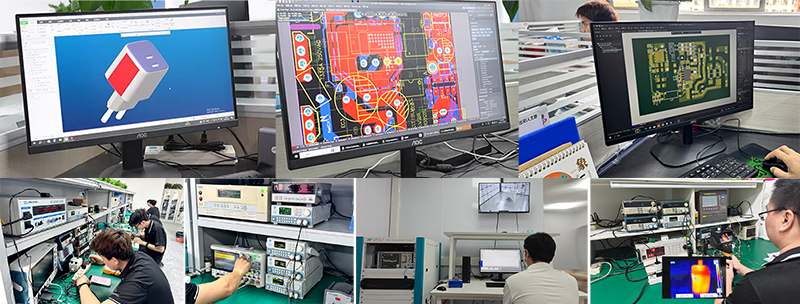
At ZONSAN, for example, charger development covers products from 5W to 240W, including compact wall chargers, GaN chargers and higher-power desktop charging products. The company has an independent R&D structure covering electronic, structural and layout engineering as well as validation functions.
The important lesson is simple: The development timeline follows the engineering workload.
What Determines the Development Time of a Custom Charger?
Before talking about specific weeks, it helps to understand what actually controls the schedule. There are several major factors.
1. Is It an Existing Platform or a New Design?
This is probably the biggest factor. Suppose a customer wants a 65W USB-C charger based on an existing production platform.
The factory may only need to modify: Logo, Housing color, Label, Packaging, Plug type, Cable, Minor specifications
That is very different from developing a completely new 65W charger.
A new design may require:
• Circuit architecture
• PCB layout
• Transformer design
• Component selection
• USB-C PD configuration
• Thermal analysis
• Mechanical design
• Prototype development
• Reliability testing
So when a supplier says: “We can make your charger in two weeks.”
The next question should be: Two weeks for what exactly? A customized existing model? Or a completely new charger?
Those are not the same project.
A Typical Custom Charger Development Timeline
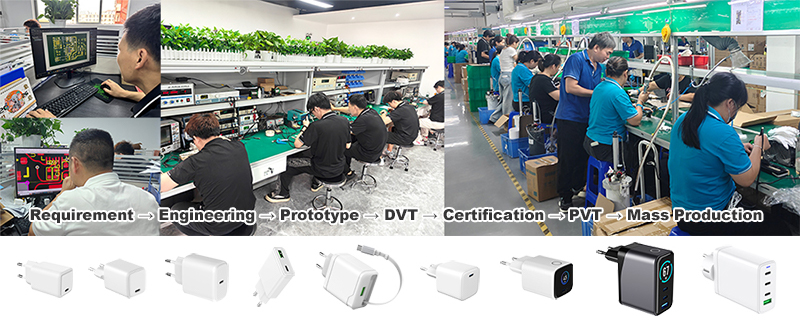
For a new OEM charger, a simplified development process may look like this: Requirement Confirmation → Engineering Review → Design & Prototype → Functional Debugging → DVT → Certification → PVT → Mass Production
The actual schedule varies by project, but this structure is useful because it shows where the time goes.
A rough project might take:
One of the first questions a brand or importer usually asks a charger manufacturer is surprisingly simple: “How long will it take?”
It sounds like a straightforward question. But there is no single answer.
A customer asking for a customized 25W USB-C charger may only need a few changes to an existing platform. Another customer may want a completely new 100W GaN charger with a custom housing, different port configuration, special charging profiles, regional certification and branded packaging.
Both are called “custom chargers.” The development work behind them is very different.
This is something worth understanding before setting a launch date.
A charger is not just a plastic housing with a PCB inside. Depending on the product, the development process may involve electrical architecture, USB-C PD configuration, thermal design, mechanical engineering, firmware or protocol tuning, reliability testing, certification and production validation.
That is why an experienced custom charger manufacturer normally starts by defining the product requirements before promising a delivery date.
At ZONSAN, for example, charger development covers products from 5W to 240W, including compact wall chargers, GaN chargers and higher-power desktop charging products. The company has an independent R&D structure covering electronic, structural and layout engineering as well as validation functions.
The important lesson is simple: The development timeline follows the engineering workload.
What Determines the Development Time of a Custom Charger?
Before talking about specific weeks, it helps to understand what actually controls the schedule. There are several major factors.
1. Is It an Existing Platform or a New Design?
This is probably the biggest factor. Suppose a customer wants a 65W USB-C charger based on an existing production platform.
The factory may only need to modify: Logo, Housing color, Label, Packaging, Plug type, Cable, Minor specifications
That is very different from developing a completely new 65W charger.
A new design may require:
• Circuit architecture
• PCB layout
• Transformer design
• Component selection
• USB-C PD configuration
• Thermal analysis
• Mechanical design
• Prototype development
• Reliability testing
So when a supplier says: “We can make your charger in two weeks.”
The next question should be: Two weeks for what exactly? A customized existing model? Or a completely new charger?
Those are not the same project.
A Typical Custom Charger Development Timeline
For a new OEM charger, a simplified development process may look like this: Requirement Confirmation → Engineering Review → Design & Prototype → Functional Debugging → DVT → Certification → PVT → Mass Production
The actual schedule varies by project, but this structure is useful because it shows where the time goes.
A rough project might take:
| Development Stage | Typical Time Range* |
| Requirement & specification | 2–7 days |
| Engineering feasibility | 3–10 days |
| Prototype development | 1–3 weeks |
| Functional debugging | 1–2 weeks |
| DVT / reliability validation | 1–3 weeks |
| Certification | 2–6+ weeks |
| PVT | 1–2 weeks |
| Mass production preparation | 1–2 weeks |
*These are planning ranges, not guaranteed delivery times. Certification, tooling, component availability and engineering changes can extend the schedule.
For relatively simple projects, the process may be shorter. For brand-new high-power GaN chargers, the process may be much longer.
Stage 1: Requirement and Specification Confirmation
Usually: 2–7 Days
The first stage is often underestimated.
Customers sometimes think development begins when the engineer starts drawing the PCB.
It does not. It starts when both sides agree on what is actually being developed. A good charger specification should define at least:
1. Plug type.
2. Target market.
3. Target quantity.
4. Certification requirements.
5. Rated output power.
6. Number of ports.
7. USB-C / USB-A configuration.
8. PD version.
9. PPS requirements.
10. QC requirements.
11. Input voltage.
12. Housing dimensions.
13. Packaging.
14. Cable requirements.
For example, “I need a 65W fast charger” is not enough.
A factory still needs to know: 65W on one USB-C port? Or: 65W total across two USB-C ports?
Does it need PPS? Does it need a USB-A port? Is it for laptops? Does it need CB CE ROHS KC ANATEL? Is the plug EU, UK, US or KR? And Does the customer need a completely new housing?
These decisions can change the engineering work considerably.
Why Specification Changes Cause Delays
One of the biggest causes of development delays is not slow engineering. It is changing requirements halfway through the project.
For example: A customer initially requests: 65W, 2C1A
The engineering team develops the prototype. Then the customer decides: “Can we make it 100W?”
That may require much more than changing a number on the label. The PCB architecture, components, thermal design and power allocation may all need to be reviewed.
The same problem happens when a customer changes the housing after the prototype has already been developed. This is why a good OEM charger manufacturer will spend time confirming specifications before starting full development.
It may feel slower at the beginning. In practice, it can save weeks later.
Stage 2: Engineering Feasibility Review
Usually: 3–10 Days
Once the requirements are clear, engineers need to determine whether the proposed charger can actually be built within the target size, power and cost. This is where practical engineering experience matters.
A customer may request: “Make the charger as small as possible.”
That sounds reasonable. But power density creates thermal challenges.
A 20W charger has a different thermal problem from a 100W GaN charger. A 140W charger has another level of power density and component requirements.
The engineering team needs to balance: Power + Size + Efficiency + Temperature + Safety + Cost
You cannot optimize all six independently.
A smaller housing may increase thermal difficulty.
A lower-cost component may affect efficiency.
More ports may complicate power allocation.
Higher output power may require a different architecture.
This is why feasibility review should happen before tooling.
Stage 3: Circuit and PCB Development
Usually: 1–3 Weeks
Once the basic architecture is approved, electrical engineering begins in earnest.
Depending on the project, this can include:
• Power topology
• Controller selection
• Power semiconductor selection
• Transformer specification
• PCB layout
• Protection circuits
• USB-C interface
• PD controller
• PPS implementation
• EMI considerations
• Component derating
For a simple charger based on an existing platform, much of this work may already be available. For a new product, it takes considerably longer.
This is one reason experienced factories can sometimes move faster than a supplier starting every project from zero.
The goal is not simply to produce a schematic. The circuit needs to work reliably under the actual conditions expected in the finished product.
Stage 4: Mechanical and Housing Development
Electrical design is only half the problem. The charger also needs to fit inside the physical product.
For a customized charger, mechanical development may include: Housing dimensions, Wall thickness, Port openings, PCB positioning, Plug structure, Heat dissipation, Internal clearances, Assembly method, Surface finish, Logo position
A very thin charger creates additional challenges because there is less room for components and heat management. This becomes particularly important for 65W GaN chargers and higher-power compact designs.
ZONSAN's current product range includes ultra-thin 65W GaN chargers as well as 100W and higher-power products, with customization options covering housing, plug types, packaging and other OEM requirements.
This is a good example of why mechanical design cannot be treated as an afterthought.
Stage 5: Prototype Development
Usually: 1–3 Weeks
After the initial engineering work, the first prototype can be produced. The prototype is not necessarily the final product (This is important).
The purpose of the first prototype is to answer questions such as:
1. Does the circuit operate correctly?
2. Does the charger achieve the target power?
3. Does USB-C PD negotiate correctly?
4. Does PPS work as expected?
5. Is the temperature acceptable?
6. Does everything fit inside the housing?
7. Are the ports positioned correctly?
A prototype can reveal problems that were difficult to identify during design. For example, a charger may meet the electrical specification but run hotter than expected. Or the housing may technically fit the PCB but leave insufficient room around a high-temperature component.
This is normal engineering work. The prototype stage is where those problems should be found.
Stage 6: PD and Fast-Charging Protocol Debugging
For modern USB-C chargers, electrical output is only part of the job. The charger also needs to communicate properly with compatible devices.
This can involve: USB PD, AVS, PPS, QC, Power profiles, Multi-port power allocation, Device compatibility
A 65W charger, may need to support different voltage and current combinations rather than simply provide one fixed 65W output. A multi-port charger adds another layer.
If the first USB-C port is delivering 65W and another device is connected, the system needs to determine how available power is redistributed. That is why protocol testing should include real devices as well as laboratory equipment.
A charger can pass a basic electrical test and still have compatibility issues in practical use. This is one of the areas where an experienced USB-C charger manufacturer can reduce development risk.
Stage 7: Thermal and Reliability Validation
Usually: 1–3 Weeks
Heat is one of the most important factors in modern charger development. The higher the power density, the more carefully thermal behavior needs to be evaluated.
Such as: 65W GaN chargers, 100W GaN chargers, 140W chargers, 240W USB-C chargers
Engineers may need to evaluate factors such as the charger's surface temperature, internal hot spots, component temperature, full load operation, multi-port load, long-term operation, and abnormal conditions.
The charger should not only work for a few minutes. It needs to remain stable under realistic operating conditions.
This is also closely related to the article "Thermal Reliability Engineering" previously published on the Zonsan blog. Thermal design should be considered during development, not added after the product is already finished.
For relatively simple projects, the process may be shorter. For brand-new high-power GaN chargers, the process may be much longer.
Stage 1: Requirement and Specification Confirmation
Usually: 2–7 Days
The first stage is often underestimated.
Customers sometimes think development begins when the engineer starts drawing the PCB.
It does not. It starts when both sides agree on what is actually being developed. A good charger specification should define at least:
1. Plug type.
2. Target market.
3. Target quantity.
4. Certification requirements.
5. Rated output power.
6. Number of ports.
7. USB-C / USB-A configuration.
8. PD version.
9. PPS requirements.
10. QC requirements.
11. Input voltage.
12. Housing dimensions.
13. Packaging.
14. Cable requirements.
For example, “I need a 65W fast charger” is not enough.
A factory still needs to know: 65W on one USB-C port? Or: 65W total across two USB-C ports?
Does it need PPS? Does it need a USB-A port? Is it for laptops? Does it need CB CE ROHS KC ANATEL? Is the plug EU, UK, US or KR? And Does the customer need a completely new housing?
These decisions can change the engineering work considerably.
Why Specification Changes Cause Delays
One of the biggest causes of development delays is not slow engineering. It is changing requirements halfway through the project.
For example: A customer initially requests: 65W, 2C1A
The engineering team develops the prototype. Then the customer decides: “Can we make it 100W?”
That may require much more than changing a number on the label. The PCB architecture, components, thermal design and power allocation may all need to be reviewed.
The same problem happens when a customer changes the housing after the prototype has already been developed. This is why a good OEM charger manufacturer will spend time confirming specifications before starting full development.
It may feel slower at the beginning. In practice, it can save weeks later.
Stage 2: Engineering Feasibility Review
Usually: 3–10 Days
Once the requirements are clear, engineers need to determine whether the proposed charger can actually be built within the target size, power and cost. This is where practical engineering experience matters.
A customer may request: “Make the charger as small as possible.”
That sounds reasonable. But power density creates thermal challenges.
A 20W charger has a different thermal problem from a 100W GaN charger. A 140W charger has another level of power density and component requirements.
The engineering team needs to balance: Power + Size + Efficiency + Temperature + Safety + Cost
You cannot optimize all six independently.
A smaller housing may increase thermal difficulty.
A lower-cost component may affect efficiency.
More ports may complicate power allocation.
Higher output power may require a different architecture.
This is why feasibility review should happen before tooling.
Stage 3: Circuit and PCB Development
Usually: 1–3 Weeks
Once the basic architecture is approved, electrical engineering begins in earnest.
Depending on the project, this can include:
• Power topology
• Controller selection
• Power semiconductor selection
• Transformer specification
• PCB layout
• Protection circuits
• USB-C interface
• PD controller
• PPS implementation
• EMI considerations
• Component derating
For a simple charger based on an existing platform, much of this work may already be available. For a new product, it takes considerably longer.
This is one reason experienced factories can sometimes move faster than a supplier starting every project from zero.
The goal is not simply to produce a schematic. The circuit needs to work reliably under the actual conditions expected in the finished product.
Stage 4: Mechanical and Housing Development
Electrical design is only half the problem. The charger also needs to fit inside the physical product.
For a customized charger, mechanical development may include: Housing dimensions, Wall thickness, Port openings, PCB positioning, Plug structure, Heat dissipation, Internal clearances, Assembly method, Surface finish, Logo position
A very thin charger creates additional challenges because there is less room for components and heat management. This becomes particularly important for 65W GaN chargers and higher-power compact designs.
ZONSAN's current product range includes ultra-thin 65W GaN chargers as well as 100W and higher-power products, with customization options covering housing, plug types, packaging and other OEM requirements.
This is a good example of why mechanical design cannot be treated as an afterthought.
Stage 5: Prototype Development
Usually: 1–3 Weeks
After the initial engineering work, the first prototype can be produced. The prototype is not necessarily the final product (This is important).
The purpose of the first prototype is to answer questions such as:
1. Does the circuit operate correctly?
2. Does the charger achieve the target power?
3. Does USB-C PD negotiate correctly?
4. Does PPS work as expected?
5. Is the temperature acceptable?
6. Does everything fit inside the housing?
7. Are the ports positioned correctly?
A prototype can reveal problems that were difficult to identify during design. For example, a charger may meet the electrical specification but run hotter than expected. Or the housing may technically fit the PCB but leave insufficient room around a high-temperature component.
This is normal engineering work. The prototype stage is where those problems should be found.
Stage 6: PD and Fast-Charging Protocol Debugging
For modern USB-C chargers, electrical output is only part of the job. The charger also needs to communicate properly with compatible devices.
This can involve: USB PD, AVS, PPS, QC, Power profiles, Multi-port power allocation, Device compatibility
A 65W charger, may need to support different voltage and current combinations rather than simply provide one fixed 65W output. A multi-port charger adds another layer.
If the first USB-C port is delivering 65W and another device is connected, the system needs to determine how available power is redistributed. That is why protocol testing should include real devices as well as laboratory equipment.
A charger can pass a basic electrical test and still have compatibility issues in practical use. This is one of the areas where an experienced USB-C charger manufacturer can reduce development risk.
Stage 7: Thermal and Reliability Validation
Usually: 1–3 Weeks
Heat is one of the most important factors in modern charger development. The higher the power density, the more carefully thermal behavior needs to be evaluated.
Such as: 65W GaN chargers, 100W GaN chargers, 140W chargers, 240W USB-C chargers
Engineers may need to evaluate factors such as the charger's surface temperature, internal hot spots, component temperature, full load operation, multi-port load, long-term operation, and abnormal conditions.
The charger should not only work for a few minutes. It needs to remain stable under realistic operating conditions.
This is also closely related to the article "Thermal Reliability Engineering" previously published on the Zonsan blog. Thermal design should be considered during development, not added after the product is already finished.

Stage 8: DVT — Design Validation Testing
DVT is where the engineering team asks a more serious question: Does the design actually meet the requirements?
The testing becomes broader than basic functional testing. Depending on the product, DVT can include: Electrical performance,
PD/PPS compatibility, Thermal performance, Safety functions, EMI/EMC pre-checks, Drop testing, Aging, High-voltage testing, Abnormal operation, Mechanical checks.
The exact test plan depends on the product and target market.
The purpose is to identify design problems before the product enters mass production. Skipping proper DVT may make the project look faster on paper. It does not necessarily make the overall project faster. A problem discovered after thousands of units have been produced is much more expensive to fix.
Why High-Power Chargers Need More Development Time
It is tempting to think:
25W charger = small project
65W charger = medium project
100W charger = bigger project
But the relationship is not quite that simple.
As power increases, several engineering requirements become more demanding.
Charger 25W — Usually easier to manage in terms of: Thermal load, Component stress, Physical size, Power density.
Charger 65W — More attention may be required for: Thermal performance, PD/PPS, Laptop compatibility, Compact housing, Multi-port behavior.
Charger 100W+ — The engineering workload can increase further because of:Higher power density, Thermal management, Component selection, USB-C PD requirements, Cable considerations, More demanding validation.
Charger 140W / 240W — These products move further into high-power USB-C charging engineering. The design, thermal and certification requirements need to be treated accordingly.
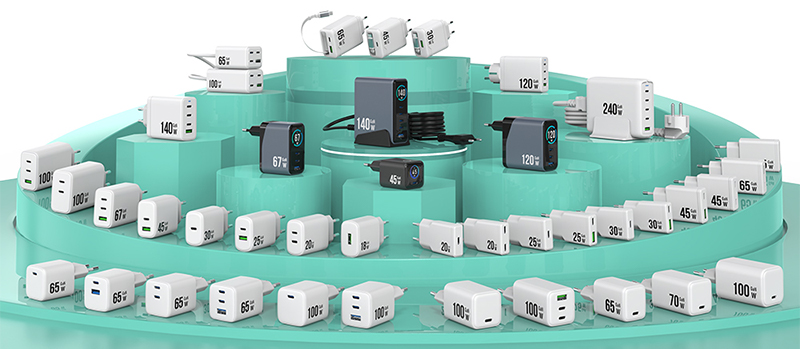
ZONSAN's current product portfolio covers chargers from 5W through 240W, including 65W, 100W, 140W and 240W products, giving it experience across different power levels rather than only one charger category.
Existing Platform vs. New Custom Charger: The Timeline Can Be Very Different
This distinction deserves its own section because it affects most OEM projects.
Option 1: Customize an Existing Charger
For example: A factory already has a production-ready 65W GaN charger.
Customer requests: New logo, New color, Custom packaging, Different plug, Modified label.
The development period can be relatively short because the core electrical design has already been validated.
Option 2: Modify an Existing Platform
The customer wants:
1. Different port combination
2. Different power distribution
3. New housing
4. Modified PD profiles
5. Different regional certification
Now engineering work increases. The factory can still reuse part of the existing platform, but additional validation is required.
Option 3: Develop a Completely New Charger
This is the longest route. For example: A new 100W 3-port GaN charger with custom housing, custom PCB, specific PPS profiles, KC certification and branded packaging.
This involves much more than product customization. It becomes a genuine new product development project.
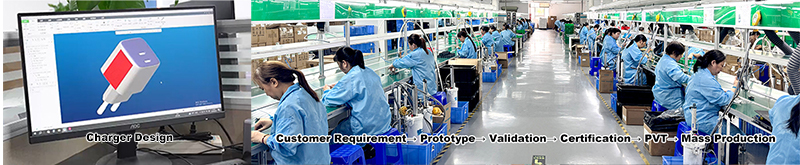
That means: Engineering → Prototype → Debugging → DVT → Certification → PVT → Mass Production
The timeline should be planned accordingly.
What Can Make a GaN Charger Development Project Faster?
Speed is not only about how fast engineers work. Several factors can make a large difference.
Clear Specifications
The earlier the customer confirms: Power, Ports, Protocols, Housing, Plug, Certification, Target market; the less rework is required.
Existing Technology Platforms
A mature charger manufacturer may already have proven architectures for certain power ranges.
This can shorten development time without sacrificing engineering validation.
Early Certification Planning
Certification should not be treated as an afterthought.
If the target market is known from the beginning, the engineering team can design around the relevant requirements.
Fast Customer Feedback
Prototype development can stall when samples are waiting for customer approval.
A one-week delay at one stage can easily become several weeks by the end of a project.
Stable Components
Changing a major component late in development can trigger another round of testing.
This is why component selection needs to be considered early.
What Usually Causes Charger Development Delays?
In real projects, delays often come from a combination of small issues rather than one dramatic failure.
Common examples include:
Changing the power requirement — 65W becomes 100W after the PCB is already designed.
Changing the housing — A new ID design no longer fits the existing internal structure.
Changing the port configuration — 2C becomes 2C1A, requiring a new power allocation strategy.
Certification problems — A product fails an EMC or safety test and needs engineering changes.
Component shortages — The selected component becomes unavailable or has an extended lead time.
Repeated sample changes — The customer requests several rounds of appearance or specification modifications.
Insufficient prototype testing — A problem is discovered too late, during certification or PVT.
These issues are why a realistic development schedule should include some engineering buffer.
DVT is where the engineering team asks a more serious question: Does the design actually meet the requirements?
The testing becomes broader than basic functional testing. Depending on the product, DVT can include: Electrical performance,
PD/PPS compatibility, Thermal performance, Safety functions, EMI/EMC pre-checks, Drop testing, Aging, High-voltage testing, Abnormal operation, Mechanical checks.
The exact test plan depends on the product and target market.
The purpose is to identify design problems before the product enters mass production. Skipping proper DVT may make the project look faster on paper. It does not necessarily make the overall project faster. A problem discovered after thousands of units have been produced is much more expensive to fix.
Why High-Power Chargers Need More Development Time
It is tempting to think:
25W charger = small project
65W charger = medium project
100W charger = bigger project
But the relationship is not quite that simple.
As power increases, several engineering requirements become more demanding.
Charger 25W — Usually easier to manage in terms of: Thermal load, Component stress, Physical size, Power density.
Charger 65W — More attention may be required for: Thermal performance, PD/PPS, Laptop compatibility, Compact housing, Multi-port behavior.
Charger 100W+ — The engineering workload can increase further because of:Higher power density, Thermal management, Component selection, USB-C PD requirements, Cable considerations, More demanding validation.
Charger 140W / 240W — These products move further into high-power USB-C charging engineering. The design, thermal and certification requirements need to be treated accordingly.
ZONSAN's current product portfolio covers chargers from 5W through 240W, including 65W, 100W, 140W and 240W products, giving it experience across different power levels rather than only one charger category.
Existing Platform vs. New Custom Charger: The Timeline Can Be Very Different
This distinction deserves its own section because it affects most OEM projects.
Option 1: Customize an Existing Charger
For example: A factory already has a production-ready 65W GaN charger.
Customer requests: New logo, New color, Custom packaging, Different plug, Modified label.
The development period can be relatively short because the core electrical design has already been validated.
Option 2: Modify an Existing Platform
The customer wants:
1. Different port combination
2. Different power distribution
3. New housing
4. Modified PD profiles
5. Different regional certification
Now engineering work increases. The factory can still reuse part of the existing platform, but additional validation is required.
Option 3: Develop a Completely New Charger
This is the longest route. For example: A new 100W 3-port GaN charger with custom housing, custom PCB, specific PPS profiles, KC certification and branded packaging.
This involves much more than product customization. It becomes a genuine new product development project.
That means: Engineering → Prototype → Debugging → DVT → Certification → PVT → Mass Production
The timeline should be planned accordingly.
What Can Make a GaN Charger Development Project Faster?
Speed is not only about how fast engineers work. Several factors can make a large difference.
Clear Specifications
The earlier the customer confirms: Power, Ports, Protocols, Housing, Plug, Certification, Target market; the less rework is required.
Existing Technology Platforms
A mature charger manufacturer may already have proven architectures for certain power ranges.
This can shorten development time without sacrificing engineering validation.
Early Certification Planning
Certification should not be treated as an afterthought.
If the target market is known from the beginning, the engineering team can design around the relevant requirements.
Fast Customer Feedback
Prototype development can stall when samples are waiting for customer approval.
A one-week delay at one stage can easily become several weeks by the end of a project.
Stable Components
Changing a major component late in development can trigger another round of testing.
This is why component selection needs to be considered early.
What Usually Causes Charger Development Delays?
In real projects, delays often come from a combination of small issues rather than one dramatic failure.
Common examples include:
Changing the power requirement — 65W becomes 100W after the PCB is already designed.
Changing the housing — A new ID design no longer fits the existing internal structure.
Changing the port configuration — 2C becomes 2C1A, requiring a new power allocation strategy.
Certification problems — A product fails an EMC or safety test and needs engineering changes.
Component shortages — The selected component becomes unavailable or has an extended lead time.
Repeated sample changes — The customer requests several rounds of appearance or specification modifications.
Insufficient prototype testing — A problem is discovered too late, during certification or PVT.
These issues are why a realistic development schedule should include some engineering buffer.
A Realistic Way to Plan Your Charger Launch
If you are a brand owner planning a new charger(ODM), do not start with: “We need 10,000 units by September.”
Start with the development backwards. For example: Target Market Launch → Mass Production → PVT → Certification → DVT → Prototype Approval → Engineering Development → Specification Confirmation
This approach makes the schedule much more realistic. It also helps identify where the actual risk is.
If certification is expected to take several weeks, that needs to be included from the beginning.
If a new mold is required, tooling time needs to be included.
If the customer wants a completely new 100W GaN platform, engineering time needs to be included.
A good OEM ODM charger factory should be able to explain these dependencies instead of simply giving a single optimistic delivery date.
If you are a brand owner planning a new charger(ODM), do not start with: “We need 10,000 units by September.”
Start with the development backwards. For example: Target Market Launch → Mass Production → PVT → Certification → DVT → Prototype Approval → Engineering Development → Specification Confirmation
This approach makes the schedule much more realistic. It also helps identify where the actual risk is.
If certification is expected to take several weeks, that needs to be included from the beginning.
If a new mold is required, tooling time needs to be included.
If the customer wants a completely new 100W GaN platform, engineering time needs to be included.
A good OEM ODM charger factory should be able to explain these dependencies instead of simply giving a single optimistic delivery date.
How Long Does It Take to Develop Different Charger Power Levels?
There is no fixed development time for a charger based only on its wattage.
Still, power level is a useful reference when planning an OEM project.
A 25W charger and a 140W charger can both be described as USB-C PD chargers, but the engineering work behind them is not comparable.
The following ranges are useful for initial project planning, assuming the customer wants a genuinely customized product rather than only a logo or packaging change.
| Charger Type | Typical Development Complexity | Main Considerations |
| 20W–25W | Low to Medium | PD/PPS, compact design, certification |
| 30W–45W | Medium | Thermal design, PPS, housing |
| 65W | Medium to High | Laptop charging, thermal performance, PD/PPS |
| 100W | High | Power density, thermal management, PD |
| 120W–140W | High | High-power architecture, thermal and safety validation |
| 240W | Very High | PD 3.1, PD3.2, high-power components, cable and system validation |
These are not promises of production lead time. They are engineering planning references.
A customer who needs a 45W charger manufacturer for an existing platform may have a much shorter path than a customer developing a completely new 45W charger from scratch.
That distinction should always be made at the beginning of the project.
25W Charger Development: Usually a Straightforward Starting Point
A 25W charger is relatively compact and is widely used for smartphones, tablets and other small consumer electronics.
For an OEM project, the engineering requirements may include:
• USB-C PD, PPS, QC
• Compact housing
• Regional plug configuration
• Thermal testing
• Safety testing
• CB, RoHS, KC, CE, FCC or other market requirements
If an existing platform can be adapted, development can move relatively quickly. For example, changing the housing color and logo is very different from developing a new 25W USB-C charger with a completely different internal architecture.
For buyers looking for a 25W charger supplier, it is therefore useful to ask whether the supplier is offering an existing platform or developing a new design.
That single question can explain a surprisingly large difference in quotation and lead time.
45W Charger Development: More Room for Design Optimization
A 45W charger is often used for both mobile devices and lightweight computing products. At this level, engineers have to pay closer attention to:
• PD profiles, PPS compatibility, AVS
• Thermal performance
• Component selection
• Housing size
• Port configuration
• Regional certification
A compact 45W GaN charger can also create a higher power-density challenge than a conventional silicon-based design.
For an OEM charger manufacturer, the target is not simply to reach 45W. The charger needs to deliver that power reliably while maintaining acceptable temperature, safety margins and long-term stability.
This is where platform experience becomes useful.
65W Charger Development: A Common OEM Sweet Spot
The 65W category deserves special attention because it sits at an interesting point in the market. 65W charger can be small enough for everyday travel while still providing useful power for laptops, tablets and smartphones.
But this also means the product may need to handle a much wider range of devices.
A typical custom 65W USB-C charger may involve:
• USB-C PD, PPS, QC, AVS
• Laptop charging
• Smartphone fast charging
• Thermal validation
• Compact mechanical design
• Multi-port power allocation
• Regional certification
If a customer requests a 65W charger with two USB-C ports and one USB-A port, the engineering team also needs to determine how power is divided when multiple devices are connected.
• Single-port operation — 65W available from USB-C.
• Dual-port operation — Power is redistributed between the connected devices.
• Three-port operation — The power allocation becomes more complicated again.
This is why a 65W charger factory should be evaluated not only by its advertised output power, but also by its ability to develop and validate the complete charging system.
100W Charger Development: Where Engineering Becomes More Important
Once a charger reaches 100W, power density becomes a much more significant design consideration. 100W charger needs to manage substantially more electrical power inside a relatively small enclosure.
Engineers need to pay close attention to:
• Efficiency
• Heat generation
• Component temperature
• Transformer design
• PCB layout
• Power semiconductor selection
• PD negotiation
• Protection mechanisms
• Housing ventilation and thermal paths
GaN technology can help enable smaller high-power chargers, but GaN itself does not automatically solve the thermal problem. A poorly optimized 100W GaN charger can still run too hot.
This is why buyers should look beyond the phrase “100W GaN charger manufacturer.”
The more useful question is: Can the manufacturer demonstrate how the design was validated under sustained high-load conditions?
That question usually leads to a much better technical discussion.
120W, 140W and 240W: High-Power Charger Development
High-power USB-C charging introduces another level of engineering complexity. At 140W and above, designers need to consider the complete charging ecosystem rather than looking only at the adapter.
For USB-C PD 3.1 applications, this can include:
1. Higher voltage operating points
2. Power delivery profiles
3. Cable requirements
4. Connector considerations
5. Thermal performance
6. Safety protection
7. EMI/EMC performance
8. Long-duration operation
For a 140W charger manufacturer, the challenge is not simply achieving the rated output during a laboratory test. The product needs to remain stable under realistic operating conditions.
The same principle becomes even more important when developing a 240W USB-C charger. At this power level, component selection, PCB layout, thermal design, protection and validation all become critical parts of the project.
How Certification Changes the OEM Charger Timeline
Certification is one of the most underestimated parts of charger development.
A customer may think: “The prototype works, so we are almost finished.”
Not necessarily. Depending on the destination market, the charger may need to meet requirements associated with certifications and regulations such as: CE, FCC, KC, ETL, CB, RoHS, ERP, UKCA, and etc.
The exact requirements depend on the product and target market. The important point is that certification should be considered during engineering, not after everything else is finished.
Why Certification Should Start With the Product Specification
Imagine a customer develops a charger first and only later decides to sell it in South Korea.
The certification requirements may then influence: Components; Safety distances; PCB design; Labeling; Testing; Documentation
If engineering changes are required late in the project, the manufacturer may need to modify the product and repeat part of the validation. That can add significant time!
This is why an experienced charger manufacturer asks about the target market early.
The question is not simply: “Which certification do you need?” It should be: “Where will this charger be sold, and what product configuration will be shipped there?”
KC Certification and Charger Development for the Korean Market
Take South Korea as an example: Korea is a good example of why market planning matters. If a customer is developing a 25W, 45W or 65W charger for Korea, KC requirements should be considered before the final design is locked.
For example, a customer searching for a: KC 25W 45W 65W charger supplier, may actually need much more than a charger carrying a KC mark.
They need:
1. Appropriate Korean plug configuration
2. Relevant safety compliance
3. Correct labeling
4. Test documentation
5. Consistent production quality
6. Stable component sourcing (Stable delivery cycle)
In other words, certification is connected to the complete product development process.
How DVT and PVT Affect the Final Schedule
Two stages that are often misunderstood are DVT and PVT.
DVT: Design Validation Testing
DVT answers: Does the design meet the intended requirements?
The team evaluates the design before mass production. This can include: Electrical performance, Thermal behavior, PD/PPS compatibility, Reliability, Safety, Mechanical durability, EMC pre-testing.
If DVT identifies a design problem, the product goes back into engineering. That is not necessarily a failure of the project.
It is exactly what DVT is designed to find.
PVT: Production Validation Testing
PVT asks a different question: Can the factory produce the approved design consistently?
This is important because a prototype produced by engineers is not the same as thousands of units coming through a production line. PVT can verify: Assembly process, Production consistency, Testing procedures, Material control, Yield, Final product performance
The goal is to reduce the gap between: Engineering Sample and Mass Production Product.
For a serious OEM project, this step should not be removed simply because the customer is trying to launch quickly.
What Is the Fastest Way to Develop a Custom Charger?
There is a misconception that the fastest route is simply to find a factory willing to promise the shortest delivery date.
In reality, the fastest route is usually:
1. Start with a clear specification
Do not begin with: “We want a fast charger.”
Define the product properly.
2. Decide what actually needs to be customized
Is it: Logo? Housing? Color? Plug? PCB? Charging protocol? Port configuration? Entire architecture?
3. Select a suitable platform
If a proven platform already meets most requirements, there may be no reason to redesign everything.
4. Confirm the target market early
Know whether the product is intended for: Europe, Korea, UK, North America, Middle East, and Other markets.
5. Freeze the major specifications early
Every major change after prototype development has a cost.
6. Prepare certification requirements before DVT
This reduces the risk of discovering certification problems too late.
7. Keep customer feedback moving
A factory can finish a sample quickly, but the project still stops if the customer takes two weeks to approve it.
What Should You Ask a Charger Manufacturer Before Starting?
Before selecting an OEM charger factory, I would suggest asking these questions.
About engineering
1. Do you have your own R&D team?
2. Can you develop new PCB designs?
3. Can you modify an existing charger platform?
4. Do you support PD and PPS development?
5. Can you customize the charger housing?
About validation
1. What DVT tests are performed?
2. How do you perform thermal testing?
3. How do you verify PD compatibility?
4. Do you conduct aging and reliability testing?
5. How is PVT handled before mass production?
About certification
1. Which certifications can the factory support?
2. Do you have experience with KC?
3. Can certification requirements be integrated during development?
4. Who handles the testing documentation?
About production
1. What happens after prototype approval?
2. How are engineering changes controlled?
3. How is production consistency monitored?
4. What quality inspection takes place before shipment?
These questions tell you much more about a factory than simply asking: “What is your lowest price?”
What Makes an OEM Charger Project Go Smoothly?
From a buyer's perspective, a smooth project usually has three characteristics.
The Specification Is Clear: Everyone knows exactly what is being developed.
Engineering and Sales Communicate: The sales team should not promise something the engineering team has never evaluated.
The Factory Has a Repeatable Development Process: A good development process reduces dependence on individual people.
This is particularly important for chargers because electrical, mechanical, thermal, certification and production issues are closely connected. A factory that only focuses on the PCB may miss a mechanical or certification problem. factory that understands the entire development chain can identify those issues earlier.
Why Factory Experience Matters in Charger Development
There is a difference between a company that can assemble a charger and a manufacturer that has spent years developing charging products.
Experience becomes particularly useful when the project contains several requirements at the same time. For example:
65W + GaN + 2C1A + PPS + compact housing + KC certification + private label.
Each individual requirement is manageable. The difficulty comes from making all of them work together.
This is where an experienced charger factory can bring practical knowledge from previous projects.
ZONSAN has been focused on charger development and manufacturing since 2009, with a product range extending from 5W to 240W and OEM/ODM development covering different charger types and power levels. That kind of accumulated experience matters because not every development problem needs to be solved from scratch.
Don't Confuse Development Time With Production Lead Time
This is another point that causes confusion in OEM projects. These are three different things:
Development Time: How long it takes to create and validate the product.
Certification Time: How long the required testing and documentation process takes.
Production Lead Time: How long it takes to manufacture the approved product.
For an existing charger, production may be relatively straightforward. For a new custom charger, however, the project may look more like:
Development → Prototype → DVT → Certification → Tooling → PVT → Mass Production
Each stage has its own schedule. Therefore, when negotiating with a charger supplier, ask them to separate: Engineering timeline + certification timeline + production lead time, rather than giving you one broad number.
A Practical Timeline for an OEM Charger Project
For planning purposes, a new custom charger can be divided into four broad phases.
Phase 1 — Product Definition
Specification → Feasibility → Cost → Design direction
The objective is to make sure everyone agrees on the product before engineering investment increases.
Phase 2 — Engineering Development
Electrical design → Mechanical design → Prototype → Debugging
This is where the physical product begins to take shape.
Phase 3 — Validation and Certification
DVT → Reliability → Certification → Engineering corrections
This phase determines whether the design is ready for commercial production.
Phase 4 — Production Introduction
Tooling → PVT → Production preparation → Mass production
At this point, the question changes from: “Can we make it?” to: “Can we make it consistently?”
That distinction is fundamental to professional charger manufacturing.
A customer who needs a 45W charger manufacturer for an existing platform may have a much shorter path than a customer developing a completely new 45W charger from scratch.
That distinction should always be made at the beginning of the project.
25W Charger Development: Usually a Straightforward Starting Point
A 25W charger is relatively compact and is widely used for smartphones, tablets and other small consumer electronics.
For an OEM project, the engineering requirements may include:
• USB-C PD, PPS, QC
• Compact housing
• Regional plug configuration
• Thermal testing
• Safety testing
• CB, RoHS, KC, CE, FCC or other market requirements
If an existing platform can be adapted, development can move relatively quickly. For example, changing the housing color and logo is very different from developing a new 25W USB-C charger with a completely different internal architecture.
For buyers looking for a 25W charger supplier, it is therefore useful to ask whether the supplier is offering an existing platform or developing a new design.
That single question can explain a surprisingly large difference in quotation and lead time.
45W Charger Development: More Room for Design Optimization
A 45W charger is often used for both mobile devices and lightweight computing products. At this level, engineers have to pay closer attention to:
• PD profiles, PPS compatibility, AVS
• Thermal performance
• Component selection
• Housing size
• Port configuration
• Regional certification
A compact 45W GaN charger can also create a higher power-density challenge than a conventional silicon-based design.
For an OEM charger manufacturer, the target is not simply to reach 45W. The charger needs to deliver that power reliably while maintaining acceptable temperature, safety margins and long-term stability.
This is where platform experience becomes useful.
65W Charger Development: A Common OEM Sweet Spot
The 65W category deserves special attention because it sits at an interesting point in the market. 65W charger can be small enough for everyday travel while still providing useful power for laptops, tablets and smartphones.
But this also means the product may need to handle a much wider range of devices.
A typical custom 65W USB-C charger may involve:
• USB-C PD, PPS, QC, AVS
• Laptop charging
• Smartphone fast charging
• Thermal validation
• Compact mechanical design
• Multi-port power allocation
• Regional certification
If a customer requests a 65W charger with two USB-C ports and one USB-A port, the engineering team also needs to determine how power is divided when multiple devices are connected.
• Single-port operation — 65W available from USB-C.
• Dual-port operation — Power is redistributed between the connected devices.
• Three-port operation — The power allocation becomes more complicated again.
This is why a 65W charger factory should be evaluated not only by its advertised output power, but also by its ability to develop and validate the complete charging system.
100W Charger Development: Where Engineering Becomes More Important
Once a charger reaches 100W, power density becomes a much more significant design consideration. 100W charger needs to manage substantially more electrical power inside a relatively small enclosure.
Engineers need to pay close attention to:
• Efficiency
• Heat generation
• Component temperature
• Transformer design
• PCB layout
• Power semiconductor selection
• PD negotiation
• Protection mechanisms
• Housing ventilation and thermal paths
GaN technology can help enable smaller high-power chargers, but GaN itself does not automatically solve the thermal problem. A poorly optimized 100W GaN charger can still run too hot.
This is why buyers should look beyond the phrase “100W GaN charger manufacturer.”
The more useful question is: Can the manufacturer demonstrate how the design was validated under sustained high-load conditions?
That question usually leads to a much better technical discussion.
120W, 140W and 240W: High-Power Charger Development
High-power USB-C charging introduces another level of engineering complexity. At 140W and above, designers need to consider the complete charging ecosystem rather than looking only at the adapter.
For USB-C PD 3.1 applications, this can include:
1. Higher voltage operating points
2. Power delivery profiles
3. Cable requirements
4. Connector considerations
5. Thermal performance
6. Safety protection
7. EMI/EMC performance
8. Long-duration operation
For a 140W charger manufacturer, the challenge is not simply achieving the rated output during a laboratory test. The product needs to remain stable under realistic operating conditions.
The same principle becomes even more important when developing a 240W USB-C charger. At this power level, component selection, PCB layout, thermal design, protection and validation all become critical parts of the project.
How Certification Changes the OEM Charger Timeline
Certification is one of the most underestimated parts of charger development.
A customer may think: “The prototype works, so we are almost finished.”
Not necessarily. Depending on the destination market, the charger may need to meet requirements associated with certifications and regulations such as: CE, FCC, KC, ETL, CB, RoHS, ERP, UKCA, and etc.
The exact requirements depend on the product and target market. The important point is that certification should be considered during engineering, not after everything else is finished.
Why Certification Should Start With the Product Specification
Imagine a customer develops a charger first and only later decides to sell it in South Korea.
The certification requirements may then influence: Components; Safety distances; PCB design; Labeling; Testing; Documentation
If engineering changes are required late in the project, the manufacturer may need to modify the product and repeat part of the validation. That can add significant time!
This is why an experienced charger manufacturer asks about the target market early.
The question is not simply: “Which certification do you need?” It should be: “Where will this charger be sold, and what product configuration will be shipped there?”
KC Certification and Charger Development for the Korean Market
Take South Korea as an example: Korea is a good example of why market planning matters. If a customer is developing a 25W, 45W or 65W charger for Korea, KC requirements should be considered before the final design is locked.
For example, a customer searching for a: KC 25W 45W 65W charger supplier, may actually need much more than a charger carrying a KC mark.
They need:
1. Appropriate Korean plug configuration
2. Relevant safety compliance
3. Correct labeling
4. Test documentation
5. Consistent production quality
6. Stable component sourcing (Stable delivery cycle)
In other words, certification is connected to the complete product development process.
How DVT and PVT Affect the Final Schedule
Two stages that are often misunderstood are DVT and PVT.
DVT: Design Validation Testing
DVT answers: Does the design meet the intended requirements?
The team evaluates the design before mass production. This can include: Electrical performance, Thermal behavior, PD/PPS compatibility, Reliability, Safety, Mechanical durability, EMC pre-testing.
If DVT identifies a design problem, the product goes back into engineering. That is not necessarily a failure of the project.
It is exactly what DVT is designed to find.
PVT: Production Validation Testing
PVT asks a different question: Can the factory produce the approved design consistently?
This is important because a prototype produced by engineers is not the same as thousands of units coming through a production line. PVT can verify: Assembly process, Production consistency, Testing procedures, Material control, Yield, Final product performance
The goal is to reduce the gap between: Engineering Sample and Mass Production Product.
For a serious OEM project, this step should not be removed simply because the customer is trying to launch quickly.
What Is the Fastest Way to Develop a Custom Charger?
There is a misconception that the fastest route is simply to find a factory willing to promise the shortest delivery date.
In reality, the fastest route is usually:
1. Start with a clear specification
Do not begin with: “We want a fast charger.”
Define the product properly.
2. Decide what actually needs to be customized
Is it: Logo? Housing? Color? Plug? PCB? Charging protocol? Port configuration? Entire architecture?
3. Select a suitable platform
If a proven platform already meets most requirements, there may be no reason to redesign everything.
4. Confirm the target market early
Know whether the product is intended for: Europe, Korea, UK, North America, Middle East, and Other markets.
5. Freeze the major specifications early
Every major change after prototype development has a cost.
6. Prepare certification requirements before DVT
This reduces the risk of discovering certification problems too late.
7. Keep customer feedback moving
A factory can finish a sample quickly, but the project still stops if the customer takes two weeks to approve it.
What Should You Ask a Charger Manufacturer Before Starting?
Before selecting an OEM charger factory, I would suggest asking these questions.
About engineering
1. Do you have your own R&D team?
2. Can you develop new PCB designs?
3. Can you modify an existing charger platform?
4. Do you support PD and PPS development?
5. Can you customize the charger housing?
About validation
1. What DVT tests are performed?
2. How do you perform thermal testing?
3. How do you verify PD compatibility?
4. Do you conduct aging and reliability testing?
5. How is PVT handled before mass production?
About certification
1. Which certifications can the factory support?
2. Do you have experience with KC?
3. Can certification requirements be integrated during development?
4. Who handles the testing documentation?
About production
1. What happens after prototype approval?
2. How are engineering changes controlled?
3. How is production consistency monitored?
4. What quality inspection takes place before shipment?
These questions tell you much more about a factory than simply asking: “What is your lowest price?”
What Makes an OEM Charger Project Go Smoothly?
From a buyer's perspective, a smooth project usually has three characteristics.
The Specification Is Clear: Everyone knows exactly what is being developed.
Engineering and Sales Communicate: The sales team should not promise something the engineering team has never evaluated.
The Factory Has a Repeatable Development Process: A good development process reduces dependence on individual people.
This is particularly important for chargers because electrical, mechanical, thermal, certification and production issues are closely connected. A factory that only focuses on the PCB may miss a mechanical or certification problem. factory that understands the entire development chain can identify those issues earlier.
Why Factory Experience Matters in Charger Development
There is a difference between a company that can assemble a charger and a manufacturer that has spent years developing charging products.
Experience becomes particularly useful when the project contains several requirements at the same time. For example:
65W + GaN + 2C1A + PPS + compact housing + KC certification + private label.
Each individual requirement is manageable. The difficulty comes from making all of them work together.
This is where an experienced charger factory can bring practical knowledge from previous projects.
ZONSAN has been focused on charger development and manufacturing since 2009, with a product range extending from 5W to 240W and OEM/ODM development covering different charger types and power levels. That kind of accumulated experience matters because not every development problem needs to be solved from scratch.
Don't Confuse Development Time With Production Lead Time
This is another point that causes confusion in OEM projects. These are three different things:
Development Time: How long it takes to create and validate the product.
Certification Time: How long the required testing and documentation process takes.
Production Lead Time: How long it takes to manufacture the approved product.
For an existing charger, production may be relatively straightforward. For a new custom charger, however, the project may look more like:
Development → Prototype → DVT → Certification → Tooling → PVT → Mass Production
Each stage has its own schedule. Therefore, when negotiating with a charger supplier, ask them to separate: Engineering timeline + certification timeline + production lead time, rather than giving you one broad number.
A Practical Timeline for an OEM Charger Project
For planning purposes, a new custom charger can be divided into four broad phases.
Phase 1 — Product Definition
Specification → Feasibility → Cost → Design direction
The objective is to make sure everyone agrees on the product before engineering investment increases.
Phase 2 — Engineering Development
Electrical design → Mechanical design → Prototype → Debugging
This is where the physical product begins to take shape.
Phase 3 — Validation and Certification
DVT → Reliability → Certification → Engineering corrections
This phase determines whether the design is ready for commercial production.
Phase 4 — Production Introduction
Tooling → PVT → Production preparation → Mass production
At this point, the question changes from: “Can we make it?” to: “Can we make it consistently?”
That distinction is fundamental to professional charger manufacturing.
Final Thoughts: Plan the Charger Development Backwards From the Launch Date
If you are buying a charger for a new product launch, the safest approach is not to ask a factory for the shortest possible development time. Instead, start with the launch date and work backwards.
Determine:
1. When must certification be completed?
2. When must DVT be approved?
3. When must the final sample be frozen?
4. When must tooling be completed?
5. When does PVT need to start?
6. When does mass production need to begin?
Once those dates are clear, the development schedule becomes much easier to manage.
For simple customization, the process can be relatively short.
For a completely new 65W, 100W, 140W or 240W charger, however, proper engineering, validation and certification should be given enough time. A charger that reaches the market two weeks earlier but requires a redesign later is not really a faster project.
The better target is: Develop the right product, validate it properly, and make the transition to mass production predictable.
That is what separates a reliable OEM charger manufacturer from a supplier that is simply trying to win an order.
FAQ: Custom Charger Development
Q1: How long does it take to develop a custom charger?
It depends on the level of customization. Simple branding changes can be completed much faster than a completely new charger involving PCB design, housing development, DVT, certification and PVT.
Q2: How long does it take to develop a 65W charger?
A new 65W charger generally requires more engineering and validation than a basic 20W–25W charger, particularly when GaN, PPS, multiple ports or a custom housing are involved.
Q3: Is a custom GaN charger more difficult to develop?
It can be. GaN technology enables higher power density, but thermal management, component selection, PCB layout and reliability still need careful engineering.
Q4: Can an existing charger platform reduce development time?
Yes. Starting from a proven platform can reduce engineering work when the existing electrical architecture already meets most of the customer's requirements.
Q5: Does certification increase charger development time?
Yes. Certification testing can add time, particularly if the product requires engineering changes after testing.
Q6: What is the difference between OEM and ODM charger development?
OEM development generally follows the customer's specifications and branding requirements, while ODM usually starts from a manufacturer's existing product or technology platform that is adapted for the customer.
Q7: When should certification be considered?
Certification requirements should be identified during the initial product definition stage, before the final electrical and mechanical design is frozen.
Q8: Why does a high-power charger need more validation?
Higher-power chargers generally operate with greater power density and thermal load. This increases the importance of component selection, thermal management, safety and long-duration testing.
Q9: What is DVT in charger development?
DVT stands for Design Validation Testing. It verifies whether the charger design meets its electrical, thermal, mechanical, safety and other intended requirements before mass production.
Q10: What is PVT in charger manufacturing?
PVT stands for Production Validation Testing. It verifies that the approved charger design can be produced consistently using the intended manufacturing process.
Q11: What should I ask a charger factory before placing an OEM order?
Ask about its R&D capabilities, existing platforms, prototype process, DVT, certification support, tooling, PVT, production quality control and experience with similar charger power levels.
Q12: Can ZONSAN develop custom chargers?
Yes. ZONSAN provides charger OEM/ODM development and manufactures products across a 5W–240W power range, covering different USB charger, GaN charger and high-power charging solutions.
Reviewed by: Zonsan R&D team — Luke and Michael
Technical Review: Charging Producrs & Power Solutions
Last reviewed: [August 26, 2026]