Multi-Port USB-C Charger Power Allocation: How Engineers Manage Shared Output Power
Provider of Information: Luke and Selike (Engineer)
Multi-port USB-C chargers may be marketed as 100W or 140W models, but this does not mean that every port can deliver its maximum output power simultaneously.
For multi-port chargers, "total rated output power" and the "power available from individual ports" are distinct technical specifications. When two or more devices are connected, the charger must follow its pre-programmed power distribution rules. Depending on the specific product design, connecting a new device may cause the power delivered to already-connected devices to change.
Multi-port USB-C charger power allocation is the way a charger distributes its available output power among connected devices according to its electrical design, port priorities and supported charging profiles. Engineers must define how each port behaves on its own and how the system behaves when several ports are used together.
For OEM buyers, understanding this behavior is essential when selecting a charger for laptops, phones, tablets and other USB-C devices.
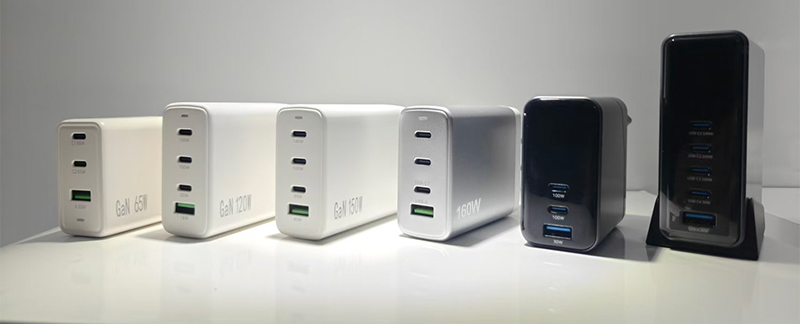
Total Rated Power Is Not the Same as Power per Port
The total power rating describes the output capability of the charger under specified conditions. A port's individual rating describes what that port can provide when the required conditions are met.
These values should not be treated as interchangeable.
Take, for example, a charger equipped with multiple USB-C ports and a total rated output of 100W: while a single port might deliver high power when used alone, the power available from that port may change if additional devices are connected (i.e., when other ports are activated). The specific power distribution logic depends on the product's design.
Consequently, product specifications should not only list the output capacity for individual ports but also clearly define the output combinations when multiple ports are in use simultaneously. Simply listing the maximum power rating for each port without specifying which ports can operate concurrently is often misleading.
For B2B buyers, this information affects how accurately the charger can be matched to the intended devices. It also helps reduce complaints caused by a customer expecting every port to provide its individual maximum rating simultaneously.
Why Multi-Port Chargers Need a Power Budget
A charge's power conversion capability is finite. Its power stage, transformer, rectifier circuitry, control circuitry, and thermal management system must all operate within their respective design limits. Charger engineers first establish the total output target and the range of devices the charger is intended to support; they then determine how to allocate the available power across the various ports.
This power budget should account for the product's actual use cases, not simply the sum of every port's headline maximum. If all ports were assumed to deliver their individual maximums at once, the resulting specification could exceed the charger's total design capability.
Power allocation rules help make the product's behavior predictable. They also provide a basis for engineering verification, product documentation and customer communication.
Fixed Power Allocation vs. Dynamic Allocation
Different multi-port charger designs can use different power-allocation strategies.
1.Fixed or predefined power combinations
Some chargers use predefined output combinations. For example, the product may specify one output profile when only the primary port is in use and another when two ports are active.
This approach can make the output behavior easier to document. However, the available combinations must be chosen carefully so that they match the intended device mix.
2.Dynamic power allocation
Other designs can adjust the power assigned to ports according to which devices are connected and which ports are active. The exact behavior depends on the power architecture and control implementation.
Dynamic allocation can provide greater flexibility, but it also requires careful definition and testing. Engineers need to establish what happens when a device is connected, disconnected or changes its requested power profile.
The important point is that "dynamic" does not mean unlimited. The charger still has a total output budget and must operate within its electrical and thermal design limits.
What Happens When a Second Device Is Connected?
Suppose a laptop is receiving power through its first USB-C port. If a mobile phone is then connected to another port, the charger—depending on its design—may need to adjust the power output allocated to the laptop while also setting an appropriate power output for the phone.
The laptop may modify its charging behavior in response to changes in the available power. The exact outcome depends on the laptop itself, its current power requirements, and the specific implementation of the charger. Do not assume that all devices will react in the same way.
Engineers should verify the output behavior during connection changes, not only when all devices are connected before power-up. This helps identify unexpected power transitions and confirms that the charger follows its defined allocation rules.
Product specifications should also clearly state whether connecting additional devices will interrupt or trigger a re-negotiation of output power for ports already in use. This detail is particularly important for users who frequently connect other devices while charging a laptop.
USB-C PD Negotiation and Power Allocation Are Related but Different
USB Power Delivery (USB PD) defines how compatible devices negotiate supported voltage and current levels. In a multi-port charger, each port may need to establish or update its own charging relationship with the connected device.
System-level power allocation determines how the charger manages its overall available power across the ports. The two functions must work together, but they are not identical. Learn more here about how a charger and a device determine their supported capabilities.
A port may support a particular PD output profile when used alone, yet the system may provide a different maximum profile when another port becomes active. Engineers need to verify both the protocol behavior and the overall power budget.
For products supporting PPS or other relevant charging modes, the required operating conditions and port combinations should be included in the verification plan. Protocol support should be stated only for combinations the finished product is designed and verified to support.
Thermal Limits Also Affect Multi-Port Operation
Power allocation cannot be designed as a purely numerical exercise. When multiple ports deliver power simultaneously, the charger's internal components operate under a different combined load.
The distribution of losses and temperature can change depending on which ports are active and how much power each one delivers. This is particularly relevant to compact, high-power chargers where available internal space is limited.
Engineers therefore need to evaluate representative simultaneous-load conditions. The appropriate test combinations depend on the charger's rated output, port configuration, intended use and design requirements.
If a product is designed to power multiple devices simultaneously, its evaluation should not be limited to the maximum output capacity of a single port. The specifications for a charger's performance in multi-port operating modes must accurately reflect its actual, verified performance under those conditions.
How Engineers Define a Useful Output Matrix
An output matrix explains the supported power combinations for a multi-port charger. It should be clear enough for engineering teams, sales teams and customers to understand without having to infer missing details.
• The ports being used in each combination.
• The maximum output assigned to each active port.
• The total output supported by that combination.
• Any change in output when another device is connected or disconnected.
• The supported charging profiles and relevant operating conditions.
The values must come from the actual product design. A generic output table should never be copied from another model simply because the total wattage is similar.
For OEM and ODM projects, the output matrix should be agreed upon before final product documentation and packaging are prepared. If a customer's target device combination changes during development, the power-allocation requirements may need to be reviewed as well.
What OEM Buyers Should Confirm Before Ordering
Before selecting a multi-port USB-C charger, buyers should identify the devices that will normally be charged together. A charger intended mainly for a laptop and phone may need a different port priority from a desktop charger intended for several mobile devices.
Confirm the total output rating, the individual port ratings, the simultaneous-output combinations and the behavior when another device is connected. Also confirm which charging protocols are supported for the intended combinations.
If the charger will be sold under a private label, these details should be consistent across the approved specification, output matrix, product page and packaging. Clear documentation is part of product quality: it sets realistic expectations and makes it easier to choose the right charger for the customer’s needs.
ZONSAN's Perspective on Multi-Port Charger Development
For a Zonsan Gan charger Factory, multi-port development requires the port arrangement, total power budget and output-allocation behavior to be considered together. The design must support the intended combination of devices while remaining within its electrical, thermal and manufacturing requirements. Read about Inside ZONSAN's Charger R&D Process here.
ZONSAN develops USB-C charging products for OEM and ODM customers with different power ratings and port configurations. For a multi-port project, the most useful starting point is a clear description of the intended devices, simultaneous charging scenarios, required port priorities and target markets.
If you are sourcing a multi-port charger, request the complete output matrix rather than relying on the total wattage alone. That makes it easier to determine whether the design fits your product requirements before moving forward with samples or production.
Final Thoughts
Multi-port USB-C charger power allocation determines how the charger shares its available output among connected devices. Total rated power, individual port capability and simultaneous-output behavior must be specified separately.
A well-defined output matrix helps engineers verify the product and helps buyers understand what it can deliver in real use. For OEM projects, agreeing on these requirements early can prevent avoidable specification changes and customer confusion later.
FAQ
Q1: Does a 100W multi-port charger deliver 100W from every port?
No. The total rating generally describes the charger's overall output capability under specified conditions. Each port has its own limits, and simultaneous use may change the available power.
Q2: Why can a laptop charge more slowly when another device is connected?
Some multi-port chargers revise their power allocation when another port becomes active. If the laptop receives a different available power profile, its charging behavior may change. The exact result depends on both the charger and the laptop.
Q3: What is a multi-port charger output matrix?
It is a table showing the supported power combinations for the charger's ports, including individual outputs and the total output for each combination.
Q4: What is the difference between USB PD negotiation and power allocation?
USB PD negotiation establishes the supported voltage and current between a port and its connected device. Power allocation manages how the charger distributes its overall available output among ports.
Q5: Can all ports deliver their maximum rated power simultaneously?
Only if the product is specifically designed and rated to support that combination. Individual port ratings should not be assumed to add up to the total output capability.
Q6: Why should engineers test device connection changes?
Connecting or disconnecting a device may cause the charger to update its power allocation and port behavior. Testing these transitions helps verify that the charger behaves according to its specification.
Q7: What should OEM buyers ask about a multi-port charger?
Ask for the total output rating, each port's individual rating, simultaneous-output combinations, supported protocols and behavior when another device is connected or disconnected.
Q8: Does multi-port power allocation affect thermal testing?
Yes. Different combinations of active ports can create different electrical losses and temperature conditions. Verification should reflect the intended use cases and the requirements of the actual product.
Reviewer: Zonsan R&D — Luis and David
Second Reviewer: Lucas, Miller
Final Review Date: [October 26, 2026]