Functional Testing (FCT) in USB-C Charger Manufacturing: How Professional Factories Verify Real Charging Performance Before Shipment
Quick Answer
Functional Testing (FCT) is the final performance verification process used in USB-C charger manufacturing to confirm that finished products operate correctly under real working conditions. FCT evaluates charging output, voltage regulation, USB PD communication, protection functions and overall product performance before chargers are shipped to customers.
Key Takeaways
• FCT verifies whether a completed charger works as designed.
• It simulates real charging scenarios instead of only checking individual components.
• FCT validates USB PD negotiation, output stability and protection functions.
• Professional manufacturers combine FCT with AOI, ICT, Hi-Pot and aging tests.
• FCT helps OEM customers reduce quality risks after mass production.
Introduction
A charger can pass PCB inspection and still fail when a customer actually uses it.
This is one of the reasons why professional charger manufacturing requires multiple layers of quality verification.
During production:
AOI checks whether components are correctly assembled.
ICT verifies whether the PCB is electrically connected properly.
However, neither test answers the most important question:
Does the finished charger actually work like a real product?
For USB-C chargers, especially high-power GaN chargers, real performance depends on many factors working together.
The charger must:
• Deliver the correct output power
• Communicate correctly with connected devices
• Switch between different voltage levels
• Protect itself under abnormal conditions
• Maintain stable performance during operation
This is where Functional Testing (FCT) becomes essential.
FCT evaluates the completed charger under simulated real-world operating conditions before products leave the factory.
For OEM and ODM customers, FCT represents the final confirmation that the product they receive is not only assembled correctly—but also performs as expected.
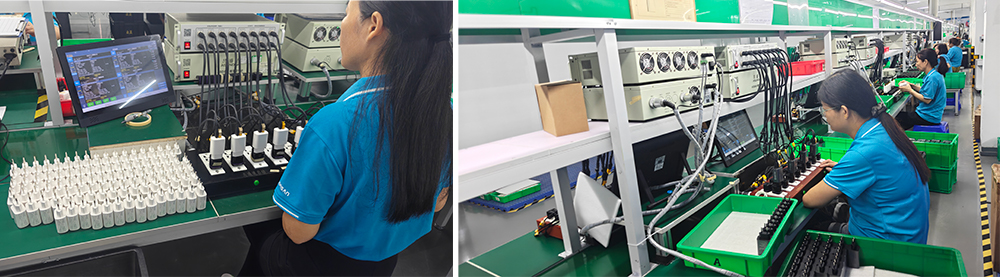
What Is Functional Testing (FCT)?
Functional Testing, commonly called FCT, is a production test method used to verify the actual operating performance of electronic products.
Unlike AOI and ICT, which mainly focus on PCB-level inspection, FCT evaluates the finished product as a complete system.
During FCT, the charger is powered on and tested under controlled conditions.
The testing system checks whether the product behaves according to its design specifications.
For a USB-C PD charger, this may include:
• Output voltage accuracy
• Output current capability
• Power delivery negotiation
• Port functionality
• Protection response
• Communication with charging devices
• Standby power performance
The purpose is simple:
Make sure the charger that reaches the customer works the same way the engineering team designed it.
Why FCT Is Critical for Modern USB-C Chargers
Older low-power chargers had relatively simple functions.
A basic 5V charger mainly needed to provide stable voltage output.
Modern fast chargers are significantly more complicated.
A 100W GaN charger, for example, may need to manage:
• Multiple USB-C ports
• Different output power combinations
• USB PD protocols
• PPS voltage adjustment
• Thermal protection
• Over-current protection
• Over-voltage protection
The charger is no longer just a power converter.
It is an intelligent power management system.
Because of this complexity, electrical component testing alone is not enough.
The entire system must be verified.
What Does FCT Test on USB-C Chargers?
A professional FCT process may include several important evaluations.
1. Output Voltage and Current Verification
The first responsibility of a charger is delivering stable power.
FCT equipment measures:
• Output voltage
• Output current
• Actual power delivery
• Voltage fluctuation
For example:
A 65W PD charger should correctly provide the expected power profile.
A 100W charger should maintain stable output when operating near its rated capacity.
If output parameters fall outside the specification range, the product is identified before shipment.
2. USB Power Delivery (PD) Communication Testing
Modern USB-C chargers rely heavily on communication protocols.
The charger and connected device must negotiate the correct charging mode.
During FCT, engineers verify:
• PD handshake
• Voltage selection
• Current negotiation
• Multi-voltage output switching
For example:
A laptop may request 20V output.
A smartphone may request 9V or PPS charging.
The charger must understand these requests and respond correctly.
A failure in communication may result in:
• Slow charging
• Charging interruption
• Device incompatibility
FCT helps identify these issues before customers encounter them.
3. Multi-Port Power Distribution Testing
Multi-port chargers create additional challenges.
A 3-port charger is not simply three independent chargers combined together.
The internal power management system must dynamically allocate available power.
For example:
When one laptop is connected, the charger may provide maximum output.
When additional devices are connected, the charger must redistribute power according to its design.
FCT verifies these scenarios.
4. Protection Function Testing
Safety is one of the most important aspects of charger design.
Professional FCT systems may verify protection responses such as:
Over Current Protection (OCP)
Ensures the charger limits excessive current.
Over Voltage Protection (OVP)
Protects connected devices from abnormal voltage output.
Short Circuit Protection (SCP)
Checks whether the charger responds correctly under short-circuit conditions.
Over Temperature Protection (OTP)
Verifies thermal protection behavior.
These protections are critical because chargers operate directly connected to expensive electronic devices.
Why FCT Cannot Replace Other Tests
A common misunderstanding is:
"If FCT is performed, why do factories still need AOI, ICT or aging testing?"
The answer is simple:
Each test checks different risks.
For example:
AOI asks:
Are components assembled correctly?
ICT asks:
Are electrical connections correct?
FCT asks:
Does the finished charger function correctly?
Aging testing asks:
Can it maintain performance over extended operation?
Environmental testing asks:
Can it handle different climates?
No single test can replace a complete quality system.
How Automated FCT Equipment Simulates Real Charging Scenarios
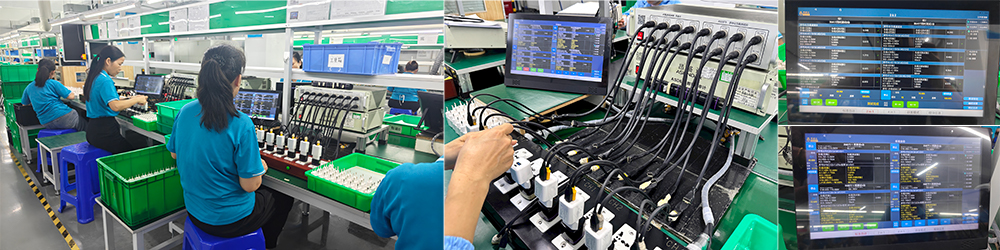
Modern charger factories rarely rely on manual plug-in tests alone
Instead, production lines are equipped with automated Functional Testing (FCT) systems that simulate real charging conditions. These systems combine programmable electronic loads, USB PD analyzers and dedicated testing software to evaluate every finished charger consistently.
Unlike simple voltage measurements, automated FCT recreates the situations that users experience every day.
For example, the system may automatically:
• Power on the charger
• Detect all available USB ports
• Request different PD voltage profiles
• Apply various output loads
• Monitor voltage stability
• Record current changes
• Verify protection functions
• Save testing data automatically
Because every unit follows the same testing procedure, manufacturers can achieve highly repeatable quality verification across large production volumes.
A Typical Functional Testing Process in Charger Manufacturing
Although production processes differ between factories, a professional FCT workflow usually follows a similar sequence.
Step 1: Product Identification
The operator scans the product barcode or serial number.
This allows the testing system to load the correct program for that specific charger model.
Step 2: Automatic Power-On
The charger is connected to the testing fixture and powered automatically.
The system checks whether the product starts normally.
Step 3: Output Performance Verification
Different voltage and current combinations are requested.
Typical checks include:
• 5V, 9V, 12V, 15V, 20V
• PPS operating range (when supported)
Engineers verify that actual output remains within design tolerances.
Step 4: USB PD Communication
The tester simulates various charging devices.
The charger must successfully negotiate the requested power profile.
Incorrect protocol communication immediately results in a failed test.
Step 5: Protection Function Verification
Depending on the testing program, selected protection features may also be evaluated, including overload response or abnormal operating conditions.
Step 6: PASS / FAIL Decision
Once all programmed tests are completed, the system automatically generates a result.
Qualified products continue to the next production stage, while failed units are separated for engineering analysis.
Functional Testing vs Aging Testing
Because both tests are performed after assembly, people sometimes confuse Functional Testing with Aging Testing.
However, they answer completely different engineering questions.
| Functional Testing (FCT) | Aging Testing |
| Confirms immediate product functionality | Verifies long-term operational stability |
| Short testing duration | Extended continuous operation |
| Focuses on electrical performance | Focuses on reliability over time |
| Checks communication and charging behavior | Detects early-life failures and latent defects |
| Performed before aging | Usually performed before final inspection |
A simple comparison illustrates the difference.
Imagine purchasing a new car.
A short road test confirms that the engine starts, the brakes work and the transmission shifts correctly.
That is similar to Functional Testing.
Driving the same vehicle continuously for hundreds of kilometers to confirm long-term stability resembles Aging Testing.
Professional charger factories perform both because immediate functionality does not always guarantee long-term reliability.
Common Problems Found During Functional Testing
Functional Testing often discovers issues that cannot be identified through AOI or ICT alone.
Examples include:
Incorrect USB PD Negotiation
The charger powers on normally but fails to communicate correctly with connected devices.
This may prevent fast charging from activating.
Unstable Output Under Load
Voltage remains correct without load but fluctuates when the charger delivers higher power.
This may indicate power regulation issues.
Multi-Port Power Allocation Errors
Some multi-port chargers fail to redistribute available power correctly after additional devices are connected.
FCT reproduces these situations automatically.
Firmware Configuration Problems
Modern fast chargers often rely on programmable controllers.
Incorrect firmware parameters may affect charging behavior even when all hardware components function normally.
Functional Testing helps identify these software-related issues before shipment.
Imagine purchasing a new car.
A short road test confirms that the engine starts, the brakes work and the transmission shifts correctly.
That is similar to Functional Testing.
Driving the same vehicle continuously for hundreds of kilometers to confirm long-term stability resembles Aging Testing.
Professional charger factories perform both because immediate functionality does not always guarantee long-term reliability.
Common Problems Found During Functional Testing
Functional Testing often discovers issues that cannot be identified through AOI or ICT alone.
Examples include:
Incorrect USB PD Negotiation
The charger powers on normally but fails to communicate correctly with connected devices.
This may prevent fast charging from activating.
Unstable Output Under Load
Voltage remains correct without load but fluctuates when the charger delivers higher power.
This may indicate power regulation issues.
Multi-Port Power Allocation Errors
Some multi-port chargers fail to redistribute available power correctly after additional devices are connected.
FCT reproduces these situations automatically.
Firmware Configuration Problems
Modern fast chargers often rely on programmable controllers.
Incorrect firmware parameters may affect charging behavior even when all hardware components function normally.
Functional Testing helps identify these software-related issues before shipment.

Why Functional Testing Matters for OEM and ODM Customers
For OEM buyers, product quality is measured by customer experience rather than laboratory reports.
A charger that occasionally disconnects, negotiates the wrong voltage or charges inconsistently may lead to product returns even if its internal PCB passes inspection.
Functional Testing helps reduce these risks by confirming that every finished charger behaves as intended before leaving the factory.
It also provides additional confidence in several important areas:
• Stable charging performance
• Consistent USB PD compatibility
• Reliable multi-port operation
• Proper protection function
• Consistent manufacturing quality
For brands building long-term customer trust, these factors are just as important as product specifications.
How FCT Data Supports Continuous Quality Improvement
Another advantage of Functional Testing is the production data it generates.
Each completed test provides engineers with valuable information about product performance.
By reviewing thousands of testing records, engineering teams can identify:
1. Repeating production issues
2. Changes in product consistency
3. Equipment calibration requirements
4. Design improvements for future revisions
Instead of treating FCT as the end of production, experienced manufacturers use the collected data to improve future manufacturing processes.
This creates a continuous quality improvement cycle rather than a simple pass-or-fail inspection system.
Common Misconceptions About Functional Testing
Misconception 1: Passing FCT Means the Product Will Never Fail
Functional Testing confirms that the charger operates correctly during production.
Long-term reliability still depends on design quality, manufacturing consistency and environmental conditions.
Misconception 2: FCT Is Only Necessary for High-Power Chargers
Although higher-power products involve more complex testing, Functional Testing is valuable across many charger categories because every product must perform correctly before shipment.
Misconception 3: Functional Testing Can Replace Safety Testing
It cannot.
Safety evaluations such as Hi-Pot testing and insulation verification remain essential because they measure different aspects of product quality.
Misconception 4: Functional Testing Is Fully Automatic
Automation improves efficiency, but experienced engineers are still responsible for developing test programs, interpreting failures and improving production processes.
Final Thoughts
Every USB-C charger leaving a production line represents the combined work of engineering, manufacturing and quality assurance.
While visual inspection and electrical verification help identify many potential problems, only Functional Testing demonstrates how the completed charger performs under realistic operating conditions.
For professional manufacturers, FCT is far more than a final checkpoint before shipment.
It confirms that charging performance, USB Power Delivery communication, protection functions and overall product behavior meet the intended design requirements.
When combined with AOI, ICT, Hi-Pot, Aging and Environmental Testing, Functional Testing becomes an essential part of a comprehensive quality assurance system that helps OEM and ODM customers deliver reliable charging products to markets around the world.
Frequently Asked Questions (FAQ)
Q1: What is Functional Testing (FCT) in charger manufacturing?
Functional Testing verifies that a completed charger operates correctly by checking charging performance, USB PD communication and protection functions under simulated real-world conditions.
Q2: How is FCT different from ICT?
ICT evaluates the electrical integrity of the PCB, while FCT verifies the operation of the fully assembled charger.
Q3: Does Functional Testing verify USB Power Delivery?
Yes. Professional FCT systems typically test USB PD negotiation, voltage switching and communication with compatible devices.
Q4: Why is FCT important for GaN chargers?
Modern GaN chargers contain intelligent power management circuits that require complete operational verification before shipment.
Q5: Can Functional Testing identify firmware problems?
In many cases, yes. Incorrect firmware configuration or protocol behavior may become apparent during Functional Testing.
Q6: Is every charger tested individually?
Testing strategies vary depending on manufacturing requirements and customer specifications. Many OEM projects require comprehensive functional testing for production units.
Q7: Can FCT replace Aging Testing?
No. Functional Testing confirms immediate operation, while Aging Testing evaluates stability during extended operation.
Q8: Why do OEM buyers care about FCT?
Because Functional Testing helps reduce field failures, improve product consistency and increase confidence that finished products will perform as expected.
Recommended
• How ICT Testing Ensures PCB Reliability in USB-C Charger Manufacturing.↗
• Why AOI Inspection Is Essential for Modern USB-C Charger Manufacturing.↗
• How Chargers Go Through Aging Tests Before Shipping: Why Burn-In Testing Is Essential for Long-Term Reliability.↗
• USB Power Delivery Specifications.↗
• IEC 62368-1 Safety Standard Overview.↗
Read More