How to Verify a Charger Manufacturer's Technical Claims: A Guide to Technical Due Diligence for OEM Buyers
Short answer: How can you check the technical performance of a charger manufacturer?
To verify a charger manufacturer's technical capabilities, buyers should examine how the factory backs up its technical claims with measurable evidence. This includes design responsibility, sustained power delivery, thermal performance, charging protocol behavior, measurement reliability, and the ability to explain technical limitations. A convincing product demonstration alone is not enough.
A technical claim is only as valuable as the evidence behind it
In the early stages of an OEM charger project, manufacturers are often asked similar questions. Can you design a smaller 100W charger? Can you adjust the PPS range? Can this product sustain its power rating over time? Can you modify the existing platform without affecting certification?
Most of these questions can be answered with a simple yes.
The hard part comes afterward, when the engineering team has to convert these statements into a working product. From our perspective as a charger manufacturer, this is where technical conversations make more sense than run-of-the-mill sales presentations. While a product catalog can tell buyers what's available today, it rarely explains how much design flexibility goes into each product.
A compact 100W GaN charger can be an excellent product under its intended operating conditions. That doesn't necessarily mean that the case can be reduced in size, the input range expanded, or another USB-C port can be added without extensive engineering work being required.
These are separate technical questions.
For brands, importers, and other OEM buyers, technical due diligence is about understanding the difference between what a manufacturer currently offers, what it can actually develop, and what has yet to be proven. The goal is not to question every statement a supplier makes. It's about building sufficient technical confidence before committing to development costs, tooling, certification, inventory, and a product launch schedule.
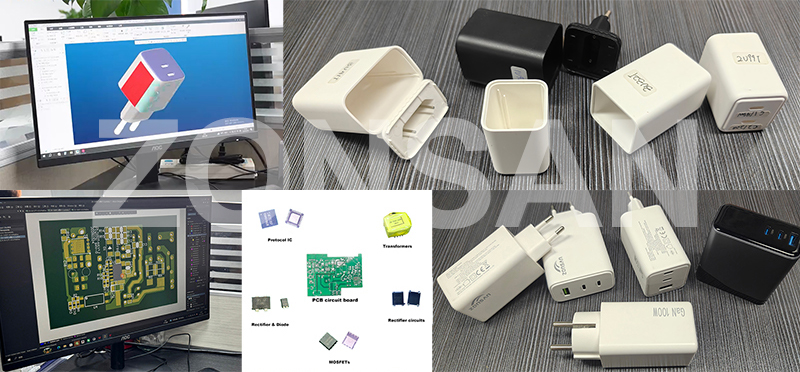
1. Determine who actually controls the design of the charger
One of the first things buyers should clarify is what a manufacturer means when it describes a charger as a proprietary design.
Does the factory control the electrical architecture? Can its engineers modify the circuit board? Who determines the configuration of the charging protocol? Who is responsible for the transformer specification, mechanical construction and thermal design?
The answers are not always apparent from the finished product.
A privately designed package does not necessarily indicate ownership of the electrical design. Likewise, the use of a commercially available controller or semiconductor reference design does not mean that the manufacturer lacks technical ability.
It makes sense for buyers to distinguish between three levels of technical control:
• Product integration based on an existing electrical solution.
• Technical modification of an established charger platform.
• Development and control of a new electrical and mechanical architecture.
All three can represent legitimate manufacturing models. Problems arise when the level of performance presented in commercial discussions exceeds the level of engineering control available during development.
Consider a desired change to the output power of an existing charger. Increasing the specified wattage is not necessarily a matter of changing a regulator setting. The power stage, transformer, switching components, output capacitors, thermal design, protection thresholds, and other parts of the circuit may need to be reconsidered.
A CHARGER manufacturer controlling the design should be able to explain which areas would be affected and why. It should also recognize when a requested change is no longer suitable for the existing platform. Buyers who wish to understand the engineering involved can contact here As part of ZONSAN charger research and development process.
The important difference is not whether each component or software feature was developed in-house. Few electronics manufacturers operate completely independently of component suppliers. The question is whether the charger manufacturer has sufficient technical expertise and knowledge to support the product throughout its commercial life.
2. Check the rated power under reasonable operating conditions
While a charger delivering its rated power during a short demonstration is encouraging, it does not demonstrate how the product will perform in normal operation. Power output must be evaluated in the context of input voltage, ambient temperature, port configuration, operating time and the limits defined in the specification. This will become particularly important as chargers become smaller and more powerful.
Take a compact 100W USB-C GaN charger. Its ability to produce 20V at 5A for several minutes tells us something about the operation of its power stage. It tells us significantly less about continuous operation after the internal components have reached thermal equilibrium.
As temperatures rise, semiconductor losses, the behavior of magnetic components and other temperature-dependent properties can change. Depending on the design and operating conditions, the product may continue to operate normally, reduce its performance or trigger a protective function.
For this reason, a power rating statement should be supported by more than one photo of a USB power meter displaying 100W.
What should buyers ask for?
For higher power chargers, a useful demonstration should include:
• The AC input voltage and frequency.
• The negotiated USB-C output profile.
• The actual output voltage and current.
• Ambient temperature and test setup.
• The duration of the test and the stabilization criteria.
• Any power reduction, interruption or protection event.
If the charger is intended for multiple markets, the manufacturer should explain which entry conditions have been evaluated and what restrictions apply.
A charger rated for an input voltage of 200-240V should not be evaluated as a universal input product. Likewise, the maximum total power of a multi-port charger should not be confused with the maximum single-port power.
The purpose of checking these conditions is to determine whether the manufacturer's power claim reflects the intended commercial specification. A credible engineering team should be able to say not only how much power their charger will deliver, but also under what conditions that power will be available.
3. Examine the technology behind high power density
GaN technology has made it possible to develop increasingly compact charging products. However, the presence of a GaN semiconductor does not automatically mean that a charger has an efficient or well-managed electrical design. Even high power density does not tell buyers everything they need to know about the product.
Power density is usually expressed as output power relative to product volume:
Power density (W/cm³) = Rated output power (W) / Product volume (cm³)
For meaningful comparisons, the definition of product volume should remain consistent, particularly with respect to solid connectors, linch pins, and irregular housing shapes. More importantly, power density is a geometric performance indicator. It does not directly measure thermal reliability, electrical safety, or operational life.
A small package leaves less space for heat distribution, insulation, magnetic components, and mechanical tolerances. To achieve a commercially viable design with high power density, these limitations must be addressed together.
Where does the heat actually come from?
The difference between input and output power is the power loss in the charger.
For a simplified stationary calculation:
Pin = pout / η
Ploss = Pin − Pout
Where:
Pin = AC input power; Pout = DC output power
η = conversion efficiency; Ploss = total power loss
Imagine a hypothetical 100W charger operating at two different levels of efficiency.
| Output power | Efficiency | Input power |
| 100W | 90% | 111.11W |
| 100W | 92% | 108.70W |
| 100W | 94% | 106.38W |
| 100W | 95% | 105.26W |
These are calculated values, not measurements of a specific charger model.
The difference between 92% and 95% efficiency may seem relatively small on a datasheet. However, in a compact package, reducing power loss from about 8.70 W to 5.26 W can make a significant difference to the thermal engineering problem. However, overall power loss is only part of the analysis.
Engineers also need to understand where this loss occurs. Heat concentrated around a particular component can pose a local reliability problem even if the overall efficiency is satisfactory.
Transformer losses, switching losses, line losses, output rectification and other sources contribute differently depending on the circuit architecture and operating conditions. Therefore, from a manufacturing perspective, reducing product size is not just a mechanical design task.
Before accepting a manufacturer's claim that a smaller enclosure is possible, buyers should understand whether the proposed dimensions are based on an existing validated product, a preliminary engineering calculation, or a tested prototype.
These three levels of evidence should not be viewed as equivalent.
4. Ask what the temperature measurements actually represent
Thermal performance is often represented by a single temperature measurement or thermal imaging photo. Both can be useful, but they need context.
The external temperature of a charger's case and the temperature of its internal components represent different aspects of the design. The case temperature is relevant to user contact and applicable product requirements. The internal temperatures influence component loading, reliability and technical margins.
A charger with a relatively cool case does not necessarily indicate low internal component temperatures. Conversely, a warmer case does not automatically indicate poor thermal design. Heat can be effectively transferred from internal components to the external surface.
The interpretation depends on the overall heat transfer arrangement and the applicable temperature limits.
Thermal imaging technology has its limits
An infrared camera measures thermal radiation from visible surfaces. Its measurements are influenced by the emissivity of the surface, reflected radiation, viewing conditions and other measurement factors.
For example, shiny metal surfaces can lead to misleading apparent temperatures if the measurement setup is not properly considered. A thermal image also cannot directly detect the temperature of a component hidden in a closed charger.
The internal technical assessment may require appropriately placed temperature sensors, appropriate measurement techniques or validated thermal models. Even then, the measurement setup is important. Opening a housing or changing its internal structure to install sensors can change the thermal conditions being examined.
For this reason, experienced engineers do not rely on a single attractive thermal image to determine whether a high-power charger has sufficient thermal margin.
Questions worth asking during a thermal inspection
Which components or locations were measured?Was the charger tested with the intended housing configuration?At what input voltage and load?How was the thermal stabilization determined?What temperature limits were used and on what basis are these limits based?
Buyers don't necessarily need access to every internal thermal calculation. They need enough information to understand what the reported measurements do. On a high-performance OEM project, the ability to explain thermal behavior is generally more valuable than a temperature photo presented without the test conditions.
5. Check the USB-C PD, PPS and AVS claims at the protocol level
Charging protocol support is another area where commercial specifications can hide important technical differences. A USB-C charger manufacturer might list PD, PPS, AVS, and other fast charging technologies on a product page.
The relevant question for an OEM buyer is what the charger actually supports within these technologies.
USB Power Delivery is based on communication between the source and the receiving device. The charger advertises functions, the device requests an operating state, and the power system responds according to applicable protocol requirements.
The power rating does not describe this entire interaction. Two chargers with the same maximum output power may offer different fixed voltage profiles, programmable voltage ranges, current limits and multi-port behavior.
What should be checked?
For fixed USB PD output, buyers should check the supported Power Data Objects or PDOs.
For PPS and AVS, the relevant programmable or adjustable voltage and current functions should be examined, including the applicable protocol revision and operating range.
For multi-port chargers, the investigation should extend to power redistribution.
If a second device is connected while the first device is charging, does the charger renegotiate the available power? Is there a temporary interruption? What happens if the second device is removed?
These behaviors can affect the user experience even when the charger reaches its maximum rated wattage.
A protocol analyzer provides more useful technical evidence than a simple wattage meter when it comes to communication behavior. The analyzer can help engineers examine announced features, device requirements, negotiated contracts, and relevant protocol events.
Real-world device compatibility testing remains valuable, as lab protocol testing and everyday charging behavior answer related but different questions. A charger that works properly with a phone or laptop is not necessarily compatible with all relevant devices and operating scenarios. For a more detailed technical explanation, see This is how USB-C PD protocol optimization works in charger development.
When evaluating a PD or GaN charger manufacturer, buyers should distinguish between protocol characteristics listed on paper and actual evaluated protocol behavior.
6. Owning testing equipment is not the same as having reliable measurement skills
A well-equipped charger lab may contain oscilloscopes, electronic loads, AC power sources, power analyzers, protocol test equipment, temperature measurement systems, and other specialized instruments.
The equipment itself is only part of the laboratory's capabilities. The type of use determines the quality of the resulting information.
Take an output ripple measurement. The displayed waveform can be affected by the probe grounding, measurement bandwidth, connection point, electrical noise pickup, and test setup. A poorly configured measurement can make a suitable charger appear worse than it actually is. It can also hide a real electrical problem.
The same concern applies to efficiency measurements. An efficiency calculation depends on reliable measurements of both AC input power and DC output power. Device accuracy, measurement limits, cable losses and operational stability can affect the result.
This becomes important when a manufacturer has relatively small performance differences between two designs. If the measurement method cannot reliably detect these differences, the reported improvement may not be technically meaningful.
Calibration is important, but it is not the complete answer
Calibration helps to characterize the relationship between an instrument's readings and appropriate measurement references. It does not automatically make each subsequent measurement accurate. In addition, the device must be suitable for the task, used under appropriate conditions, and incorporated into a sound measurement procedure.
The National Institute of Standards and Technology explains this difference in its guidelines metrological traceability and measurement reliability.Traceability refers to the measurement result and not just to the possession of calibrated devices.
For OEM buyers, the practical implications are clear. If two charger suppliers provide different efficiency, ripple, or temperature measurements, first determine whether the measurements were taken under comparable conditions. Otherwise, even technically correct results may lead to an incorrect purchasing decision.
A capable laboratory should be able to identify the measurement method behind an important result, not just show the instrument used to obtain it.
7. Test a manufacturer's ability to explain technical compromises
One of the most revealing parts of a technical discussion is how an engineering team responds to a requirement that presents conflicting design goals. Consider a request for a smaller charger with higher power output, universal AC input, additional USB-C ports, lower operating temperature, and lower target cost.
Each requirement can make sense individually. Meeting them all at the same time is a different technical problem.
Smaller dimensions may reduce available component space and heat distribution. Additional ports may require more complex power allocation and output circuitry. A wider input range may result in different electrical loads. Lower cost may limit component or architecture selection.
A manufacturer should evaluate these requirements as a cohesive system rather than as independent elements on a proposal sheet.
Experienced charging technicians generally deal with questions such as:
• Which requirements are essential for the customer's application?
• What parameters can be adjusted without affecting the intended value of the product?
• Where does the existing platform have sufficient scope for design?
• Which proposed changes would require significant redesign or additional validation?
A technical discussion becomes less useful if every request is accepted immediately and without qualification before the engineering work has been evaluated. An honest limitation is not necessarily a sign of weak R&D capability. This may indicate that the engineering team understands the limitations of their design.
For OEM buyers, a manufacturer explaining why a particular requirement cannot be met with current dimensions, cost or architecture provides information that can be used to make a better product decision. The alternative is to discover the same limitation after tooling or development expenditure has already been made.
8. Evaluate how the engineering team handles an unresolved technical issue
Not every technical question can be answered at the first meeting. A buyer may wonder whether an existing charger will support a specific device, operate reliably under a new load combination, or support a planned mechanical modification.
Sometimes the responsible answer is that additional assessment is required. What matters is what happens next.
A useful technical response should identify what is already known, what is still uncertain, and how the uncertainty can be resolved.
For example, say a multi-port charger intermittently disconnects from a laptop when another device is connected. An experienced engineering team should avoid immediately attributing the problem to the laptop, cable, or charger firmware without supporting evidence.
The power redistribution sequence, negotiated PD contracts, output transient behavior, protection events, and device-specific responses may all be relevant.
The aim of the investigation is to find out which mechanism is actually responsible. A proposed fix should then be evaluated under conditions that resolve the original problem. This approach is explained in more detail in our article Root cause analysis in the manufacture of chargers.
For the buyer conducting technical due diligence, it is not important to require the manufacturer to solve every problem during a meeting. The purpose is to determine whether the factory has a credible method to convert an unresolved technical problem into a technical task.
A vague promise that everything will improve later is not the same as a defined investigation.
9. Use a claim-to-evidence matrix before making a purchasing decision
Technical information often comes through multiple channels: product specifications, emails, test reports, meetings, sample demonstrations and sales presentations.
When a project reaches the purchase stage, it can become difficult to remember which claims have been independently supported and which are still preliminary. A claim-to-evidence matrix is a practical way to solve this problem.
It doesn't have to be complicated. Every important technical statement is accompanied by the evidence necessary to support it.
| Manufacturer's claim | Evidence to be requested | What still needs to be clarified |
| Independent charger design capability | Technical review of the existing architecture | Design control and change authority |
| Continuous rated power | Results of the continuous load test | Relevant input and environmental conditions |
| Compact and powerful | GaN design efficiency and thermal evaluation | Adequacy of thermal and electrical margins |
| PD, PPS or AVS support | Log analysis and supported output profiles | Actual negotiated skills |
| Multi-port compatibility | Port allocation and transition test results | Behavior when switching device connections |
| High conversion efficiency | Defined input and output measurements | Measurement accuracy and comparability |
| Product compliance | Applicable model-specific documents | Coverage of intended configuration and market |
| Adaptability | Assessment of technical feasibility | Required changes and scope of validation |
Buyers can classify each claim as supported, conditionally supported, unverified, or inconsistent with available evidence. This avoids any unanswered question being treated as a supplier failure.
Some requirements can actually only be verified at the beginning of development. They should still be identified as open technical elements with a corresponding evaluation plan.
However, basic security and applicable compliance requirements should not be viewed as optional commercial compromises. The purpose of the matrix is to make technical uncertainties visible before they become a purchasing or production risk.
10. How to conduct a product-specific technical review meeting
A general overview of a factory helps understand a company's background, but a technical review meeting should go beyond that. Instead of asking the manufacturer to explain its entire product range and development system, select a charger platform that is relevant to the proposed project.
Before the meeting, specify the intended application, target markets, electrical requirements, connection configuration, and any key mechanical constraints. The discussion can then focus on whether these requirements fit the existing architecture.
We recommend involving the engineers responsible for the relevant technical decisions rather than having the entire discussion through sales representatives.
A productive meeting should establish the following:
1.What requirements are supported by the current charger platform?
2.Which statements are supported by existing technical evidence?
3. What design changes are likely to be required.
4. What technical risks or limitations need further investigation?
5. What evaluation is required before finalizing the product specification?
If confidentiality prevents disclosure of complete circuit designs or proprietary records, a manufacturer may provide redacted information, controlled demonstrations, or a technical explanation under an appropriate confidentiality agreement.
Technical due diligence should respect the legitimate boundaries of intellectual property. The buyer does not need to obtain the manufacturer's full schematic to determine whether the company understands the proposed design.
What is crucial is access to sufficient relevant information to support the intended purchasing decision. We offer a more comprehensive supplier assessment, including production, quality management and organizational performance Charger Factory Audit Guide covers the areas that lie outside this product-specific technical review.
11. How ZONSAN views technical transparency in charger manufacturing
ZONSAN has been developing and producing chargers since 2009 with a product portfolio from 5W to 240W and technologies such as USB-C PD, PPS, GaN and other fast charging solutions.
Our OEM and ODM projects vary significantly in technical scope. Some customers require changes to the branding and packaging of an existing charger. Others require a specific electrical configuration, mechanical structure, charging behavior or market-specific product design.
From a manufacturing perspective, these differences need to be recognized early. A request that fits an existing validated platform may not require extensive new engineering work. A request that changes the electrical or thermal limits of that platform deserves a different level of evaluation.
The value of technical communication is that it helps both parties make this distinction before making significant development commitments. We believe buyers should feel comfortable discussing the technical assumptions behind their proposed charger, including areas that are still subject to feasibility assessment or validation.
The scope of technical evidence, confidentiality agreements and technical support should be determined according to the specific OEM or ODM project. A reliable business relationship begins with a shared understanding of what the product is intended to do and what technical work is required to achieve it.
Final Thoughts: Buy technical skills, not just technical aspirations
Evaluating a charger manufacturer is not about finding the company with the most impressive technical terminology. It is about determining whether the manufacturer understands the product, controls the relevant technical decisions, and can support its technical claims with appropriate evidence.
The more sophisticated the product becomes, the more important this distinction becomes.
High-performance GaN chargers, advanced USB-C charging protocols, compact housings and complex multi-port architectures present requirements that cannot always be assessed through ordinary spot inspection.
Before placing an OEM order, buyers should understand what has been proven, what remains conditional, and what still requires technical review. A phone charger manufacturer that can clearly communicate these differences is better positioned to support a technically sound development project.
In the long term, this ability is often more valuable than a promising specification.
Frequently asked questions
Q1.How can buyers check a charger manufacturer's technical capabilities?
Buyers should review product-specific technical evidence, including design control, continuous power output, thermal measurements, charging protocol behavior and technical feasibility assessments. Discussions with the responsible engineers can help clarify the manufacturer's actual capabilities.
Q2.What is technical due diligence in charger manufacturing?
Technical due diligence is the assessment of a manufacturer's product-specific technical claims prior to making a commercial commitment. It examines whether the available evidence supports the intended specifications, operating conditions and customization requirements.
Q3.Does using a semiconductor reference design mean a charger manufacturer lacks research and development capabilities?
No.Reference designs are often used in electronics development. Important considerations are whether the manufacturer understands the architecture, can adapt it accordingly, and validate the resulting product.
Q4.How can I check if a 100W charger provides 100W continuous power?
Review continuous load test results under defined input voltage, ambient temperature, and output conditions. The evaluation should consider thermal stabilization, output stability, and any power derating or protection behavior.
Q5.Does higher power density mean a better GaN charger?
Not necessarily. Power density describes the relationship between output power and product volume. Efficiency, thermal performance, safety, reliability and the intended operating conditions must also be evaluated.
Q6.How can buyers check PPS and AVS support?
Request the supported voltage and current ranges, applicable protocol revision, and relevant USB-C protocol analysis. Testing on real devices can provide additional evidence of compatibility.
Q7.Is thermal imaging photo sufficient to judge the reliability of the charger?
No.Thermal images provide useful surface temperature information, but they cannot independently determine internal component temperatures, design margins, or long-term reliability. Measurement conditions must also be considered.
Q8.Does calibrated laboratory equipment guarantee accurate test results for chargers?
No.Calibration is important, but measurement reliability also depends on instrument suitability, test methods, operating conditions, instrument configuration, and measurement uncertainty.
Q9.Should OEM buyers request the full wiring diagram of a charger?
Not necessarily. Adequate disclosure depends on design ownership and confidentiality agreements. Redacted technical evidence, technical discussions and controlled demonstrations can provide sufficient information for supplier evaluation.
Q10.What is the difference between a charger factory audit and a technical due diligence?
A factory audit typically examines broader organizational, production and quality capabilities. Technical due diligence focuses more on the evidence that supports the technical claims and development requirements of a particular product.
Q11.What are warning signs when evaluating a charger manufacturer's specifications?
Warning signs include undefined test conditions, inconsistent technical explanations, unsupported performance claims, and customization promises without a feasibility assessment. An unresolved technical issue is not necessarily a red flag if the manufacturer has a credible evaluation plan.
Q12.Why is technical due diligence important for high-performance OEM GaN chargers?
Compact high-power chargers require interconnected electrical, thermal, mechanical and protocol requirements. Technical due diligence helps buyers identify unsupported assumptions and technical limitations before committing to development, tooling or production.
Reviewer: Lily and Miller Second reviewer: Jack and Jeroen Groen
Date of final review: [23.November 2026]