OEM vs ODM Charger Manufacturing: What Is the Difference and Which Is Better?
OEM and ODM charger manufacturing are two different ways to develop and produce branded chargers.
With OEM, the customer usually has a more defined product specification, design requirement, or technical direction, while the manufacturer develops and produces the charger according to those requirements.
With ODM, the charger manufacturer usually starts from an existing product platform, circuit architecture, housing, or mature design and adapts it for the customer.
For a brand launching a 65W USB-C charger, for example, ODM can often provide a faster route to market if an existing platform already meets most requirements. OEM or fully custom development makes more sense when the brand needs an exclusive housing, PCB, port configuration, power architecture, or other product-specific requirements.
The better choice is not simply OEM or ODM. It depends on how much of the charger you actually need to customize.

OEM vs ODM Charger Manufacturing: The Difference Buyers Need to Understand
When a brand starts looking for a charger manufacturer, one of the first terms it will encounter is OEM. Then comes ODM.
And sometimes the two terms are used almost interchangeably. That creates confusion.
Supplier may describe an existing charger as an “OEM product” simply because it can carry the customer's logo. Another manufacturer may call the same type of project “ODM.”
For buyers, the terminology itself is not what matters; the actual development arrangements are the key.
Such as:
Who owns the product specification?
Who designs the electronics?
Can the outer shell be modified?
Is the PCB already developed?
Is the mold already available?
How much can be changed?
Who handles validation?
Who handles certification?
Is the product exclusive?
How much engineering work is required?
Once those questions are answered, the difference between OEM and ODM becomes much easier to understand.
What Does OEM Mean in Charger Manufacturing?
OEM stands for Original Equipment Manufacturer. In charger manufacturing, OEM usually refers to a project where the customer's requirements drive the product development (Brand is responsible for product design).
The client will provide some or all of the following information: product specifications, industrial design, electrical requirements, port configuration, power targets, charging protocols, branding/logo requirements, packaging requirements, target markets, and certification requirements.
The OEM charger manufacturer then works with the customer to turn those requirements into a manufacturable product. The exact division of responsibility can vary from project to project.
For example, a brand might already have its own design and product specifications, but need a charger factory to develop the PCB (printed circuit board), charging architecture, prototypes, and manufacturing processes, or simply modify and customize existing products from the factory. Conversely, another customer might only have a product concept and therefore heavily rely on the factory's engineering team.
Therefore, OEM doesn't necessarily mean the customer is responsible for all design work; it more often means the project is primarily driven by the customer's specific product needs.
What Does ODM Mean in Charger Manufacturing?
ODM stands for Original Design Manufacturer. In an ODM project (Factory is responsible for product design), the charger factory normally already has a product platform, technical solution, housing, mold or mature design that can be adapted for the customer.
For example, a factory may already have a production-ready: 25W USB-C charger, 45W GaN charger, 65W GaN charger, 100W PD charger, and 140W desktop charger.
The customer may then customize: Logo, Color, Packaging, Plug, Label, Cable, Minor output specifications and Housing details.
This can significantly reduce development work.
Key advantage is simple: You are not starting from zero.
For a brand that wants to launch quickly, this can be a major advantage.
OEM vs ODM Charger Manufacturing at a Glance
| Factor | OEM | ODM |
| Starting point | Customer requirements | Existing manufacturer platform |
| Product design | More customer-driven | More factory-driven |
| Factory Role | Purely manual labor, purely manufacturing | Technology, Design, and Manufacturing |
| PCB customization | High | Low to medium |
| Housing customization | High | Usually limited |
| Development time | Usually longer | Usually shorter |
| Engineering cost | Usually higher | Usually lower |
| Tooling | May be required | Existing tooling may be available |
| Product differentiation | High | Medium |
| Time to market | Longer | Faster |
| Best for | Exclusive products | Faster launches |
| Suitable for private label | Yes | Yes |
| Suitable for new charger platform | Yes | Sometimes |
These are general differences. The actual scope should always be confirmed with the manufacturer before an order is placed.
OEM Does Not Always Mean “Completely New Charger”
This is an important point.
People sometimes assume: OEM = completely new product and ODM = existing product
Real projects are not always that clean.
Customer may start with an existing 65W charger platform but request:
1.New housing
2.New PCB layout
3.Different port combination
4.Different power allocation
5.New thermal structure
6.New plug
7.Specific certification
At that point, the project may become a hybrid development. The charger manufacturer may reuse some existing technology while developing new parts of the product.
This is common in charger engineering because many components and technologies can be reused across different product platforms. For example, a proven 65W architecture may provide a starting point for a new product, but changing from one USB-C port to 2C1A can still require substantial engineering work.
(Here, you can gain a comprehensive understanding of the NPI process at OEM/ODM charger factories.)
What Is a Private Label Charger?
Private label is another term that often gets mixed into the OEM/ODM discussion. A private label charger generally means a charger manufactured by one company and sold under another company's brand.
The product may be:
• An existing ODM model
• A customized ODM model
• An OEM-developed product
• A fully custom charger
So private label describes more about the branding and commercial arrangement than the engineering method itself.
For example: Retailer selects an existing 45W GaN charger, adds its own logo and packaging, and sells it under its own brand. That can be considered a private label charger.
There may be very little engineering involved.
Now consider another example: Technology brand develops an exclusive 100W USB-C charger with its own housing, PCB, charging profiles and packaging. That is also sold under a private label, but the engineering project is much closer to full OEM development.
When Should You Choose ODM Charger Manufacturing?
ODM makes sense when speed, cost and proven technology are important.
It can be a good choice if you:
• Need to launch quickly
• Have a limited engineering team
• Do not need a completely unique product
• Want to reduce development costs
• Need a proven charger platform
• Want private label packaging
• Are testing a new market
• Have relatively standard specifications
For example, new e-commerce brand may want to launch a: 65W USB-C GaN charger; with: Black housing, Brand logo, EU plug, Custom packaging, PD + PPS, 1,000–3,000 units
If a suitable production-ready platform already exists, there may be little reason to develop an entirely new electrical architecture.
An experienced ODM charger manufacturer can adapt the existing product and move the project toward production more quickly.
When Does OEM Make More Sense?
OEM becomes more attractive when product differentiation matters.
For example, your brand may need:
A unique housing. A proprietary appearance. A specific size. A special port combination. Custom power allocation. Special PD/PPS requirements. Unique thermal design. A new PCB. Exclusive tooling. A product designed for a specific device ecosystem.
In these situations, simply putting a logo on an existing charger may not be enough. The product itself becomes part of the brand.
Example: 30W Charger OEM vs ODM
Let's take a simple example. A customer wants a 30W USB-C charger.
ODM Approach — The factory already has a tested 30W GaN charger (Understanding Thermal Reliability Engineering for Chargers).
The customer chooses: White housing, New logo, Custom packaging, EU plug.
The project may require relatively limited engineering.
The main work becomes: Sample approval → branding → packaging → production.
OEM Approach
The customer wants: A new housing, Smaller dimensions,Specific USB-C port position, Custom PD/PPS profiles, Different internal architecture, Korean KC certification
Now the project may require: Specification → Engineering → Prototype → Validation → Certification → PVT → Production
The difference is obvious. Second project is not simply a branding exercise, it is product development.
The difference becomes even clearer with a 65W product.
Suppose you are looking for a: 65W charger manufacturer and find an existing 65W GaN platform.
If it already supports your required: Power output, PD profiles, PPS, Plug type, Housing size, Certification; then ODM may be the most efficient option.
But suppose you need: 65W + 2C1A + custom housing + ultra-thin design + special power allocation + CE/KC
Now the factory needs to evaluate whether the existing platform can support all those requirements.
It may be possible to modify the platform or the engineering team may recommend a new design.
That decision should be based on engineering feasibility rather than simply on the OEM/ODM label.
OEM vs ODM: Which One Costs More?
There is no universal price difference. But the development structure is usually different.
ODM typically reduces: Engineering cost, Initial development work, Tooling cost, Prototype cycles, Development risk.
because the manufacturer is starting from an existing solution.
OEM may increase: Engineering cost, Prototype cost, Tooling investment, Validation workload, Certification work.
But the customer gets more control over the final product.
This is why comparing only the unit price can be misleading. An ODM charger may have a lower initial cost. An OEM charger may cost more to develop but provide a much stronger product advantage over several years.
The right comparison is: Total development cost + unit cost + time to market + product differentiation + long-term business value.
Does OEM Mean You Own the Charger Design?
Not automatically. This is one of the most important issues buyers should clarify before starting a project.
A customer should ask:
• Who owns the mold?
• Who owns the industrial design?
• Who owns the PCB design?
• Is the design exclusive?
• Can the factory sell the same design to other customers?
• Are there existing patents or design rights?
• Who owns custom engineering files?
• What happens if the partnership ends?
These questions should be discussed before tooling or development begins. A written agreement is much safer than relying on verbal promises.
How Does Charger Factory Experience Change the OEM/ODM Decision?
A factory's existing technology base can make a significant difference. And experienced manufacturer may have already solved many of the problems involved in:
• USB-C PD, PPS, GaN power conversion, Multi-port power allocation, Thermal management, Compact housing, High-power charging, Safety protection, Certification.
That does not mean every new product can simply reuse an old design. It means the engineering team has a reference point.
ZONSAN, for example, states that its charger R&D covers 5W–240W, with dedicated electronic, structural and layout engineering, DQE validation and sample development functions. Its product development history also includes 20W, 30W, 45W, 65W, 100W, 120W, 140W, 150W and 240W products.
That type of engineering range is useful when deciding whether an OEM project should start from an existing platform or move into a new design.
The Real Advantage of ODM: Faster Time to Market(Cost saving)
For many brands, this is the biggest reason to choose ODM.
Imagine you want to launch a 65W charger before the holiday selling season.
If a factory already has: A validated 65W GaN platform, Existing mold, Stable components, Existing certification ,Production experience; then you can spend more time and money on: Branding, Packaging, Market positioning, Sales, Distribution.
You do not necessarily need a completely new product. This can be especially useful for companies entering the charger market for the first time.
So how long does it take to develop a custom charger?
The Real Advantage of OEM: Product Differentiation
ODM is about using existing capability efficiently. OEM is more useful when the product itself needs to be different.
A unique charger can differentiate through: Size, Appearance, Creative features etc.
For example, an ultra-thin 65W charger.
Shell design — anti-slip design, drop resistance, brand pattern design, etc.
2 USB-C + 1 USB — Instead of a standard single-port design.
Power Allocation — Different ports can have different output priorities.
Industrial Design — A charger can be designed around a particular retail or brand identity.
Technology — The product may integrate: GaN, PD 3.1, AVS, PPS, Display, Retractable cable, Multi-port charging, Certification Strategy
The product can be engineered for specific markets from the beginning. This is where OEM becomes more than manufacturing.
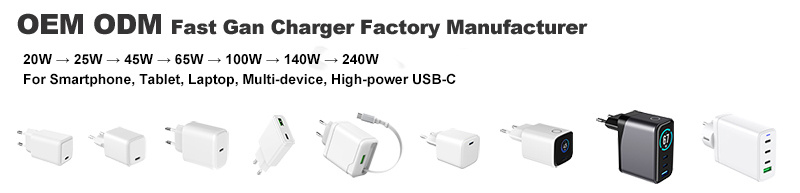
OEM vs ODM for 65W, 100W and 140W Chargers
Power level can also influence the decision.
| Power | ODM Can Be Suitable When | OEM Is More Useful When |
| 25W | Standard smartphone charger | Unique housing or protocol |
| 45W | Standard PD/PPS charger | Special size or design |
| 65W | Proven GaN platform | Custom multi-port solution |
| 100W | Existing GaN platform | New high-density architecture |
| 140W | Existing PD 3.1 platform | New thermal/mechanical design |
| 240W | Mature platform available | Advanced high-power custom solution |
The higher the power, the more carefully the factory should evaluate whether an existing platform can actually meet the new requirements.
A 140W charger is not simply a 65W charger with a larger number printed on the label. The electrical, thermal and safety requirements are different.
OEM vs ODM and Certification
Certification is another area where the choice matters. If you use an existing ODM charger that already has relevant certification, the project may be more straightforward.
However, the exact product configuration still needs to be checked.
Changing: PCB, Components, Housing, Power output, Plug, Port configuration; may affect the certification status.
So never assume: “The factory says it is CE certified, so our customized version is automatically certified.” That is too simplistic.
Ask for the actual certification and test documentation that applies to the final product configuration.
OEM vs ODM Is Not Really a “Better or Worse” Question
This is probably the most useful way to think about the subject. ODM is not the cheap version of OEM. And OEM is not automatically the premium version of ODM.
They solve different business problems.
Choose ODM when you value: Speed + lower development risk + proven platform
Choose OEM when you value: Customization + differentiation + engineering control
And sometimes the best project uses both.
Brand may start with an ODM platform to enter the market. Then, after sales data and customer feedback are available, it may develop a proprietary OEM charger for the next product generation.
That is a perfectly reasonable product strategy.
OEM vs ODM Charger Manufacturing: Cost, Lead Time, IP and Factory Selection
How Much Does OEM Charger Development Cost?
There is no standard OEM charger development price. That is because the engineering scope can be completely different from one project to another.
For example, a customer asking for a logo, packaging and color change is not doing the same project as a customer requesting a new 100W GaN charger with a custom housing and PCB.
One involves only the costs of printing, packaging, and color.
The other entails additional expenses ranging from tooling and product structure to certification.
This is why a professional OEM charger manufacturer should first review the product requirements before giving a meaningful development quotation. A very low initial quotation is not necessarily a better deal if important engineering work is excluded.
OEM vs ODM: Which One Has a Shorter Development Time?
In most cases, ODM has the advantage here. If the manufacturer already has a proven platform, some work has already been completed.
For example, a factory may already have a tested: 65W GaN charger platform, with: USB-C PD, PPS, Existing PCB, Existing housing, Existing transformer, Tested components, Production tooling.
If the customer only needs branding and minor customization, the project can move directly toward sample confirmation.
A completely new OEM charger takes longer because the product must go through additional engineering stages. A typical custom project may look like:
Specification → Feasibility → Electrical Design → Structural Design → Prototype → DVT → Certification → PVT → Mass Production
This is why buyers should never compare an ODM lead time with a full OEM development timeline as if they were the same thing.
*DVT and PVT Validation for Chargers: How New Products Move From Design to Mass Production
OEM vs ODM and Certification
Certification is another area where the choice matters. If you use an existing ODM charger that already has relevant certification, the project may be more straightforward.
However, the exact product configuration still needs to be checked.
Changing: PCB, Components, Housing, Power output, Plug, Port configuration; may affect the certification status.
So never assume: “The factory says it is CE certified, so our customized version is automatically certified.” That is too simplistic.
Ask for the actual certification and test documentation that applies to the final product configuration.
OEM vs ODM Is Not Really a “Better or Worse” Question
This is probably the most useful way to think about the subject. ODM is not the cheap version of OEM. And OEM is not automatically the premium version of ODM.
They solve different business problems.
Choose ODM when you value: Speed + lower development risk + proven platform
Choose OEM when you value: Customization + differentiation + engineering control
And sometimes the best project uses both.
Brand may start with an ODM platform to enter the market. Then, after sales data and customer feedback are available, it may develop a proprietary OEM charger for the next product generation.
That is a perfectly reasonable product strategy.
OEM vs ODM Charger Manufacturing: Cost, Lead Time, IP and Factory Selection
How Much Does OEM Charger Development Cost?
There is no standard OEM charger development price. That is because the engineering scope can be completely different from one project to another.
For example, a customer asking for a logo, packaging and color change is not doing the same project as a customer requesting a new 100W GaN charger with a custom housing and PCB.
One involves only the costs of printing, packaging, and color.
The other entails additional expenses ranging from tooling and product structure to certification.
This is why a professional OEM charger manufacturer should first review the product requirements before giving a meaningful development quotation. A very low initial quotation is not necessarily a better deal if important engineering work is excluded.
OEM vs ODM: Which One Has a Shorter Development Time?
In most cases, ODM has the advantage here. If the manufacturer already has a proven platform, some work has already been completed.
For example, a factory may already have a tested: 65W GaN charger platform, with: USB-C PD, PPS, Existing PCB, Existing housing, Existing transformer, Tested components, Production tooling.
If the customer only needs branding and minor customization, the project can move directly toward sample confirmation.
A completely new OEM charger takes longer because the product must go through additional engineering stages. A typical custom project may look like:
Specification → Feasibility → Electrical Design → Structural Design → Prototype → DVT → Certification → PVT → Mass Production
This is why buyers should never compare an ODM lead time with a full OEM development timeline as if they were the same thing.
*DVT and PVT Validation for Chargers: How New Products Move From Design to Mass Production
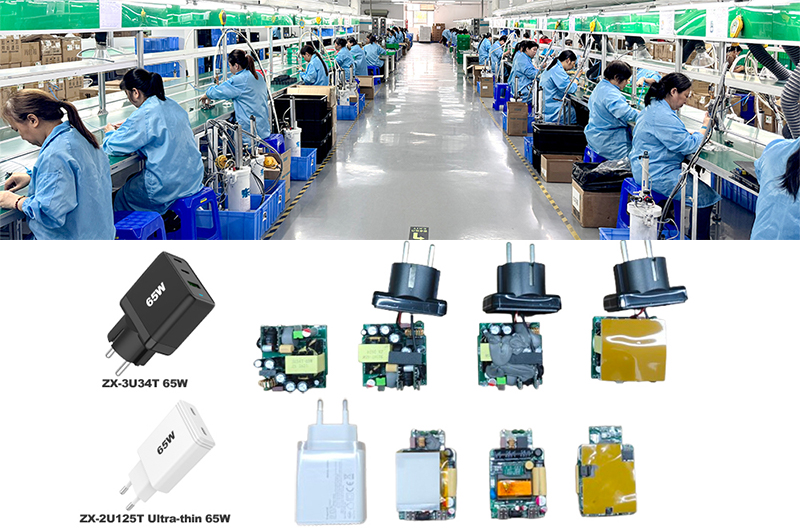
How Much Can You Customize With ODM Charger?
This depends largely on the charger factory. Established ODM vendors may allow customers to customize more than just the logo; options can include colors (for the casing and USB ports), plug types, minor design tweaks, printing, packaging (labels, manuals, color box, and shipping cartons), and custom data cables.
Can an ODM Charger Have a Custom Housing?
Sometimes. If the existing housing is close to the customer's requirements, minor modifications may be possible.
But if the customer wants a completely new industrial design, a new mold may be required.
For example: Existing 65W charger
→ reduce thickness
→ change port position
→ redesign plug structure
→ change internal PCB
→ improve heat dissipation
This is no longer a matter of simple aesthetic customization; it has evolved into an engineering project.
For clients seeking a 65W charger factory, clearly defining requirements—such as product specifications, quantities, and pricing—can significantly improve communication efficiency with the factory.
Should You Choose an OEM or ODM Charger for a Brand?
For a new brand or established brand, I would normally start with a simple question: Do you need to prove the market first, or are you building a long-term proprietary product?
The ODM model is highly practical if the goal is to conduct market testing or build brand awareness. This approach can reduce initial risks and costs.
You can launch a: 25W charger, 30W charger, 45W GaN charger, 65W Fast charger, and with customized branding and packaging without taking on the full cost of a new product platform.
Once the product and brand have gained market recognition, the brand owner can consider more differentiated OEM designs.
In this situation, OEM can provide much more control. The factory becomes an engineering and manufacturing partner rather than simply a supplier of finished products.
How to Choose an OEM Charger Manufacturer
Price should not be the primary consideration (but for small and medium-sized brands or entrepreneurs, price is the most important factor).
I would normally evaluate a charger factory across several areas.
1. Engineering Capability. Ask:
• Do you have in-house electrical engineers?
• Do you have structural engineers?
• Can you design PCB layouts?
• Can you develop GaN chargers?
• Can you tune PD/PPS?
• Can you design high-power chargers?
A factory that only performs assembly will have limited ability to support a true OEM project.
2. Product Range. Look at the manufacturer's actual development range.
Does it only make: 20W–30W chargers? Or does it also have experience with: 45W / 65W / 100W / 140W / 240W?
A broad product range does not automatically mean better engineering. But it can indicate that the manufacturer has experience solving different power-density, thermal and certification problems.
ZONSAN currently lists charger products from 5W to 240W, including PD, QC, PPS and AVS solutions, and provides OEM/ODM customization.
3. Factory or Trading Company?
This question matters. A trading company can sometimes provide access to several factories. However, if you require product development as well as the best price and quality assurance, you may need to communicate directly with the manufacturer.
For example, you should ask:
Where are the factory and engineering teams located?
I need information about the charger engineering design and R&D team and production line.
How can final quality control be ensured?
Can I visit the factory?
ZONSAN states that it operates as an original wall and desktop charger factory rather than a trading company, and offers factory visits or online factory visits.
That distinction is particularly important when your project involves engineering changes.
4. Production Capacity
Engineering capability is only half the battle; manufacturers must also consistently deliver on approved designs, production processes, testing protocols, quality control, and more.
For example, ZONSAN's USB-C PD manufacturing page states a current daily production capacity of around 50,000 chargers, alongside dedicated R&D and quality-control staff.
The actual capacity available to your project, of course, depends on production scheduling and order requirements.
5. Certification Experience
A charger manufacturer should understand the certification requirements before the product reaches the testing laboratory.
Depending on the target market, this may include: CE, RoHS, FCC, KC, CB, ETL, ERP, UKCA, ANATEL, Other regional requirements.
ZONSAN many of its charger models have certifications including CE, KC, FCC, RoHS, ETL and CB, and that it can assist with special certification requirements.
6. Reliability Testing
A charger can pass a basic functional test and still have problems later.
Professional development should consider reliability.
Testing may include: Aging, High-temperature testing, Drop testing, Impact testing, Pressure testing, Fireproof testing, Safety testing, Function testing.
ZONSAN's published factory FAQ lists these types of reliability checks among its product testing activities.
A 100W GaN charger manufacturer should be able to explain how the product behaves under sustained load, not only how much power it can output for a few seconds.
What MOQ Should You Expect?
MOQ varies by manufacturer and customization level.
For standard ODM products, the minimum order quantity varies depending on the product and the factory's regulations.
For example, ZONSAN currently states that its customization MOQ is 1,000 pieces, while sample MOQ can be one unit.
This is useful as a reference, but buyers should still confirm MOQ for the exact project.
A new private mold project may require a different commercial arrangement.
What Is a Typical Production Lead Time?
Do not confuse this with development time. Once a charger has already been approved and the production process is stable, the lead time can be much easier to estimate.
ZONSAN currently publishes approximately:
1,000–3,000 pcs: about 30 days
3,000–10,000 pcs: about 45 days
for bulk orders.
But that should be treated as a production reference rather than a universal promise.
If the project requires new certifications, new packaging, OEM engineering, or involves tight raw material supplies, the overall project timeline will obviously be longer.
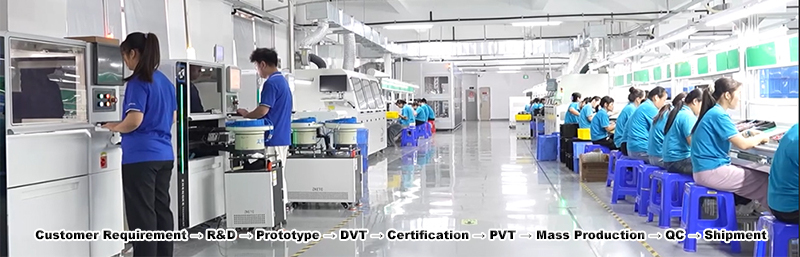
OEM vs ODM Charger Manufacturing: The Bottom Line
There is no single answer to whether OEM or ODM is better. The right model depends on your product strategy.
If you want to launch a branded charger quickly, an existing ODM platform can make a lot of sense.
If your charger needs to be smaller, more powerful, visually different or technically unique, OEM development may be worth the additional investment.
And if you are somewhere in between, a hybrid approach can often provide the best balance.
The important thing is to understand what you are actually buying.
You are not only buying a charger. You may also be buying: Engineering experience. Testing capability. Certification support. Production stability. Supply-chain management.
And the ability to turn a product specification into something that can be manufactured repeatedly.
That is why choosing an OEM charger manufacturer should be treated as a product-development decision, not simply a price comparison.
For B2B buyers, the best factory is not necessarily the one with the lowest quotation.
It is the one that can explain what it is going to build, how it will validate it, how it will manufacture it, and what happens when something does not go according to plan.
FAQ: OEM vs ODM Charger Manufacturing
Q1: Is OEM better than ODM for chargers?
Not always. OEM is better when you need significant customization or a proprietary product. ODM is often better when you need a proven charger platform and faster time to market.
Q2: What is the difference between OEM and ODM chargers?
OEM projects are generally driven by the customer's specific product requirements, while ODM projects usually start from the manufacturer's existing product or technology platform.
Q3: Can I customize an ODM charger?
Yes. As a PD charger manufacturer, Zonsan offers customization options that include the logo, color, packaging, plug type, specification label, casing, and certain electrical parameters.
Q4: Is private label the same as ODM?
No. Private label describes a branding/business arrangement. A private-label charger can be an ODM product, an OEM product or a customized existing design.
Q5: Can the charger factory develop new PCBs?
Yes. As a charger manufacturer with an in-house engineering team, Zonsan can develop new PCB designs or modify existing ones.
Q6: Which is faster, OEM or ODM?
ODM is normally faster because it can use an existing product platform, tooling and engineering solution.
Q7: Is ODM cheaper than OEM?
Usually the initial development cost is lower because much of the engineering has already been completed. However, the final cost depends on customization, MOQ, tooling, certification and production volume.
Q8: Can I get a custom 65W GaN charger?
Yes. A 65W GaN charger can be customized in areas such as housing, branding, plug, port configuration and, depending on the platform, charging parameters.
Q9: Can I commission the Zonsan OEM factory to develop a 100W GaN charger?
Yes. As a GaN charger manufacturer, Zonsan has the capability to develop new 100W charger products based on specific requirements or to modify existing high-power platforms.
Q10: What should I look for in a charger factory?
Look at R&D capability, production experience, testing, certifications, quality systems, tooling capability, MOQ, lead time and previous experience with similar power levels.
Q11: What is the MOQ for custom chargers?
MOQ varies by project. ZONSAN's current minimum order quantity for customized products is 1,000 units, whereas the minimum order quantity for samples can be as low as a single unit.
Q12: Can ZONSAN provide both OEM and ODM charger manufacturing?
Yes. ZONSAN positions itself as an OEM/ODM charger manufacturer and offers customization covering areas such as logo, packaging, labels, PCB design, ID design and charger specifications.
Reviewers by: Zonsan Sales Team and Engineers – Emma and Michael
Last Review Date: [August 31, 2026]