Can One USB-C Charger Replace a 120W ASUS Charger and a 100W OnePlus SUPERVOOC Charger?
A charger may be rated at 100W, 120W, or even 140W, yet that does not automatically mean it can replace every 100W or 120W charger you already own.
A recent discussion in the Reddit r/UsbCHardware community is a good example. The question was straightforward: can one USB-C charger replace both an ASUS 120W charger and a OnePlus 100W SUPERVOOC charger?
The interesting part is that the answer is not simply about wattage.
The real issue is how that wattage is delivered.
USB Power Delivery, PPS, SUPERVOOC, proprietary high-current charging modes, cable ratings, device-side charging controllers, and laptop power requirements can all affect the result.
For consumers, this can be confusing. For charger manufacturers and OEM buyers, it is even more important because these differences have to be considered at the engineering stage.
Quick Answer
A high-power USB-C PD charger can potentially replace the ASUS charger for USB-C PD-compatible charging, especially when the laptop supports USB PD and the charger provides an appropriate PD 3.1 power profile.
However, a standard 100W or 140W USB-C PD charger should not be expected to reproduce 100W SUPERVOOC charging on a OnePlus device. SUPERVOOC uses proprietary charging technology and, on compatible chargers, can use substantially higher current than standard USB PD operation.
So the right question is not: "Does the new charger have enough watts?"
It is: "Does the new charger support the voltage, current, protocol, cable and device requirements of both products?"
Why 120W and 100W Do Not Tell the Whole Story
When people compare chargers, wattage is usually the first specification they look at.
That makes sense.
A 120W charger sounds more powerful than a 100W charger. A 140W USB-C charger sounds like it should easily replace a 120W charger. But the wattage number is only the result of two basic electrical variables: Power = Voltage × Current
That distinction becomes important at higher charging power.
For example:
• 20V × 5A = 100W
• 28V × 5A = 140W
• 36V × 5A = 180W
• 48V × 5A = 240W
USB PD 3.1 uses higher voltage levels to extend USB-C power delivery beyond the traditional 100W range. USB-IF specifies new fixed voltage levels of 28V, 36V and 48V for power levels up to 140W, 180W and 240W respectively. (USB PD3.1 EPR Explained: 240W USB-C charging)
This is fundamentally different from simply increasing current.
And that is exactly where proprietary fast-charging systems become interesting.
A proprietary charger may achieve a high power level using a different voltage/current combination from USB PD.
Therefore, two chargers with almost identical wattage labels can have completely different electrical architectures.
The ASUS 120W Charger and OnePlus 100W SUPERVOOC Charger Are Not the Same Problem
The Reddit discussion is useful because it puts two very different charging requirements next to each other.
One charger is an ASUS 120W charger.
The other is a OnePlus 100W SUPERVOOC charger.
At first glance, both simply look like high-power chargers. Technically, however, their requirements can be very different.
A laptop may need a relatively high continuous power level to operate under load while charging its battery.
A smartphone using SUPERVOOC, on the other hand, may be designed around a proprietary high-current charging architecture.
This means the charger has to communicate with the device and provide the appropriate electrical mode.
OnePlus itself provides a useful example.
Its official 100W SUPERVOOC dual-port adapter lists support for SUPERVOOC, VOOC, PD, PPS and QC. But the maximum values are different between those modes. Its USB-C SUPERVOOC output can reach 100W using a high-current mode, while the listed USB PD output is limited to 65W and PPS to 63W.
That is an important engineering detail.
The charger is not simply a "100W USB-C charger." It is a charger with multiple charging architectures and protocol profiles.
USB-C Is a Connector, Not a Charging Protocol
This is one of the most common misunderstandings in the charger market. People often use "USB-C charger" and "USB PD charger" as if they mean exactly the same thing.
They do not.
USB-C describes the connector and associated interface specifications.
USB Power Delivery is a power negotiation protocol that operates over USB-C.
A USB-C charger can support different combinations of USB Power Delivery, PPS, proprietary fast-charging protocols, QC, legacy charging modes, and manufacturer-specific charging behavior.
This is why two chargers can both have USB-C ports but provide very different charging experiences.
For manufacturers, the USB-C connector is therefore only one part of the product architecture.(Learn about USB-C charger manufacturing process.)
A charger also requires an appropriate power topology, control chip (IC), PD controller, protocol implementation scheme, protection system, transformer design, thermal design, firmware or configuration, cable compatibility, and so on.
The USB-IF specification is designed to allow USB Power Delivery to negotiate the power required by the connected device. Modern USB PD can scale well beyond the older 100W limit.
But that does not mean every proprietary charging system automatically becomes equivalent to USB PD.
Why SUPERVOOC Is Difficult to Replace with a Generic 100W Charger
This is probably the most important point from the Reddit discussion.
A generic 100W USB-C charger may provide 100W. That does not mean a OnePlus phone will charge at 100W.
The phone and charger need to support the same charging mode.
SUPERVOOC is a proprietary charging technology(Proprietary Fast Charging vs Standard USB-PD Chargers) associated with OPPO/OnePlus devices. OnePlus describes SUPERVOOC as a separate charging protocol from USB PD and PPS. The electrical difference can be significant.
The official OnePlus 100W adapter lists a 100W mode of up to approximately 11V at 9.1A, while its USB PD profiles use substantially lower current.
That is why simply buying a 100W USB-C PD charger does not reproduce the same charging behavior.
The charger may deliver: 20V × 5A = 100W under USB PD
while the OnePlus charger may use: approximately 11V × 9.1A = 100W under SUPERVOOC
Although the total power output is similar, the electrical paths differ significantly.
That difference affects the charger, cable, connector, phone-side charging circuitry and thermal design.
Why USB PD Uses Higher Voltage Instead of Simply Increasing Current
This is where the engineering behind modern high-power USB-C chargers becomes more interesting. Suppose a manufacturer wants to deliver approximately 100W.
One option is to increase current.
Another is to increase voltage.
Higher current creates additional challenges because resistive losses increase with the square of current: Power loss = I²R
This means that increasing current can make conductor resistance, connector resistance and cable heating increasingly important.
USB PD 3.1 addresses higher power primarily through higher voltage.
The specification adds 28V, 36V and 48V fixed voltage levels while keeping the maximum current within the USB-C 5A framework for these high-power modes.
This creates a very different design philosophy from proprietary high-current fast charging.
For a USB-C PD 3.1 charger manufacturer, the challenge becomes:
• high-voltage insulation, creepage and clearance, transformer design,;
• switching efficiency, thermal management, protection circuits;
• cable qualification, PD negotiation.
For a proprietary high-current charger, the engineering focus can shift toward:
• high-current paths, connector resistance, cable construction, thermal control;
• current handling, proprietary protocol communication, device-side conversion architecture.
Neither approach can be understood by looking at the wattage label alone.
Why a 140W USB-C Charger Can Still Be a Poor SUPERVOOC Replacement
This is an important distinction for charger buyers.
You may find a 140W USB-C GaN charger and assume: "If 140W is available, it should easily replace a 100W charger."
That conclusion is incomplete.
A 140W USB-C PD charger likely delivers its 140W output via the USB PD 3.1 EPR (Extended Power Range) protocol.
However, the connected OnePlus phone may fail to recognize this protocol as SUPERVOOC.
Consequently, the phone might revert to a different supported charging mode.
As a result, the actual charging power could be significantly lower than the charger's rated maximum output.
This is why charger selection should begin with protocol compatibility, not maximum wattage.
For laptop users, this is often less complicated if the laptop supports standard USB PD.
For proprietary smartphone fast charging, it can be much more restrictive.
The Laptop Side Has a Different Consideration
The ASUS 120W side of the problem requires another question: Does the laptop actually accept 120W through USB-C PD?
Not every laptop that ships with a 120W adapter can necessarily receive the full 120W through USB-C.
Some laptops support USB-C charging but at a lower maximum input power.
Others may support USB-C PD only under certain operating conditions.
ASUS itself documents USB-C PD charging on supported ROG notebooks and notes that 65W or 100W USB-C adapters can be used in certain lower-load situations.
This is why a laptop's original charger rating should not automatically be treated as its USB-C PD input specification.
There are really two separate numbers: Original power supply rating and USB-C PD input capability.
They may be different.
For a buyer trying to replace a 120W laptop charger, checking the laptop's USB-C charging specification is therefore essential.
What Happens If a 100W PD Charger Is Used Anyway?
In many cases, nothing dangerous happens simply because the charger has a lower maximum power rating.
USB PD is based on negotiation.
The device requests an available power level, and the charger provides a supported profile.
The device does not normally "force" the charger to deliver its maximum advertised wattage.
The practical issue is performance.
If a laptop can consume more power than the USB-C charger can provide, several things may happen depending on the laptop design:
• charging may be slower
• battery charging may pause under heavy load
• system performance may be limited
• the battery may discharge while the laptop is operating
• the charger may remain at its maximum supported output
This is particularly relevant to gaming laptops.
A laptop can consume significantly more power during CPU and GPU-intensive workloads than during normal office use.
A 100W USB-C charger may therefore be perfectly adequate for travel and normal productivity but insufficient to maintain the same behavior as a 120W or higher dedicated adapter during sustained heavy workloads.
That is not necessarily a charger problem. It is a system-level power budget issue.
This explains very well why some USB-C chargers charge faster.
The Cable Can Also Become the Limiting Factor
High-power charging is not only about the charger.
The cable matters.
USB-IF's current USB-C cable compliance framework distinguishes cables by their power capabilities, including 60W and 240W certified power markings.
For high-power USB PD applications, the charger, cable and device have to form a compatible system.
A charger capable of 140W does not magically turn every USB-C cable into a 140W cable.
For example, if a system requires a 5A cable for a particular high-power PD configuration, the cable needs to be properly rated for that application.
This is another reason why charger specifications should be evaluated as a complete package: charger + cable + device + protocol, rather than as an isolated wattage number.
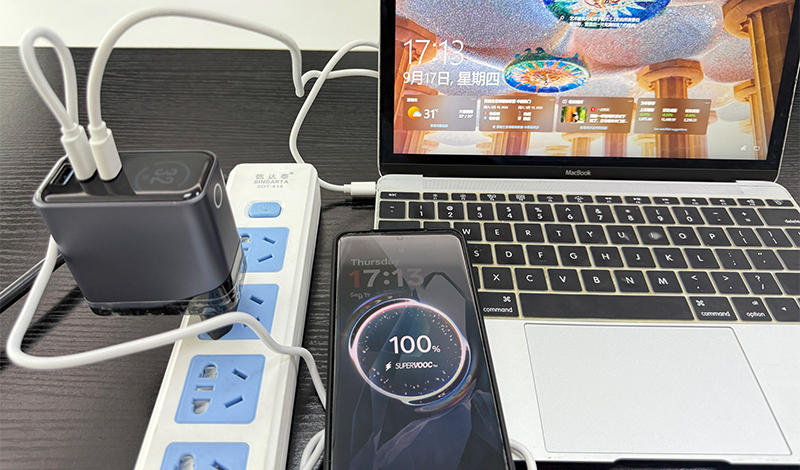
* The Charger Shown in the image is the ZX-3U39T 120W TFT Display Charger
Why One Charger Can Support Multiple Protocols
The most practical solution for this type of problem is not necessarily choosing between PD and proprietary charging.
Modern multi-protocol chargers can be designed to support several charging systems.
A well-designed charger platform may include: USB PD, PD 3.1, PPS, QC, proprietary fast charging, and legacy charging modes.
The OnePlus 100W adapter is a good example of this approach. Its official specifications list SUPERVOOC, PD, PPS and QC support in the same product.
This type of architecture is becoming increasingly useful because consumers do not want to carry one charger for every device.
The factory engineering challenge is that adding protocols is not simply a software checkbox.
The power architecture still has to support the required voltage and current combinations.
The thermal system must also handle the worst-case operating condition.
And when multiple ports are used simultaneously, the internal power budget has to be managed carefully.
What a Real "One Charger Replaces Both" Solution Should Look Like
If the goal is to replace both a high-power laptop charger and a proprietary smartphone charger, I would not start by searching for "the highest wattage charger."
I would build the requirement around five questions.
1. What does the laptop actually support?
Check the laptop's USB-C input specification.
If it supports 100W USB PD, a good 100W PD charger may be enough for normal use.
If it supports USB PD 3.1 at a higher power level, a 140W or higher PD charger may be more appropriate.
2. What does the phone actually support?
Check the phone's supported charging protocols.
If it requires proprietary SUPERVOOC for its maximum charging speed, a generic PD charger should not be expected to reproduce that maximum. (For example: A SUPERVOOC 100W charger can fully charge the battery in 30 minutes, whereas a PD 100W charger takes 45 minutes to an hour.)
3. Does the charger support PPS?
PPS can improve compatibility with many modern smartphones and is increasingly common in multi-protocol chargers.
It is not the same thing as SUPERVOOC, but it can provide a useful intermediate compatibility mode.
4. What cable is required?
For higher-power USB PD charging, use a properly rated USB-C cable.
The cable should match the intended power level rather than simply being labeled “fast charging.” (3A, 5A, 6A cable)
5. What happens when multiple devices are connected?
A charger advertised as 140W does not necessarily provide 140W to every port simultaneously.
The internal power allocation may change when multiple ports are used.
For a travel charger intended to replace several original adapters, this matters just as much as the headline wattage.
What This Means for Charger Manufacturers
This Reddit discussion also highlights a larger issue in charger manufacturing.
The market increasingly asks for a charger that can support:
• laptops, smartphones, tablets;
• handheld gaming devices, earbuds, and multiple USB-C devices.
But compatibility is becoming more complicated, not less.
A manufacturer developing a 100W or 140W USB-C charger needs to consider more than output power.
The engineering process can involve:
Power architecture → protocol support → PD/PPS negotiation → thermal design → cable compatibility → protection → EMC → certification → production testing.
This is why two 100W chargers can have very different real-world performance.
One may be optimized primarily for USB PD laptops.
Another may prioritize smartphone PPS compatibility.
Another may include proprietary fast-charging support.
And another may be designed as a multi-port desktop charger where the total power must be dynamically allocated.
From a factory perspective, protocol support also affects component selection, PCB layout, firmware or controller configuration, testing procedures and validation.(Internal PCB, IC, and transformer architecture of the charger.)
The higher the power, the less room there is for a poorly integrated design.
Why GaN Helps but Does Not Solve Protocol Compatibility
GaN is another specification that is sometimes misunderstood.
A GaN charger can be smaller, more efficient and better suited to high power density than many conventional silicon-based designs. But GaN itself does not determine whether a charger supports SUPERVOOC, USB PD 3.1 or PPS.
GaN is a semiconductor technology used in the power conversion stage. Protocol compatibility is a separate part of the charger architecture.
So: GaN ≠ PD 3.1 and GaN ≠ SUPERVOOC
A 140W GaN charger can still fail to provide the charging mode required by a particular smartphone. Likewise, a conventional silicon charger can support USB PD if its electrical architecture is designed appropriately.
The technology inside the charger should therefore be evaluated as a complete system rather than as a marketing label.
The Real Difference Between "Maximum Power" and "Usable Power"
This is perhaps the biggest lesson from the original question.
The charger might be rated at 140W, but the power actually received by the connected device might only be:
• 100W because of its PD limit;
• 65W because of the selected protocol;
• 45W because of PPS compatibility;
• much less because the cable or device does not support the required mode.
That does not mean the charger is falsely rated. It means the maximum output is conditional.
The actual charging power is determined through negotiation between the charger and the device.
This is why professional charger specifications should clearly separate:
• maximum total power, single-port power, PDO output,PPS range;
• proprietary protocol output, multi-port power distribution, and cable requirements.
For OEM and ODM charger buyers, this level of detail is far more useful than simply putting "100W Fast Charger" on the product box.
What Charger Should You Look for?
If your goal is to replace a high-power ASUS charger and a OnePlus SUPERVOOC charger with one travel charger, the practical target is a high-power multi-protocol USB-C charger, not simply the charger with the largest wattage number.
For the laptop side, look for:
• USB PD support
• PD 3.1 if higher than 100W is required
• appropriate single-port output
• suitable cable
• sufficient continuous power under load
For the smartphone side, look for:
• PPS, PD, AVS support
• documented compatibility with the phone
• proprietary fast-charging support if maximum SUPERVOOC speed is essential
If maximum SUPERVOOC charging speed is a hard requirement, a standard USB PD charger should not be assumed to replace the original charger.
If maximum phone charging speed is less important and the goal is simply to carry one charger, a good 100W or 140W multi-protocol USB-C charger may provide a much more practical compromise.
Final Thoughts
The Reddit question about replacing an ASUS 120W charger and a OnePlus 100W SUPERVOOC charger looks like a simple charger-shopping question.
It is actually a good illustration of where modern USB-C charging is heading.
Wattage alone is no longer enough to describe a charger.
A 100W USB-C PD charger and a 100W SUPERVOOC charger may deliver the same headline power while using very different voltage, current and communication strategies.
USB PD 3.1 solves higher-power USB-C charging mainly by increasing voltage, extending the standard to 140W, 180W and 240W. Proprietary systems such as SUPERVOOC can use different power architectures and much higher current levels. OnePlus' own 100W adapter demonstrates this difference by supporting both proprietary SUPERVOOC operation and lower-power USB PD/PPS modes in the same product.
For consumers, this means the best one-charger setup depends on the actual devices being powered.
For charger manufacturers, it means something even more important: The future of high-power USB-C charging is not simply about increasing wattage. It is about making different power architectures, protocols, thermal systems and device requirements work together reliably.
That is where charger engineering becomes much more important than the number printed on the front of the box.
FAQ – Engineering Insights from a PD Charger Manufacturer
Q1: Can a 140W USB-C charger replace a 120W ASUS charger?
A: It may, if the ASUS device supports USB-C PD at the required power level. The laptop's actual USB-C input specification should be checked rather than assuming that its original 120W adapter rating equals its USB-C charging capability.
Q2: Can a 100W USB-C PD charger provide 100W SUPERVOOC?
A: Not necessarily. SUPERVOOC and USB PD are different charging systems. A phone may fall back to another supported charging mode when connected to a standard USB PD charger.
Q3: Why does a 100W SUPERVOOC charger use more than 5A?
A: Some proprietary fast-charging implementations use higher-current architectures. OnePlus' official 100W adapter, for example, specifies SUPERVOOC output up to approximately 9.1A, while its USB PD output uses lower current profiles.
Q4: Is 140W USB-C PD better than 100W SUPERVOOC?
A: They are designed for different charging architectures, so comparing them simply by wattage is misleading. USB PD 3.1 reaches higher power primarily through higher voltage, while proprietary systems may use different voltage/current combinations.
Q5: Does GaN automatically mean faster charging?
A: No. GaN is a power semiconductor technology. It can help manufacturers achieve higher efficiency and power density, but charging speed still depends on the charger architecture, protocol support, device and cable.
Q6: Does a USB-C charger always support USB PD?
A: No. USB-C describes the connector/interface ecosystem. USB Power Delivery is a separate power protocol.
Q7: Can PPS replace SUPERVOOC?
A: PPS can improve compatibility with many modern smartphones, but PPS should not automatically be treated as equivalent to proprietary SUPERVOOC charging. The actual phone model and supported charging modes determine the result.
Q8: Why can my laptop charge from USB-C but still need its original charger?
A: The laptop may support USB-C charging at a lower power level than its original adapter. ASUS, for example, documents USB-C PD charging on supported notebooks and notes that lower-power 65W or 100W adapters can be suitable under lighter workloads.
Q9: What should I check when buying a high-power USB-C charger?
A: Check the charger's single-port power, PD version, PPS range, supported protocols, cable rating, multi-port power allocation and compatibility with the specific devices you intend to charge.
Q10: What is the most important specification for a 100W or 140W charger?
A: There is no single specification that determines real-world compatibility. The complete combination of output profiles, charging protocols, cable capability, device support, thermal design and power allocation matters.
Reviewers: Zonsan R&D: Engineer Michael; Product Manager: Elie
Second Reviewers: Selike and Lucas
Final Review Date: [September 16, 2026]