How Charger Factories Scale Production
A charger factory can make a good sample without necessarily being ready for mass production. That distinction is easy to miss when choosing a supplier.
A buyer may receive a well-built 65W GaN charger, test it, approve the sample, and assume the factory can produce the same product at a much larger volume.
But scaling production is not simply a matter of adding more workers or running the production line for longer hours.
As order volume increases, almost every part of the manufacturing system is put under more pressure.
Materials have to arrive on time.
SMT production has to remain stable.
Assembly stations need to keep pace with each other.
Testing cannot become a bottleneck.
Quality standards must remain consistent.
And engineering needs to make sure that the product being manufactured at scale is still the same product that was originally validated.
This is what separates a factory that can make chargers from a charger manufacturer that can scale charger production reliably.
For OEM and ODM buyers, that difference matters.
Quick Answer
Charger factories scale production by combining production planning, material control, SMT capacity, balanced assembly lines, standardized processes, automated and functional testing, quality control, traceability, and controlled engineering changes.
The objective is not simply to produce more chargers. It is to increase output without allowing quality, efficiency, yield, or product consistency to fall.
A reliable charger manufacturer therefore scales the entire production system—not just the number of units coming off the line.
1. Scaling Starts With Production Planning
Before a factory increases output, it needs to understand what the order actually requires.
Production planning typically requires consideration of order quantities, delivery schedules, product models, Bills of Materials (BOM), component availability, SMT (Surface Mount Technology) requirements, assembly and testing capabilities, packaging requirements, and existing production schedules.
This sounds straightforward, but charger production can involve many different configurations.
A factory may manufacture several power levels and port configurations at the same time.
A 25W USB-C charger, 65W GaN charger, 100W multi-port charger, and 140W PD3.1 charger may require different components, PCB assemblies, housings, testing parameters, and packaging.
Production planning therefore needs to allocate the right resources to the right product.
The first step in scaling is not producing faster. It is knowing what needs to be produced, when, and with which resources.
2. Capacity Is More Than the Number of Workers
When buyers ask about factory capacity, they sometimes look primarily at employee numbers.
That is not enough. A factory's effective production capacity depends on the entire manufacturing system.
Imagine an assembly line capable of assembling thousands of chargers per day. If the aging-test area can handle only a fraction of that volume, overall production capacity is still limited by testing.
The same problem can occur with SMT, final QC, packaging or a particular manual assembly operation.
For this reason, professional factories evaluate bottlenecks, not just headline capacity.
3. SMT Capacity Is a Major Part of Charger Production
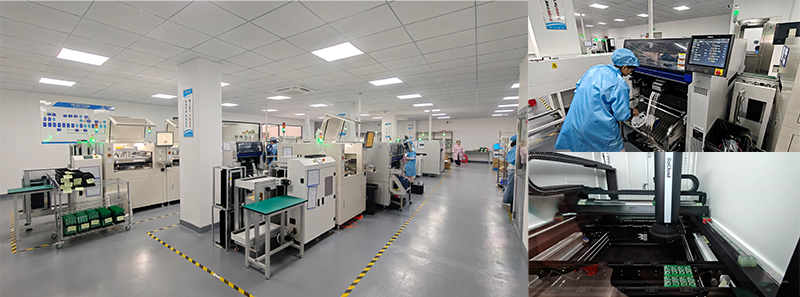
Modern chargers depend heavily on SMT manufacturing.
Components are placed onto PCBs using automated equipment, followed by reflow soldering and inspection.
When production volume increases, the SMT process needs to remain stable.
Examples include: placement machine speed, feeder configuration, PCB changeover time, reflow oven throughput, AOI (Automated Optical Inspection) capabilities, component supply status, production scheduling, etc.
The challenge lies not merely in mounting more components onto more PCBs; the process requires maintaining consistent placement and soldering quality across the entire batch.
A small SMT problem repeated across a large production run can quickly become a major quality issue.
That is why SMT capacity and process control are fundamental when evaluating a charger factory for bulk orders.
4. Production Lines Need to Be Balanced
Adding workers to a production line does not automatically increase output.
If one workstation takes significantly longer than the others, it becomes a bottleneck.
This is known as line balancing.
A charger production line may include stages such as: PCB Preparation → Component / Transformer Assembly → Housing Assembly → Functional Testing → Aging → Final QC → Packaging
Each stage needs enough capacity to support the next stage.
If housing assembly is faster than functional testing, finished units can accumulate before the testing station.
If testing is fast but packaging is slow, the same thing happens later in the process.
A well-managed charger manufacturer therefore looks at the production line as one system.
The goal is to keep material moving steadily rather than maximizing the speed of one individual station.
5. Standardized Work Becomes More Important as Volume Grows
Small production runs can sometimes depend heavily on experienced workers. That approach becomes difficult to manage when production volume increases.
In large-scale production, processes such as work instructions, assembly procedures, testing specifications, inspection standards, torque requirements, welding requirements, component identification, and packaging procedures must be more standardized.
Standardization reduces variation between operators and between production batches. It also makes training easier when a factory needs to add production capacity.
The buyer expects the product manufactured six months later to remain consistent with the approved sample.
A standardized production process helps make that possible.
6. Material Control Can Limit Production Before the Line Does
A factory cannot scale production if critical components are missing.
Charger manufacturing involves many components(Power ICs, GaN devices, MOSFETs, capacitors, transformers, USB-C connectors, cables, housing components, plugs, packaging materials) with different lead times and supply conditions.
One missing component can delay an otherwise ready production order.
This is why production scaling also requires effective material planning.
The factory needs visibility into:
• Current inventory andIncoming materials,
• Supplier lead times and Production requirements,
• Safety stock and Approved alternatives.
Component substitution also needs engineering control.
A cheaper or more available component cannot simply be inserted into a production batch without considering its effect on electrical performance, thermal behavior, safety, and certification.
7. Scaling Should Not Mean Constantly Changing the BOM
One of the risks during high-volume production is uncontrolled component substitution.
A factory may discover that a component is temporarily difficult to obtain.
Replacing it may appear to be a simple purchasing decision.
For a charger, it may not be.
Changing a power component can affect: Efficiency, Temperature, Switching behavior, EMI, Protection, Reliability, and Certification.
This is why a professional charger manufacturer needs engineering change control.
An alternative component should be evaluated and approved before it becomes part of mass production.
The purpose is simple: Increase production capacity without changing the product specification by accident.
8. NPI Connects Charger R&D With Mass Production
Scaling becomes much easier when the factory has a structured NPI process.
NPI stands for New Product Introduction.
It is the bridge between product development and manufacturing.
During the NPI phase, the factory reviews the final Bill of Materials (BOM), PCB files, assembly instructions, testing requirements, molds, tooling and fixtures, production equipment, quality control points, packaging, certification requirements, and other related items.
The objective is to make sure the design is ready to be manufactured repeatedly.
This is particularly important for customized chargers.
A prototype may be assembled manually by engineers. Mass production requires a process that ordinary production operators can follow consistently.
That transition needs to be planned.
9. DVT and PVT Help Control the Scaling Risk
The difference between DVT and PVT becomes particularly important when moving toward volume production.
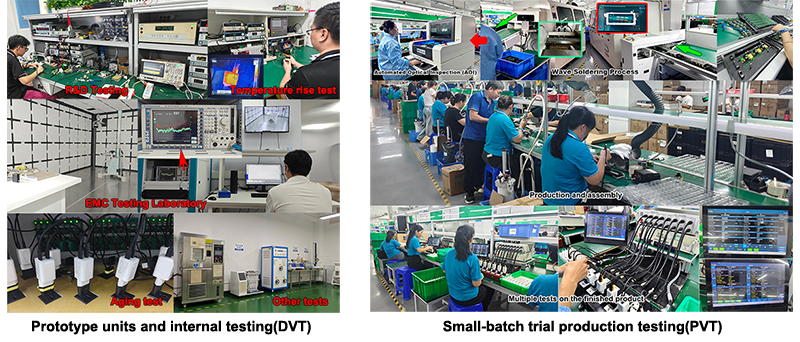
DVT — Design Validation Testing focuses on whether the design meets its requirements.
PVT — Production Validation Testing focuses on whether the validated design can be manufactured using the intended production process.
Because manufacturing introduces variables that may not appear during engineering prototypes.
PVT provides an opportunity to identify these issues before a large production run.
For OEM customers, this is one of the reasons a mature OEM charger manufacturer can be less risky than a supplier that moves directly from a prototype to full production.
10. Automation Helps, But It Does Not Replace Process Engineering
Automation is often associated with scaling up production.
It certainly offers significant benefits, including enhanced production speed, repeatability, placement accuracy, inspection efficiency, and data acquisition capabilities.
SMT is a clear example. But automation by itself does not guarantee quality.
A poorly designed process can still produce large numbers of defective units—just faster.
The more important question is whether automation is integrated into a controlled manufacturing process.
A good production system combines: Automation + Process Control + Inspection + Data + Skilled Engineering, rather than relying on machines alone.
11. Testing Capacity Must Scale With Production
Testing is often overlooked when buyers evaluate production capacity.
But every charger leaving the factory needs to pass appropriate functional and quality checks.
Testing covers: output voltage, output current, power output (Power Delivery), PD protocol negotiation, PPS performance, protection functions, temperature rise, aging tests, visual inspection, and port functionality.
If production output doubles but testing capacity does not, testing can become the bottleneck.
Worse, a factory under delivery pressure may be tempted to reduce testing time.
A professional charger factory increases production capacity while maintaining the required inspection and testing process.
12. Aging Capacity Is Part of Real Production Capacity
A charger is not finished simply because it passes a quick functional test.
Aging testing provides another layer of verification.
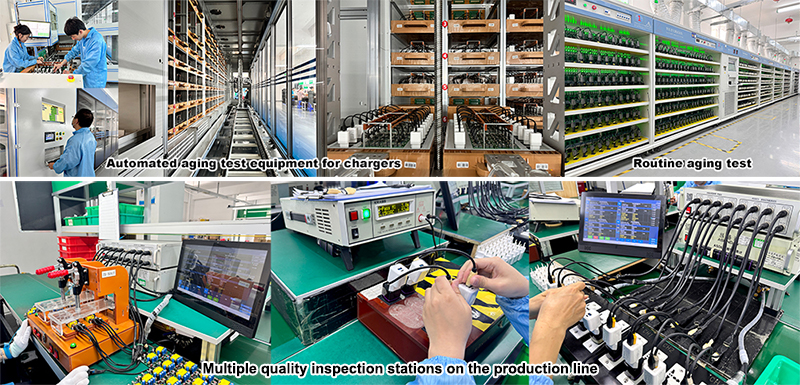
Chargers can be operated under controlled electrical load to identify potential issues such as: Abnormal temperature, Voltage instability, Component weakness, Unexpected shutdown, Charging instability.
The exact aging conditions depend on the product and factory quality system.
But the production principle is important: Aging capacity has to grow with production capacity.
If a factory can assemble 20,000 units but can only properly age-test a small portion of them, the theoretical assembly capacity does not represent the real finished-goods capacity.
13. Quality Control Has to Move With the Production Line
Scaling production creates another challenge.
More units mean more opportunities for variation.
Quality control therefore needs to exist at multiple points rather than only at the end.
Typical control points can include:
Incoming Quality Control. - Components are inspected before entering production.
In-Process Quality Control. - The manufacturing process is checked while products are being assembled.
Functional Testing. Electrical performance is verified.
Aging / Reliability Testing. - Products are subjected to defined operating conditions.
Final Quality Control. - Finished products are inspected before packaging and shipment.
This layered approach helps prevent a problem from moving through the entire production process unnoticed.
14. Yield Is One of the Most Important Scaling Metrics
Yield matters! Production volume alone does not tell the whole story.
If a factory produces 10,000 units but has a significant defect rate, its effective output is much lower.
A simplified example makes the point.
If 10,000 units enter production and 98% pass the required process without rework, approximately 9,800 units are good units.
If the process becomes less stable and yield falls, additional labor, repair, inspection and material costs appear.
Experienced factories closely monitor production line metrics: first-pass yield, defect rate, rework, scrap, reasons for repair, and process fluctuations.
Improving yield can increase effective capacity without necessarily adding another production line.
This is one of the less visible ways engineering contributes to manufacturing scale.
15. Traceability Becomes More Valuable at Higher Volume
When production is small, a quality issue may be relatively easy to investigate.
When tens of thousands of chargers are involved, traceability becomes much more important.
A good traceability system can help identify:
• Production date, Production batch, Component batch;
• Production line, Test results ,Inspection records, Operator or station information.
If a problem appears after shipment, the factory can investigate the affected batch rather than treating the entire production history as one group.
This helps reduce the scope of corrective action. It also gives OEM customers greater confidence when dealing with large production programs.
16. Engineering Support Becomes More Important During Scaling
Production problems do not always originate on the production line.
Sometimes a manufacturing issue reveals a weakness in the product design.
For example, a component may be technically acceptable but difficult to assemble consistently.
A housing tolerance may be too tight.
A thermal material may be difficult to position correctly.
A PCB layout may create unnecessary production complexity.
When these issues appear, production and engineering need to work together.
Top-tier charger manufacturers do not isolate their R&D teams from their manufacturing departments; engineering teams should remain actively involved even after products have entered the mass production stage.
17. Scaling a Charger Product Is Different From Scaling Every Charger
A factory may have large overall capacity but still struggle with a particular product.
This is because production capacity is not completely interchangeable.
Different chargers utilize completely different materials and manufacturing processes for some of their components.
A 65W GaN charger and a 140W multi-port charger may require very different manufacturing arrangements.
Therefore, when asking about factory capacity, buyers should ask: "What is the production capacity for this specific product and configuration?"
That is much more useful than simply asking: "How many chargers can you make per month?"
18. Packaging Can Become a Hidden Bottleneck
The charger itself may be finished while the order is still not ready to ship.
Packaging is part of production.
For OEM customers, packaging involve customized: Boxes, Labels, Manuals, Barcodes, Cartons and Inserts.
If the packaging process cannot keep pace with finished chargers, inventory accumulates.
That is why a factory scaling production needs to consider the entire process: Components → PCB → Assembly → Testing → Aging → QC → Packaging → Shipment.
Not just the manufacturing of the charger itself.

How a Mobile Phone Charger Factory Increases Capacity
There is no single method for scaling production.
A factory may improve capacity through several approaches.
Improve Existing Processes. Before adding equipment, the factory can reduce bottlenecks, improve line balance and increase yield.
Add Production Equipment. Additional SMT or testing equipment can increase throughput where existing capacity is insufficient.
Add Assembly Capacity. Additional lines or stations can increase final assembly output.
Improve Automation. Automation can reduce repetitive manual operations and improve consistency.
Expand Testing. Additional test equipment and aging capacity may be required as output grows.
Improve Material Planning. Better inventory and supplier management can prevent production interruptions.
The important point is that these improvements should be coordinated.
Adding an SMT machine does not help much if final testing remains the bottleneck.
Scaling Should Protect Product Consistency
The most important principle in mass production is simple: The millionth unit should still meet the same product requirements as the first approved production unit.
This requires exercising control over all stages of production.
The brand's product specification is based on an approved sample.
Production scaling should not quietly turn that product into something different.
What Buyers Should Ask a PD Gan Charger Factory About Capacity
When evaluating a charger manufacturer, buyers should ask specific questions.
Production
• What is the daily capacity for this product?
• How many production lines are available?
• Which processes are automated?
SMT
• Is SMT performed in-house?
• What inspection is used after SMT?
• How is PCB quality controlled?
Testing
• What functional tests are performed?
• How is aging handled?
• Can testing capacity support the proposed order volume?
Quality
• How is production yield monitored?
• Is batch traceability available?
• How are defects handled?
Engineering
• Who manages NPI?
• How are engineering changes controlled?
• Can the factory support design modifications during production?
These questions are far more useful than simply asking for the factory's maximum monthly output.
What Makes a Scalable Charger Manufacturer?
A scalable charger manufacturer usually has several capabilities working together.
1. Stable component sourcing. The factory can secure the materials required for ongoing production.
2. Strong manufacturing engineering. Production processes are designed for repeatability.
3. Sufficient SMT capacity. PCB production can support the required volume.
4. Balanced assembly lines. Bottlenecks are identified and managed.
5. Scalable testing. Functional, aging and quality testing can support production output.
6. Quality systems. Quality does not depend entirely on final inspection.
7. Traceability.Production data can be used to investigate problems.
8. Engineering support. R&D remains connected to production.
9. Production planning. Capacity is allocated according to actual orders and product requirements.
10. Controlled expansion. New equipment, workers and production lines are introduced without losing process control.
This is what allows a factory to grow without simply creating more production problems.
ZONSAN's Approach to Charger Production
ZONSAN has been developing and manufacturing chargers since 2009, with product solutions ranging from 5W to 240W and supporting technologies such as USB-C PD, PPS, GaN and other fast-charging platforms.
The company's manufacturing information describes an integrated process covering SMT, assembly, testing, aging and quality inspection, while its OEM/ODM model connects product development with customized production.
Scaling up the charger business is not as simple as merely increasing the number of assembly workers.
A manufacturer needs to connect: R&D → NPI → Material Planning → SMT → Assembly → Testing → Quality Control → Packaging → Shipment.
ZONSAN's experience across multiple charger power levels and configurations provides a production base for OEM and ODM customers that need to move from product development into repeat manufacturing.
The exact capacity available for a particular order still depends on the product configuration, production schedule, component availability and testing requirements.
And this is the correct perspective for evaluating a factory's production capacity.
Scaling Production Is About Control, Not Just Speed
There is a temptation to think of factory expansion as a simple equation: More machines + more workers = more chargers
In reality, scaling is more complicated.
→ If production increases faster than quality control, defect rates can rise.
→ If material planning does not keep up, lines can stop.
→ If testing capacity is insufficient, finished goods can accumulate.
→ If engineering changes are not controlled, product consistency can suffer.
→ If production processes are not standardized, output can vary between lines.
The best factories therefore scale through control first and speed second.
The objective is stable output.
Final Thoughts
A reliable charger manufacturer does not prove its manufacturing capability by producing one impressive sample.
It proves it by reproducing the same product consistently across large production volumes.
That requires much more than assembly capacity.
It requires production planning, material control, SMT capability, line balancing, NPI, DVT/PVT, testing, aging, quality management, traceability and engineering support.
For B2B buyers, this is why factory capacity should never be judged only by a monthly production number.
A better question is: Can this charger factory scale my specific product while maintaining the same engineering, quality and performance standards?
That is the real meaning of scalable charger manufacturing.
For OEM and ODM projects, the strongest manufacturing partner is not necessarily the factory with the largest production floor.
It is the one that can increase volume without losing control of the product.
So, this is also why the engineering design of a charger is more important than is price.
FAQ
Q1: How do charger factories increase production capacity?
Charger factories increase capacity through better production planning, additional SMT and assembly resources, improved line balancing, automation, expanded testing capacity, higher production yield and better material management.
Q2: What is the difference between factory capacity and actual charger production capacity?
Factory capacity refers to the overall manufacturing capability, while actual capacity depends on the specific charger model, PCB, components, assembly process, testing requirements, production schedule and available resources.
Q3: How does SMT affect charger production capacity?
SMT produces the PCBs used in chargers. If SMT capacity is insufficient, PCB availability can become a bottleneck and limit the entire charger production process.
Q4: Why is production yield important for charger manufacturers?
Higher yield means more finished products can be produced from the same amount of materials, labor and production time. Low yield creates additional repair, rework and inspection costs.
Q5: What is NPI in charger manufacturing?
NPI, or New Product Introduction, is the process of transferring a charger from engineering development into a controlled manufacturing process suitable for repeat production.
Q6: Why are DVT and PVT important for mass production?
DVT validates the product design, while PVT validates the production process. Together they reduce the risk of discovering design or manufacturing problems after large-scale production begins.
Q7: Can a charger factory increase production without adding workers?
Yes. Process optimization, automation, better line balancing, improved yield and additional equipment can increase effective capacity without simply increasing headcount.
Q8: Why is traceability important in charger production?
Traceability allows a factory to identify production batches, materials, test records and other manufacturing information when investigating quality problems.
Q9: What should I ask a charger factory about production capacity?
Ask about capacity for the specific charger model, SMT capability, assembly lines, testing and aging capacity, production yield, material availability, lead time and how the factory manages production peaks.
Q10: Is a large charger factory always a better manufacturer?
Not necessarily. Factory size alone does not guarantee engineering quality or production consistency. The more important factors are process control, engineering capability, testing, quality systems and the ability to scale a specific product reliably.
Reviewers: Zonsan teams: Lucas and Miller; Production Supervisor: Luo Zhang
Second Reviewers: Ken and Selike
Final Review Date: [September 12, 2026]