Why Charger Engineering Matters More Than Price
When buyers compare charger suppliers, price is usually one of the first numbers on the table.
A supplier offers a lower unit price. Another factory is slightly more expensive. On paper, the cheaper option can look attractive, especially when the order quantity is large.
But charger manufacturing is one of those industries where the lowest quotation does not always mean the lowest cost.
A charger is not simply a plastic housing, a PCB, and a USB-C port assembled together. Modern USB-C PD, PPS, GaN, and high-power chargers depend heavily on electrical engineering, thermal design, component selection, firmware and protocol tuning, mechanical design, testing, and production control.
That difference may not be obvious when comparing two samples on day one.
It often becomes obvious later.
A charger may run hotter after extended use. A production batch may have a higher failure rate. A new device may expose a PD compatibility issue. Certification may require another engineering revision. Or a factory may struggle to keep the same performance from the first production run to the tenth.
This is why, for serious B2B buyers, charger engineering capability can be more important than the initial unit price.
Quick Answer
Charger engineering matters more than price because engineering determines how reliably a product can achieve its rated power, thermal performance, safety requirements, protocol compatibility, and production consistency.
A low-cost charger may reduce the purchase price, but poor engineering can create higher costs through failures, returns, certification problems, redesigns, production delays, and customer complaints.
For OEM and ODM buyers, the better question is not simply “How much does this charger cost?”
It is: “How much engineering risk am I taking with this supplier?”
1. Price Is Only One Part of Charger Cost
A charger quotation normally gives you a simple number: Unit price × quantity = purchase cost
That calculation is useful, but incomplete.
The actual cost of a charger project may encompass product development, mold manufacturing, certification fees, sample revisions, engineering changes, labor costs, production losses (scrap), and quality inspections (as well as potential costs for custom colors, logos, packaging, etc.).
Additionally, it may include expenses related to product returns, warranty claims, replacement shipments (spare units), inventory losses, and delays in market launch; requirements in these areas vary from factory to factory.
For OEM charger projects:
Suppose two factories quote different prices for a 65W USB-C charger.
Factory A offers lower prices, but its products are imitations.
Factory B has slightly higher prices but possesses superior engineering and testing capabilities, and maintains high quality standards.
If both products perform equally well for years, Factory A may appear to be the better choice.
But if Factory A experiences repeated thermal issues, inconsistent components, failed samples, or production instability, the original price advantage can disappear quickly.
This is why experienced sourcing teams look beyond the first quotation. They evaluate the total cost of ownership and total project risk, not only the unit price.
2. Charger Engineering Starts Before the PCB Is Manufactured
Excellent charger engineering design does not begin on the production line; it starts at a much earlier stage.
Before a charger enters the SMT (Surface Mount Technology) production process, engineers must determine its electrical architecture.
For a PD Gan USB-C charger, this involve:
• Input requirements, Output power, PD profiles, PPS ranges, Power allocation, Transformer design;
• Switching components, Protection circuits, EMI considerations, Thermal requirements, PCB layout, Mechanical constraints, Certification requirements.
These decisions are interconnected; changing one part of the design could affect other parts.
For example, increasing output power may require changes to the power stage, transformer, thermal path, PCB layout, components, and enclosure.
Developing a charger involves far more than simply selecting an IC with a higher power rating or using higher-power components. (For details, you can view the in-depth analysis of the internal components and engineering design of the Zonsan PD GaN charger.)
The engineering system has to work as a whole.
3. The Same Wattage Does Not Mean the Same Engineering
This is one of the most important points for charger buyers.
Both chargers are rated for 65W of power and support the USB-C PD protocol.
They may even be nearly identical in physical dimensions. However, their internal engineering designs could be vastly different.
These differences generally manifest in the following areas:
• PCB layout, component quality, transformer construction, power IC selection, and thermal management materials;
• Switching frequency, protection mechanism design, EMI (electromagnetic interference) control, firmware or protocol tuning, manufacturing tolerances, etc.
These differences affect how the charger behaves under real operating conditions.
A charger that performs well for several minutes is not necessarily a well-engineered charger. The more meaningful question is how it performs:
• At full load, At elevated ambient temperature, During long operating periods;
• With different devices, Across different input voltages, During repeated charging cycles.
This is where engineering starts to separate one manufacturer from another.
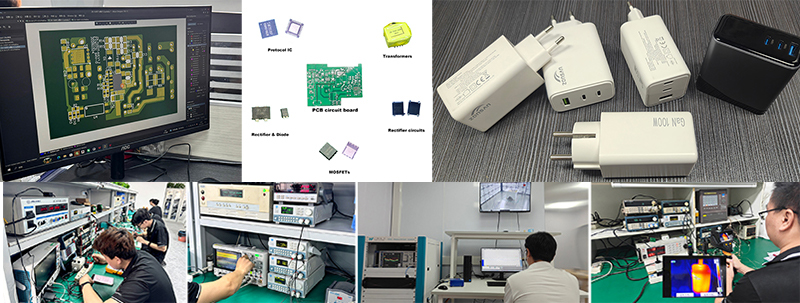
4. Thermal Engineering Is One of the Hidden Cost Factors
Heat is a good example of why engineering matters.
Modern chargers are becoming increasingly compact while their power output continues to rise.
Compared to a standard 20W adapter, a 65W charger must handle significantly more energy, while 100W or 140W chargers place even greater demands on the internal power architecture.
Consequently, engineers must consider factors such as component losses, PCB copper trace design, transformer efficiency, thermal pads, internal clearances, heat dissipation paths, and the temperatures of both the casing and components; simply increasing power output is not a sufficient solution.
The engineering design challenge lies in delivering the required power while keeping temperatures within an acceptable range.
Poor thermal design can lead to reduced efficiency, increased component stress, unstable charging, shortened component lifespan, the triggering of thermal protection, customer complaints, and—in severe cases—even fire.
This is one reason professional charger manufacturers invest heavily in temperature-rise testing and reliability verification.
ZONSAN's manufacturing process describes PCB engineering, thermal architecture, aging testing, and safety verification as interconnected parts of production rather than isolated quality checks.
5. Component Selection Can Change the Long-Term Result
A charger BOM can look simple from the outside. Inside, however, dozens of components have to work together consistently.
Key components include Power ICs, MOSFETs, Capacitors, Transformers, Rectifiers, USB-C connectors, Protection components, Thermal interface materials, and heat sinks.
The cheapest component is not automatically the wrong choice. Likewise, the most expensive component is not automatically the best choice.
The real engineering question is whether the component is appropriate for the intended application.
Engineers will consider factors such as electrical ratings, temperature characteristics, reliability, supply stability, availability, certification requirements, production stability, and long-term procurement risks, in accordance with company requirements.
This is especially important for OEM products because a charger may remain in production for several years.
A component that is available today may become difficult to source later.
Good engineering therefore considers not only “Can we build this charger?”
It also asks: “Can we keep building the same charger consistently?”
6. USB-C PD and PPS Make Engineering More Important
Modern fast charging is not only about power conversion. The charger also has to communicate correctly with the connected device.
USB-C Power Delivery and PPS introduce additional engineering requirements.
Depending on the product, engineers may need to verify:
• PD negotiation
• Voltage profiles
• Current limits
• PPS behavior
• Power allocation
• Protection response
• Device compatibility
For example, a 100W multi-port charger does not simply provide 100W independently from every port.
The power architecture needs to manage how available power is distributed.
This requires a sound electrical architecture and protocol control; suppliers with only basic assembly capabilities might be able to replicate the charger's appearance.
A capable charger manufacturer needs to understand what is happening inside the power system. (Want to know how Gallium Nitride (GaN) chargers are made? Here’s an inside look at the factory.)
7. Engineering Directly Affects Certification
Certification should not be viewed as an additional step to be addressed after product development is complete; safety and compliance requirements(Charger Safety Standards↗) influence the engineering design of the charger from the very beginning.
Failure to consider these requirements early on could lead to issues during the certification process that necessitate a redesign of the product.
In other words, stronger engineering can reduce certification risk before the product reaches the laboratory.
This is particularly important for OEM buyers targeting markets with different certification requirements.
Capable manufacturers view certification as an integral part of product engineering and design, rather than simply handing off finished samples to a testing laboratory.
8. Better Engineering Can Improve Production Yield
Engineering does not stop when the prototype works. The design also needs to be manufacturable.
This is where DFM — Design for Manufacturing becomes important.
A good charger design should consider how it will behave during:
• SMT production, Reflow soldering, Assembly, Transformer installation, Housing assembly, Testing, Packaging.
A design that works perfectly in a laboratory but is difficult to manufacture consistently is not a successful commercial design.
Production engineers may need to optimize:
• Component placement, Soldering conditions, Assembly sequence, Tolerances, Internal mechanical positioning andTesting procedures.
The goal is not merely to produce a satisfactory sample, but to manufacture thousands of products of consistent quality.
That difference is fundamental in OEM manufacturing.
9. Engineering Capability Helps Reduce Failure Rates
A strong engineering team does not try to eliminate every possible failure by testing finished products only.
It tries to prevent failures from being created in the first place. This means using engineering data from:
• Prototype testing, DVT, PVT, Thermal testing, Aging tests, Production testing,Customer feedback, and Failure analysis.
When a problem appears, engineers should ask: What failed?
But that is only the beginning.
They also need to determine: Why did it fail? And then: How do we prevent the same failure from appearing again?
This is the difference between simply rejecting defective products and improving the manufacturing system.
ZONSAN’s charger testing process comprises incoming material inspection, in-process quality control, functional testing, PD/PPS testing, temperature rise testing, burn-in testing, protection function verification, and final inspection, forming a multi-layered quality control system.
10. Cheap Engineering Can Become Expensive After Launch
The biggest risk with a low-cost charger supplier is not necessarily that the first sample will fail.
Sometimes the sample works. The problem appears later.
A production project encounter:
• Higher-than-expected defect rates, Component substitutions, Thermal problems, Compatibility complaints;
• Certification revisions, Production inconsistency, Delayed deliveries, Warranty claims.
These problems are expensive because they happen after money has already been invested in the product.
For an e-commerce brand, a quality problem can also affect reviews and customer trust.
For a distributor, it can create replacement and after-sales costs.
For a retailer, inconsistent quality can become a much larger commercial problem.
Engineering capability should be viewed as a form of risk management.
11. What Strong Charger Engineering Looks Like
B2B buyers do not need to become electrical engineers to evaluate a charger factory. But they should look for evidence.
A capable charger manufacturer should be able to discuss:
Electrical Engineering
• Power architecture, PCB design, IC selection, Transformer design, PD/PPS implementation, and Protection circuits.
Thermal Engineering
• Temperature-rise testing, Heat dissipation, Component temperature, Thermal materials, and High-load operation.
Mechanical Engineering
• Housing design, Internal space, Port positioning, Plug structure, Thermal interaction between PCB and enclosure.
Manufacturing Engineering
• SMT, DFM, Assembly process, Production testing, Process control.
Validation
• Prototype testing, DVT, PVT, Reliability testing, Aging testing, Certification preparation.
The key lies not in whether a supplier can list a long string of technical terms, but in whether their engineers can articulate the considerations and rationale behind every engineering decision. A high-quality charger relies on high standards and excellent product/PCB design.
12. A Charger Factory Should Be Able to Explain Trade-Offs
In real-world engineering practice, there is rarely a single, definitive answer to a problem.
Reducing a charger's size can compromise thermal performance.
Increasing power density places greater demands on thermal design.
Adding more ports complicates power distribution.
Changing components affects costs, supply availability, and certification outcomes.
Lowering the Bill of Materials (BOM) cost may introduce new reliability risks.
Therefore, a capable charger manufacturer should be able to clearly articulate these trade-offs.
For example: "We could reduce the housing size, but that would shrink the thermal margin."
This type of communication is far more valuable from an engineering perspective than simply saying, "No problem, we can make it smaller."
The former response demonstrates that the supplier fully understands the implications of the design decision.
This is crucial when developing OEM or ODM products.
13. Engineering Is Especially Important Above 65W
Engineering becomes increasingly important as charger power rises.
At lower power levels, the thermal and electrical challenges are relatively manageable.
As output increases toward: 65W, 100W, 140W, 240W; the design margin becomes more demanding.
For higher-power products, greater emphasis is often placed on aspects such as the charger's internal structural design and the results of various tests.
This does not necessarily mean that all high-power chargers are superior, but it does indicate that engineering requirements have become impossible to ignore.
For buyers sourcing high-power GaN or PD3.1 products, supplier engineering capability should therefore be part of the initial evaluation—not something checked after price negotiation.
14. Engineering Also Determines How Well a Charger Can Be Customized
OEM buyers often think customization means changing Logo, Color(Casing or USB port), Packaging, Plug type.
Those are only the visible parts.
Real charger customization can involve:
• Output profiles, PD/PPS configuration, Port combinations, Power allocation, PCB changes, Housing dimensions, Thermal structure, and Plug configuration, Certification requirements (About charger certification preparation).
This is where the difference between an OEM factory and a trading supplier becomes clearer.
If the customer needs a modified electrical architecture, the supplier needs engineers who can actually develop and validate that change.
A supplier that only changes the label or packaging is not providing the same level of OEM capability.
15. Why the Cheapest Charger Factory Is Not Always the Cheapest Partner
Price still matters. There is no reason to ignore it.
A professional buyer should absolutely negotiate pricing and compare suppliers.
The problem is using price as the first and only filter.
A better evaluation sequence is: Engineering capability → Product quality → Certification → Manufacturing consistency → Delivery capability → Price
Price should remain one of the factors considered in the final decision, but it should be evaluated based on a full understanding of the product's essence.
A slightly higher unit price may be reasonable if it provides:
• Better engineering
• More stable components
• Better thermal performance
• Stronger testing
• Lower failure risk
• Better production consistency
The goal is not to purchase the most expensive charger, but rather to acquire the one with the lowest risk at a commercially reasonable cost.
16. How to Compare Two Charger Manufacturers
When comparing suppliers, do not only request a quotation.
Ask both factories the same technical questions.
For example: Product Engineering
• Who designs the PCB?
• Is the design developed in-house?
• How are PD and PPS requirements validated?
• How is thermal performance evaluated?
Manufacturing
• Is SMT performed in-house?
• What production inspections are used?
• How is production consistency controlled?
Testing
• What tests are performed before shipment?
• Is aging testing performed?
• How are temperature-rise results verified?
• How are protection functions tested?
OEM Development
• Can the factory modify the electrical design?
• Can it develop a new housing?
• Does it support DVT and PVT?
• How are engineering changes controlled?
These questions reveal much more than a simple supplier price list.
Heat is a good example of why engineering matters.
Modern chargers are becoming increasingly compact while their power output continues to rise.
Compared to a standard 20W adapter, a 65W charger must handle significantly more energy, while 100W or 140W chargers place even greater demands on the internal power architecture.
Consequently, engineers must consider factors such as component losses, PCB copper trace design, transformer efficiency, thermal pads, internal clearances, heat dissipation paths, and the temperatures of both the casing and components; simply increasing power output is not a sufficient solution.
The engineering design challenge lies in delivering the required power while keeping temperatures within an acceptable range.
Poor thermal design can lead to reduced efficiency, increased component stress, unstable charging, shortened component lifespan, the triggering of thermal protection, customer complaints, and—in severe cases—even fire.
This is one reason professional charger manufacturers invest heavily in temperature-rise testing and reliability verification.
ZONSAN's manufacturing process describes PCB engineering, thermal architecture, aging testing, and safety verification as interconnected parts of production rather than isolated quality checks.
5. Component Selection Can Change the Long-Term Result
A charger BOM can look simple from the outside. Inside, however, dozens of components have to work together consistently.
Key components include Power ICs, MOSFETs, Capacitors, Transformers, Rectifiers, USB-C connectors, Protection components, Thermal interface materials, and heat sinks.
The cheapest component is not automatically the wrong choice. Likewise, the most expensive component is not automatically the best choice.
The real engineering question is whether the component is appropriate for the intended application.
Engineers will consider factors such as electrical ratings, temperature characteristics, reliability, supply stability, availability, certification requirements, production stability, and long-term procurement risks, in accordance with company requirements.
This is especially important for OEM products because a charger may remain in production for several years.
A component that is available today may become difficult to source later.
Good engineering therefore considers not only “Can we build this charger?”
It also asks: “Can we keep building the same charger consistently?”
6. USB-C PD and PPS Make Engineering More Important
Modern fast charging is not only about power conversion. The charger also has to communicate correctly with the connected device.
USB-C Power Delivery and PPS introduce additional engineering requirements.
Depending on the product, engineers may need to verify:
• PD negotiation
• Voltage profiles
• Current limits
• PPS behavior
• Power allocation
• Protection response
• Device compatibility
For example, a 100W multi-port charger does not simply provide 100W independently from every port.
The power architecture needs to manage how available power is distributed.
This requires a sound electrical architecture and protocol control; suppliers with only basic assembly capabilities might be able to replicate the charger's appearance.
A capable charger manufacturer needs to understand what is happening inside the power system. (Want to know how Gallium Nitride (GaN) chargers are made? Here’s an inside look at the factory.)
7. Engineering Directly Affects Certification
Certification should not be viewed as an additional step to be addressed after product development is complete; safety and compliance requirements(Charger Safety Standards↗) influence the engineering design of the charger from the very beginning.
Failure to consider these requirements early on could lead to issues during the certification process that necessitate a redesign of the product.
In other words, stronger engineering can reduce certification risk before the product reaches the laboratory.
This is particularly important for OEM buyers targeting markets with different certification requirements.
Capable manufacturers view certification as an integral part of product engineering and design, rather than simply handing off finished samples to a testing laboratory.
8. Better Engineering Can Improve Production Yield
Engineering does not stop when the prototype works. The design also needs to be manufacturable.
This is where DFM — Design for Manufacturing becomes important.
A good charger design should consider how it will behave during:
• SMT production, Reflow soldering, Assembly, Transformer installation, Housing assembly, Testing, Packaging.
A design that works perfectly in a laboratory but is difficult to manufacture consistently is not a successful commercial design.
Production engineers may need to optimize:
• Component placement, Soldering conditions, Assembly sequence, Tolerances, Internal mechanical positioning andTesting procedures.
The goal is not merely to produce a satisfactory sample, but to manufacture thousands of products of consistent quality.
That difference is fundamental in OEM manufacturing.
9. Engineering Capability Helps Reduce Failure Rates
A strong engineering team does not try to eliminate every possible failure by testing finished products only.
It tries to prevent failures from being created in the first place. This means using engineering data from:
• Prototype testing, DVT, PVT, Thermal testing, Aging tests, Production testing,Customer feedback, and Failure analysis.
When a problem appears, engineers should ask: What failed?
But that is only the beginning.
They also need to determine: Why did it fail? And then: How do we prevent the same failure from appearing again?
This is the difference between simply rejecting defective products and improving the manufacturing system.
ZONSAN’s charger testing process comprises incoming material inspection, in-process quality control, functional testing, PD/PPS testing, temperature rise testing, burn-in testing, protection function verification, and final inspection, forming a multi-layered quality control system.
10. Cheap Engineering Can Become Expensive After Launch
The biggest risk with a low-cost charger supplier is not necessarily that the first sample will fail.
Sometimes the sample works. The problem appears later.
A production project encounter:
• Higher-than-expected defect rates, Component substitutions, Thermal problems, Compatibility complaints;
• Certification revisions, Production inconsistency, Delayed deliveries, Warranty claims.
These problems are expensive because they happen after money has already been invested in the product.
For an e-commerce brand, a quality problem can also affect reviews and customer trust.
For a distributor, it can create replacement and after-sales costs.
For a retailer, inconsistent quality can become a much larger commercial problem.
Engineering capability should be viewed as a form of risk management.
11. What Strong Charger Engineering Looks Like
B2B buyers do not need to become electrical engineers to evaluate a charger factory. But they should look for evidence.
A capable charger manufacturer should be able to discuss:
Electrical Engineering
• Power architecture, PCB design, IC selection, Transformer design, PD/PPS implementation, and Protection circuits.
Thermal Engineering
• Temperature-rise testing, Heat dissipation, Component temperature, Thermal materials, and High-load operation.
Mechanical Engineering
• Housing design, Internal space, Port positioning, Plug structure, Thermal interaction between PCB and enclosure.
Manufacturing Engineering
• SMT, DFM, Assembly process, Production testing, Process control.
Validation
• Prototype testing, DVT, PVT, Reliability testing, Aging testing, Certification preparation.
The key lies not in whether a supplier can list a long string of technical terms, but in whether their engineers can articulate the considerations and rationale behind every engineering decision. A high-quality charger relies on high standards and excellent product/PCB design.
12. A Charger Factory Should Be Able to Explain Trade-Offs
In real-world engineering practice, there is rarely a single, definitive answer to a problem.
Reducing a charger's size can compromise thermal performance.
Increasing power density places greater demands on thermal design.
Adding more ports complicates power distribution.
Changing components affects costs, supply availability, and certification outcomes.
Lowering the Bill of Materials (BOM) cost may introduce new reliability risks.
Therefore, a capable charger manufacturer should be able to clearly articulate these trade-offs.
For example: "We could reduce the housing size, but that would shrink the thermal margin."
This type of communication is far more valuable from an engineering perspective than simply saying, "No problem, we can make it smaller."
The former response demonstrates that the supplier fully understands the implications of the design decision.
This is crucial when developing OEM or ODM products.
13. Engineering Is Especially Important Above 65W
Engineering becomes increasingly important as charger power rises.
At lower power levels, the thermal and electrical challenges are relatively manageable.
As output increases toward: 65W, 100W, 140W, 240W; the design margin becomes more demanding.
For higher-power products, greater emphasis is often placed on aspects such as the charger's internal structural design and the results of various tests.
This does not necessarily mean that all high-power chargers are superior, but it does indicate that engineering requirements have become impossible to ignore.
For buyers sourcing high-power GaN or PD3.1 products, supplier engineering capability should therefore be part of the initial evaluation—not something checked after price negotiation.
14. Engineering Also Determines How Well a Charger Can Be Customized
OEM buyers often think customization means changing Logo, Color(Casing or USB port), Packaging, Plug type.
Those are only the visible parts.
Real charger customization can involve:
• Output profiles, PD/PPS configuration, Port combinations, Power allocation, PCB changes, Housing dimensions, Thermal structure, and Plug configuration, Certification requirements (About charger certification preparation).
This is where the difference between an OEM factory and a trading supplier becomes clearer.
If the customer needs a modified electrical architecture, the supplier needs engineers who can actually develop and validate that change.
A supplier that only changes the label or packaging is not providing the same level of OEM capability.
15. Why the Cheapest Charger Factory Is Not Always the Cheapest Partner
Price still matters. There is no reason to ignore it.
A professional buyer should absolutely negotiate pricing and compare suppliers.
The problem is using price as the first and only filter.
A better evaluation sequence is: Engineering capability → Product quality → Certification → Manufacturing consistency → Delivery capability → Price
Price should remain one of the factors considered in the final decision, but it should be evaluated based on a full understanding of the product's essence.
A slightly higher unit price may be reasonable if it provides:
• Better engineering
• More stable components
• Better thermal performance
• Stronger testing
• Lower failure risk
• Better production consistency
The goal is not to purchase the most expensive charger, but rather to acquire the one with the lowest risk at a commercially reasonable cost.
16. How to Compare Two Charger Manufacturers
When comparing suppliers, do not only request a quotation.
Ask both factories the same technical questions.
For example: Product Engineering
• Who designs the PCB?
• Is the design developed in-house?
• How are PD and PPS requirements validated?
• How is thermal performance evaluated?
Manufacturing
• Is SMT performed in-house?
• What production inspections are used?
• How is production consistency controlled?
Testing
• What tests are performed before shipment?
• Is aging testing performed?
• How are temperature-rise results verified?
• How are protection functions tested?
OEM Development
• Can the factory modify the electrical design?
• Can it develop a new housing?
• Does it support DVT and PVT?
• How are engineering changes controlled?
These questions reveal much more than a simple supplier price list.

17. ZONSAN's Engineering Approach
ZONSAN has been developing and manufacturing chargers since 2009, with product solutions covering 5W to 240W and technologies including USB-C PD, PPS, GaN and other fast-charging platforms. In its manufacturing process, the company places great emphasis on internal engineering design, SMT production, thermal design, testing and validation, and OEM/ODM development capabilities, rather than viewing manufacturing merely as a simple assembly operation.
This engineering approach is particularly relevant for B2B customers developing customized charging products.
A charger manufacturer needs to connect several stages:
Product Requirement → Electrical Engineering → PCB & Power Architecture → Mechanical & Thermal Engineering → Prototype → Validation → Certification → Mass Production → Quality Control
The value of an experienced manufacturer is not simply having a production line at the end of this chain.
It is being able to manage the entire chain.
18. The Real Value of Engineering Is Risk Reduction
This is ultimately why engineering matters more than price.
Excellent engineering design can reduce uncertainty, thereby lowering the likelihood of the following situations occurring:
• A prototype fails late
• Certification requires major redesign
• A charger overheats under load
• PD negotiation behaves unexpectedly
• Production quality changes between batches
• Components become difficult to replace
• A product needs repeated engineering revisions
No supplier can eliminate every possible problem.
That is not realistic. But a strong engineering team can identify risks earlier, test them properly, and solve them before they become expensive commercial problems.
Final Thoughts
The charger industry is becoming more technically demanding.
USB-C PD, PPS, GaN, higher power density, multi-port charging, smaller housings and increasingly strict market requirements all place more pressure on product engineering.
As a result, choosing a charger manufacturer should not be based on quotation alone.
Price tells you what the product costs to buy.
Engineering tells you what kind of product you are actually buying.
For B2B buyers, OEM brands, distributors and retailers, the better long-term strategy is to evaluate the complete manufacturing capability behind the charger: Engineering + Components + Testing + Manufacturing + Certification + Consistency
A low price can save money on the first purchase order.
Good engineering can save money across the entire product lifecycle (Enhance brand effect). And that difference becomes increasingly important as chargers move toward higher power, smaller form factors and more advanced USB-C charging technologies.
FAQ
Q1: Is a more expensive charger always better?
No. Higher price does not automatically mean better quality. The important factors are engineering design, component selection, testing, certification and production consistency.
Q2: Why does charger engineering matter for OEM buyers?
OEM buyers depend on the factory to develop, validate and reproduce the product consistently. Strong engineering reduces development, certification and production risks.
Q3: Can two 65W chargers have different quality?
Yes. The same 65W rating does not mean the internal PCB, transformer, components, thermal design or protection architecture are identical.
Q4: Why is thermal engineering important in fast chargers?
Higher power density generates more heat. Proper thermal engineering helps control component temperatures, maintain efficiency and improve long-term reliability.
Q5: Does a low charger price mean lower quality?
Not necessarily. A competitive price can come from efficient manufacturing. The concern is when low pricing is achieved by compromising engineering, components or testing.
Q6: What should I check when choosing a charger manufacturer?
Look at engineering capability, PCB development, component control, thermal testing, certification experience, production quality control and OEM/ODM development capability—not just the quotation.
Q7: Why is engineering important for GaN chargers?
GaN chargers operate at high switching frequencies and high power density. PCB layout, thermal management, component selection and power architecture therefore require careful engineering.
Q8: Does charger engineering affect certification?
Yes. PCB layout, insulation, transformer construction, protection circuits, thermal performance and other design decisions can all influence certification results.
Q9: What is the difference between an OEM charger factory and a trading company?
A capable OEM charger factory can participate directly in product development, engineering, testing and manufacturing. A trading company may primarily coordinate sourcing and production through another manufacturer.
Q10: Why should buyers evaluate engineering before negotiating price?
Because the cheapest quotation is not necessarily the lowest total cost. Engineering problems can create redesigns, certification delays, production defects, returns and warranty costs.
Reviewers: Zonsan R&D: Lukeand; Sales Managers: Kelly.
Second Reviewers: Miller, Ken
Final Review Date: [September 12, 2026]
Final Review Date: [September 12, 2026]