How Charger Factories Prepare for Certification Testing
A charger does not usually walk into a certification laboratory as a finished product and simply wait for a pass or fail result.
Long before the formal test begins, there is a lot of engineering work happening inside the factory.
The PCB needs to be reviewed. Critical components need to be identified. The transformer and insulation structure need to be checked. Thermal performance has to be understood. Protection functions need to work as intended. Production samples need to represent the actual design.
This preparation is especially important, and factory manufacturers will try their best to pass the certification test on the first try (certification bodies charge a fee for each certification).
Take the compact 65W Gallium Nitride (GaN) charger, for instance; its thermal and electrical designs may differ significantly from those of traditional low-power adapters. Multi-port chargers rated at 100W or 140W are even more complex, as they impose stricter requirements regarding power distribution, temperature rise control, and protection mechanisms.
For charger manufacturers, certification testing is viewed as an integral part of product engineering and development, rather than merely a final administrative step prior to shipment.
This article looks at what a professional charger factory does before certification testing starts, how engineers prepare samples and documents, which internal checks are important, and why good preparation can significantly reduce certification delays.
Quick Answer
Before sending a charger for certification testing, a professional charger factory normally prepares the product in several areas:
1. Certification requirements for the target market
2. Freeze the basic product specifications
3. Review the schematic and PCB design
4. Identify safety-critical components
5. Check transformer and insulation construction
6. Verify creepage and clearance requirements
7. Conducting various internal tests (such as current and voltage, power, ripple, burn-in, drop, protection, noise, high/low-temperature testing, enclosure tests, and others).
8. Verify protection functions
9. Conduct EMC/pre-compliance checks where applicable
10. Prepare representative engineering samples
11. Prepare technical documents and BOM information
12. Verify the production process
13. Confirm production-line testing requirements
14. Review labels and markings
15. Conduct a final certification-readiness review
The goal is simple: for the factory to identify and resolve product issues before a certified laboratory discovers them.
This is where the true value of certification preparation lies.

1. Start With the Target Market
Certification preparation begins with a basic question: Where will the charger be sold?
The answer affects the compliance work that follows.
A charger intended for the United States require a different certification pathway from one designed primarily for Europe or South Korea.
For a global OEM charger project, the target markets include:
• United States, Canada (need FCC, ETL or UL)
• European Union, United Kingdom (need CE, CB, RoHS, ERP, REACH and UKCA.)
• South Korea (need KC, KCC, RoHS)
• Australia (need SAA and RCM; CB can be converted to RCM/SAA.)
• Middle East markets (CE or CB certifications can be converted into certifications for the Middle East market.)
• South America (Brazil: ANATEL; Argentina: IRAM)
Therefore, the factory determines certification requirements at the very beginning of the engineering sample design phase.
Changes made during the later stages of development can affect the PCB, housing, transformer, and components, and also extend the project timeline.
For OEM projects, this is one of the primary matters that buyers should discuss with the charger manufacturer as early as possible.
2. Freeze the Basic Product Specification
Before commencing certification preparations, the charger factory will clearly define the product.
Normally includes:
• Model number, Input voltage, Rated power, Output voltage and current, Number of ports.
• USB-C / USB-A configuration
• PD support, PPS support, Other charging protocols.
• Plug type, Product dimensions, Enclosure material, and etc.
Before sample submission, the specifications and parameters should be stable (having passed multiple internal factory tests).
This sounds obvious, but it is a common source of unnecessary delays.
If a client decides to switch a 65W charger from a single USB-C output to a dual-port design midway through the certification process, the engineering team must evaluate factors extending well beyond the connector itself, including:
1.Increased costs related to personnel, time, and certification fees.
2.Adjustments to the power architecture.
3.Re-testing of thermal loads.
4.Changes to output allocation.
5.Modifications to protection strategies.
Consequently, once core product specifications have been finalized, the product is not altered arbitrarily unless absolutely necessary.
3. Review the Schematic Before Testing
Certification preparation should start at the schematic level.
Engineers review the complete power architecture and look for potential safety or compliance issues.
For an AC-to-DC USB-C charger, this can include:
• AC input protection, Rectification, Primary switching stage, Transformer, Secondary rectification.
• Output filtering, USB-C PD controller, Feedback circuit, Protection circuits, EMI filtering.
The objective goes beyond merely verifying that the charger outputs the correct voltage or current; engineers also aim to understand the system's operating characteristics under both normal and abnormal conditions.
Even if performance is flawless during laboratory testing, unexpected behavior by the protection circuitry under specific load or input conditions could still lead to issues during formal testing.
Consequently, experienced charger manufacturers proactively review the electrical architecture to identify potential problems.
4. Identify Safety-Critical Components
Not all components within a charger are of equal importance regarding certification.
Charger manufacturers identify components that are critical to electrical safety and product construction.
Depending on the specific design, these components generally include:
• Fuse, Transformer, Optocoupler, Safety capacitors, Primary switching devices.
• Insulation materials, PCB materials, Power ICs, GaN devices (Inside a GaN Charger Production Line), Connectors, etc.
This creates a controlled component list.
This is crucial for OEM charger manufacturers, as the production process may involve the procurement of substitute components.
Certain components may appear electrically similar yet differ in safety characteristics, ratings, structural design, or quality; therefore, a controlled Bill of Materials (BOM) is far more valuable than a simple list of part numbers.
Charger engineering teams clearly identify which components are critical and determine which alternatives require technical review.
5. Review the Transformer and Insulation Structure
The transformer deserves special attention in charger certification preparation.
It sits at the boundary between the primary and secondary sides of the power supply and is therefore closely connected with the charger's isolation system.
Engineers review areas such as:
• Winding construction, Insulation materials, Wire specifications, Bobbin construction, Tape, Core, Pin configuration, Primary-to-secondary separation.
Compact GaN chargers present unique challenges in this regard. The charger must maintain a small form factor while simultaneously meeting requirements for electrical isolation and thermal management.
Reducing physical dimensions certainly does not mean that safety clearances can simply be scaled down; transformer design and PCB layout must be considered holistically during the charger development process.
6. Check Creepage and Clearance
Creepage and clearance are technical details that may not be visible to the end customer, but they are fundamental parts of charger safety engineering.
In simple terms:
• Clearance relates to the shortest distance through air between conductive parts.
• Creepage relates to the shortest distance along an insulating surface.
Engineers evaluate these clearance distances in areas subject to hazardous high voltage (primary-side voltage).
Specific requirements depend on applicable standards, product construction, the pollution environment, and other design factors; simply copying the PCB layout of another charger is not a reliable certification strategy.
Two products may look nearly identical on the outside, yet their internal design requirements could differ significantly.
Professional charger manufacturers verify these details during the PCB design (charger development from PCB design to mass production) phase rather than waiting for a laboratory to identify issues later.
7. Review the PCB Layout
The PCB is where many design decisions come together.
Before certification testing, engineers review:
• High-voltage areas, Low-voltage areas, Component spacing, Copper routing, Thermal paths, Transformer location, EMI-sensitive circuits, Grounding structure, Protection circuits, etc.
For GaN chargers, PCB optimization becomes particularly important because switching frequencies and power density can be high.
The factory is trying to achieve several things at once: Safety + efficiency + thermal performance + EMI control + compact size.
However, these goals sometimes conflict with each other. For instance, relocating a component to improve thermal performance might affect the surrounding layout.
8. Perform Internal Safety Testing
Professional charger manufacturers conduct internal testing first; they do not rely on certification laboratory testing as the initial rigorous safety assessment (since the cost of certification lab testing is very high).
Depending on the product type and applicable requirements, charger engineers will perform the following checks:
• Input/output verification
• Dielectric withstand testing
• Output ripple and noise
• Insulation checks
• Leakage-related measurements
• Grounding checks where applicable
• Short-circuit behavior, Over-current protection, Over-voltage protection, Over-temperature protection.
The exact test plan depends on the product and certification target.
The objective is not to fully replicate all laboratory tests (compliance requirements), but rather to identify obvious defects prior to the formal assessment.
If internal testing has already revealed abnormal heating or unstable protective behavior, there is little point in sending samples of that model to an accredited laboratory.
The product should be corrected and optimized first.

9. Run Thermal Tests Before Certification
For GaN fast chargers, thermal performance is a critical consideration (most B2B buyers specify temperature requirements and subject received samples to multi-dimensional testing). The smaller the charger, the more limited the space available for engineers to manage heat dissipation.
Therefore, factories evaluate the following:
• Surface temperature
• Internal component temperature
• Transformer temperature
• Power IC temperature
• PCB hotspots
• Enclosure temperature
• Temperature under full load
Testing may be performed under different input conditions and loads depending on the project.
For a 65W or 100W GaN charger, engineers need to understand not only the peak temperature but also where the heat is concentrated.
A charger can have an acceptable average temperature while still having a problematic hotspot around a critical component.
This is why thermal imaging and component-level temperature measurements are useful during pre-certification engineering.
ZONSAN's charger factory has consistently regarded temperature rise testing as a key step in the quality control of USB-C chargers.
10. Check Protection Functions
Before formal testing, engineers verify that the charger's protection system operates as expected.
Protection functions include:
Over-Current Protection
The charger should respond correctly when the output current exceeds its intended operating range.
Over-Voltage Protection
The system needs to prevent an abnormal output voltage from creating a dangerous operating condition.
Short-Circuit Protection
The charger should respond safely when an output is shorted.
Over-Temperature Protection
If the internal temperature becomes excessive, the protection system should respond according to the design.
For multi-port chargers, these functions become more complex, and engineering teams need to understand what happens when different ports are under load simultaneously.
This is part of certification preparation, but it is also part of basic product reliability.
11. Perform EMC Pre-Compliance Testing
Electrical safety is only one part of the certification preparation process.
Failure to consider electromagnetic compatibility (EMC) issues early on can also lead to malfunctions.
Modern fast chargers and PD chargers utilize high-frequency switching circuits, which means engineers need to focus on the following aspects:
• Conducted emissions
• Radiated emissions
• Switching noise
• Transformer behavior
• PCB layout
• Grounding
• EMI filter design
A charger can deliver stable power and still have an EMC problem.
Many experienced charger manufacturers conduct EMC pre-compliance testing prior to formal certification assessment.
The purpose is not to claim that in-house pre-testing is equivalent to final certification, but rather to identify potential issues at an early stage.
If excessive noise is detected, R&D can still make adjustments before submitting samples for final certification:
• PCB routing, EMI components, Switching behavior, Transformer construction, Grounding, Shielding where applicable, and etc.
12. Verify USB-C PD and PPS Behavior
Modern charger certification preparation cannot ignore the charging protocol itself.
A USB-C charger support:
• USB Power Delivery, PPS, PD3.1 / PD3.2, AVS, Other proprietary or device-specific charging behavior.
Engineers need to confirm that the advertised operating modes are actually stable.
This is especially important for chargers intended for phones, tablets and laptops.
A charger can pass a basic output test while still having a protocol problem that only appears under a particular negotiation sequence.
Therefore, protocol verification will be included in the pre-certification checklist.
13. Prepare Representative Samples
One of the most important rules in certification preparation is simple: The sample should represent the production product.
The factory avoids producing special samples that incorporate components or structures not used in mass production.
Samples intended for certification are based on approved engineering designs.
This means the factory's R&D team verifies the following:
• PCB revision
• BOM revision
• Transformer version
• Enclosure version
• Power IC version
• GaN device
• Safety components
• Firmware or protocol configuration where applicable
If the sample passes but the mass-production product is different, the factory has created a much bigger problem.
Certification is useful only when the certified design is actually maintained in production. (Buyers need to be wary of products that do not match their certification certificates—cases where the product was compliant at the time of certification, but internal changes occurred during production and sales.)
14. Prepare the Technical Documentation
Comprehensive documentation can significantly save time.
Before undergoing certification testing, the factory must organize the technical documentation required for the project.
Depending on the specific certification project and product type, the documentation includes: product specifications, circuit schematics, PCB (Printed Circuit Board) data, BOM (Bill of Materials), transformer specifications, details on critical components, enclosure material information, label artwork, product photos, user documentation, test records, manufacturing information, and more.
The specific list of required documents depends on the certification body and the applicable standards.
Ensure consistency across all information.
The model number on the sample matches the model number in the documentation.
The Bill of Materials (BOM) aligns with the engineering design.
Label details match the configuration of the certified product.
Even minor inconsistencies can trigger unnecessary questions and lead to certification failure during the technical review process.
15. Review the Product Label Before Testing
Labels are easy to overlook. Do not treat them merely as a packaging issue to be addressed later.
The factory needs to verify information such as:
• Model number
• Input rating
• Output rating
• Manufacturer information where required
• Certification markings where authorized
• Regulatory information
• Warning information where applicable
One important point is that certification marks cannot simply be printed because a factory expects the product to pass.
Taking CE, RoHS, and ETL certifications as examples, Intertek explicitly stipulates that manufacturers must obtain authorization before using these marks on certified products.
The label should therefore be reviewed as part of the certification process rather than treated as a last-minute artwork task.
16. Review the Production Process
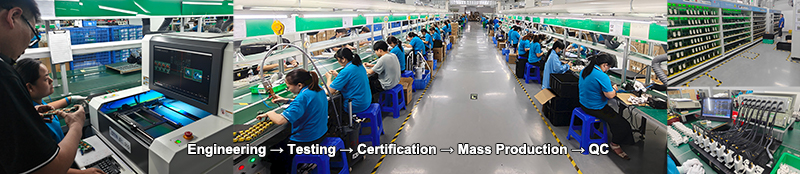
Certification testing is performed on samples, but the final product will be manufactured in volume.
The factory therefore needs to confirm that the production process can consistently reproduce the tested design.
Engineers and quality teams should review:
• SMT process
• Reflow profile
• Transformer assembly
• Soldering
• Insulation installation
• PCB assembly
• Housing assembly
• Wiring
• Final testing
This is where product engineering meets manufacturing engineering.
A design may work perfectly in the laboratory but still be difficult to manufacture consistently.
That is not a successful production design.
For an OEM charger factory, certification readiness should therefore include a basic question: Can we manufacture this exact design repeatedly?
17. Establish Production-Line Testing
Before commencing mass production, the factory clearly defines the required production test items and their control methods.
Depending on the product type and certification scheme, production line tests include:
• Hi-pot testing
• Ground continuity testing where applicable
• Functional testing
• Output verification
• Visual inspection
• Other safety-related checks
Testing equipment must align with the production process (USB-C charger testing process), and operators must be familiar with the relevant operating procedures.
Test results must be recorded when necessary, and non-conforming products must not be returned directly to the production line without undergoing controlled disposition.
This is also one of the key differences between a mature charger factory and a small-scale assembly workshop.
Certification entails more than just obtaining a test report; the core lies in maintaining the production conditions for the certified products.
18. Conduct a Certification Readiness Review
Before sending samples to the laboratory, the engineering team conducts a final internal review.
A practical checklist covers the following five areas:
Product: Specifications finalized, Model number confirmed, Port configuration confirmed, Power rating confirmed.
Electrical: Schematic reviewed, PCB revision frozen, Transformer verified, Protection functions tested, High-voltage layout checked.
Thermal: Full-load temperature checked, Hotspots identified, Enclosure temperature reviewed, Thermal margins understood.
Documentation: BOM controlled, Technical drawings updated, Product label reviewed, Sample information consistent.
Manufacturing: Production process reviewed, Critical components controlled, Production tests defined, QC procedures established.
What Happens If a Charger Fails Certification Testing?
If the product fails testing, it cannot be sold in the target market. However, this does not necessarily mean the project is over.
In fact, one of the reasons factories conduct pre-compliance testing is precisely to reduce the likelihood of failure during the formal assessment stage.
Once an issue is identified, engineers must determine the root cause of the failure.
Do not blindly modify the design simply to pass the test; a professional engineering process should clearly identify the specific reasons for the failure.
Otherwise, the same issue could recur in subsequent tests or create hidden risks during the production phase.
Why Certification Preparation Should Start During Charger Development
This is the main lesson for OEM and ODM charger projects.
Certification preparation should not be separated from product development.
The engineering sequence is more effective when it looks something like this:
Product requirements → Target market and certification planning → Electrical architecture → PCB and transformer design → Mechanical and thermal design → Engineering prototype → Internal safety testing → EMC pre-compliance → Protocol verification → Certification sample → Formal laboratory testing → Factory assessment / production readiness → Mass production
This approach reduces the risk of discovering a fundamental problem after tooling and production preparation have already been completed.
* Learn about charger PCB and transformer engineering.↗
Why High-Power GaN Chargers Need More Certification Preparation
The certification principles are not fundamentally different simply because a charger uses GaN.
But the engineering challenge can become greater as power density increases.
Current chargers can output power of 65W, 100W, 140W, or even 240W and above.
from increasingly compact housings.
This means that engineers have increasingly limited physical space available for aspects such as thermal management, component spacing, insulation design, EMI (electromagnetic interference) control, and power circuit routing.
A high-power GaN charger therefore requires careful coordination between electrical, mechanical and thermal engineering. This is one reason certification preparation should happen while the product is still being developed.
Waiting until the final prototype makes the factory's options much more limited.
What a Good Charger Factory Should Be Able to Show
If you are evaluating a charger manufacturer for an OEM project, do not only ask: “Can you provide CE, ETL or FCC certification?”
You should also request the factory's internal product specifications and verify whether the charger's specifications align with certification requirements (and obtain samples for testing).
A supplier that merely sends samples to a third-party laboratory might obtain a report, whereas a manufacturer with in-house engineering and quality systems can typically do much more: design → verification → testing → correction → certification → ongoing production.
That difference becomes important when developing a customized charger rather than buying an existing off-the-shelf model.
How ZONSAN Approaches Charger Certification Preparation
ZONSAN develops and manufactures USB-C, PD, PPS and GaN chargers for OEM and ODM customers, with products covering a wide range of power levels.
Its published manufacturing information describes a production and testing system covering PCB/SMT production, functional testing, USB-C protocol verification, thermal testing, aging testing and final quality inspection.
The company also publishes certification information covering markets and standards including ETL, CE, FCC, KC, CB and RoHS.
For certification projects, the important capability is not the number of certification logos on a website.
The true core lies in the underlying engineering processes and the authenticity of the product (i.e., whether specifications are genuine and not inflated or falsified).
A charger factory needs to connect: R&D → testing → certification → production → quality control (Here, you can learn how the factory reduces failure rates.)
If those areas operate separately, certification can become a bottleneck.
When they work together, certification becomes part of the normal product development process.
Final Thoughts
Certification testing is often viewed as the ultimate verdict on a charger. In reality, the samples submitted to certification laboratories by top charger manufacturers almost invariably meet the required standards. (For factories that are serious about product quality, passing certification is a straightforward matter.)
The factory has already made decisions about the PCB, transformer, insulation, components, thermal structure, protection system and manufacturing process.
Good certification results usually start with good engineering decisions.
For OEM and ODM charger buyers, this is worth remembering.
A supplier that says “we can get the charger certified” is giving you one answer. (and might even imply that they have alternative channels to secure the certification).
A supplier that can explain how the product is prepared for certification, how failures are investigated, how critical components are controlled, and how the certified design is maintained during mass production is giving you a much more useful answer.
That is the difference between certification as paperwork and certification as part of professional charger manufacturing.
FAQ
Q1: How do charger factories prepare for certification testing?
They normally review the product specification, PCB, transformer, insulation, safety components, thermal performance, protection functions, EMC behavior, documentation and production process before submitting certification samples.
Q2: When should certification planning start?
Ideally, certification requirements should be considered during the early engineering stage, before the PCB, mechanical structure and major components are finalized.
Q3: What does a charger factory test before certification?
Typical internal checks can include electrical performance, dielectric withstand, insulation, temperature rise, protection functions, USB-C PD/PPS behavior and EMC pre-compliance testing.
Q4: Why is pre-compliance testing important?
Pre-compliance testing helps identify potential problems before formal laboratory testing. It can reduce redesigns, additional samples and certification delays.
Q5: What components are important during charger certification?
Safety-critical components may include the transformer, fuse, safety capacitors, insulation materials, power switching devices, PCB materials and other components depending on the charger architecture.
Q6: Does a GaN charger require special certification?
GaN itself does not create a separate universal certification category. However, compact high-power GaN chargers can create additional engineering challenges involving thermal performance, switching behavior, PCB layout and EMI.
Q7: Should the certification sample be the same as the production charger?
Yes. The sample should represent the actual production design. Significant differences between the tested sample and mass-production product can create compliance and quality risks.
Q8: What happens if a charger fails certification testing?
Engineers normally identify the failure mechanism, modify the design where necessary, perform internal verification and then repeat the relevant evaluation.
Q9: Can a charger factory change components after certification?
Changes to certified construction should be controlled and reviewed. A safety-critical component should not be replaced simply because another component has similar electrical specifications.
Q10: What should OEM buyers ask a charger manufacturer before certification?
Ask about the factory's pre-compliance testing, engineering capability, critical component control, production-line testing, documentation process and experience with the certification requirements of the target market.
Reviewer: Zonsan R&D and Certification Engineers — Luis and Judy
Second Reviewer: Lucas
Final Review Date: [September 8, 2026]