How Chargers Go Through Aging Tests Before Shipping: Inside a Professional Charger Factory
A charger aging test, or burn-in test, runs chargers under controlled conditions for a defined period to verify long-term stability and identify potential failures before shipment. It helps manufacturers detect thermal, electrical, component and manufacturing problems that may not appear during a short functional test.
Key Takeaways
• Aging tests verify long-term charger stability.
• High-load testing helps reveal hidden failures.
• Temperature monitoring is critical for GaN and high-power chargers.
• Failed units are analyzed, traced, and corrected.
• Aging testing supports better production quality and reliability.
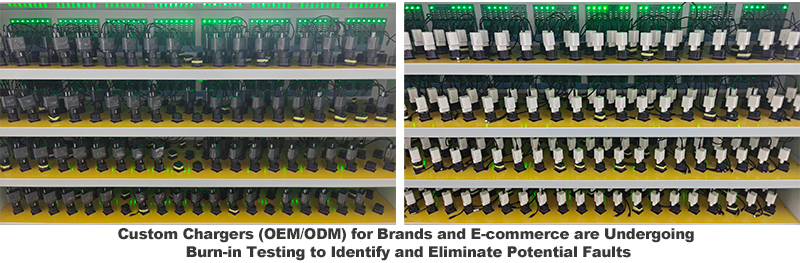
How Manufacturers Use Aging Tests to Find Potential Failures Before USB-C Chargers Reach Customers
A charger can pass a functional test and still have a problem.
It may produce the correct voltage.
It may communicate correctly with a USB-C device.
It may deliver the rated power.
Everything looks normal.
But what happens after the charger runs continuously for several hours?
What happens after repeated high-load operation?
What happens when the internal temperature gradually increases?
This is where aging testing becomes useful.
In a professional charger factory, aging testing is used to expose potential problems that may not appear during a short functional test. The idea is straightforward:
Run the charger under controlled conditions for a defined period, monitor its performance, and identify abnormal behavior before the product is shipped.
For USB-C PD chargers, GaN chargers and other high-power charging products, this can be an important part of the production quality process.
What Is an Aging Test for a Charger?
An aging test, sometimes called a burn-in test, involves operating a charger for a defined period under controlled electrical and environmental conditions. During the test, engineers or production quality teams may monitor:
• Output voltage.
• Output current.
• Power delivery.
• Temperature.
• Charging stability.
• Protection behavior.
• Abnormal noise or other operating conditions.
The exact test conditions depend on the product design, power rating, customer requirements and factory quality plan. The purpose is not simply to make the charger "old" before shipping.
Instead, aging testing gives the factory additional operating time in which certain weaknesses may become visible.
Why Do Chargers Need Aging Tests?
Electronic components can behave differently after continuous operation than they do during a short test. A component may perform normally for a few minutes but become unstable after prolonged electrical or thermal stress.
For example, a charger could initially show:
Normal output → Normal temperature → Normal charging
After extended operation, however, engineers may observe:
Increasing temperature → Output fluctuation → Protection activation
That information is valuable.
It gives the manufacturer an opportunity to investigate the problem before the product reaches the customer. This is particularly important for chargers because they are often expected to operate for long periods while charging devices such as:
• Smartphones, Tablets, Laptops, Handheld gaming devices and other USB-C powered electronics.
Aging Testing vs. Functional Testing
These two tests are closely related, but they are not the same.
Functional Testing
Functional testing primarily asks: Does the charger work according to its specifications?
A factory may check:
• Input and output.
• USB-C PD communication.
• Voltage.
• Current.
• Port functionality.
• Protection functions.
The test may be relatively short.
Aging Testing
Aging testing asks a different question: Does the charger remain stable after operating continuously under defined conditions?
The charger is operated for a longer period while its behavior is monitored. This can reveal problems that a short functional test may not catch.
So the relationship can be summarized simply:
Functional Testing = Does it work?
Aging Testing = Does it remain stable during extended operation?
Both are useful.
Neither completely replaces the other.
So, how Functional Testing Verifies USB-C Charger Performance Before Shipment?

What Happens During a Charger Aging Test?
A typical production aging process can involve several stages. The exact procedure varies between factories and products, but the basic workflow is usually straightforward.
Step 1: Select the Test Samples
Depending on the production quality plan, the factory may test:
• Selected production units.
• Samples from a production batch.
• Engineering samples.
• Units from a specific production line.
The sampling strategy depends on the product and customer requirements. For new products, engineering teams may perform more extensive testing.
For stable mass-production products, routine aging checks may follow a defined sampling plan.
Step 2: Connect the Charger to the Test Equipment
The charger is connected to a controlled load or testing system.
For example, a USB-C charger may be connected to an electronic load that can simulate the required power consumption. The test equipment allows engineers to control the load more precisely than simply connecting a consumer device.
This is important because a smartphone or laptop may change its charging behavior during normal use. A controlled electronic load provides a more repeatable test condition.
Step 3: Apply the Defined Load
The charger is operated under a specified load condition.
Depending on the testing objective, this may involve:
• Rated output.
• High load.
• Multiple-port operation.
• Specific USB-C PD output profiles.
For a multi-port charger, the test may also evaluate different combinations of active ports. For example:
Test USB-C1 first, then USB-C2.
Next, test USB-C1 + USB-C2,
as well as possible USB-C + USB-A combinations.
The purpose is to understand how the charger behaves when its power system is under different operating conditions.
Why High-Load Aging Tests Are Important
High-load operation creates more stress than light-load operation. This makes high-load aging particularly useful for high-power chargers.
Consider a 100W GaN charger. If it is tested at a very light load, many thermal and electrical issues may never become visible. At a high load, however:
• Power losses increase.
• Internal temperatures rise.
• Thermal management becomes more important.
• Components operate closer to their intended limits.
This places higher demands on reliability assessment, but it does not mean that the charger must simply operate at maximum power during every test. Test conditions need to align with the product's engineering and quality objectives.
What Does the Factory Monitor During Aging?
An aging test is more useful when the charger is actually monitored. Depending on the testing system, manufacturers may record:
Output Voltage
Does the voltage remain stable throughout the test?
Output Current
Does the charger maintain the expected current under the defined load?
Power
Does the actual power output remain consistent?
Temperature
Does temperature rise normally and eventually stabilize?
Protection Behavior
Does the charger respond correctly if an abnormal condition occurs?
Charging Communication
For USB-C PD products, does the charger maintain stable communication with the connected load?
These measurements give engineers more information than simply checking whether a charger is still switched on at the end of the test.
Temperature Is One of the Most Important Aging Test Parameters
Heat and reliability are closely connected. As discussed in the previous ZEEAS article, a charger naturally generates heat during power conversion. During an aging test, engineers can observe how temperature changes over time.
A typical pattern might look like:
Initial operation: Temperature begins to rise.
↓
Continuous operation: Temperature continues increasing.
↓
Thermal stabilization: Temperature reaches a relatively stable range.
This information helps engineers understand the product's thermal characteristics; however, if the temperature shows an abnormal, sustained rise or becomes unstable, further analysis is required.
• Thermal Reliability Engineering for GaN Chargers: How Manufacturers Control Heat in High-Power Charging Products
A typical production aging process can involve several stages. The exact procedure varies between factories and products, but the basic workflow is usually straightforward.
Step 1: Select the Test Samples
Depending on the production quality plan, the factory may test:
• Selected production units.
• Samples from a production batch.
• Engineering samples.
• Units from a specific production line.
The sampling strategy depends on the product and customer requirements. For new products, engineering teams may perform more extensive testing.
For stable mass-production products, routine aging checks may follow a defined sampling plan.
Step 2: Connect the Charger to the Test Equipment
The charger is connected to a controlled load or testing system.
For example, a USB-C charger may be connected to an electronic load that can simulate the required power consumption. The test equipment allows engineers to control the load more precisely than simply connecting a consumer device.
This is important because a smartphone or laptop may change its charging behavior during normal use. A controlled electronic load provides a more repeatable test condition.
Step 3: Apply the Defined Load
The charger is operated under a specified load condition.
Depending on the testing objective, this may involve:
• Rated output.
• High load.
• Multiple-port operation.
• Specific USB-C PD output profiles.
For a multi-port charger, the test may also evaluate different combinations of active ports. For example:
Test USB-C1 first, then USB-C2.
Next, test USB-C1 + USB-C2,
as well as possible USB-C + USB-A combinations.
The purpose is to understand how the charger behaves when its power system is under different operating conditions.
Why High-Load Aging Tests Are Important
High-load operation creates more stress than light-load operation. This makes high-load aging particularly useful for high-power chargers.
Consider a 100W GaN charger. If it is tested at a very light load, many thermal and electrical issues may never become visible. At a high load, however:
• Power losses increase.
• Internal temperatures rise.
• Thermal management becomes more important.
• Components operate closer to their intended limits.
This places higher demands on reliability assessment, but it does not mean that the charger must simply operate at maximum power during every test. Test conditions need to align with the product's engineering and quality objectives.
What Does the Factory Monitor During Aging?
An aging test is more useful when the charger is actually monitored. Depending on the testing system, manufacturers may record:
Output Voltage
Does the voltage remain stable throughout the test?
Output Current
Does the charger maintain the expected current under the defined load?
Power
Does the actual power output remain consistent?
Temperature
Does temperature rise normally and eventually stabilize?
Protection Behavior
Does the charger respond correctly if an abnormal condition occurs?
Charging Communication
For USB-C PD products, does the charger maintain stable communication with the connected load?
These measurements give engineers more information than simply checking whether a charger is still switched on at the end of the test.
Temperature Is One of the Most Important Aging Test Parameters
Heat and reliability are closely connected. As discussed in the previous ZEEAS article, a charger naturally generates heat during power conversion. During an aging test, engineers can observe how temperature changes over time.
A typical pattern might look like:
Initial operation: Temperature begins to rise.
↓
Continuous operation: Temperature continues increasing.
↓
Thermal stabilization: Temperature reaches a relatively stable range.
This information helps engineers understand the product's thermal characteristics; however, if the temperature shows an abnormal, sustained rise or becomes unstable, further analysis is required.
• Thermal Reliability Engineering for GaN Chargers: How Manufacturers Control Heat in High-Power Charging Products
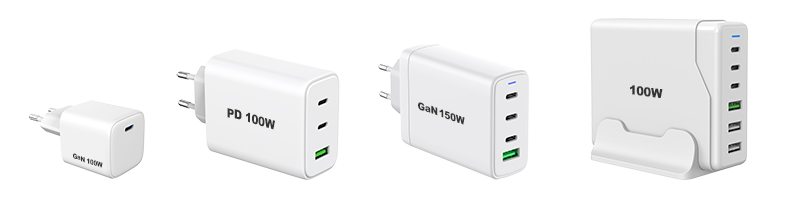
Aging Testing for GaN Chargers
GaN chargers are particularly interesting from a reliability perspective because they combine:
• High power.
• High switching frequency.
• Compact dimensions.
• High power density.
A 65W GaN charger may be much smaller than an older-generation charger with a similar output rating. That compact size is attractive to customers.
But it also means engineers have less physical space to manage heat. During aging testing, manufacturers may therefore pay close attention to:
• Internal temperature.
• Output stability.
• High-load performance.
• Protection behavior.
• Long-duration operation.
For 100W and higher-power GaN chargers, these considerations become even more important.
• Thermal Reliability Engineering for GaN Chargers: How Manufacturers Control Heat in High-Power Charging Products
Aging Tests for USB-C PD Chargers
USB-C PD chargers have additional considerations because power delivery involves communication between the charger and connected device. Fast charger may support several output profiles.
For example:
• 5V, 9V, 12V, 15V, 20V.
Depending on the product, PPS may also be supported.
During reliability validation, engineers may evaluate whether the charger continues to negotiate and maintain the expected output under defined conditions. This is especially relevant when the charger is designed for laptops and other higher-power USB-C applications.
Aging Tests for Multi-Port Chargers
Multi-port products introduce another layer of complexity. A charger with two USB-C ports and one USB-A port does not always behave the same way when:
• One port is active.
• Two ports are active.
• All ports are active.
At this point, the internal power distribution changes, and the temperature distribution may also shift accordingly.
Therefore, a professional test plan may include different port combinations.
This is one reason multi-port charger testing cannot always be reduced to: "Plug something into each port and see whether it charges."
The interaction between ports matters.
What Problems Can Aging Tests Reveal?
Aging testing can potentially reveal different types of problems. For example:
Thermal Problems
• Excessive temperature rise.
• Unexpected hot spots.
• Thermal protection activation.
Electrical Problems
• Output instability.
• Unexpected voltage fluctuation.
• Current regulation problems.
Component Problems
• Component degradation.
• Abnormal component behavior.
• Early component failure.
Manufacturing Problems
• Soldering issues.
• Assembly variation.
• Incorrect component installation.
Protection Problems
• Abnormal protection triggering.
• Failure to recover correctly.
The exact failure mode depends on the charger design and test conditions.
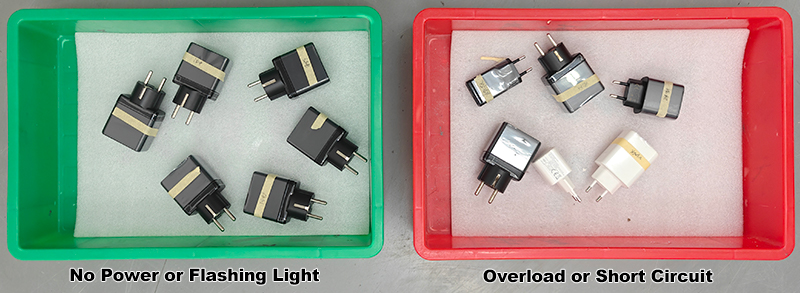
Aging Testing Can Help Find Early Failures
One important reason manufacturers use burn-in or aging tests is to identify products with early-life weaknesses. If a small number of units have abnormal components or manufacturing defects, extended operation can provide more opportunity for those weaknesses to appear.
This is valuable because finding a problem at the factory is usually much easier than finding the same problem after the product has been shipped.
A factory can:
1. Isolate the affected batch.
2. Investigate the failure.
3. Review production records.
4. Check components.
5. Perform additional testing.
6. Implement corrective action.
The customer does not have to discover the problem first.
Aging Testing Is Not a Guarantee of Lifetime
It is important to understand what an aging test can and cannot prove.Passing an aging test does not mean: "This charger will never fail." No practical production test can guarantee that.
Instead, aging testing provides evidence that the product has remained stable under the defined test conditions. Reliability is influenced by many other factors:
• Component quality.
• Product design.
• Manufacturing consistency.
• Operating environment.
• Usage pattern.
• Storage conditions.
Aging testing is therefore one part of a larger reliability system.
How Failed Chargers Are Investigated After Aging Tests
An aging test is only useful if the factory knows what to do when something goes wrong.
Suppose a charger passes its initial functional test but fails after several hours of continuous operation. The quality team should not simply mark the item as "NG" (non-conforming) and leave it at that; instead, they must conduct an in-depth investigation into the cause of the failure. Engineers may check:
1. When did the failure occur?
2. What was the load condition?
3. What was the temperature at the time?
4. Which output port was being used?
5. Was the failure repeatable?
6. Did other units from the same batch show similar behavior?
The failed unit can then go through additional testing and failure analysis. The purpose is to determine whether the problem is:
1. A component issue.
2. A design issue.
3. A manufacturing issue.
4. A test equipment issue.
5. An isolated abnormality.
This distinction matters because the corrective action will be different in each case.
What Happens When a Batch Fails Aging Testing?
A single failed sample does not automatically mean that every charger in the batch is defective. The factory first needs to understand the situation.
For example, engineers may compare:
Failed sample and Passed samples from the same batch;and potentially: Samples from previous batches.
They may then review:
• Production records.
• Component lots.
• Assembly records.
• Functional test data.
• Previous reliability results.
If a common cause is identified, the factory may increase the inspection scope or temporarily hold the affected production. The goal is to make a decision based on evidence rather than assumption.
How Aging Test Data Connects With Traceability
This is where aging testing becomes much more valuable. A test result by itself tells engineers that something happened. Traceability helps answer: Where did it come from?
Suppose several 100W GaN chargers show abnormal temperature behavior during aging testing.
If the factory has proper traceability, engineers may be able to identify:
• Production date.
• Production line.
• Component batch.
• PCB batch.
• Assembly records.
• Test results.
The investigation becomes much more focused. Without traceability, engineers may need to investigate a much larger production range.
For this reason, aging tests and traceability should complement each other. Testing serves to detect anomalous signals, while traceability helps trace the root cause of issues.
• Traceability System in Electronics Manufacturing: How Charger Factories Track Every Production Step
Aging Testing and CAPA
If an aging failure reveals a systematic problem, it may trigger a CAPA process(CAPA Process in Charger Manufacturing: How Factories Prevent Repeated Quality Problems). For example:
A factory discovers that several chargers from different production batches show excessive temperature rise. The investigation finds that a thermal interface material is occasionally being positioned incorrectly during assembly.
A simple reaction would be: Rework the affected units.
But that only addresses the current products.
A stronger approach is to ask:
1. Why did the assembly error occur?
2. Why was it not detected earlier?
3. Can the assembly process be improved?
4. Does the work instruction need updating?
5. Does the operator need additional training?
6. Should an additional inspection point be introduced?
Subsequently, the factory can implement appropriate corrective and preventive actions. This is precisely the distinction between "fixing a problem" and "improving the process that caused the problem."
A simple reaction would be: Rework the affected units.
But that only addresses the current products.
A stronger approach is to ask:
1. Why did the assembly error occur?
2. Why was it not detected earlier?
3. Can the assembly process be improved?
4. Does the work instruction need updating?
5. Does the operator need additional training?
6. Should an additional inspection point be introduced?
Subsequently, the factory can implement appropriate corrective and preventive actions. This is precisely the distinction between "fixing a problem" and "improving the process that caused the problem."

Aging Testing During Mass Production
Aging testing is particularly useful during new product development, but it can also play a role after a charger enters mass production. The testing strategy may be different.
During development, engineers may perform extensive testing on prototypes and pilot-production units.
During stable mass production, the factory may use a defined sampling plan and routine quality checks.
The specific approach adopted depends on: product complexity, customer requirements, production volume, historical quality performance, and internal quality standards.
For a new high-power GaN charger, the factory may initially use more intensive validation.
Once the production process becomes stable, routine monitoring can help verify that the same level of performance continues.
Why Aging Testing Should Not Be the Only Production Test
Subjecting every charger to prolonged burn-in testing may sound ideal, but in practice, it is not necessarily the best quality strategy. Burn-in testing is both time-consuming and resource-intensive. More importantly, it cannot replace other forms of testing; professional charger production lines typically employ a combination of quality control measures.
For example:
Incoming Inspection: Check materials and components.
↓
Production Process Control: Control critical manufacturing steps.
↓
Functional Testing: Verify electrical performance.
↓
Safety Testing: Verify applicable electrical safety requirements.
↓
Aging / Burn-In Testing: Evaluate stability during extended operation.
↓
Final Inspection: Check finished products before shipment.
Each step has a different purpose.
Common Mistakes in Charger Aging Tests
Mistake 1: Using an Unrealistic Test Condition
Aging tests should simulate realistic operating conditions. If the test load is too low, certain issues may never manifest. Conversely, if test conditions are excessively harsh (and unnecessarily so), the results may fail to reflect the product's actual usage.
The test needs to be designed around the actual product and its expected use.
Mistake 2: Only Checking the Final Result
Suppose a charger has been tested for several hours and is still functioning correctly at the end of the test. While this is certainly useful information, it is not comprehensive.
If the testing system records temperature and output behavior throughout the test, engineers can see whether the charger:
• Stabilized normally.
• Experienced abnormal fluctuations.
• Reached an unexpected temperature.
• Recovered from a protection event.
The trend can be more informative than the final pass/fail result.
Mistake 3: Treating Every Failure as a Random Event
A malfunction in a single charger might be an isolated incident, but recurring failures can by no means be dismissed as mere coincidence.
If several units show similar behavior, the factory should investigate whether they share:
• A component batch.
• A production process.
• An operator.
• A design feature.
• A test condition.
Patterns are often more important than individual failures.
Mistake 4: Failing to Close the Improvement Loop
Finding a problem is not the end of the process. The factory needs to verify that the corrective action actually worked.
For example:
Failure → Root Cause → Corrective Action → Process Improvement → Repeat Testing → Effectiveness Verification
Only after the problem has been properly addressed should the quality issue be considered closed.
Aging Testing vs. Long-Term Reliability Testing
These terms are sometimes used interchangeably, but they can represent different concepts.
Aging testing generally focuses on operating a product for a defined period under controlled conditions to identify early problems or verify production stability.
Reliability testing can be broader. It may include:
• Temperature testing.
• Humidity testing.
• Mechanical testing.
• Electrical stress testing.
• Environmental testing.
• Long-duration operation.
So aging testing can be considered one part of a broader reliability engineering program. This distinction is useful when evaluating a charger manufacturer.
If factory saying: "We do aging tests." does not necessarily tell you the complete picture of its reliability capability.
A better question is: "What reliability validation and production quality controls are performed for this product?"
Reliability Testing for USB-C Chargers: How Manufacturers Verify Long-Term Performance
How OEM Buyers Should Evaluate a Factory's Aging Test Capability
For an OEM or ODM customer, it is reasonable to ask a manufacturer about its aging process. You do not necessarily need a highly technical audit. A few practical questions can reveal a lot.
Ask What Is Tested - Does the factory perform aging tests on:
• 20W chargers?
• 65W chargers?
• 100W chargers?
• Multi-port chargers?
• High-power GaN products?
Ask How the Load Is Controlled
Is the charger tested with actual consumer devices or controlled electronic loads?
Controlled loads generally provide more repeatable test conditions.
Ask What Is Recorded - Does the factory record:
• Temperature? Voltage? Current? Power? Test duration? Pass/fail status?
Ask What Happens When a Unit Fails
This may be the most revealing question. A mature factory should be able to explain how failed units are: Isolated, Investigated, Traced, Analyzed, andCorrected.
The quality of the response tells you more than simply knowing that an aging test exists.
What a Mature Aging Test System Looks Like
A mature system is not necessarily the one with the largest number of testing machines. It is the one where the test results are connected to the manufacturing process.
A strong system looks something like this:
Defined Test Conditions → Controlled Load → Continuous Monitoring → Automatic / Manual Pass-Fail Evaluation → Failed Unit Isolation → Failure Analysis → Traceability Review → CAPA if Required → Effectiveness Verification
This creates a closed-loop quality process.
Aging Testing for Different Charger Types
Different products may require different priorities.
For a 20W USB-C charger, key points of interest might include:
• Output stability.
• Basic thermal performance.
• Protection behavior.
• Long-duration operation.
65W PD GaN Charger, additional attention may be given to:
• High-load thermal performance.
• USB-C PD profiles.
• Sustained output.
• Component temperature.
100W Gallium Nitride (GaN) chargers, testing requirements may be more rigorous due to their higher power density.
Engineers may pay closer attention to:
• Maximum-load operation.
• Thermal stabilization.
• Multi-port power allocation.
• Long-duration stability.
140W or Higher-Power Charger, the testing strategy may need to consider:
• Higher power density.
• PD 3.1 / EPR operation.
• Thermal behavior.
• Cable and connector requirements.
• Multi-port interaction.
The exact testing requirements should always be determined by the actual product design and applicable standards.

Why Aging Testing Matters to Global B2B Buyers
For a consumer, charger quality may simply mean: "It works."
For a B2B buyer, the definition is broader.
What buyers need is a product that ensures high production consistency, enables large-scale delivery, offers reliable performance for end-users, and provides support throughout the entire product lifecycle.
If a manufacturer has a mature aging and reliability system, it can provide another layer of confidence. This becomes particularly important for:
• Private-label chargers.
• Retail products.
• E-commerce brands.
• Large-volume OEM projects.
• High-power GaN chargers.
A supplier's quality system can have a direct impact on the buyer's own brand reputation.
Final Thoughts
Aging testing is not about intentionally trying to damage a charger. It is about giving the product enough controlled operating time to expose potential weaknesses before those weaknesses become customer problems.
For a professional charger factory, aging testing works best as part of a much larger system.
The complete process can connect:
Functional Testing → Does the charger work?
Aging Testing → Does it remain stable during extended operation?
Reliability Testing → How does it perform under different stresses?
Traceability → Where did the product and components come from?
Failure Analysis → Why did the problem happen?
CAPA → How do we prevent it from happening again?
That is the real value of factory aging testing.
It is far more than just a routine pre-shipment inspection; it is also a crucial means for manufacturers to enhance production stability and reduce the risk of potential defects reaching customers.
For modern USB-C and GaN chargers, especially compact high-power products, that additional layer of testing becomes increasingly valuable.
Frequently Asked Questions
Q1: What is an aging test for a charger?
An aging test, also called a burn-in test, operates a charger under defined conditions for a specified period to evaluate its stability and identify potential early failures.
Q2: How long does a charger aging test take?
There is no single standard duration for every charger. The test duration depends on the product, test objectives, customer requirements and factory quality plan.
Q3: What is the difference between aging testing and functional testing?
Functional testing checks whether the charger performs its required functions. Aging testing evaluates whether it remains stable during extended operation.
Q4: Are GaN chargers aging tested?
Professional manufacturers may include aging or burn-in testing as part of their quality program for GaN chargers, particularly higher-power products.
Q5: What happens if a charger fails an aging test?
The failed unit should be isolated and investigated. Engineers may perform failure analysis and review production records to determine the root cause.
Q6: Can aging testing guarantee that a charger will never fail?
No. Aging testing evaluates performance under defined conditions. It is one part of a broader product reliability and quality system.
Q7: Why is traceability important for aging tests?
Traceability allows engineers to connect a failed unit with its production batch, components, process records and previous test results.
Q8: How should OEM buyers evaluate aging testing?
Buyers should ask what products are tested, how loads are controlled, what data is recorded and how failed units are investigated and corrected.
Reviewer: ZONSAN R&D Team — Michael and Miller
Technical Review: Charging Products and Power Solutions
Final Review Date: [August 18, 2026]