How Charger Manufacturers Develop New Product Platforms
When a charger manufacturer launches a new product, it is tempting to think that the process starts with a new product drawing.
In a professional charger factory, that is usually not how it works. A new charger often starts from something much broader: a product platform.
A platform is the engineering foundation that can support several charger models, power levels, port configurations, plug types, housing designs and market requirements.
For example, a manufacturer may develop one core charging architecture and then build different versions around it:
• 30W single-port charger
• 35W dual-port charger
• 45W compact GaN charger
• 65W laptop charger
• 65W 3-port charger
• 100W multi-port GaN charger
• 140W PD3.2 charger
The products may look different from the outside, but some of the engineering knowledge, circuit architecture, firmware, components, testing methods and manufacturing processes can be shared.
This is one of the reasons experienced charger manufacturers can develop new products faster than companies that approach every SKU as a completely new project.
It also explains why B2B buyers should look beyond a factory's existing product catalog. A factory may have 100 charger models listed online, but the more important question is: How many underlying product platforms does the factory actually control?
In this article, we will look inside the development process and explain how a professional charger manufacturer builds, validates and expands new product platforms for OEM and ODM customers.
Quick Answer: What Is a Charger Product Platform?
A charger product platform is a reusable electrical, mechanical and manufacturing architecture that allows a manufacturer to develop multiple charger products from a common engineering foundation.
A platform include: Power architecture, PCB design, Transformer design, GaN or silicon power components, PD/PPS/QC protocol architecture, Firmware, Thermal design, Protection circuits, Mechanical structure, Testing procedures, Manufacturing process.
The platform can then be adapted to different: Wattages, Port configurations, Plug standards, Housing designs, Customer requirements, Certifications, Target markets.
The idea is simple: Develop the engineering foundation once, then scale it intelligently across a product family.
That does not mean every product uses exactly the same circuit.
A professional platform is designed to allow controlled changes without compromising safety, performance or reliability.
Key Takeaways
• A product platform is the engineering foundation behind multiple charger SKUs.
• Good platforms reduce repeated development work without simply copying the same charger.
• Wattage, ports, thermal design and certification determine how far a platform can scale.
• Platform development normally starts with market requirements and electrical architecture.
• Prototype, DVT, PVT and reliability testing are critical before platform expansion.
• Strong charger manufacturers combine R&D, tooling, testing and mass production.
• OEM buyers should evaluate a factory's platform capability, not only its product catalog.

1. Why Do Charger Manufacturers Build Product Platforms?
Imagine a factory receives five customer projects.
One customer needs a 45W USB-C charger.
Another wants a 65W GaN charger.
A third wants a 65W 2C1A model.
A fourth needs a 100W desktop charger.
The fifth wants a 140W PD3.1 charger.
If the factory starts every project completely from zero, engineering time becomes very expensive. There will be repeated work.
A better approach is to build reusable technology platforms.
The platform does not eliminate engineering. It makes engineering more efficient.
A proven power architecture can become the starting point for the next generation of products.
This is particularly valuable in fast-changing charging markets, where brands may need several wattages within a relatively short period.
2. A Product Platform Is Not the Same as One Charger
This distinction is important.
A charger model is a specific finished product; charger platform is the engineering system behind a group of related products.
For example:
Platform A Platform B Platform C
→ 30W → 65W → 100W
→ 35W → 67W → 120W
→ 45W → 70W → 140W
This is only a simplified example. The actual engineering relationship can be much more complicated.
A 65W and 100W charger may share some design concepts while requiring completely different power-stage components and thermal solutions.
Likewise, a single-port charger and a 4-port desktop charger can share certain protocol knowledge but still require different power-allocation architectures.
So when manufacturers talk about a "platform," they are not necessarily saying: "We use the same PCB for everything."
That would be an oversimplification. A good platform is more like a controlled engineering framework.
3. Product Platform Development Starts With the Market
Before engineers draw a schematic, someone needs to answer a basic question: What product are we actually trying to build?
This sounds obvious, but it is one of the most important parts of product development.
For example, a 25W smartphone charger has a very different commercial purpose from a 140W laptop charger.
A 25W charger may prioritize:
• Small size
• Low BOM cost
• High production volume
• Compact housing
• Simple single-port operation
A 140W charger may prioritize:
• High power density
• PD3.1 or PD3.2 EPR
• Thermal performance
• Multi-port power management
• Premium housing
• Laptop compatibility
The engineering platform has to reflect these commercial goals.
* custom charger mold development
4. Engineers Define the Power Architecture
Once the requirements are clear, engineers begin defining the electrical architecture. This is one of the most important decisions in a new charger platform.
For a GaN charger, the power architecture also needs to take advantage of the higher-frequency switching capability of GaN components.
The goal is not simply to make the charger smaller. The goal is to achieve an appropriate balance between: Power + Efficiency + Heat + Size + Cost + Reliability.
That balance becomes increasingly difficult as wattage increases.
5. Choosing the Platform's Power Range
A new charger platform is often designed around a target power range rather than one exact wattage.
For example, a manufacturer may explore whether an architecture can reasonably support:
45W → 65W → 67W or 65W → 100W or 100W → 140W
The important word is reasonably.
It is not good engineering to force one platform into every power level simply because it is technically possible.
Increasing power require:
• Larger magnetic components
• Different MOSFET or GaN devices
• Different transformer design
• Larger capacitors
• Improved cooling
• Different PCB copper design
• New protection parameters
• Different firmware
• A larger charger housing
At some point, the next power level becomes a new platform.
6. PCB Architecture Is the Foundation
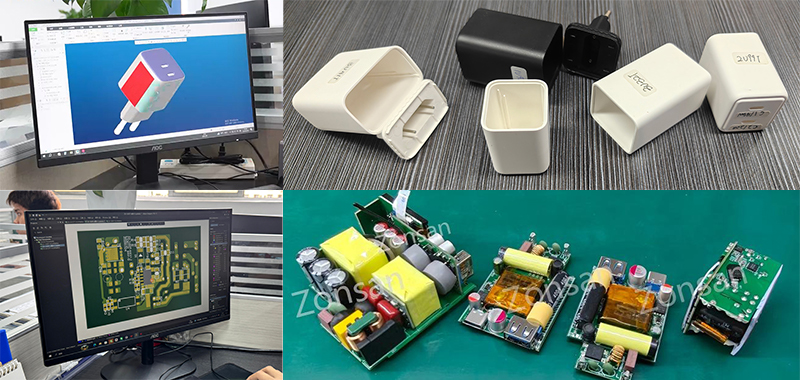
After the power architecture is defined, PCB development begins. The PCB has to accommodate the electrical system while meeting mechanical and thermal constraints.
Engineers need to consider: Component placement, High-voltage clearance, Creepage, Current paths, Grounding, EMI control, Transformer position, USB-C connector location, Heat-producing components, Mechanical mounting, Housing dimensions.
This is why PCB design cannot be treated as a simple layout exercise. For a compact GaN charger, a few millimeters can make a difference.
A component moved slightly can change: Thermal performance
EMI behavior, PCB dimensions, Housing size, Transformer placement, Assembly difficulty.
A strong product platform therefore begins with a PCB architecture that can be adapted without constantly rebuilding the entire design.
7. The Transformer Is Part of the Platform Strategy
The transformer deserves special attention. It is one of the components that can limit how far a charger architecture can scale.
For example, the transformer design for a compact 30W charger will not simply be scaled up indefinitely for a 140W product. The magnetic design, winding structure and thermal requirements can change significantly.
For a charger manufacturer, developing transformer know-how can therefore become an important part of platform development.
This is also why two factories using similar GaN ICs can still produce very different charger designs. The semiconductor is only one part of the system.
8. GaN Technology Changes the Platform Strategy
Gallium Nitride has changed how manufacturers approach compact high-power chargers.
Traditional silicon designs can still be highly capable, especially for lower-power applications.
But GaN makes it possible to design compact chargers with higher switching frequencies and power density when the overall architecture is properly engineered.
That creates new opportunities for product platforms.
A manufacturer may develop a GaN architecture that can serve several premium charger families.
For example:
| Compact GaN platform | High-power GaN platform |
| → 35W | → 65W |
| → 45W | → 100W |
| → 65W | → 140W |
But again, these ranges are not fixed industry rules.
The exact platform boundary depends on the power architecture, components, thermal design and product requirements.
For buyers, the useful question is not simply: "Does your factory use GaN?"
A better question is: "Do you have a mature GaN platform that can be adapted to our product roadmap?"
That is a much more meaningful engineering question.
9. PD, PPS and QC Need to Be Designed Into the Platform
Protocol implementation is another important part of a modern charger platform.
Modern chargers are not only power converters. They also need to communicate with connected devices.
USB Power Delivery allows compatible devices and chargers to negotiate power requirements. USB PD 3.1 expanded the specification to support up to 240W over USB Type-C with the appropriate system design and cable requirements.
For a modern charger platform, engineers need to support USB PD, PPS, QC, USB-C current modes, Multiple output profiles, Power-sharing logic, Protection responses.
This becomes more complicated with multi-port chargers.
A single-port charger may have a relatively straightforward power profile.
A 3-port or 4-port charger needs to determine what happens when several devices are connected at the same time.
The exact power-sharing strategy becomes part of the product architecture.
10. Multi-Port Chargers Often Need a Different Platform
Adding more USB ports does not simply mean drilling more holes into the housing.
The electrical architecture changes.
65W single-port charger and a 65W 3-port charger should not automatically be treated as the same product platform.
They may share some technology.
But their power management requirements can be significantly different.
For a charger factory, developing a reliable multi-port platform is a valuable engineering capability because one architecture can potentially support several products.
11. How One Platform Becomes Multiple Charger SKUs
After the platform is validated, manufacturers can begin developing product variations.
For example:
Base Platform → 65W GaN USB-C architecture
Product A → 65W 1C wall charger
Product B → 65W 2C wall charger
Product C → 65W 2C1A charger
Product D → 67W compact charger
Product E → 65W ultra-slim charger
The electrical architecture may share certain elements, while the PCB, firmware, housing and component configuration are adjusted for each product.
This approach can reduce development time. More importantly, it creates a family of related products. A mature platform can reduce repeated development work, although every new SKU still requires its own validation.
For a brand, that can be much more useful than buying unrelated chargers from different suppliers.
The exact platform boundary depends on the power architecture, components, thermal design and product requirements.
For buyers, the useful question is not simply: "Does your factory use GaN?"
A better question is: "Do you have a mature GaN platform that can be adapted to our product roadmap?"
That is a much more meaningful engineering question.
9. PD, PPS and QC Need to Be Designed Into the Platform
Protocol implementation is another important part of a modern charger platform.
Modern chargers are not only power converters. They also need to communicate with connected devices.
USB Power Delivery allows compatible devices and chargers to negotiate power requirements. USB PD 3.1 expanded the specification to support up to 240W over USB Type-C with the appropriate system design and cable requirements.
For a modern charger platform, engineers need to support USB PD, PPS, QC, USB-C current modes, Multiple output profiles, Power-sharing logic, Protection responses.
This becomes more complicated with multi-port chargers.
A single-port charger may have a relatively straightforward power profile.
A 3-port or 4-port charger needs to determine what happens when several devices are connected at the same time.
The exact power-sharing strategy becomes part of the product architecture.
10. Multi-Port Chargers Often Need a Different Platform
Adding more USB ports does not simply mean drilling more holes into the housing.
The electrical architecture changes.
65W single-port charger and a 65W 3-port charger should not automatically be treated as the same product platform.
They may share some technology.
But their power management requirements can be significantly different.
For a charger factory, developing a reliable multi-port platform is a valuable engineering capability because one architecture can potentially support several products.
11. How One Platform Becomes Multiple Charger SKUs
After the platform is validated, manufacturers can begin developing product variations.
For example:
Base Platform → 65W GaN USB-C architecture
Product A → 65W 1C wall charger
Product B → 65W 2C wall charger
Product C → 65W 2C1A charger
Product D → 67W compact charger
Product E → 65W ultra-slim charger
The electrical architecture may share certain elements, while the PCB, firmware, housing and component configuration are adjusted for each product.
This approach can reduce development time. More importantly, it creates a family of related products. A mature platform can reduce repeated development work, although every new SKU still requires its own validation.
For a brand, that can be much more useful than buying unrelated chargers from different suppliers.
12. Platform Development Helps Brands Build a Product Roadmap
This is where the concept becomes particularly valuable for OEM customers.
A brand may not want just one charger, it may want a product family.
For example:
Smartphone Line: 20W → 25W → 30W → 45W → 65W → 100W
Tablet & Phone Line: 35W → 45W → 65W
Laptop Line: 65W → 100W → 140W
Desktop Charging Line: 100W → 120W → 150W → 240W
Instead of developing every product independently, the brand can work with a manufacturer to create a technology roadmap. This makes future product development easier to plan.
It also helps maintain a consistent visual and technical identity across the product family.
13. Why Platform Development Matters for OEM Buyers
From a buyer's perspective, platform development has several advantages.
Faster New Product Development
A mature engineering foundation can reduce repeated development work.
Better Product Consistency
Products developed from related platforms can share engineering standards.
Easier Product Expansion
A brand can move from 45W to 65W or from 65W to 100W without completely restarting the supplier-selection process.
Easier Supply Chain Management
Using related platforms can reduce the number of completely different components and production processes.
Easier Quality Control
A mature platform can have established testing procedures and known failure modes.
Better Long-Term Cooperation
Instead of treating each purchase order as a separate project, the manufacturer becomes part of the brand's product roadmap.
This is one reason experienced B2B charger buyers often look for a long-term OEM charger manufacturer rather than simply comparing unit prices.
14. What Makes a Good Charger Product Platform?
Not every platform is good simply because it supports several models.
A strong platform should have several characteristics.
1. Reusability. The engineering foundation can support multiple products.
2. Scalability. The architecture can be adapted to different power levels where technically appropriate.
3. Reliability. The platform has been properly tested under realistic operating conditions.
4. Manufacturability. The design can be produced consistently at scale.
5. Certification Readiness. The architecture can be adapted to target market compliance requirements.
6. Thermal Stability. The platform has a clear thermal strategy.
7. Protocol Compatibility. PD, PPS and other required charging protocols are properly implemented.
8. Supply Chain Stability. Key components can be sourced consistently over the product lifecycle.
9. Cost Control. The platform provides reasonable BOM and manufacturing economics.
10. Upgrade Potential. The architecture can evolve as charging technology changes.
Important: GaN technology has become an important foundation for compact, high-power charger platforms.
15. What Happens When a Platform Component Becomes Obsolete?
This is an issue that does not get enough attention.
A charger product may stay in the market for several years. But semiconductor components can change much faster.
A power IC may become End-of-life, Difficult to source, Too expensive, Replaced by a newer generation.
The same can happen with GaN transistors, PD controllers, Capacitors, Transformers, USB-C connectors.
A professional charger manufacturer therefore needs a component-management strategy. If a key component disappears, engineers may need to qualify an alternative.
Read More
16. How Charger Manufacturers Decide Whether to Create a New Platform
Not every new product deserves a completely new architecture.
Engineers may first ask: Can the existing platform meet the requirements?
If yes, the new product can potentially be developed as a platform variation.
If not, the team may need a new platform.
For example, moving from a simple 30W wall charger to a 140W multi-port PD3.1 desktop charger is not simply a larger version of the same product.
It may require a fundamentally different engineering platform.
17. How ZONSAN Approaches Charger Platform Development
ZONSAN has been focused on charger manufacturing since 2009, with products spanning multiple power levels and charging technologies including PD, PPS and GaN.
It‘s current manufacturing and OEM/ODM materials describe development capabilities covering PCB design, charger customization, multiple port configurations and power levels from entry-level chargers through high-power 140W/240W-class solutions.
For an OEM customer, the practical value of this type of capability is not simply having a large catalog. It is being able to start with an existing engineering foundation and then determine: What can be reused? What needs to change? What needs to be redesigned completely?
That distinction helps avoid unnecessary engineering work.
Before a platform is expanded into multiple SKUs, its core design should be properly validated DVT and PVT.
18. How to Evaluate a Charger Manufacturer's Platform Capability
If you are sourcing an OEM or ODM charger, ask these questions before choosing a supplier.
Engineering
Does the factory have its own R&D engineers?
Does it develop its own PCB architecture?
Can it customize power levels?
Can it develop GaN platforms?
Can it tune PD and PPS?
Mechanical
Can the factory develop custom housings?
Does it support private molds?
Can mechanical engineering work directly with PCB engineers?
Testing
Does the factory perform prototype validation?
Is DVT/PVT supported?
Are full-load aging tests available?
Can thermal testing be performed internally?
Manufacturing
Does the factory have SMT capability?
Can it support stable mass production?
Are production processes documented?
Is component traceability available?
Product Roadmap
Can one platform support multiple SKUs?
Can the factory develop future wattages?
Can it maintain the platform when components change?
These questions tell you much more about a manufacturer's real capability than simply asking: "How many charger models do you have?"
Zonsan possesses the relevant capabilities and experience to address the concerns raised by buyers above.
19. Platform Development vs. One-Off Product Development
The difference can be summarized like this:
| One-Off Development | Platform Development |
| One product | Product family |
| High repeated engineering work | Reusable engineering foundation |
| Limited future scalability | Designed for expansion |
| Short-term project focus | Long-term product roadmap |
| More isolated testing | Shared engineering knowledge |
| Less reusable tooling | Potentially reusable tooling concepts |
| Suitable for unique products | Suitable for product families |
Neither approach is automatically better. A highly specialized charger may genuinely need a one-off architecture.
But for brands planning several charger products, platform development usually makes more strategic sense.
20. The Real Value of a Charger Platform Is Not Just Speed
It is easy to say: "A platform helps factories develop products faster."
That is true, but not the whole story; the greater benefit lies in the continuity of engineering technology.
When manufacturers develop multiple products based on a common platform, they accumulate knowledge regarding chargers—such as component characteristics, thermal limits, failure modes, manufacturing tolerances, protocol compatibility, certification requirements, and supplier stability.
That knowledge can be carried into the next project. Over time, the manufacturer becomes faster not because it cuts corners, but because it has already solved similar engineering problems.
That is a very different kind of efficiency.
21. From One Charger to a Complete Product Family
The long-term objective of platform development is not to produce one successful SKU. It is to create a product family that can evolve.
A simplified roadmap could look like:
Platform Development → Prototype → DVT → PVT → Mass Production → 65W Product → New Housing → 67W Product → Multi-Port Version → Higher-Power Platform → 100W / 140W Products.
The exact sequence will vary from project to project.
But the principle remains the same: A good platform creates options for the next product.
That is particularly valuable in the charger industry, where device power requirements and charging standards continue to evolve.
Final Thoughts
The best charger manufacturers do not think only in terms of individual SKUs.
They think in terms of technology platforms.
A 65W charger is a product, but the engineering platform behind that charger may become the foundation for several future products.
The same applies to 100W, 140W and other high-power charging solutions.
Developing a platform is far more than just a matter for PCB engineers; it requires collaboration from multiple parties.
That is why platform capability can be one of the most useful things to evaluate when choosing an OEM charger manufacturer.
A factory with a strong product platform can potentially help a brand move from one charger SKU to an entire product roadmap.
And that is the real difference between simply manufacturing chargers and engineering charging products for long-term growth.
FAQ: Charger Product Platform Development
Q1: What is a charger product platform?
A charger product platform is a reusable engineering foundation used to develop multiple charger models with related electrical, mechanical, protocol and manufacturing architectures.
Q2: Why do charger manufacturers develop product platforms?
Platforms reduce repeated engineering work, improve product consistency and allow manufacturers to develop multiple charger SKUs from a validated technology foundation.
Q3: Can one charger platform support different wattages?
Sometimes. The actual range depends on the power architecture, thermal design, components and safety requirements. A platform may support several related wattages, but major power increases can require a new architecture.
Q4: Can a 65W charger platform be used for a 100W charger?
Parts of the engineering knowledge may be reusable, but the 100W product may require changes to the power stage, transformer, GaN components, PCB, thermal design and protection system.
Q5: What is the difference between a charger platform and a charger model?
A charger model is a specific finished product. A platform is the underlying engineering architecture that can potentially support several related models.
Q6: How does GaN affect charger platform development?
GaN can enable higher switching frequencies and higher power density, allowing manufacturers to develop smaller high-power charger architectures when the complete electrical and thermal design is properly optimized.
Q7: Does a multi-port charger need a different platform?
Not always, but multi-port chargers often require substantially different power-management and allocation logic compared with single-port products. DVT stands for Design Validation Test. It is used to verify whether the product design meets its intended electrical, thermal, mechanical and functional requirements.
Q9: What is PVT in charger development?
PVT stands for Production Validation Test. It verifies whether the validated design can be manufactured consistently using the intended production process.
Q10: Why is thermal design important for charger platforms?
Thermal performance can determine the maximum practical power, component lifetime, housing temperature and long-term reliability of the platform.
Q11: Can OEM customers develop a charger platform with a factory?
Yes. OEM customers can work with an experienced charger manufacturer to define a product roadmap and develop a platform that supports multiple products, power levels or housing configurations.
Q12: What should I ask a charger manufacturer about its product platforms?
Ask about in-house R&D, PCB development, GaN engineering, PD/PPS tuning, thermal testing, custom housing, DVT/PVT, mass-production capability and whether the factory can support future product expansion.
Reviewer: Zonsan R&D Team and Factory Supervisors — Michael and Luo Zhang
Second Reviewer: Emma
Final Review Date: [September 6, 2026]
20. The Real Value of a Charger Platform Is Not Just Speed
It is easy to say: "A platform helps factories develop products faster."
That is true, but not the whole story; the greater benefit lies in the continuity of engineering technology.
When manufacturers develop multiple products based on a common platform, they accumulate knowledge regarding chargers—such as component characteristics, thermal limits, failure modes, manufacturing tolerances, protocol compatibility, certification requirements, and supplier stability.
That knowledge can be carried into the next project. Over time, the manufacturer becomes faster not because it cuts corners, but because it has already solved similar engineering problems.
That is a very different kind of efficiency.
21. From One Charger to a Complete Product Family
The long-term objective of platform development is not to produce one successful SKU. It is to create a product family that can evolve.
A simplified roadmap could look like:
Platform Development → Prototype → DVT → PVT → Mass Production → 65W Product → New Housing → 67W Product → Multi-Port Version → Higher-Power Platform → 100W / 140W Products.
The exact sequence will vary from project to project.
But the principle remains the same: A good platform creates options for the next product.
That is particularly valuable in the charger industry, where device power requirements and charging standards continue to evolve.
Final Thoughts
The best charger manufacturers do not think only in terms of individual SKUs.
They think in terms of technology platforms.
A 65W charger is a product, but the engineering platform behind that charger may become the foundation for several future products.
The same applies to 100W, 140W and other high-power charging solutions.
Developing a platform is far more than just a matter for PCB engineers; it requires collaboration from multiple parties.
That is why platform capability can be one of the most useful things to evaluate when choosing an OEM charger manufacturer.
A factory with a strong product platform can potentially help a brand move from one charger SKU to an entire product roadmap.
And that is the real difference between simply manufacturing chargers and engineering charging products for long-term growth.
FAQ: Charger Product Platform Development
Q1: What is a charger product platform?
A charger product platform is a reusable engineering foundation used to develop multiple charger models with related electrical, mechanical, protocol and manufacturing architectures.
Q2: Why do charger manufacturers develop product platforms?
Platforms reduce repeated engineering work, improve product consistency and allow manufacturers to develop multiple charger SKUs from a validated technology foundation.
Q3: Can one charger platform support different wattages?
Sometimes. The actual range depends on the power architecture, thermal design, components and safety requirements. A platform may support several related wattages, but major power increases can require a new architecture.
Q4: Can a 65W charger platform be used for a 100W charger?
Parts of the engineering knowledge may be reusable, but the 100W product may require changes to the power stage, transformer, GaN components, PCB, thermal design and protection system.
Q5: What is the difference between a charger platform and a charger model?
A charger model is a specific finished product. A platform is the underlying engineering architecture that can potentially support several related models.
Q6: How does GaN affect charger platform development?
GaN can enable higher switching frequencies and higher power density, allowing manufacturers to develop smaller high-power charger architectures when the complete electrical and thermal design is properly optimized.
Q7: Does a multi-port charger need a different platform?
Not always, but multi-port chargers often require substantially different power-management and allocation logic compared with single-port products. DVT stands for Design Validation Test. It is used to verify whether the product design meets its intended electrical, thermal, mechanical and functional requirements.
Q9: What is PVT in charger development?
PVT stands for Production Validation Test. It verifies whether the validated design can be manufactured consistently using the intended production process.
Q10: Why is thermal design important for charger platforms?
Thermal performance can determine the maximum practical power, component lifetime, housing temperature and long-term reliability of the platform.
Q11: Can OEM customers develop a charger platform with a factory?
Yes. OEM customers can work with an experienced charger manufacturer to define a product roadmap and develop a platform that supports multiple products, power levels or housing configurations.
Q12: What should I ask a charger manufacturer about its product platforms?
Ask about in-house R&D, PCB development, GaN engineering, PD/PPS tuning, thermal testing, custom housing, DVT/PVT, mass-production capability and whether the factory can support future product expansion.
Reviewer: Zonsan R&D Team and Factory Supervisors — Michael and Luo Zhang
Second Reviewer: Emma
Final Review Date: [September 6, 2026]